
Does your procurement strategy generate real value, or is it merely shifting administrative burdens to a third party while your margins silently erode? Most enterprise leaders accept that outsourcing is the standard path to operational efficiency. However, many find themselves locked into opaque pricing models and losing the internal category expertise that once provided a competitive edge. When evaluating WNS procurement outsourcing vs RightCostIQ, the choice isn't just between two service providers. It's a fundamental decision between delegating your supply chain to a broad BPO model or adopting a surgical, data-driven framework designed for elite margin expansion.
You're right to feel that traditional managed services often trade strategic control for temporary convenience. This article provides a clinical comparison of these two distinct approaches. You'll discover whether a global BPO or a specialized negotiation framework is the superior driver for your enterprise's financial growth. We'll analyze how to reclaim control over vendor relationships, implement predictable price risk management, and utilize category cost benchmarking to outperform real-time market shifts.
Key Takeaways
- Contrast the broad managed services of a BPO model with the surgical precision of a strategic architect framework to identify the most efficient path for margin expansion.
- Analyze the fundamental trade-offs of WNS procurement outsourcing vs RightCostIQ when deciding between process standardization and high-stakes RFP management.
- Implement granular category cost benchmarking and market price trending to reclaim strategic control over vendor negotiations and price risk management.
- Prioritize the retention of internal category intelligence and data ownership to ensure your procurement team maintains a long-term competitive advantage.
- Discover how integrating advanced should-cost modeling transforms procurement from a back-office function into a primary driver for enterprise financial growth.
Scaling Procurement: The Structural Divide Between BPO and Precision Optimization
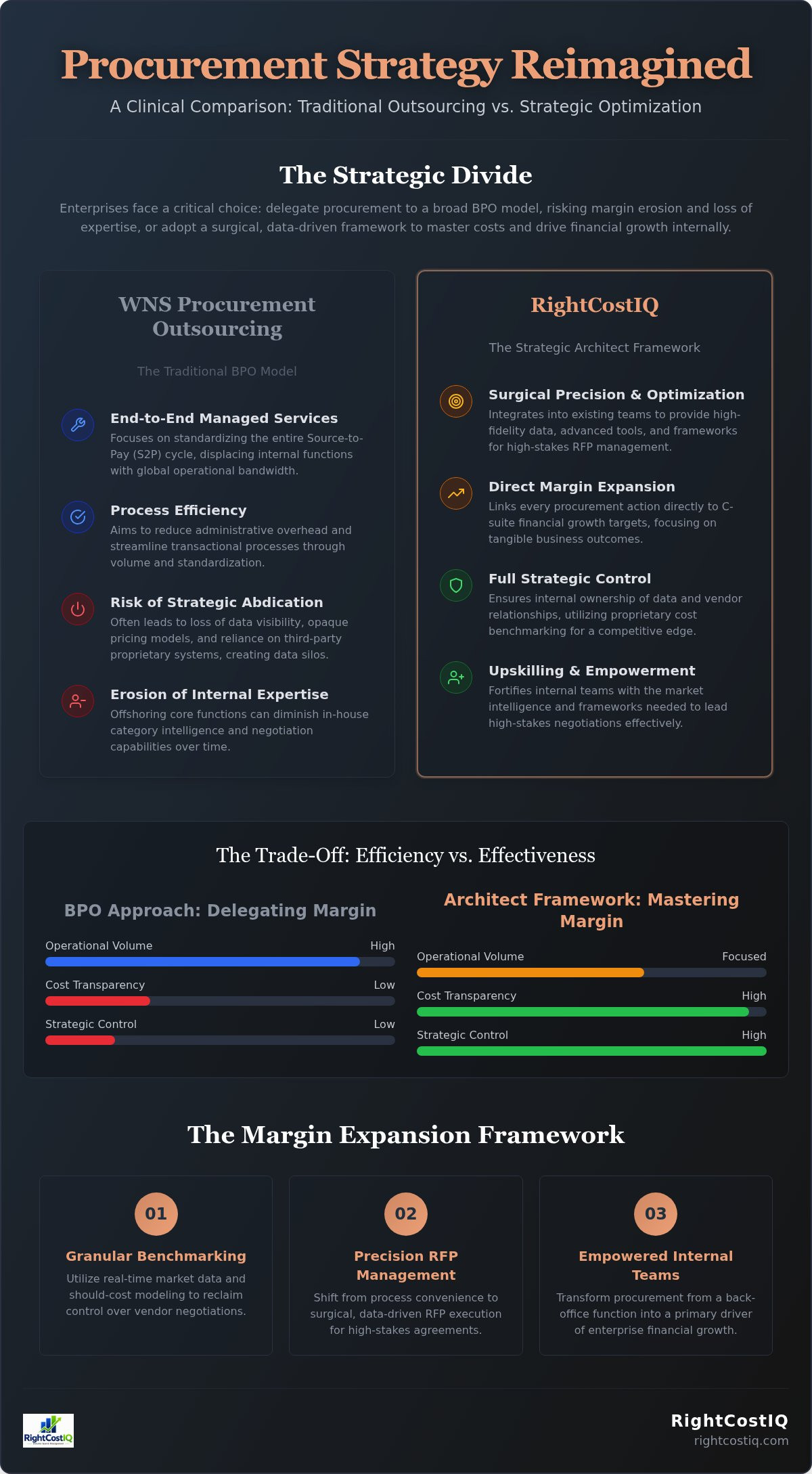
Procurement leaders in 2026 face a decisive fork in their operational strategy. The choice between WNS procurement outsourcing vs RightCostIQ represents a fundamental divergence between broad operational scale and surgical financial precision. While one model focuses on displacing internal functions with global bandwidth, the other seeks to fortify existing teams with high-fidelity data and negotiation frameworks. This is not merely a service comparison; it's a choice between delegating your margin to a third party or mastering it internally.
Understanding the BPO Value Proposition
Procurement outsourcing through the Business Process Outsourcing (BPO) model typically prioritizes end-to-end Source-to-Pay (S2P) management. WNS has expanded its footprint in this sector, notably through the acquisition of Denali Sourcing Services, to provide what it calls smarter procurement ecosystems. This approach relies on standardized processes and massive operational volume to drive efficiency across the entire supply chain.
However, this managed services model often introduces a significant risk of strategic abdication. When an enterprise hands over its sourcing ecosystem, it frequently loses granular visibility into its own data. Third-party proprietary systems can create silos that prevent internal teams from benchmarking costs against real-time market shifts. For high-level decision-makers, this often results in an erosion of category expertise and a reliance on opaque pricing models that prioritize the BPO's operational KPIs over the client's specific margin expansion goals.
The Clinical Framework of Precision Optimization
RightCostIQ operates as a strategic architect for financial growth, offering a surgical alternative to the broad BPO approach. This philosophy centers on optimization over replacement. Instead of absorbing the entire procurement department, this framework integrates into existing infrastructures to provide the specific tools necessary for elite performance. It's built for organizations that recognize their internal teams are the most effective negotiation leads when equipped with the right market intelligence.
This precision model focuses on tangible business outcomes through specific service pillars:
- Strategic Control: Retaining internal ownership of vendor relationships while utilizing proprietary category cost benchmarking.
- Financial Growth Metrics: Linking every procurement action directly to C-suite margin targets through clinical data analysis.
- Upskilling: Empowering internal personnel to handle high-stakes negotiations rather than offshoring the expertise.
Effective RFP management requires these precision frameworks to ensure that data ownership remains within the enterprise. In the modern landscape, operational volume is a commodity. True competitive advantage stems from the ability to execute with data-driven precision. When evaluating WNS procurement outsourcing vs RightCostIQ, the primary metric for success is whether you are building a resilient internal intelligence asset or simply renting someone else's bandwidth.
Operational Execution: End-to-End Managed Services vs. Surgical RFP Management
The operational divide between WNS procurement outsourcing vs RightCostIQ is most visible in the transition from process-heavy management to outcome-focused execution. WNS prioritizes the Procure-to-Pay (P2P) cycle, seeking to standardize every transaction to reduce administrative overhead. While this approach creates operational speed, it often neglects the granular financial optimization required for true margin expansion. RightCostIQ, acting as a strategic architect, shifts the focus toward high-stakes RFP management and negotiation assistance, ensuring that every vendor agreement is a product of clinical data analysis rather than process convenience.
The P2P Efficiency Trap
Efficiency in the procurement process doesn't equate to efficiency in the price. Many enterprise leaders fall into the trap of believing that faster S2P cycles lead to better margins. In reality, standardized BPO models often utilize pre-approved vendor pools and standard contract templates to maintain their own operational velocity. This creates hidden margin erosion. When vendors recognize they are participating in a standardized, volume-driven process, they rarely offer their most competitive pricing. The human intelligence factor is often stripped away in favor of process compliance, leaving your internal team without the specialized negotiation leverage needed to challenge market benchmarks.
Advanced RFP Architectures
Precision optimization requires a different operational blueprint. Utilizing a framework for Request For Proposal (RFP) Management allows organizations to force vendor transparency through clinical execution. RightCostIQ provides the data-driven architectures necessary to evaluate vendor responses against proprietary category cost benchmarking. This ensures that vendor selection is based on tangible financial performance rather than just process fit. By focusing on surgical RFP management, companies can identify specific cost drivers that are often buried in broad-scale managed service contracts.
Targeted negotiation coaching offers a significantly higher ROI than broad-scale outsourcing. By upskilling internal teams to lead complex category sourcing, enterprises retain strategic control and foster long-term category intelligence. This methodical approach to vendor evaluation cycles ensures that every RFP is a surgical strike against price volatility. To determine if your current model is leaking value, consider a targeted procurement diagnostic to identify specific areas for margin recovery. This level of granular oversight is the only way to ensure that your operational execution aligns with your long-term financial growth targets.
Data Architectures: Global Analytics vs. Granular Category Cost Benchmarking
Strategic decision-makers often mistake global data aggregates for actionable intelligence. When comparing WNS procurement outsourcing vs RightCostIQ, the distinction lies in the granularity of the underlying data architecture. WNS utilizes global analytics suites to drive what it terms insight-led execution across vast spend volumes. While useful for broad oversight, these aggregates often lack the specific should-cost precision required to win high-stakes category negotiations.
Global Aggregates vs. Surgical Benchmarking
Relying on average market pricing is a high-risk strategy for elite procurement teams. Averages hide the specific cost drivers that vary by region, volume, and vendor capability. RightCostIQ’s methodology replaces these broad metrics with granular procurement category cost benchmarking. By leveraging Should-Cost analysis, enterprises can uncover hidden margins that global BPO models typically overlook. This surgical approach identifies exactly what a product or service ought to cost based on raw material fluctuations and labor indices, providing a clinical baseline for every RFP evaluation.
Predictive Market Intelligence
Elite margin expansion requires moving beyond historical spend analysis into predictive forecasting. RightCostIQ’s market price trending services allow procurement leaders to anticipate shifts before they impact the bottom line. This predictive capability functions as a strategic lever during active contract negotiations. Instead of reacting to vendor-driven price increases, internal teams can utilize real-time forecasting to lock in favorable rates or trigger renegotiations before market volatility erodes existing gains. This approach transforms data from a reporting tool into a primary driver for financial growth.
Reclaiming your procurement intelligence from third-party siloes is a core tenet of the RightCostIQ philosophy. Managed services often trap data within proprietary BPO systems, making it difficult for the client to benchmark performance independently. A strategic architect ensures that data remains an internal asset. This approach aligns with a modern category management framework, where long-term ROI is built on proprietary knowledge rather than outsourced reporting. By maintaining ownership of your category intelligence, you ensure that your procurement strategy remains resilient against shifting vendor landscapes.
Strategic Risk Management: Navigating Market Volatility and Vendor Compliance
Strategic risk management in 2026 demands more than passive compliance monitoring. When evaluating WNS procurement outsourcing vs RightCostIQ, the core differentiator is how each model handles financial volatility. WNS typically relies on AI-led monitoring to track supplier risk ecosystems, focusing on basic compliance and operational continuity. While this protects against supply chain disruptions, it often ignores the financial risk of price erosion during active contract periods. RightCostIQ adopts the role of a strategic architect, prioritizing active price risk management to insulate the enterprise from market fluctuations.
Mitigating Financial Volatility
Standard BPO models often treat price stability as a secondary concern to process compliance. This leaves margins vulnerable to surprise vendor price hikes that aren't addressed until the next renewal cycle. RightCostIQ implements rigorous price risk management and tracking frameworks that monitor commodity and labor indices in real-time. By utilizing a Negotiation Coach, procurement leaders can execute risk-adjusted sourcing strategies that lock in value despite market instability. This clinical approach ensures that vendor negotiations are grounded in market reality rather than vendor-driven narratives.
Vendor Performance as a Growth Driver
True margin expansion requires moving beyond basic KPIs toward operational value capture. WNS focuses on standardized vendor performance metrics that ensure contract fulfillment. This is a necessary but insufficient baseline for elite organizations. RightCostIQ’s Vendor Performance Tracking Service links vendor behavior directly to margin targets. This automated tracking architecture identifies exactly where vendors fail to meet efficiency benchmarks, allowing for immediate corrective action during the contract term.
Linking vendor performance to financial growth transforms the procurement department from a cost center into a value generator. Ensuring supply chain compliance shouldn't mean abdicating strategic oversight to a third-party provider. By integrating forecasting and performance data, organizations can transform vendor management into a primary engine for financial growth. To see how your current vendor relationships measure up against elite benchmarks, utilize a clinical procurement diagnostic to identify hidden risks in your supply chain. This methodical oversight ensures that every vendor relationship contributes to the bottom line without compromising operational integrity.
The Margin Expansion Framework: Why Precision Outperforms Outsourcing in 2026
The final evaluation of WNS procurement outsourcing vs RightCostIQ rests on how an enterprise defines its primary value driver. Managed services deliver administrative relief. Precision optimization delivers elite margin expansion. In 2026, the competitive landscape rewards organizations that possess deep internal category intelligence rather than those that rent third-party bandwidth. The transition to a precision model is a strategic pivot toward data ownership and surgical execution.
The Decision Matrix for Procurement Leaders
Decision-makers must differentiate between operational maintenance and strategic growth when selecting a partner. A Business Process Outsourcing (BPO) model is often suitable for offloading low-complexity, high-volume transactions where strategic leverage is minimal. However, for categories that directly impact enterprise value, a precision framework is mandatory. The strategic tipping point occurs when the cost of lost internal expertise and opaque pricing exceeds the perceived savings of outsourced headcount.
A Total Cost of Ownership (TCO) comparison reveals that BPO fees often obscure the opportunity cost of missed negotiation leverage. Precision tools offer a superior ROI by targeting the specific 20% of spend that dictates 80% of the margin. By upskilling internal teams through negotiation assistance and benchmarking, organizations build a resilient intelligence asset that appreciates over time.
Executing the Precision Shift
Transitioning from a managed services model to surgical optimization requires a methodical approach to data. Laying the foundation with Procurement Analytics allows for a clinical audit of existing spend. This baseline identifies hidden cost drivers and price risks that broad BPO ecosystems typically overlook. Unlike massive BPO shifts that require months of process re-engineering, precision optimization offers immediate speed to value by focusing on active RFP cycles.
The implementation steps for a precision shift include:
- Data Reclamation: Moving spend data from third-party siloes into internal analytics frameworks.
- Category Benchmarking: Applying should-cost modeling to high-stakes categories to identify immediate margin recovery opportunities.
- Surgical RFP Management: Executing data-driven vendor evaluations that prioritize financial performance over process compliance.
- Internal Upskilling: Utilizing market price trending to empower internal leads during active negotiations.
The future of procurement leadership belongs to those who prioritize precision over volume. Surgical optimization ensures that financial growth is a predictable outcome of data-driven negotiation rather than a byproduct of process standardization. Organizations that retain their strategic architect functions will consistently outperform those that abdicate control. Precision is the only viable path for high-stakes financial outcomes in a volatile market.
Mastering the Strategic Pivot Toward Margin Precision
The divergence between WNS procurement outsourcing vs RightCostIQ represents a fundamental shift in how enterprises value their supply chain intelligence. While global BPO models offer administrative relief through process standardization, they often result in the erosion of internal category expertise and opaque pricing. Strategic architects recognize that elite financial growth requires surgical RFP management and granular should-cost modeling. By retaining data ownership and upskilling internal teams, organizations transform procurement from a back-office function into a primary driver of enterprise value.
Grounded in specialized healthcare financial analytics roots, our framework provides the clinical precision in RFP management and data-driven negotiation assistance necessary to navigate market volatility. Reclaiming strategic control is the only way to ensure that your vendor relationships align with your long-term margin expansion targets. It's time to move beyond operational volume and embrace a model built for financial performance. You'll find that a precision-led approach creates a more resilient and profitable organization.
Optimize Your Procurement Strategy with RightCostIQ Precision
Frequently Asked Questions
What is the primary difference between WNS procurement outsourcing and RightCostIQ?
WNS operates as a broad Business Process Outsourcing provider focusing on end-to-end Source-to-Pay management and operational volume. In contrast, RightCostIQ functions as a strategic architect for procurement optimization. The fundamental divergence in WNS procurement outsourcing vs RightCostIQ lies in the choice between delegating administrative functions to a third party or utilizing surgical, data-driven frameworks to fortify internal teams and expand enterprise margins through precise category cost benchmarking.
Does RightCostIQ replace my internal procurement team like a BPO would?
RightCostIQ doesn't replace your internal procurement team; it empowers them with high-fidelity analytics and negotiation frameworks. Unlike the BPO model that seeks to displace internal functions with offshore bandwidth, our approach focuses on optimization over replacement. We act as a sophisticated mentor for high-level decision-makers, providing the market intelligence necessary to retain strategic control and upskill internal personnel for high-stakes vendor negotiations and elite margin expansion.
How does RightCostIQ’s RFP management assistance improve negotiation outcomes?
Our RFP management assistance improves outcomes by replacing process-heavy standardization with clinical data execution. We utilize proprietary should-cost modeling to identify hidden cost drivers that vendors typically obscure. By applying granular category cost benchmarking during the evaluation cycle, internal teams can force vendor transparency and secure risk-adjusted pricing. This methodical approach ensures that every contract is a product of data-driven leverage rather than simple process compliance.
Can RightCostIQ integrate with my existing ERP or procurement software?
RightCostIQ integrates seamlessly with existing internal infrastructures and enterprise resource planning (ERP) systems. Our platform functions as a specialized analytical layer that bridges the gap between traditional business functions and cutting-edge digital innovation. This technical integration ensures that your procurement data remains actionable and centralized, allowing for real-time market price trending without requiring the disruptive overhaul often associated with massive BPO ecosystem transitions or managed service implementations.
What categories does RightCostIQ provide cost benchmarking for?
We provide cost benchmarking for high-complexity indirect and direct spend categories where market volatility is most prevalent. Our proprietary analytics cover sectors ranging from IT and professional services to logistics and specialized manufacturing inputs. By focusing on granular category intelligence, we enable procurement leaders to benchmark costs against real-time market shifts, ensuring that vendor agreements reflect current economic realities rather than historical averages that erode potential margins.
How long does it take to see ROI with RightCostIQ compared to traditional outsourcing?
RightCostIQ delivers a faster speed to value because it targets specific active RFP cycles rather than requiring months of end-to-end process re-engineering. While traditional BPO transitions often involve long implementation timelines and high friction, our surgical optimization model identifies immediate margin recovery opportunities within the first negotiation cycle. This clinical focus on high-stakes financial outcomes ensures a superior ROI compared to the recurring fees of managed services.
Who owns the procurement data when using RightCostIQ vs WNS?
You retain full ownership and control of your procurement intelligence when using RightCostIQ. Traditional managed services often trap data within proprietary BPO systems, creating strategic silos that limit independent benchmarking. Our architecture ensures that all spend data and market intelligence remain internal assets. This transparency allows your team to maintain a competitive advantage and avoid the strategic abdication commonly found in broader WNS procurement outsourcing vs RightCostIQ comparisons.
Is RightCostIQ suitable for healthcare-specific procurement challenges?
RightCostIQ is uniquely suited for healthcare-specific procurement due to its specialized healthcare financial analytics roots. We understand the clinical precision required to manage complex vendor relationships and volatile pricing in the medical supply chain. Our data-driven framework addresses the specific margin expansion needs of healthcare systems by providing the granular cost benchmarking and price risk management necessary to navigate this highly regulated and financially sensitive procurement environment.


