

A weighted spreadsheet cannot make an award defensible on its own. When criteria are vague, duplicated, or disconnected from business requirements, an rfp scoring matrix can give inconsistent judgments the appearance of precision. Evaluators need shared standards, relevant evidence, and a clear link between scores and the priorities behind the purchase.
The challenge is familiar: evaluators interpret rating scales differently, while price, risk, and qualitative strengths resist simple comparison. A disciplined evaluation model addresses these issues before proposals are scored. It turns documented requirements into criteria, defines what each rating means, and makes trade-offs visible rather than leaving them to an unstructured final discussion.
This guide explains how to structure, weight, and govern an RFP scoring matrix so your team can compare proposals consistently and justify its award decision. You’ll learn how to select and weight criteria, establish evidence-based scoring anchors, manage independent evaluator input, and document the rationale behind the final result. The goal is a transparent process that connects evaluation outcomes to business priorities, supported by procurement cost analysis and negotiation preparation where they add value.
Key Takeaways
- Build criteria from documented requirements, then define rating anchors and weights that reflect the project’s priorities.
- Use an rfp scoring matrix to compare proposals against consistent standards while preserving evidence and evaluator judgment.
- Separate price from other evaluation factors when needed, and choose a cost or value comparison method that fits the sourcing decision.
- Calibrate evaluators before scoring, review material score gaps, and record the rationale for any approved changes.
- Use ranked results, risks, and commercial assumptions to shape negotiation objectives without changing the published evaluation rules.
What an RFP Scoring Matrix Measures, and Why the Process Needs One
An rfp scoring matrix turns a sourcing team’s requirements into a structured method for comparing proposals. It brings together evaluation criteria, rating definitions, weights, and recorded evidence so evaluators assess supplier responses against the same decision framework. A Request for Proposal (RFP) sets out the requirements and evaluation approach. The matrix makes that approach practical when proposals arrive.
A scoring matrix is a documented evaluation model that connects each requirement to a defined rating, an approved weight, and evidence supporting the score. Unlike a checklist, which records whether an item is present, a matrix shows how well a qualified proposal meets weighted priorities. It structures professional judgment rather than removing it. Evaluators still assess the quality and relevance of evidence, but they do so using shared standards.
Start by separating mandatory pass/fail requirements from weighted criteria. A required security attestation, for example, may determine whether a proposal proceeds to evaluation. Among proposals that pass, the team might score implementation approach, relevant experience, service levels, and commercial value. This prevents a high score in one area from compensating for failure to meet a critical threshold. State the distinction in the RFP and apply it consistently.
What belongs in an RFP evaluation matrix?
Build the matrix from stated business requirements, not from a generic template. Include fields for:
- Criteria and subcriteria: The factors evaluators will assess, such as technical fit or delivery capability.
- Rating scale and anchors: Defined meanings for each score, including the evidence that distinguishes a partial response from a strong one.
- Weights: The relative importance of each scored factor in the overall result.
- Evidence notes and evaluator records: Proposal references, observations, individual ratings, and any approved revisions.
Assess measurable requirements against explicit thresholds, such as whether a proposed service meets a stated response time. Qualitative judgments need anchors too. For instance, “strong implementation approach” should describe observable evidence, such as a complete sequence of activities, named responsibilities, and credible risk controls, rather than rely on an evaluator’s impression.
What makes a scoring decision defensible?
Traceability. Every criterion should connect to a documented requirement, sourcing objective, or material risk. Evaluators should record what the supplier proposed and why that evidence supports the rating, rather than enter a number without explanation. This creates a reviewable path from requirement to score to recommendation, and helps distinguish a genuine proposal gap from a difference in evaluator interpretation.
A consistent process strengthens the rationale for an award, but it does not guarantee a particular outcome or eliminate disagreement. RightCostIQ provides RFP management and negotiation assistance to help teams organize requirements, evaluation records, and decision rationale around their sourcing objectives. For example, RFP management assistance supports evaluation discipline and decision traceability. The matrix is governance in practice: it makes the basis for comparison visible and the resulting decision easier to explain.
How to Design Criteria, Weights, and Rating Scales That Work Together
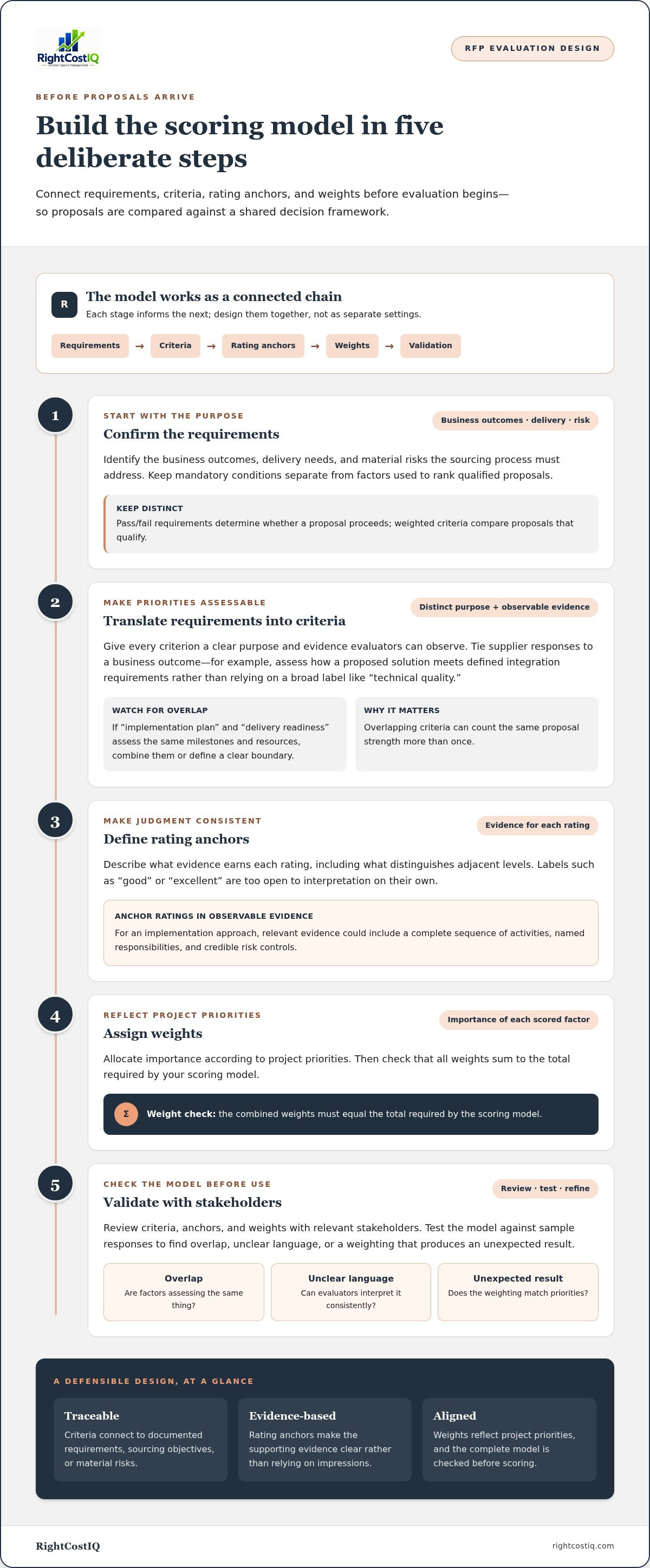
A strong rfp scoring matrix is designed as a connected model, not a collection of independent settings. Requirements determine what matters, criteria make those priorities assessable, rating anchors guide judgment, and weights determine how each score contributes to the result. Use this sequence before proposals arrive:
- Confirm requirements. Identify the business outcomes, delivery needs, and material risks the sourcing process must address. Keep mandatory conditions separate from factors used to rank qualified proposals.
- Translate requirements into criteria. Give each criterion a distinct purpose and observable evidence. If “implementation plan” and “delivery readiness” assess the same milestones and resources, combine them or define a clear boundary to prevent double counting.
- Define rating anchors. Describe what evidence earns each rating, including the differences between adjacent levels. Labels such as “good” or “excellent” are too open to interpretation on their own.
- Assign weights. Allocate importance according to project priorities, then check that all weights sum to the total required by your scoring model.
- Validate the model. Review criteria, anchors, and weights with relevant stakeholders. Test the model against sample responses to find overlap, unclear language, or a weighting that produces an unexpected result.
How should teams define and weight evaluation criteria?
Write each criterion so evaluators can connect a supplier response to a business outcome. For example, replace “technical quality” with a specific assessment of how the proposed solution meets defined integration requirements. Before review begins, align stakeholders on which outcomes matter most and document why each material weight reflects those priorities.
Category benchmarks can inform discussion, but copying generic percentages risks misrepresenting the purchase. A complex service with substantial delivery risk may warrant more emphasis on implementation capability; a standardized purchase may place greater emphasis on commercial terms. Resources such as RFP Evaluation Criteria discuss criteria and weighted scoring, but the final allocation should fit the requirements and trade-offs of the specific sourcing event.
Which rating scale creates more consistent scores?
A simple numeric scale is quick to use, but numbers alone do not explain what separates one rating from another. Behaviorally anchored descriptions take more design effort and give evaluators shared evidence standards. They also make calibration more productive: reviewers can discuss which proposal evidence fits an anchor instead of debating what a number means.
Hypothetical example: For implementation planning, a low rating might mean the proposal omits key milestones; a middle rating might show milestones but leave ownership or dependencies unclear; a high rating might provide a complete sequence with responsibilities, dependencies, and risk responses. These anchors are illustrative, not universal. Test them against sample responses, then resolve ambiguous wording before formal scoring begins.
Weights determine how much a criterion matters; rating definitions determine how proposal evidence earns its score. Both must be clear before evaluators apply the model. Procurement cost benchmarking and analytics can help inform market-related assumptions. RightCostIQ’s RFP management assistance supports disciplined criteria development and evaluation preparation.
How to Compare Proposals Without Letting Price or Subjectivity Distort the Result
Price can be easy to quantify and still be easy to misuse. A low quoted amount may exclude work another supplier included, depend on different volume assumptions, or shift costs into implementation or ongoing support. The evaluation method should specify in advance how commercial information will be assessed, which assumptions will be normalized, and how the result contributes to the award decision.
Some teams score commercial criteria separately from technical and qualitative criteria, then combine results using the approved weights. Others assess price within an overall value model. Either approach can work if the method is defined before proposals are reviewed and applied consistently. Do not introduce a new adjustment, change a weight, or reinterpret a price formula after seeing which supplier benefits.
How can an RFP matrix balance price and non-price factors?
Separate the quoted price from scope assumptions, lifecycle cost components, and commercial terms in the evaluation record. Check that each proposal is being compared on a consistent basis, and flag exclusions or dependencies for review rather than silently treating them as equivalent. Procurement category cost benchmarking can provide market context for evaluating assumptions, but it does not replace analysis of the actual offers and their stated scope.
Use the rfp scoring matrix to keep each factor distinct. For instance, assess implementation feasibility against the proposed work plan, ownership, dependencies, and resources. Assess risk against identified exposures and the supplier’s mitigation evidence. If a delivery concern is already captured under implementation, do not score the same concern again under a broad “overall quality” criterion.
How should evaluators handle qualitative criteria and trade-offs?
Require proposal-specific evidence for judgments about capability, service, or delivery. A polished presentation is not proof of execution capacity; assess claims against relevant examples, named resources, or a credible operating approach. Record material strengths and gaps, not preferences about writing style or familiarity with a supplier.
Scenario analysis can show how approved priorities affect comparative results. For example, a hypothetical model that gives delivery capability greater weight may rank a technically stronger, higher-priced proposal above a lower-priced offer. A different hypothetical model that emphasizes price may reverse that order. Any example percentages are contextual illustrations, not prescribed weightings. Use scenarios to test the rationale before release, then score proposals under the approved model.
How to Calibrate Evaluators, Resolve Score Gaps, and Preserve the Audit Trail
A well-designed rfp scoring matrix still depends on how evaluators apply it. A repeatable review process helps surface differences in interpretation without allowing the loudest voice in a discussion to determine the outcome. Establish that process before formal scoring begins, then preserve the original assessments alongside any approved updates.
How can an evaluation team calibrate scores before review?
Hold a calibration session using a hypothetical or practice response. Have evaluators score it independently, compare their ratings, and identify where the anchors or evidence standards leave room for conflicting interpretations. For example, if one reviewer treats a general claim as proof of implementation readiness while another expects a resourced plan, clarify the evidence threshold. Record agreed clarifications before opening supplier evaluations.
During the formal review, use this sequence:
- Score independently. Evaluators assess each assigned criterion and record proposal-specific evidence before group discussion.
- Review the evidence. Confirm that notes support the rating and refer to the relevant response, assumption, or omission.
- Flag material gaps. Identify score differences that could affect the ranking, as well as ratings with insufficient evidence.
- Discuss against the rubric. Compare the evidence with the agreed anchors, not with personal preferences or another evaluator’s seniority.
- Record approved updates. Preserve initial scores and document any revised score, rationale, and approval under the team’s evaluation process.
A score gap should not trigger automatic averaging. If evaluators disagree, ask what evidence each relied on and whether they applied the same criterion definition. If the difference remains, record the competing rationale and the resolution, including whether the original ratings stand or an approved consensus score replaces them.
What records should support the final award rationale?
Maintain a decision file that connects the evaluation method to the recommendation. Retain the approved criteria and weights, rating definitions, evaluator assignments, individual scores, evidence notes, and the final consolidated result. Keep a record of material clarifications, rubric versions, score changes, and the reason for each change, so the decision can be reconstructed rather than inferred later.
Document abstentions and conflicts of interest according to the organization’s process, including who abstained and which evaluation stages were affected. Record clarifications that influenced interpretation, when they were agreed, and how they were applied consistently. For material disagreements, capture the differing evidence-based views and the rationale for the resolution. Do not overwrite original entries; a clear history distinguishes initial judgment from later review.
The final recommendation should explain how the results align with stated priorities, address material strengths and risks, and identify why the selected proposal represents the best fit under the approved method. A high aggregate score alone is not a complete rationale if mandatory requirements or significant risks remain unresolved. RightCostIQ provides RFP management and negotiation assistance to support evaluation discipline and traceability across the sourcing process. Learn more through our RFP process assessment.
Turn RFP Scoring Results into a Sourcing Decision and Negotiation Plan
The ranking is an input to the sourcing decision, not the decision by itself. Review total scores alongside criterion-level results, mandatory requirements, material risks, and the organization’s stated priorities. A top-ranked proposal may still have an unresolved requirement failure or a significant delivery exposure that needs explicit consideration before award.
How should a team interpret the final scores?
Check how the result changes when you examine individual criteria, missing evidence, or sensitivity to the approved weights. Sensitivity analysis can reveal whether a narrow score difference depends heavily on one weighting choice. Use it to understand the result, not to revise the model after seeing which supplier ranks first. Handle any unresolved mandatory failure under the stated evaluation method.
Then document why the selected option best meets the approved sourcing objectives. Connect the recommendation to the evidence and trade-offs in the evaluation record, including material risks and how they will be managed. If the highest aggregate score is not selected, explain the rationale against the established method rather than relying on an undocumented exception.
How can evaluation findings inform negotiation?
Turn documented proposal gaps into specific negotiation priorities. An unclear scope assumption can prompt a request to define deliverables; a delivery risk can inform discussion of milestones, responsibilities, and mitigation commitments. Keep negotiation grounded in the record. Do not use it to retroactively alter the scoring criteria or give a supplier an undisclosed advantage.
Use relevant category and market benchmarks to test commercial assumptions and prepare negotiation positions, while distinguishing external context from the supplier’s actual offer. A benchmark can inform questions about pricing or terms; it does not prove that a proposal is incorrect or replace analysis of its scope, assumptions, and evidence. RightCostIQ provides negotiation assistance to help translate evaluation findings into focused commercial objectives. Teams can align this handoff with RFP management support.
The decision record should also establish a practical transition to supplier performance management. Convert commitments that mattered in the evaluation, such as service levels, implementation milestones, or reporting obligations, into post-award expectations. Define how performance will be measured, who reviews it, and how material deviations are addressed. This preserves the connection between what was scored, what was agreed, and what the organization monitors after award.
Use the final record as a decision-to-delivery chain: evaluation evidence supports the award rationale, documented gaps shape negotiation, and agreed commitments inform performance tracking. That continuity helps procurement teams preserve decision traceability while focusing negotiations on the business outcomes that mattered in the RFP.
RightCostIQ’s RFP management, negotiation assistance, cost benchmarking, and vendor performance tracking services can help connect evaluation, commercial decisions, and supplier oversight.
Make the Next Sourcing Decision More Deliberate
The value of an rfp scoring matrix extends beyond selecting a supplier. It gives procurement a repeatable decision structure that can inform future sourcing priorities, improve how teams define requirements, and create a stronger link between evaluation and performance after award. Treat each completed process as an opportunity to refine the next one: identify where evidence was difficult to assess, where commercial assumptions needed clarification, and which evaluation priorities best reflected business needs.
RightCostIQ supports this work through RFP management and negotiation assistance, alongside procurement category cost benchmarking and analytics. These services connect evaluation discipline with market-informed commercial decisions while keeping the specific sourcing objectives behind each award in view.
Use the link below to start a procurement diagnostic and identify practical opportunities to strengthen your sourcing process. A clearer evaluation model creates a more confident path from supplier comparison to business results.
Start a procurement diagnostic
Frequently Asked Questions
What is an RFP scoring matrix?
An RFP scoring matrix is a structured tool for evaluating supplier proposals against the priorities of a sourcing event. It helps the team convert responses into comparable results while preserving the reasoning behind each assessment. For example, a procurement team selecting a logistics provider could use it to compare coverage, integration needs, service continuity, and commercial assumptions. The matrix supports a decision; it does not replace due diligence or required approvals.
How do you calculate weighted scores in an RFP evaluation?
Multiply each criterion’s rating by its assigned weight, then add the weighted results according to the published method. For example, if a proposal receives 4 out of 5 for a criterion weighted at 30 points, it earns 24 points for that criterion. Repeat for each scored factor and total the points. Confirm whether the model uses raw ratings, normalized percentages, or another formula before calculating supplier rankings.
Should price have the highest weight in an RFP scoring matrix?
Not automatically. Price should carry the weight that matches the purchase’s priorities and the meaningful differences among qualified offers. For a standardized commodity with comparable scope, a price-led model may be appropriate. For a complex service, capability, continuity, or implementation risk may matter more. Before release, test whether the selected price method compares equivalent scope and assumptions, and whether a lower quote could conceal a material delivery gap.
How many criteria should an RFP evaluation matrix include?
There is no universal ideal count. Include enough distinct criteria to represent the decision’s important requirements, but avoid splitting one requirement into several scores that measure the same thing. A useful test is whether evaluators can explain what unique evidence belongs under each criterion. If two fields repeatedly rely on the same proposal content, combine them or clarify their boundaries. Keep subcriteria only when they improve evaluation precision.
Can evaluators change their scores after a consensus meeting?
Yes, if the evaluation process allows revisions and the team records why a score changed. A consensus meeting may uncover overlooked proposal evidence, an inconsistent reading of an anchor, or a calculation error. Preserve the original rating, the revised result, the supporting rationale, and the required approval. Do not change a score simply to make evaluators agree. Apply any clarified interpretation consistently to all proposals affected by it.
What happens if two suppliers receive the same total score?
Use a tie-resolution method established before evaluation, such as comparing performance on a designated priority criterion or applying another disclosed decision rule. The appropriate method depends on the sourcing objectives and the approved process. First confirm that calculations are accurate and that both suppliers meet mandatory requirements. If the tie remains, document how the predetermined method was applied. Do not create a new tie-breaker after seeing which suppliers are tied.
Should suppliers see the RFP scoring criteria and weights?
Yes, disclose the evaluation criteria and weights in the RFP so suppliers can respond to the stated priorities and the team can assess proposals against the announced method. Clear disclosure also reduces avoidable ambiguity about how the decision will be made. Include enough detail for suppliers to understand the rated factors and any mandatory conditions. Keep internal evaluator notes and deliberations distinct from the criteria and rules shared with bidders.


