

An annual supplier score can create a false sense of security. A supplier stability assessment should look beyond a snapshot of financial health to the evidence that shows whether a supplier can support your business over time. How can you tell whether a warning points to a temporary setback or a material threat to continuity?
Procurement teams need consistent evidence, not subjective impressions or reviews that vary by category. Financial indicators matter, but so do operational performance, sourcing dependencies, and the supplier’s ability to sustain delivery as conditions change. If an early signal goes unnoticed, there may be little time to protect continuity.
This guide sets out a repeatable process to assess supplier resilience, interpret evidence, and prioritize suppliers for deeper review. You’ll learn how to distinguish temporary issues from material stability concerns, connect findings to sourcing and mitigation decisions, and use ongoing vendor performance tracking to monitor change. It also explains how stability insights can inform RFP evaluation, cost benchmarking, and negotiation planning, so assessment becomes an input to procurement decisions rather than a static score on file.
Key Takeaways
- Assess whether a supplier can remain viable and deliver reliably over time, not just pass an initial qualification check.
- Compare financial, operational, dependency, and external-risk evidence while accounting for each signal’s limitations.
- Set the assessment scope, review horizon, business owner, and decision threshold before gathering evidence.
- Use a supplier stability assessment to distinguish early warnings from corroborated concerns and prioritize proportionate action.
- Translate findings into RFP criteria, supplier oversight, sourcing priorities, and informed cost and negotiation decisions.
What Does Supplier Stability Assessment Tell Procurement Teams?
A supplier stability assessment evaluates a supplier’s capacity to remain viable and deliver reliably over a defined business horizon. It asks whether the supplier can sustain operations, meet contractual commitments, and continue supporting the organization as financial, operational, or market conditions change. The goal is not to label a supplier “safe” or “unsafe,” but to identify exposure early enough to make an informed procurement decision.
This differs from a point-in-time qualification check, which establishes whether a supplier meets requirements at onboarding or award. It also differs from a general supplier performance score. Performance measures how well a supplier has delivered against past expectations; stability considers whether the supplier is positioned to keep delivering in the future. A supplier may meet service targets today while facing a dependency or financial issue that could threaten continuity.
A useful assessment creates a shared view for procurement, finance, and operations. Finance can interpret changes in payment or financial indicators; operations can identify capacity or delivery concerns; procurement can evaluate the impact of limited alternatives and contractual commitments. This cross-functional view fits within broader Supply Chain Risk Management, where identifying exposure is valuable only when it informs decisions. An assessment can support those decisions, but it can’t guarantee future continuity or predict every disruption.
Which supplier stability questions should an assessment answer?
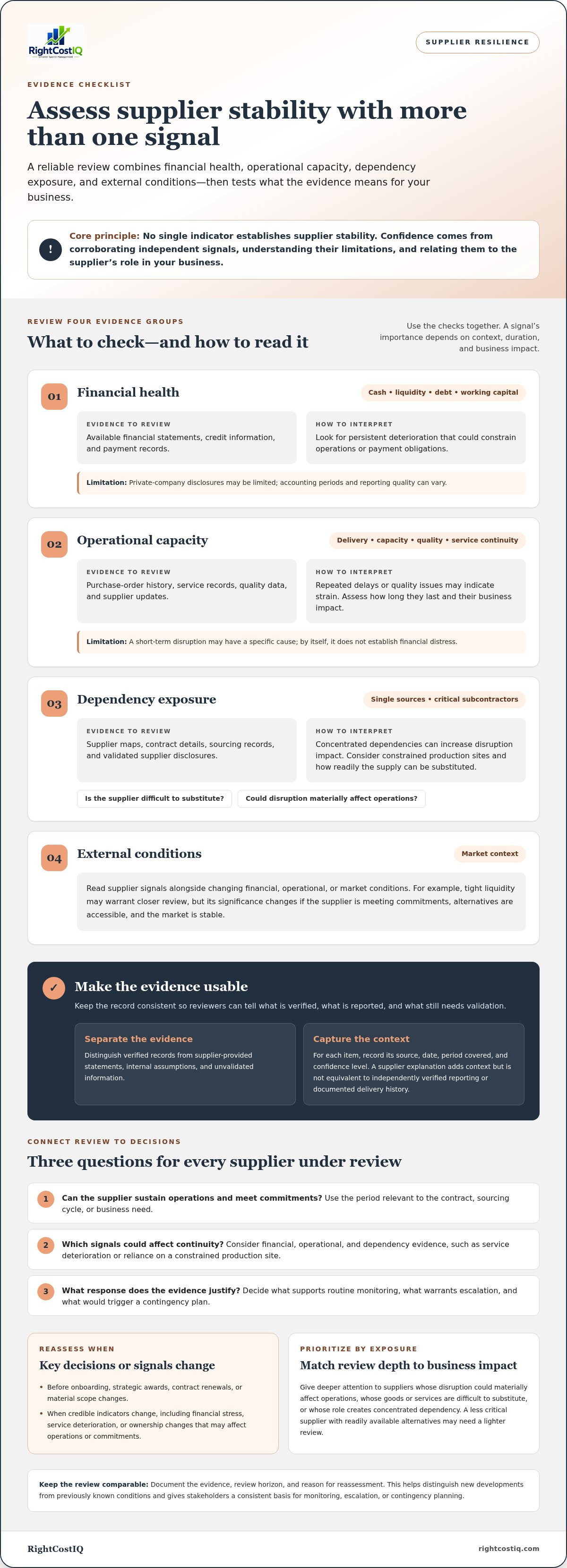
Keep the assessment tied to a decision horizon and the supplier’s role in the business. For each supplier under review, ask:
- Can the supplier sustain operations and meet commitments? Consider the period relevant to the contract, sourcing cycle, or business need, rather than relying on a vague judgment of long-term health.
- Which signals could affect continuity? Review financial, operational, and dependency evidence, such as service deterioration or reliance on a constrained production site.
- What response does the evidence justify? Define what supports routine monitoring, what warrants escalation, and what would trigger a contingency plan.
These questions keep evidence connected to action. They also help teams distinguish an isolated concern from a pattern that could affect delivery.
When should procurement reassess supplier stability?
Assess stability before onboarding, strategic awards, contract renewals, and material scope changes. Reassessment is also warranted when credible indicators change, including signs of financial stress, service deterioration, or an ownership change that may affect operations or commitments.
Review frequency and depth should reflect exposure, not administrative convenience. Prioritize suppliers whose disruption could materially affect business operations, whose goods or services are difficult to substitute, or whose role creates concentrated dependency. A less critical supplier with readily available alternatives may need a lighter review than a sole-source partner supporting an essential process.
Document the evidence, review horizon, and reason for reassessment so the next review can distinguish new developments from previously known conditions. This gives procurement and business stakeholders a consistent basis for monitoring, escalation, or contingency planning.
Which Evidence Measures Supplier Stability Most Reliably?
A reliable supplier stability assessment combines evidence across four areas: financial health, operational capacity, dependency exposure, and external conditions. The value comes from how signals interact. Tight liquidity may warrant closer review, but its significance changes if the supplier is meeting commitments, alternatives are accessible, and the market is stable.
No single indicator establishes supplier stability. Confidence comes from corroborating independent signals, understanding their limitations, and relating them to the supplier’s role in your business.
Separate verified records from supplier-provided statements, internal assumptions, and information that still needs validation. For each item, record the source, date, period covered, and confidence level. A supplier’s explanation can provide useful context, but it isn’t equivalent to independently verified financial reporting or documented delivery history.
| Signal | Evidence source | Interpretation | Assessment limitations |
|---|---|---|---|
| Cash flow, liquidity, debt, and working capital | Available financial statements, credit information, and payment records | Look for persistent deterioration that could constrain operations or payment obligations. | Private-company disclosures may be limited; accounting periods and reporting quality can vary. |
| Delivery, capacity, quality, and service continuity | Purchase-order history, service records, quality data, and supplier updates | Repeated delays or quality issues may indicate strain; assess duration and business impact. | Short-term disruption may have a specific cause and doesn’t by itself establish financial distress. |
| Single-source exposure and critical subcontractors | Supplier maps, contract details, sourcing records, and validated supplier disclosures | Concentrated dependencies can increase disruption impact when alternatives are limited. | Sub-tier visibility may be incomplete, and disclosed dependencies can change. |
| Geographic, regulatory, and market conditions | Relevant market reporting, operational locations, and applicable requirements | Identify exposures that could affect access to inputs, production, or delivery. | Exposure indicates a risk factor, not proof that failure or interruption will occur. |
How do financial indicators reveal potential supplier stress?
Where reliable data exists, review cash flow, liquidity, debt obligations, and working capital together. Compare trends across reporting periods instead of treating one ratio as a verdict. For example, weakening liquidity alongside rising debt and delayed payments deserves more scrutiny than one adverse measure alongside otherwise stable evidence. Private-company disclosure gaps reduce certainty, so document what’s unavailable and assign an explicit confidence level rather than presenting estimates as facts.
What operational and dependency evidence matters?
Assess delivery reliability, capacity constraints, quality patterns, and continuity of service against the supplier’s commitments and your needs. Map single-source inputs, critical subcontractors, and viable alternatives for essential goods or services. Then consider relevant regulatory, geographic, and market exposure. These conditions help frame potential consequences, but they don’t prove supplier failure. Use vendor performance tracking to maintain a dated operational evidence trail for future reviews.
Combining source quality, trend, exposure, and business impact gives procurement a defensible basis for deciding which signals need validation and which warrant action.
How to Conduct a Supplier Stability Assessment Step by Step
A repeatable supplier stability assessment turns scattered signals into a documented decision. Set the review boundaries first, then match evidence depth to the supplier’s importance and the decision at hand. The process should end with a named owner, a proportionate response, and a clear record of what remains uncertain.
- Classify supplier criticality. Evaluate the service or input’s impact on business operations, the difficulty of replacing the supplier, and concentration exposure. A supplier supporting an essential process with few alternatives warrants more scrutiny than one providing a readily substitutable item.
- Set the assessment parameters. Define the scope, relevant review horizon, accountable business owner, and decision threshold before collecting evidence. Specify which commitments and business needs are in scope, and what level of concern would prompt escalation or contingency planning.
- Collect proportionate evidence. Request documentation relevant to the identified exposure, then compare it with internal delivery, quality, service, and purchasing records. For a renewal, recent operating performance can help test whether supplier statements align with observed results.
- Validate and record findings. For each material signal, document the source, date, period covered, confidence level, and any unresolved questions. Mark information as missing, stale, or conflicting when applicable. Treat those gaps as uncertainty, not as proof of supplier distress.
- Make and document the decision. Summarize the evidence, its business implications, the selected response, and the person responsible for follow-up. Record whether the supplier remains under routine monitoring, needs escalation, or warrants a contingency action, along with the conditions that would trigger another review.
How should teams scope and collect assessment evidence?
Criticality determines review depth. Consider service impact, replacement difficulty, and concentration exposure together, then request evidence proportionate to the resulting risk. Compare supplier-provided documents with internal performance records and available independent information. If evidence is unavailable or inconsistent, record precisely what needs validation and how that affects confidence. This preserves the distinction between an adverse finding and an information gap, while keeping the review focused on decision-relevant facts.
How can assessment findings be scored consistently?
Use transparent criteria for likelihood, business impact, evidence quality, and confidence. Define what each rating means before applying it across suppliers, and make clear how ratings lead to actions. A weighted score can support prioritization, but only if the team can explain its inputs and intended use. Don’t let a composite number hide a critical dependency or weak evidence. During sourcing, add relevant stability criteria to supplier evaluation without duplicating every diligence step. A structured RFP management framework can help align those criteria with the broader selection process.
Finally, assign a review owner and update trigger. A score without a decision path, evidence trail, or accountable follow-up is only a label, not a usable procurement control.
How to Interpret Stability Signals and Choose a Response
A stability signal matters in context. A change in financial information may warrant attention, but its urgency depends on whether it’s persistent, supported by other evidence, and relevant to the supplier’s operational role. Strong delivery performance doesn’t erase serious dependency exposure; one late shipment doesn’t establish financial distress. Assess the combined picture before escalating.
Trend, exposure, and evidence confidence jointly shape response priority. A persistent adverse trend affecting a critical supplier demands more attention than an isolated, low-confidence signal.
How should teams distinguish warning signals from material instability?
Start by checking whether a signal repeats, aligns with other evidence, or has a documented connection to delivery continuity. If a supplier reports financial pressure, compare that explanation with available records and operational performance. If a disruption has occurred, establish its cause, scope, and impact on commitments. Record the supplier’s account alongside independent evidence and unresolved discrepancies. A plausible explanation can inform the assessment, but it shouldn’t replace corroboration.
For example, a supplier may report a temporary capacity constraint while delivery records show isolated delays followed by recovery. That may call for follow-up, not an automatic assumption of broader distress. If delays persist, affect critical orders, and coincide with reduced capacity or limited alternatives, the combined exposure supports stronger action.
What actions can procurement take after an assessment?
Match the response to both the evidence and the potential business impact. A practical response ladder helps teams act proportionately:
- Monitor: Set a review cadence, an accountable owner, and specific indicators to revisit when concerns are uncertain or manageable.
- Engage: Discuss material findings with the supplier, clarify recovery actions, and document commitments and follow-up points.
- Diversify: Assess sourcing alternatives where dependency is high and replacement options are limited. Use the assessment to determine whether qualification or sourcing work should begin.
- Prepare contingencies: For credible exposure that could interrupt an essential input or service, define practical steps to reduce disruption and assign responsibility for executing them.
Ongoing vendor performance tracking adds delivery and service evidence to future reviews. It helps procurement distinguish a resolved issue from a worsening pattern and reassess when actual performance changes. Keep the response decision-linked: note which evidence prompted action, what would change the risk judgment, and who will review that change.
RightCostIQ provides vendor performance tracking and procurement optimization support to connect supplier evidence with ongoing oversight and sourcing decisions.
Apply Supplier Stability Findings to Sourcing with RightCostIQ
A supplier stability assessment creates procurement value when its findings shape sourcing choices, not just a risk register. Use evidence to decide what requirements matter in an award, where supplier review needs more depth, and which categories deserve closer attention. The objective isn’t to select the lowest-risk supplier at any cost. It’s to make continuity exposure visible alongside capability, price, and documented performance.
How can stability assessment inform an RFP decision?
Translate material continuity needs into clear evaluation criteria that apply consistently to each bidder. If delivery depends on specialized capacity or a limited source, request relevant evidence about capacity, continuity measures, or dependency exposure. Keep criteria tied to the category’s actual requirements, and distinguish mandatory thresholds from factors that can be scored comparatively.
Evaluate resilience alongside technical capability, cost, and documented performance. A low bid doesn’t establish that a supplier can reliably meet future commitments, just as a risk signal alone doesn’t determine that a supplier is unsuitable. Consider how the evidence affects the business, whether it’s sufficiently reliable, and whether proposed controls address the exposure. RightCostIQ provides RFP management support to structure sourcing requirements and evaluation so stability criteria inform supplier selection without duplicating the full assessment.
How does RightCostIQ connect procurement analysis to action?
RightCostIQ provides RFP management and negotiation assistance, category cost benchmarking and analytics, vendor performance tracking, and market price trending and forecasting. These services help teams connect supplier evidence to sourcing execution and ongoing oversight. For example, delivery trends can inform supplier review, while benchmark and market data can give procurement context for evaluating pricing and planning negotiations.
Cost evidence is one input, not a stability verdict. A price that differs from category benchmarks may warrant analysis of market conditions, scope, or commercial assumptions; it doesn’t prove that a supplier is financially distressed or operationally resilient. Likewise, market trends can help teams understand price movement and exposure, but they don’t replace supplier-specific financial, operational, and dependency evidence. Keep each input in its proper role, then bring them together for a sourcing decision that reflects both commercial priorities and continuity needs.
Assessment findings can also shape ongoing priorities. Where performance tracking identifies a sustained change, procurement can revisit the original assumptions, update supplier oversight, and consider whether sourcing options should be reviewed. Where cost trends shift, negotiation planning can account for market context without treating price movement as evidence of supplier stability on its own.
RightCostIQ’s procurement services connect assessment findings with procurement analysis and sourcing decisions.
Make Supplier Resilience Part of Your Next Sourcing Decision
A supplier stability assessment becomes more valuable when it shapes what your team does next. Use the findings to decide where to strengthen supplier oversight, what to test in an upcoming sourcing event, and which commercial assumptions need a closer look. This turns risk analysis into a practical input to sourcing priorities, rather than a review that ends with a score.
RightCostIQ supports that work through procurement and vendor performance tracking, RFP management and negotiation assistance, and category cost benchmarking with market price trending. Together, these services help teams bring supplier evidence and commercial context into procurement decisions, without treating price as a proxy for resilience.
Choose one priority supplier or category and identify the next decision your evidence should inform. Start a free procurement diagnostic to focus your procurement analysis and define a practical path forward. With clear priorities and consistent evidence, your team can make more deliberate sourcing decisions and build resilience step by step.
Frequently Asked Questions
What is supplier stability assessment?
A supplier stability assessment is a structured way to judge whether a supplier can keep operating and meet your business needs over a defined period. It can help procurement decide what to review next, but it can’t guarantee uninterrupted supply. For example, assess a supplier against the period covered by a renewal or sourcing decision, then document which findings are verified, which rely on supplier statements, and what remains unknown.
How often should a company assess supplier stability?
Set review frequency according to the supplier’s importance, exposure, and pace of change. A provider supporting a difficult-to-replace process may need closer oversight than a supplier with readily available alternatives. Revisit the assessment ahead of a renewal or scope expansion, and when credible changes emerge. Record the review schedule and event triggers in the supplier file so the next owner can maintain continuity when responsibilities change.
Can you assess a supplier without access to its financial statements?
Yes. Use available evidence such as delivery history, quality records, capacity updates, supplier disclosures, and dependence on constrained inputs. State clearly that limited financial information reduces confidence in conclusions, but don’t treat the absence of statements as evidence of financial trouble. For a critical supplier, procurement can document targeted follow-up questions and use operational indicators as interim monitoring inputs while noting the remaining uncertainty.
What are the main warning signs of supplier instability?
Potential warning signs include persistent delivery slippage, repeated quality issues, reported capacity limits, major operational changes, or credible information pointing to financial stress. Look for corroboration before drawing a conclusion. For instance, a missed delivery may have a one-time cause, while repeated delays across orders combined with a documented capacity constraint could signal a broader continuity concern. Record the supplier’s explanation and compare it with available records.
What is the difference between supplier stability and supplier performance?
Supplier performance measures delivery against current requirements; stability considers the ability to sustain operations and support future needs. The distinction matters because past performance may not reveal emerging exposure. A supplier might currently meet delivery targets yet rely on a single production site or critical subcontractor. Performance records can inform a stability review, while dependency and continuity evidence help test whether strong results are likely to be sustainable.
How do you prioritize suppliers for stability reviews?
Rank suppliers by the consequences of interruption, difficulty of replacement, and degree of dependency. Ask business owners which processes would be affected if a supplier stopped delivering, then compare those answers with available sourcing alternatives. Apply the same criteria across categories and record why a supplier received its priority. Revisit the ranking when business needs or sourcing arrangements change.
What should procurement do when a supplier receives a high-risk assessment?
Validate the findings, then select an action that reflects both the evidence and the disruption potential. Depending on the situation, procurement might set a near-term review, request a documented recovery plan, or evaluate alternate sources while maintaining supply. Assign an owner and record the next decision point. A high-risk rating should trigger structured judgment, not automatic termination, especially when switching could create additional continuity exposure.


