

The lowest unit price can become the costliest sourcing decision if it compromises supply continuity or clinical requirements. Effective hospital procurement optimization connects cost visibility with operational needs, helping teams identify opportunities without treating price as the only measure of value.
That balance is difficult when spend is fragmented, contract terms are hard to compare, and purchasing practices vary across departments. Procurement, finance, clinical stakeholders, and suppliers may also assess performance using different measures. Cost control matters, but so do dependable access to essential supplies and consistent supplier execution.
This guide presents a practical approach to improving sourcing decisions and supplier performance in 2026. You’ll learn how to use spend and contract data to prioritize categories, apply benchmarking and market insight to RFPs and negotiations, and track supplier performance after award. The central principle is straightforward: cost intelligence, sourcing execution, and supplier accountability work best as one continuous cycle. With that structure, procurement teams can make evidence-based decisions while keeping operational needs in view.
Key Takeaways
- Build a dependable procurement baseline by consolidating purchasing, contract, supplier, and demand data before prioritizing opportunities.
- Use hospital procurement optimization to evaluate total commercial value, operational requirements, and supplier risk alongside unit price.
- Compare supplier proposals fairly by matching specifications and contract scope before applying category cost benchmarks.
- Structure RFPs, negotiations, and reviews around clear decision points for procurement, finance, clinical stakeholders, and suppliers.
- Track supplier performance after award to assess execution and identify where further sourcing or contract action may be needed.
Why Hospital Procurement Optimization Must Balance Cost, Continuity, and Clinical Needs
Hospital procurement optimization is the ongoing work of improving purchasing value, spend visibility, and supplier execution while protecting operational and clinical requirements. It isn’t across-the-board price cutting. A lower quoted price may deliver weaker overall value if contract terms, service levels, or implementation demands create extra work or disrupt supply.
Assess the full commercial and operational picture. Compare pricing alongside contract scope, delivery and support expectations, renewal terms, and the effort required to implement a change. For example, a proposal with a lower unit price may not be preferable if it offers different service commitments or its transition requirements place extra demands on hospital teams. Make those trade-offs visible before choosing a sourcing strategy.
What does hospital procurement optimization include?
The process connects spend visibility to ongoing supplier review: identify purchasing patterns, set category priorities, choose a sourcing approach, negotiate terms, and assess performance after award. Hospitals may also use Group Purchasing Organizations (GPOs) to leverage collective buying power. A GPO agreement can inform sourcing decisions, but teams still need to assess how its scope and terms fit their requirements.
Each stakeholder brings a distinct perspective. Finance helps assess budget impact and financial measures; supply chain contributes purchasing, contract, and supplier information; clinical stakeholders define care-related requirements and assess whether proposed changes meet them. Procurement coordinates the process and commercial analysis, but doesn’t replace clinical judgment about product selection or patient care.
Why can cost-only targets create poor procurement decisions?
A target focused only on price can obscure obligations and risks. A supplier change may affect service expectations, transition workload, or continuity if capacity and implementation requirements aren’t considered. Overlooking contract terms can also make an apparent price advantage difficult to realize under the agreement.
Comparisons fail when specifications differ. If proposals cover different service levels, contract scope, or requirements, their quoted prices aren’t like-for-like. Normalize the comparison before using category benchmarks or negotiating. Otherwise, apparent savings may simply reflect a change in what’s included.
Set measurable value objectives and operational guardrails before sourcing. Define what must remain consistent, what can change, and how success will be assessed after award. This gives finance, procurement, supply chain, and clinical stakeholders a shared basis for decisions: pursue better terms where the evidence supports them while keeping agreed requirements in view.
How to Build a Reliable Hospital Procurement Baseline Before Sourcing
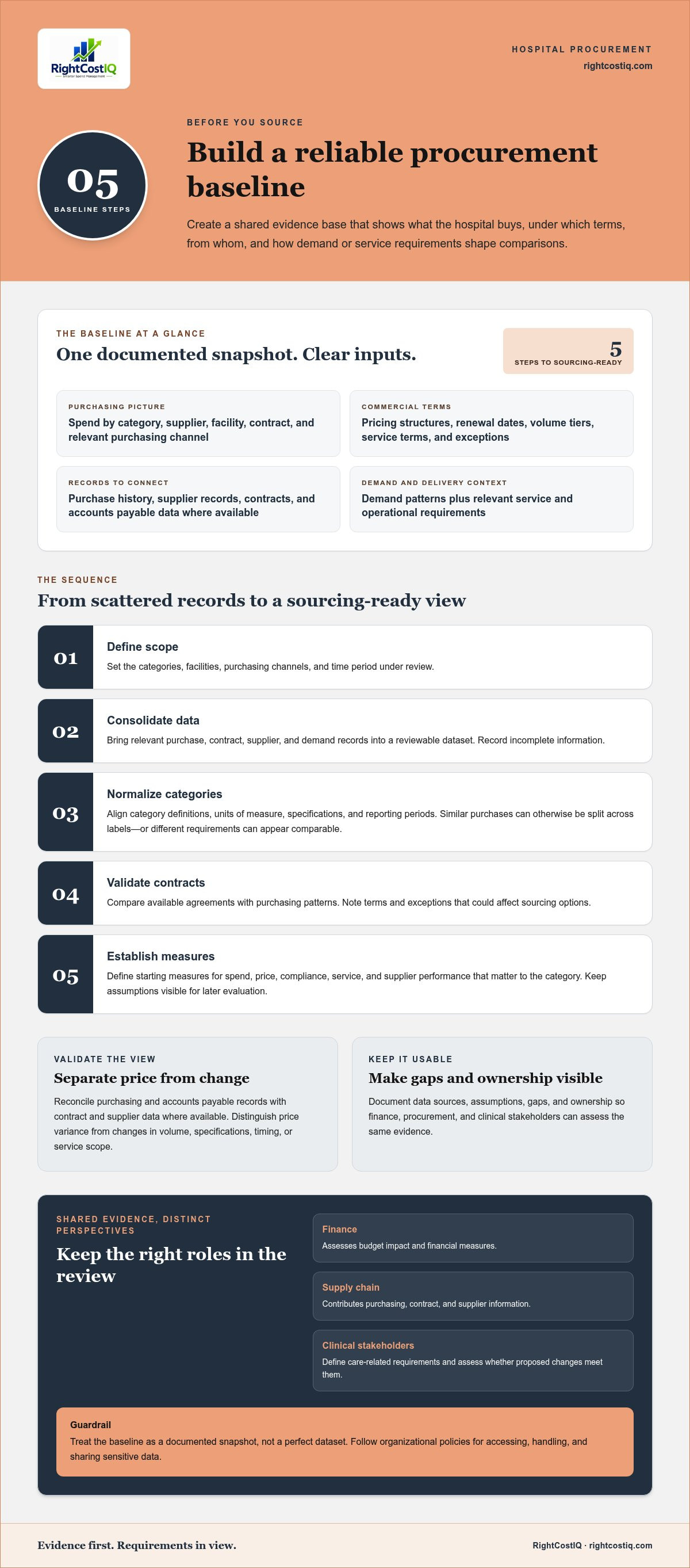
A reliable baseline gives sourcing decisions a common evidence base. For hospital procurement optimization, it should show what the organization buys, under which terms, from whom, and how demand or service requirements affect comparisons. Treat the baseline as a documented snapshot, not a perfect dataset: flag missing records and assign owners to resolve them.
Which procurement data should a hospital assemble?
Bring together spend by category, supplier, facility, contract, and relevant purchasing channel, alongside purchase history, supplier records, and demand patterns. Capture renewal dates, pricing structures, volume tiers, service terms, and known exceptions. The Association for Health Care Resource & Materials Management is a useful professional reference for healthcare supply chain practices. Follow organizational policies for accessing, handling, and sharing sensitive data.
How should teams validate the baseline?
Reconcile purchasing and accounts payable records with contract and supplier data where available. Separate price variance from changes in volume, specifications, timing, or service scope. Document data sources, assumptions, gaps, and ownership so finance, procurement, and clinical stakeholders can assess the same evidence instead of relying on different versions of the baseline.
Use this sequence to turn collected data into a sourcing-ready baseline:
- Define scope. Set the categories, facilities, purchasing channels, and time period under review.
- Consolidate data. Bring relevant purchase, contract, supplier, and demand records into a reviewable dataset. Record incomplete information.
- Normalize categories. Align category definitions, units of measure, specifications, and reporting periods. Otherwise, similar purchases may be split across labels, or different requirements may appear comparable.
- Validate contracts. Compare available agreements with purchasing patterns. Note pricing structures, renewal dates, volume tiers, service terms, and exceptions that could affect sourcing options.
- Establish measures. Define starting measures for spend, price, compliance, service, and supplier performance that matter to the category. Keep assumptions visible for later evaluation.
For example, a price comparison across two facilities can mislead if one dataset uses different units or covers a different period. Normalize those fields first, then distinguish a genuine price movement from a change in volume or scope. This makes the baseline useful for prioritization without presenting incomplete records as verified facts.
A procurement diagnostic can help identify questions and potential improvement areas to examine before sourcing begins.
How to Compare Hospital Procurement Opportunities and Supplier Proposals
A useful comparison makes commercial differences visible without reducing the decision to a single price. For hospital procurement optimization, assess proposals against consistent requirements, then weigh potential value alongside supply continuity, service expectations, risk, and implementation demands. This supports seeking the best value rather than defaulting to the lowest quoted cost.
How can hospitals assess whether a benchmark is comparable?
Before using a category benchmark to set a negotiation target, check whether it reflects equivalent specifications, delivery terms, purchase volumes, contract duration, and service scope. A difference in any of these dimensions can make a price gap look like an opportunity when it actually reflects a different offer.
A benchmark is negotiation-ready only when its scope matches the deal being evaluated and its assumptions are visible. Identify whether the comparison uses observed market data or modeled outcomes. Record the data date, exclusions, and organization-specific assumptions; treat the benchmark as decision support, not a promised result. The Walton College study reported modeled savings of up to 50% versus current spending and 14% versus optimized existing thresholds in its analysis of GPO tier contracts. Those findings reflect a specific dataset and contract context, not typical or guaranteed hospital savings.
Which proposal dimensions belong in a sourcing comparison?
Use the same RFP criteria, response format, and scoring definitions for each supplier. A category management framework can help organize priorities, while should-cost analysis can inform commercial evaluation. Keep assumptions consistent and distinguish confirmed proposal details from estimates.
| Dimension | What to compare |
|---|---|
| Total commercial terms | Pricing structure, volume tiers, contract duration, renewal terms, and relevant exceptions. |
| Supplier capacity | Documented ability to meet the stated scope and expected demand. |
| Service expectations | Agreed delivery, support, and other service requirements. |
| Risks | Known dependencies, contract limitations, and continuity considerations. |
| Implementation | Transition requirements, responsibilities, and operational effort. |
Score commercial and operational dimensions separately before reviewing the combined result. Procurement can lead the evaluation, finance can assess commercial implications, and clinical and supply chain stakeholders can assess requirements within their responsibilities. This makes trade-offs explicit and gives negotiation teams a defensible basis for prioritizing terms.
How to Execute RFPs, Negotiations, and Supplier Reviews Without Losing Control
A disciplined process keeps an opportunity connected from initial requirements through post-award performance. In hospital procurement optimization, control comes from clear decision rights, documented evidence, and a record of supplier commitments. Procurement coordinates the commercial process; finance, clinical stakeholders, and suppliers contribute at defined points rather than relying on informal consensus.
Use this sequence to move from sourcing need to supplier review:
- Define category scope and requirements. Procurement documents the scope, expected demand, contract context, and comparable response requirements. Clinical stakeholders identify care-related requirements and provide input on clinical approval through the organization’s governance process.
- Issue the RFP. Set response formats, evaluation criteria, submission expectations, and decision owners in advance. Consistent questions make supplier responses easier to compare.
- Evaluate proposals. Procurement coordinates scoring against documented criteria. Finance assesses commercial implications; clinical and operational stakeholders assess requirements within their responsibilities.
- Negotiate and approve. Use benchmark evidence, documented assumptions, and a prioritized negotiation position. Record approval ownership and distinguish commercial evaluation from clinical approval and organization-specific governance.
- Award and review. Capture final contract obligations, assign measure owners, and schedule supplier reviews against agreed commitments.
How should a hospital structure an RFP and negotiation?
Specify scope, response requirements, evaluation criteria, and decision owners before issuing the RFP. RightCostIQ manages RFPs and provides negotiation assistance to help structure the process and use benchmark evidence to inform priorities. Document assumptions and proposed exceptions. Keep proposal scoring separate from clinical approval so each decision follows its proper authority.
How can teams track supplier performance after award?
Translate contract commitments into reviewable measures with an accountable owner and reporting cadence. Measures should reflect the actual service and commercial terms, not generic scorecard fields. Review performance against those commitments, record exceptions, and assign corrective actions with clear follow-up. Procurement can coordinate the review while finance, operational stakeholders, and suppliers address the measures relevant to them.
Use review findings to inform renewal decisions, future RFP requirements, and supplier risk discussions. A documented record also helps teams distinguish a one-time exception from a recurring performance issue. Connect sourcing and contract outcomes with supplier execution, then run a procurement diagnostic to identify questions and potential improvement areas in the current process.
How RightCostIQ Can Support a Measurable Hospital Procurement Optimization Cycle
RightCostIQ connects procurement analysis with sourcing execution and post-award review. The company provides category cost benchmarking and analytics, RFP management, negotiation assistance, and supplier performance tracking. These services support a hospital procurement optimization cycle: identify a priority, assess the evidence, act through a structured sourcing process, then evaluate supplier execution against agreed commitments.
Where can external procurement support add execution capacity?
Benchmarking and analytics can help teams identify categories for further review and frame negotiation priorities. Benchmarks inform decisions but don’t guarantee savings; their usefulness depends on available data and comparable scope. RightCostIQ’s RFP management can organize requirements, supplier responses, and evaluation steps, helping teams move from analysis to a documented sourcing decision. Negotiation assistance can help translate evidence and priorities into commercial discussions.
After award, supplier performance tracking gives teams an input to ongoing operational and commercial reviews. Compare supplier execution with agreed service and contract commitments, record exceptions, and use review findings to guide follow-up. This closes the loop between sourcing assumptions and performance in practice.
What should leaders expect from an optimization diagnostic?
A diagnostic is a starting point for clarifying procurement priorities and identifying questions that merit further analysis. Its usefulness depends on the evidence available, the categories in scope, and the organization’s objectives. It isn’t a guarantee of savings or a substitute for clinical review, internal approvals, or organization-specific governance.
To turn findings into action, connect each priority to a measurable follow-up question. For example: Are purchasing records and contract scope aligned? Is the benchmark comparable to the proposed sourcing requirement? Which supplier commitments should be monitored after award? Assign an owner to each question and define a review milestone that fits the organization’s sourcing process. The next steps can then be tailored to the categories, objectives, and evidence under review.
With that structure, analysis becomes a practical input to sourcing, negotiation, and supplier accountability, rather than a standalone report. Start the free diagnostic to identify procurement questions and potential improvement areas.
Make Procurement Decisions More Measurable
Strong hospital procurement optimization connects reliable spend and contract data to comparable sourcing decisions, clear negotiation priorities, and supplier reviews after award. The lowest quoted price isn’t the only measure of value; operational requirements and supplier commitments need to remain visible throughout the process.
RightCostIQ supports this cycle with category cost benchmarking and analytics, RFP management and negotiation assistance, supplier performance tracking, and market price trending. These capabilities help teams examine opportunities, structure sourcing activity, and assess execution against agreed commitments. Priorities depend on the available evidence and scope, so treat analysis as a basis for informed decisions, not a guarantee of savings.
Start with the questions your data can answer, then define the next sourcing action and how its results will be reviewed. Start the free procurement diagnostic to identify potential improvement areas and practical next steps. With a disciplined, evidence-led approach, your team can pursue better value while keeping essential operational needs in view.
Frequently Asked Questions
What is hospital procurement optimization?
Hospital procurement optimization is the ongoing work of improving purchasing value, spend visibility, and supplier performance while maintaining operational continuity and clinical requirements. It goes beyond lowering unit prices. Teams review purchasing data, contract terms, sourcing options, and supplier execution to identify where changes may improve value. Finance, procurement, supply chain, and clinical stakeholders contribute distinct evidence and requirements, while clinical decisions remain with the appropriate clinical stakeholders.
How can hospitals reduce procurement costs without increasing supply risk?
Hospitals can pursue cost opportunities while managing supply risk by evaluating commercial terms alongside supplier capacity, service commitments, implementation demands, and continuity considerations. Use documented requirements and comparable proposals to identify viable options, then set operational guardrails before negotiating or changing suppliers. After award, track supplier performance against agreed commitments and document exceptions. This lets teams assess whether the commercial decision is working in practice, rather than treating a lower quoted price as proof of value.
What data is needed to optimize hospital procurement?
A useful baseline combines purchasing history, accounts payable information, contracts, supplier records, and demand patterns where available. Organize spend by category, supplier, facility, contract, and relevant purchasing channel. Capture pricing structures, renewal dates, volume tiers, service terms, and known exceptions. Align units, specifications, category definitions, and reporting periods before comparing results. Document missing fields, assumptions, data ownership, and applicable organizational controls so decision-makers can distinguish verified information from gaps.
How should hospitals compare supplier proposals?
Compare proposals against the same scope, specifications, response format, and evaluation criteria. Assess total commercial terms, supplier capacity, documented service expectations, risks, and implementation requirements alongside price. Score dimensions consistently and assign decision owners before reviewing bids. A proposal that appears less expensive may cover a different service scope or require a more demanding transition. Separating commercial scoring from clinical approval helps ensure each decision is evaluated by the appropriate stakeholders.
How can procurement benchmarks support hospital negotiations?
Benchmarks can help hospitals identify categories for further review and establish evidence-based negotiation priorities. First check that specifications, volumes, delivery terms, contract duration, and service scope are comparable. Record the benchmark’s data date, exclusions, and assumptions, and distinguish observed market information from modeled results. Use the comparison as decision support, not as a guaranteed outcome or automatic target. Category cost benchmarking and analytics can help clarify where further analysis or negotiation may be warranted.
What role do GPO contracts play in hospital procurement optimization?
Group purchasing organization (GPO) contracts can give hospitals access to collective purchasing arrangements and negotiated terms. Their value depends on how the contract’s scope, pricing structure, volume conditions, and service provisions align with the hospital’s needs and purchasing patterns. Review the applicable terms alongside other sourcing options, and assess requirements with relevant stakeholders. A GPO agreement informs procurement decisions, but teams still need clear visibility into contract fit and supplier performance.
How should hospitals measure supplier performance after a contract is awarded?
Hospitals should translate contract commitments into defined measures, reporting responsibilities, and review milestones. Track relevant service and commercial performance, exceptions, and corrective actions against the agreed terms. Assign owners to follow up on issues and record whether actions resolve them. Procurement can coordinate reviews with finance, operational stakeholders, and suppliers, each contributing relevant information. Use the documented findings to inform renewal planning, future RFP requirements, and supplier risk discussions.


