

A rate comparison can look precise and still lead to the wrong negotiation. Vendor rate card benchmarking only produces defensible insight when rates are compared on equal terms. Vendor cards may use different units, role definitions, service scopes, and commercial conditions, and a historical price may reflect a market or contract that no longer applies.
To tell whether a vendor’s rates are genuinely out of line, don’t simply sort the numbers from lowest to highest. Normalize the work, compare equivalent roles and units, and account for geography, experience, market timing, and contract terms before treating a variance as evidence. If a rate cannot be matched reliably, keep it separate rather than forcing a comparison.
This guide lays out a repeatable approach to building apples-to-apples comparisons, interpreting pricing gaps in context, and turning credible benchmarks into focused negotiation priorities. You’ll learn how to assess scope and commercial terms, distinguish a defensible opportunity from a misleading difference, and connect benchmark findings to RFP evaluation and vendor performance decisions. The result is a stronger basis for procurement decisions, not just a spreadsheet of rates.
Key Takeaways
- Separate quoted, contracted, and paid rates from benchmark references so each figure is used for the right decision.
- Use a consistent sequence to align category, scope, rate units, commercial context, and evidence before comparing vendors.
- Assess whether a rate gap is actionable by accounting for feasibility, timing, and switching effects, not just the price difference.
- Turn validated vendor rate card benchmarking into prioritized negotiation questions, targets, and decision thresholds.
- Make the process repeatable by assigning ownership, setting refresh triggers, and tracking evidence quality and outcomes.
What vendor rate card benchmarking measures, and what it does not
Vendor rate card benchmarking is the structured comparison of rates for equivalent work under comparable service and commercial conditions. It tests whether pricing is aligned for a defined scope, not whether one vendor’s list is lower than another’s. A rate card presents standard prices, but those published figures may differ from the terms ultimately negotiated or paid.
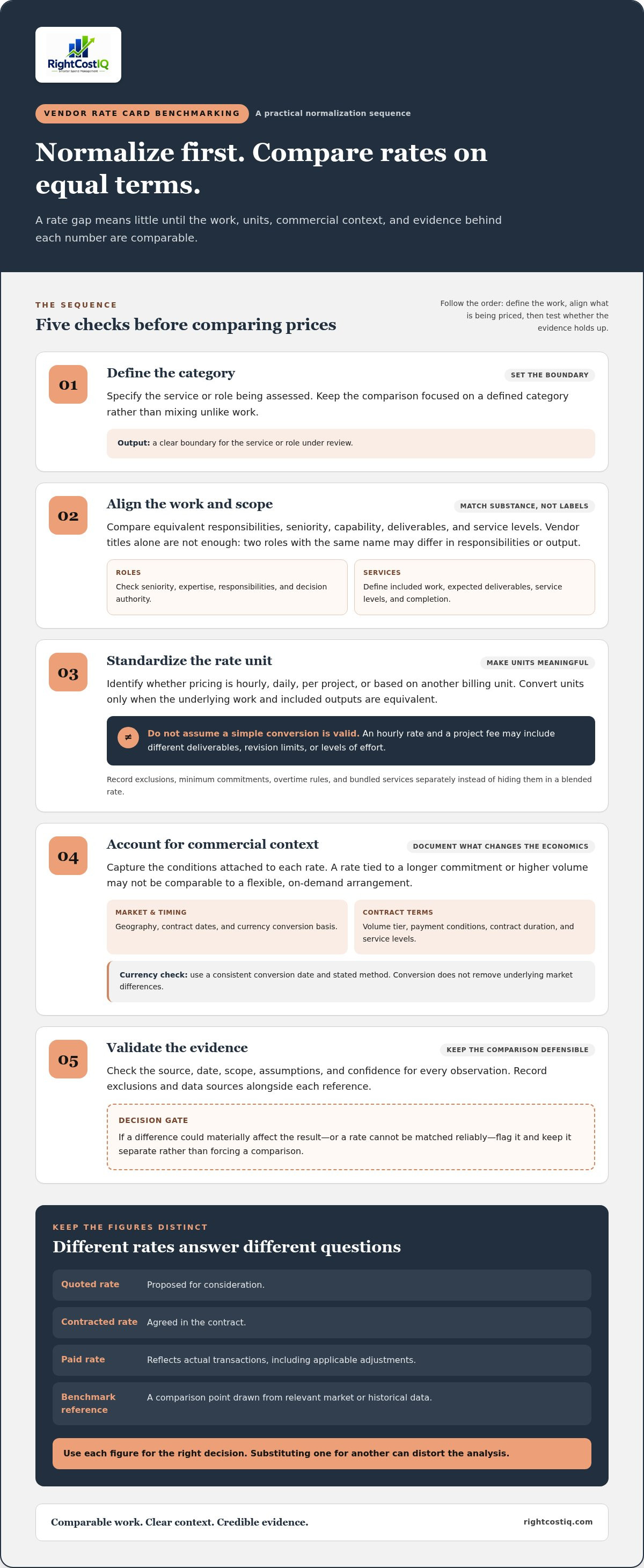
Rate benchmarking is a like-for-like assessment of vendor pricing and its underlying conditions, not a simple comparison of listed prices. Keep four figures distinct: a quoted rate is proposed for consideration; a contracted rate is agreed in the contract; a paid rate reflects actual transactions, including applicable adjustments; and a benchmark reference is a comparison point drawn from relevant market or historical data. They answer different questions. Substituting one for another can distort the analysis.
Within category sourcing, rate-card analysis focuses on the pricing components of a category or sourcing event. It can support RFP evaluation, contract renewal, negotiation planning, and budget assumptions. It doesn’t replace broader spend analysis, which examines purchasing patterns and total expenditure across a category. Nor does a rate comparison establish supplier performance, risk, or service quality. Those require separate evidence. A benchmark informs judgment; it doesn’t automatically prove that a price is fair or that a lower rate represents savings.
Which procurement decisions can rate benchmarking support?
During an RFP, normalized rates help assess commercial proposals against a consistent reference. At renewal, they can identify specific terms that merit review. In negotiation planning, they help focus questions on pricing gaps rather than invite a blanket discount request. For budgeting, they provide an evidence-based input when the reference reflects relevant market conditions and contract assumptions.
What makes two vendor rates genuinely comparable?
Start with the work, not the job title. Compare equivalent roles, seniority, capability, deliverables, service levels, and billing units. A daily rate cannot be directly compared with an hourly rate without a defensible conversion and a clear understanding of what each unit includes. Likewise, two vendors’ “senior analyst” roles may differ in responsibilities or output.
Then account for material commercial context: geography, contract duration, volume commitments, payment conditions, and included or excluded services. For example, a rate tied to a longer commitment or higher volume may not be comparable to a flexible, on-demand arrangement. Record assumptions, exclusions, and data sources alongside each reference. If a difference could materially affect the result, flag it instead of forcing a match. That discipline makes the comparison more useful for sourcing decisions and reduces the risk of treating an unadjusted variance as proof of overpricing.
How to normalize vendor rate cards before comparing prices
Normalization turns inconsistent rate-card inputs into a controlled comparison. In vendor rate card benchmarking, sequence matters: define the category, align the work, standardize units, account for commercial context, then validate the evidence. Normalize first, because a rate gap means little until the work and terms behind each number are comparable.
- Define the category: Set the boundary for the service or role being assessed.
- Align scope: Specify expected deliverables, responsibilities, and service levels.
- Standardize units: Identify whether rates are hourly, daily, per project, or based on another billing unit.
- Adjust context: Record relevant commercial and market conditions without assuming every difference has a universal adjustment.
- Validate: Check the source, date, assumptions, and whether the comparison is defensible.
This disciplined method reflects the broader logic of procurement benchmarking: comparisons need a clear basis and relevant context to support decisions.
Standardize roles, services, units, and scope
Map vendor terminology to agreed internal definitions. A “lead consultant” at one firm may not match another vendor’s role with the same title. Compare seniority, decision authority, required expertise, and deliverables, not labels alone. For services, define what work is included and what counts as completion.
Convert units only when the underlying work and included outputs are equivalent. An hourly rate and a project fee may cover different deliverables, revision limits, or levels of effort, so a simple conversion can create false precision. Record exclusions, minimum commitments, overtime rules, and bundled services separately instead of hiding them in a blended rate.
Adjust for commercial context and data quality
For each observation, document currency and conversion basis, geography, contract dates, volume tier, payment conditions, contract duration, and service levels. For example, a rate for a high-volume commitment may not represent the economics of a smaller, flexible engagement. Currency comparisons also need a consistent conversion date and stated method. A converted figure does not remove underlying market differences.
Keep a clear record of source, date, scope, and confidence. A current signed contract may provide stronger evidence of realized terms than an undated public rate card, but neither is automatically a perfect match. Separate unmatched or weakly supported observations from validated comparisons. Flag missing assumptions and exclusions instead of forcing equivalence. This gives procurement a transparent basis for deciding which data points can guide sourcing or negotiation and which need further validation.
How to analyze rate variance without mistaking it for savings
A rate difference is an observation, not a savings result. In vendor rate card benchmarking, a gap becomes a negotiation opportunity only after procurement confirms the comparison is credible, identifies a feasible action, and accounts for timing and switching effects. A lower reference rate may be unattainable under the current contract or may exclude work the incumbent performs.
Use a comparison record that shows what each rate represents and how much confidence to place in it. The example below is illustrative and makes no claim about market rates.
| Observation | Equivalent scope | Rate unit | Contract context | Source | Confidence |
|---|---|---|---|---|---|
| Current vendor | Same defined role and deliverables | Per approved billing unit | Current term; stated volume tier | Executed contract | High, terms documented |
| Reference vendor | Same defined role and deliverables | Same billing unit | Comparable duration and service level | Recent, documented proposal | Medium, some assumptions remain |
Keep scope, unit, contract context, source, and confidence visible. Don’t blend a weak observation into a precise-looking average. An apparent outlier may reveal a data-entry error, a scope or unit mismatch, or a genuinely different commercial position. Investigate the cause before treating it as evidence of overpricing.
Which comparison methods fit the available data?
With several current, comparable observations, use a range or distribution to show market variation without implying a single “correct” rate. With a small dataset, use direct like-for-like pairs and explain the limits. A handful of references cannot establish statistical certainty. Exclude or separately label observations with unclear scope, old dates, or weak documentation, and avoid unsupported market averages.
How should procurement interpret a rate gap?
Separate three stages: benchmark position, where the rate sits relative to credible references; contract opportunity, what could feasibly change given renewal timing, supplier options, and switching effects; and realized savings, the measurable result after an action is implemented. These stages are related, but they are not interchangeable.
Before prioritizing a gap, test whether differences in scope, service quality, delivery conditions, or risk explain it. A higher rate may buy capabilities or service levels the lower reference does not include. Focus analysis on material categories and upcoming contract events, where evidence can inform an actual sourcing decision. Procurement category cost benchmarking and analytics can help organize these comparisons; RFP evaluation and negotiation planning can then turn validated findings into targeted actions.
How to turn vendor rate benchmarks into a negotiation plan
A validated benchmark is useful when it shapes a decision, not when it simply produces a target number. Use vendor rate card benchmarking to identify where a proposal differs from comparable evidence, then test that finding against demand, supplier performance, market movement, contract timing, and switching considerations. A rate gap is a starting point for discussion, not a demand for an automatic reduction.
Build a defensible negotiation position
Prepare a concise evidence summary before meeting with the vendor: comparable scope, rate components, data sources and dates, contract assumptions, and confidence level. Turn the analysis into focused questions. For example, ask which service or commercial condition explains a difference in a specific rate component rather than challenging the total price without context.
Set a desired outcome, an acceptable alternative, and decision thresholds based on internal economics and business requirements. Include supplier performance and service needs in those limits. A lower rate may not be the right outcome if it compromises delivery or increases risk. Procurement teams can use negotiation planning assistance to connect benchmark findings with discussion priorities.
Before the pricing discussion, prepare:
- Validated comparisons with scope, unit, source, date, and confidence recorded.
- Contract terms, renewal timing, volume assumptions, and relevant demand forecasts.
- Supplier performance evidence and any service, quality, or risk requirements.
- Priority questions, target outcomes, acceptable alternatives, and decision thresholds.
Connect rate benchmarking to RFP and should-cost work
Use benchmark findings to make RFP pricing schedules more precise. Define comparable roles, units, deliverables, and commercial assumptions so proposals can be evaluated consistently. Rate evidence can also inform evaluation criteria alongside service quality and supplier performance. For a new sourcing event, RFP management can connect requirements, proposal evaluation, and negotiation preparation.
Where cost inputs and drivers can be credibly examined, should-cost analysis can provide another reference for testing a proposed price. It should complement, not replace, market and contract evidence. If key inputs are uncertain, document that limitation rather than presenting an unsupported target as fact.
With evidence and decision thresholds in place, RightCostIQ’s free diagnostic can help assess a benchmarking opportunity and how the analysis may support sourcing and negotiation priorities.
How to make vendor rate card benchmarking a repeatable process
A benchmark creates lasting value when procurement can reproduce the comparison, explain its assumptions, and trace what action followed. Treat vendor rate card benchmarking as a governed workflow, not a one-time spreadsheet exercise. Clear ownership and consistent records help teams distinguish fresh evidence from outdated or weakly supported data.
Set governance for rate data and benchmark updates
Assign accountable owners for category and rate definitions, source records, data validation, and exception approvals. Set refresh triggers around sourcing events, contract renewals, material scope changes, or meaningful market shifts. Retain version history, including the evidence and assumptions used for each decision, so teams can reconstruct what was known at the time.
Standardize documentation across categories. Each record should identify the source, date, scope, rate unit, commercial conditions, confidence level, and any approved exceptions. Track benchmark coverage and data recency alongside negotiation actions and realized outcomes. These measures show whether the process is producing decision-ready evidence, not just accumulating rate observations.
Move from analysis to procurement action
Prioritize findings by business relevance, evidence quality, timing, and execution feasibility. A well-supported variance tied to an upcoming renewal may warrant action sooner than a larger gap based on weak or outdated evidence. Record the decision, owner, next step, and outcome. Use those results to refine future RFP pricing schedules, negotiation plans, and supplier reviews.
RightCostIQ connects procurement category benchmarking and analytics with RFP management and negotiation assistance, helping teams carry validated findings into sourcing decisions and commercial discussions. Vendor performance tracking and market price trending can add context as teams assess suppliers and changing costs.
To assess where structured benchmarking could strengthen your sourcing decisions, start the free procurement diagnostic.
Turn Rate Evidence Into Better Procurement Decisions
Reliable vendor rate card benchmarking starts with comparable scope and commercial terms, then tests rate differences against evidence quality, supplier performance, and execution feasibility. A benchmark can focus an RFP or renewal discussion, but it becomes a savings opportunity only when procurement can act on it and measure the outcome.
Make the process repeatable: document assumptions and sources, refresh evidence when contracts or markets change, and carry findings into future sourcing decisions. RightCostIQ connects procurement category cost benchmarking and analytics with RFP management and negotiation assistance, supported by vendor performance tracking and market price trending.
Ready to assess where stronger rate comparisons could support your sourcing priorities? Start the free procurement diagnostic and take the next step toward more defensible, actionable procurement decisions.
Frequently Asked Questions
What is vendor rate card benchmarking?
Vendor rate card benchmarking is the structured comparison of rates for equivalent services under comparable commercial conditions. It helps procurement assess pricing against relevant contract, proposal, or market references. A quoted rate, contracted rate, paid rate, and benchmark reference represent different things, so label each clearly. The goal is to identify useful pricing signals for sourcing and negotiation, not to treat a rate card as proof that a price is fair.
How do you compare vendor rate cards accurately?
Define the category and scope first, then align roles, deliverables, service levels, and billing units. Account for material differences such as geography, currency, contract timing, volume commitments, and payment terms. Document each source, its date, assumptions, exclusions, and confidence level. If two observations cannot be matched reliably, keep them separate rather than forcing an adjustment. This process makes comparisons more defensible for RFP evaluation, renewal planning, and vendor discussions.
How often should procurement teams benchmark vendor rates?
Set a review cadence based on category importance and market volatility, then refresh benchmarks when a sourcing event, renewal, material scope change, or market shift could affect pricing. There’s no single interval that fits every category. A stable, low-impact service may need less frequent review than a strategically important category with changing requirements. Record the date and trigger for each refresh so decision-makers can judge whether evidence is current enough to use.
What data is needed for vendor rate card benchmarking?
Gather the rate and billing unit, role or service definition, deliverables, service levels, contract dates, geography, currency, volume assumptions, payment conditions, and relevant exclusions. Include the source and date for every observation, such as a current contract or proposal, and note its confidence. Supplier performance and market price trends add decision context, but they should remain distinct from rate evidence. Complete records help procurement determine which comparisons are suitable for negotiation or budget planning.
Can vendor rate benchmarking identify savings?
It can reveal a potential pricing opportunity, but a benchmark gap isn’t the same as realizable savings. Procurement must test whether the comparison is truly equivalent, whether the contract can be changed, and whether timing, switching effects, supplier performance, or service requirements affect the available options. Estimate an opportunity only after assessing those factors. Track negotiation actions and realized outcomes separately so reported savings reflect implemented changes, not simply a difference between two rates.
What is the difference between rate card benchmarking and should-cost analysis?
Rate card benchmarking compares observed vendor rates with other relevant rates, contracts, or market references under comparable conditions. Should-cost analysis estimates what a service or input may reasonably cost by examining its underlying cost drivers, where those inputs can be credibly assessed. The methods answer different questions: benchmarking asks how a rate compares, while should-cost analysis asks what factors may explain or support its level. Used together, they can inform RFP evaluation and negotiation planning.
How do you handle missing or inconsistent vendor rate data?
First, identify what’s missing or inconsistent, such as the rate unit, scope, contract date, currency, or included services. Seek supporting contract, proposal, invoice, or sourcing records where available, and record any conversion or assumption used. Assign a confidence level to the observation. Keep weakly supported or unmatched data separate from validated comparisons; don’t fill gaps with unsupported estimates. If the evidence remains incomplete, use it as a question for further analysis, not as proof of overpricing.


