

What if the proposal with the highest score isn’t the supplier that delivers the strongest value? Evaluating rfp responses can become unreliable when reviewers apply different standards, pricing models don’t align, or stakeholders interpret requirements differently. A scorecard helps only when every score is tied to the same published criteria and supported by evidence.
These challenges are common in complex sourcing decisions. The answer isn’t to make evaluation more subjective or simply award points to the lowest bid. Instead, use a consistent method to assess supplier capability, commercial terms, risk, and fit, then make the trade-offs visible to decision-makers.
This guide explains how to build a transparent procurement scorecard, compare proposals on a like-for-like basis, and test supplier claims against RFP requirements. You’ll learn how to align evaluators, normalize pricing, document strengths and gaps, and turn findings into negotiation priorities and a defensible award decision. Structured evaluation, supported by cost benchmarking and commercial analysis, gives your team a clearer basis for selecting the supplier that best meets the requirements.
Key Takeaways
- Separate compliance gates from scored criteria so mandatory requirements aren’t blurred with comparative strengths.
- Make evaluating rfp responses more consistent by defining score anchors and aligning evaluators before they review proposals.
- Use a comparison matrix to record supplier evidence, exceptions, assumptions, and assessments side by side.
- Normalize commercial offers to a common scope and set of terms to reveal meaningful differences in value and risk.
- Translate evaluation findings into focused clarification questions, negotiation priorities, and a documented award rationale.
What evaluating RFP responses means, and what a sound decision must prove
Evaluating RFP responses is a structured assessment of each supplier’s offer against the requirements and decision criteria established for the procurement. The process turns business needs into an evidence-based recommendation, rather than a collection of impressions. A Request for proposal (RFP) explains the need and invites suppliers to propose solutions; evaluation tests how well each offer addresses that need and what value it can deliver.
Keep four activities distinct. Compliance screening checks whether submissions meet mandatory requirements. Qualitative evaluation assesses factors such as capability, approach, and service fit. Commercial analysis compares pricing, assumptions, and financial terms. Final approval confirms the recommendation and required decision authority. A supplier can pass compliance without offering the strongest overall value. Likewise, the lowest-priced offer or highest aggregate score isn’t automatically the right award.
Consistency is the governing principle: assess every supplier against the same disclosed requirements, criteria, and evidence standards. Don’t change the rules midway, reward an unstated preference, or treat similar claims differently across proposals.
What should an RFP response evaluation accomplish?
A sound evaluation translates the organization’s stated needs into a documented supplier recommendation. It distinguishes responsiveness, whether an offer addresses a requirement, from overall value, whether the full proposal best supports the procurement’s priorities, commercial objectives, and acceptable risk level.
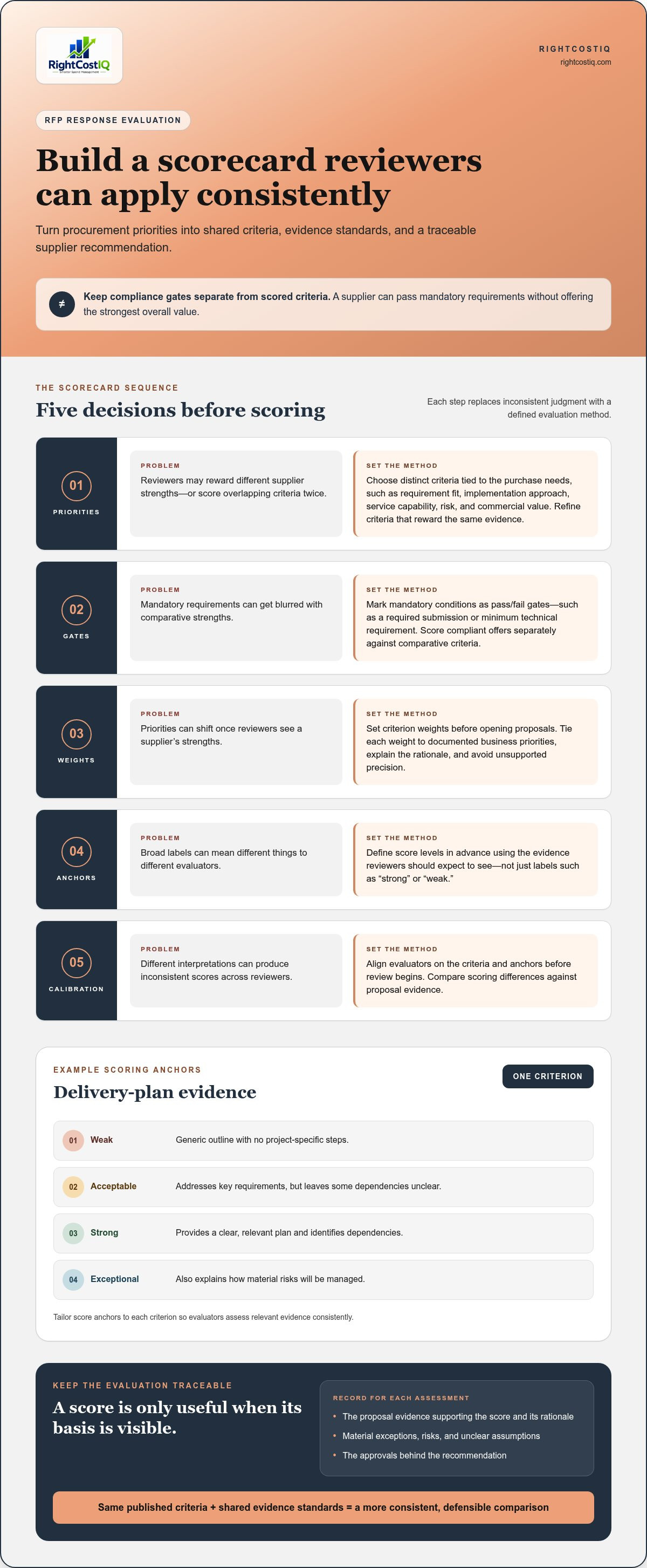
Make the decision record traceable. Capture scores and their rationale, material exceptions, identified risks, and approvals. If a response is unclear or relies on an assumption that affects scope, record the issue instead of silently interpreting it in the supplier’s favor. This creates a usable basis for clarification, negotiation, and award.
Who should evaluate supplier proposals?
Build a cross-functional team and assign criteria to evaluators with relevant expertise and decision authority. Procurement coordinates the process and applies consistency controls; technical and operational reviewers assess solution fit and delivery; finance examines commercial assumptions; legal reviews contractual issues; and end users assess practical usability. Not every evaluator needs to score every criterion.
Set roles before review begins. A strategic RFP management framework connects evaluation to the wider sourcing lifecycle, from requirements through negotiation. RightCostIQ provides RFP management and negotiation assistance to help connect structured assessment with commercial priorities. The evaluation team should record its evidence-based judgments and route the recommendation to the designated approvers.
Build an RFP response scorecard with criteria evaluators can apply consistently
A scorecard makes the evaluation method explicit before reviewers compare suppliers. Start with the requirements and business priorities established for the RFP, then turn relevant priorities into distinct criteria. For each criterion, specify the evidence reviewers should look for, who will assess it, and how the assessment will inform the recommendation. This structure makes evaluating rfp responses repeatable instead of dependent on individual preferences.
Use a sequence the team can follow:
- Define criteria: Select decision factors tied to the procurement’s needs, such as requirement fit, implementation approach, service capability, risk, and commercial value.
- Separate gates: Identify mandatory pass/fail conditions, such as a required submission or minimum technical requirement. Keep these separate from scored criteria used to compare compliant offers.
- Set weights: Reflect the relative importance of each scored criterion to documented business priorities. Record why each criterion carries its weight, and avoid precision the decision rationale can’t support.
- Anchor scores: Define what different levels of evidence mean before reviewers assess proposals.
- Calibrate evaluators: Align on how to apply criteria and anchors, then review scoring differences against proposal evidence.
How do you choose and weight evaluation criteria?
Choose criteria that distinguish what matters for this purchase. If implementation risk is a major concern, assess the proposed transition, dependencies, and evidence of mitigation. If commercial value is central, compare offers against a consistent scope and documented assumptions. Set weights before opening proposals so the team doesn’t reshape its priorities around a supplier’s strengths. Check for overlap: if “implementation plan” and “delivery capability” reward the same evidence, refine them to avoid counting one advantage twice.
How can evaluators use scoring anchors consistently?
Anchors turn broad labels into shared evidence standards. For a delivery-plan criterion, weak evidence might be a generic outline with no project-specific steps. Acceptable evidence addresses key requirements but leaves some dependencies unclear. Strong evidence provides a clear, relevant plan and identifies dependencies. Exceptional evidence also explains how material risks will be managed. Tailor anchors to each criterion instead of relying on adjectives alone.
Require a concise rationale and proposal reference for every material score. A useful scorecard records:
- Criterion and weight, including the business priority behind the weighting.
- Evidence and proposal reference, showing what the supplier actually submitted.
- Score and rationale, explaining how the evidence meets the anchor.
- Evaluator, identifying who assessed the criterion.
Consistent criteria and documented rationale strengthen the decision record and make differences easier to resolve. RightCostIQ’s RFP management and negotiation assistance supports a structured evaluation process linked to commercial priorities.
Compare RFP responses fairly by normalizing evidence, assumptions, and offers
A scorecard compares supplier responses against shared criteria; a comparison matrix shows what each supplier offered and where the evidence differs. Use one row per requirement and record the supplier’s response, supporting evidence, exception or qualification, and evaluator assessment. Separate what the supplier states from what the evidence demonstrates, what the evaluator infers, and what still needs clarification.
This distinction matters. A supplier may claim it can meet a requirement but provide evidence that addresses only part of it. An unanswered field isn’t proof of compliance. Mark responses as incomplete, conditional, or materially different, and log the gap for review instead of filling it with an assumption.
How do you compare supplier pricing on a like-for-like basis?
Bid normalization means aligning proposal assumptions before comparing value. Reconcile differences in scope, volume, contract term, currency, implementation approach, recurring charges, and optional components where applicable. For example, distinguish a base offer from an optional service, or a one-time implementation charge from a recurring fee. Make adjustments transparent and keep the supplier’s original submission visible so the comparison doesn’t obscure what was actually proposed.
Category cost benchmarking can provide a reference point for assessing commercial reasonableness, but it doesn’t replace aligning scope and assumptions. State the comparison basis, data limitations, and any differences that remain. RightCostIQ’s procurement category cost benchmarking and analytics can support reference-cost analysis alongside proposal review.
How should evaluators assess evidence and exceptions?
Check whether each cited document, example, or data point directly addresses the requirement and is sufficiently current and relevant to the decision. Record exceptions, dependencies, substitutions, and unanswered questions in a consistent log. This prevents a conditional offer from appearing equivalent to an unqualified commitment and gives the team a clear basis for clarification.
A practical matrix can include:
- Requirement: The stated need or evaluation criterion.
- Supplier response and evidence: The answer and its supporting proposal reference.
- Exception or assumption: Any deviation, dependency, substitution, or qualification.
- Evaluator assessment: Interpretation against the criterion, including unresolved questions.
Keep commercial adjustments and evidence judgments traceable to their sources. That discipline makes evaluating rfp responses more consistent and helps the team distinguish a genuine difference in supplier value from a difference in proposal format or assumptions.
Resolve scoring disagreements and test supplier risk before recommending an award
A high aggregate score can conceal a material exception, an untested delivery assumption, or a risk that could undermine the procurement’s objectives. Before recommending an award, review significant risks alongside the scorecard. The scorecard supports judgment, but it doesn’t replace it.
How should an evaluation team resolve score differences?
Use consensus sessions to examine the basis for a difference, not to steer scores toward a preferred supplier. For each material variance, review the requirement, cited proposal evidence, applicable scoring anchor, and evaluator rationale. Ask what evidence supports each interpretation, then determine whether the difference reflects inconsistent scoring, a genuine trade-off, or an unresolved question.
Keep the process traceable. Preserve individual assessments where required, distinguish them from the agreed consensus outcome, and record the reason for any score change. Log clarification decisions and responses consistently, including who authorized them. Evaluators should disclose potential conflicts of interest and follow the organization’s controls for managing them. The designated decision owner should resolve or escalate questions the team can’t settle, retaining the rationale in the decision record.
Which supplier risks belong in the final review?
Test whether the proposal’s commitments appear feasible in practice. Review delivery capacity, service continuity, implementation dependencies, and relevant compliance exposure against the evidence supplied. Separate confirmed facts from supplier claims, evaluator assumptions, and open questions. Assign an owner to each material risk and document the planned follow-up or mitigation before approval.
For example, a proposed implementation may depend on access to internal systems or resources that haven’t been confirmed. Record the dependency as a risk, identify who will validate it, and consider its effect on delivery before relying on the supplier’s score. A high rating in another category shouldn’t erase an unresolved condition that could affect performance.
Keep the final review focused on decision quality. Document the evaluation team’s recommendation, material trade-offs, unresolved risks, clarification outcomes, and the person responsible for approval. This gives decision-makers a clear view of both the scoring result and factors that may affect supplier performance after award.
RightCostIQ’s procurement services include cost benchmarking and analytics, vendor performance tracking, and price risk management. These capabilities can support the review of commercial assumptions and supplier risks. Explore your procurement evaluation process.
Turn the evaluation outcome into a negotiation plan and defensible award decision
Evaluation findings become commercially useful when they shape negotiation priorities. Convert low-scoring areas, unclear commitments, and material exceptions into focused questions. Rank each potential negotiation item by business impact, strength of supporting evidence, and connection to the requirements suppliers received. This keeps discussions anchored to the procurement’s stated priorities rather than preferences introduced after scoring.
How do evaluation findings shape supplier negotiations?
Separate clarification from negotiation. A clarification seeks to understand what a supplier already proposed, such as an unclear implementation dependency. A negotiation explores changes to offered terms or commitments. Keep both tied to the original requirements, and follow the established process if a proposed change could alter the competitive basis of the decision. Benchmarking and market trends can help frame commercial objectives, while the evaluation record shows which issues warrant attention. RightCostIQ’s RFP management and negotiation assistance helps translate findings into focused priorities.
Build a short negotiation plan that identifies the objective, supporting evidence, supplier question, and acceptable outcome for each priority. For example, if recurring charges rely on an assumption about service volume, clarify that assumption before comparing final commercial terms. Avoid reopening settled criteria or treating a weak score as automatic leverage if it reflects a non-negotiable requirement.
What belongs in a defensible award recommendation?
Give approvers a concise account of how the recommendation was reached. Summarize the evaluation method, supplier scores, normalized commercial findings, material exceptions, and rationale for selecting the preferred supplier. State the important trade-offs plainly, including residual risks, contract assumptions, and any conditions requiring follow-up. Record required approvals and identify who owns outstanding actions.
Connect proposed commitments to post-award oversight. Where relevant, translate measurable supplier commitments from the proposal into vendor performance measures, with clear ownership for tracking and review. This creates a practical handoff from evaluation to supplier management and keeps the basis of the award visible after contract signature.
A strong award recommendation doesn’t claim that the selected supplier is best in every respect. It explains why the supplier offers the strongest fit against the published priorities, what trade-offs the organization accepts, and how remaining risks will be managed. That record makes evaluating rfp responses part of a controlled decision process, not simply a ranking exercise.
RightCostIQ provides RFP management and negotiation assistance to help procurement teams connect evaluation findings to commercial priorities. Review your procurement process with RightCostIQ.
Make every RFP decision easier to defend
Strong procurement decisions rely on more than a final score. A consistent scorecard ties evaluation to published requirements, while normalized comparisons make supplier evidence, assumptions, and commercial terms easier to assess fairly. Documented trade-offs and risk reviews then give approvers a clear basis for the recommendation.
Evaluating rfp responses with this level of discipline also creates a stronger handoff to negotiation and post-award oversight. Use cost benchmarking and analytics to inform commercial priorities, then carry relevant supplier commitments into vendor performance tracking and price risk management.
RightCostIQ supports procurement teams with RFP management and negotiation assistance, procurement cost benchmarking and analytics, vendor performance tracking, and price risk management. Start a procurement diagnostic to assess where your evaluation process can become more consistent, transparent, and decision-ready.
Frequently Asked Questions
How do you evaluate RFP responses fairly?
Evaluate every proposal against the same requirements, scoring criteria, and evidence standards established for the RFP. Reviewers should cite proposal evidence, explain scores using shared anchors, and record exceptions and assumptions consistently. Separate mandatory compliance checks from comparative scoring, then document how the findings support the recommendation. This makes evaluating rfp responses more transparent and helps the team explain its decision without relying on personal preference.
What criteria should be included in an RFP evaluation scorecard?
Include criteria that reflect the procurement’s documented priorities. Depending on the requirement, these may cover technical fit, implementation approach, service capability, delivery feasibility, relevant risk, and commercial value. Define each criterion clearly enough that evaluators can distinguish it from the others. For example, assess implementation planning separately from ongoing service capability, and check that the same supplier strength isn’t rewarded under multiple overlapping criteria.
How do you score RFP responses using a weighted matrix?
Assign each scored criterion a weight based on its importance to the business need, then define consistent scoring anchors before reviewers assess proposals. Multiply each criterion’s score by its weight and add the weighted results to calculate a supplier’s total. If weights are percentages, use a consistent calculation basis. Record evidence and rationale for material scores, and interpret the total alongside exceptions and risks rather than treating it as the decision by itself.
Should mandatory RFP requirements be scored or treated as pass/fail?
Treat mandatory requirements as pass/fail gates when they determine whether a proposal is eligible for comparative evaluation. Keep them separate from scored criteria, which distinguish the relative strengths of responsive offers. Define the requirements and how the team will assess them before reviewing submissions. If an answer is incomplete or unclear, record the issue and follow the RFP’s established clarification process rather than assuming the supplier has met the requirement.
How do you compare RFP pricing when supplier proposals use different assumptions?
Normalize the offers to a common basis before comparing commercial value. Reconcile differences in scope, volume, contract term, currency, implementation assumptions, recurring charges, and optional components where relevant. Preserve each supplier’s original submission and document any adjustments made for comparison. Cost benchmarking can provide context, but state its scope and limitations. A reference cost is useful only when its assumptions align closely enough with the offers being assessed.
What happens if evaluators disagree on an RFP response score?
Review the specific requirement, proposal evidence, scoring anchor, and each evaluator’s rationale. Use a consensus discussion to resolve differences through evidence, not to move scores toward a preferred supplier. If the team can’t settle a material issue, refer it to the designated decision owner and document the resolution. Where required, retain the original individual ratings separately from the consensus score so the decision trail remains clear.
How should an RFP evaluation team handle missing or unclear supplier answers?
Record the unanswered requirement or ambiguity as an open item, exception, or potential risk. Don’t interpret silence as proof of compliance or fill gaps with favorable assumptions. Use the established clarification process to seek information where permitted, apply the same process consistently, and preserve the question, response, and resulting assessment. If the issue remains unresolved, explain how it affects the score, compliance status, recommendation, or approval decision.


