
What if healthcare procurement optimization depends less on cutting prices and more on connecting the decisions behind every purchase? Fragmented purchasing, inconsistent pricing, and siloed departments can hide total spend and make supplier consolidation difficult. At the same time, savings targets can raise valid concerns about quality, availability, and service continuity.
Effective optimization starts with reliable, comparable data, then carries that evidence into sourcing and supplier oversight. This framework explains how to identify actionable opportunities, assess suppliers using consistent criteria, and pursue savings without treating price as the only measure of value.
You’ll see how spend visibility and category benchmarking can inform RFP design and negotiation preparation, how market trends can strengthen sourcing decisions, and how supplier performance tracking can test whether expected outcomes continue after award. The result is a practical way to connect analysis to execution, make decisions with clearer evidence, and monitor financial results alongside operational performance.
Key Takeaways
- Build a reliable spend baseline by normalizing purchasing data before comparing suppliers, facilities, or contract terms.
- Use a repeatable healthcare procurement optimization cycle to turn category insights into focused sourcing and negotiation priorities.
- Evaluate proposals against total cost, scope alignment, service levels, quality requirements, and continuity risk, not price alone.
- Start implementation with a manageable pilot and clear ownership across procurement, finance, executive leadership, and operational teams.
- Connect structured RFP management, category benchmarking, market trends, and vendor tracking to guide decisions before and after contract award.
Why healthcare procurement optimization starts with spend visibility
Healthcare procurement optimization means improving purchasing costs, processes, and supplier outcomes while protecting the continuity of essential operations. It concerns procurement strategy and execution, not medical care or clinical decision-making. The distinction matters: a lower quoted price isn’t an improvement if it compromises required quality, availability, or service.
Procurement optimization is the disciplined use of spend and supplier evidence to improve cost and performance without weakening operational continuity. That discipline starts with visibility. Fragmented contracts, decentralized purchasing, and inconsistent records can obscure what an organization buys, from whom, under which terms, and at what total cost. Without a comparable baseline, teams can’t reliably distinguish genuine opportunities from differences in scope, utilization, or contract conditions.
What does healthcare procurement optimization include?
Strategic procurement connects spend visibility to category priorities, sourcing strategy, negotiation, supplier governance, and ongoing performance measurement. Transaction processing and accounts-payable administration support purchasing, but don’t determine on their own whether demand is consolidated appropriately, terms remain competitive, or suppliers meet expectations.
Priorities vary by organization, category, operating model, and continuity requirements. A category with interchangeable specifications may offer different sourcing options than one with strict operational dependencies. Establish a clear basis for decisions, then choose an approach suited to the category instead of applying a uniform cost-cutting target.
Why does fragmented purchasing make optimization harder?
Facility-level purchasing can produce multiple vendor relationships, inconsistent contract terms, and varied pricing for comparable requirements. Apparent duplication doesn’t automatically mean consolidation will help. A location may have distinct service needs, contract conditions, or continuity considerations that change the case for a shared agreement.
Disconnected category, contract, and invoice data make these differences harder to assess. Supplier names may appear in inconsistent formats, invoices may not map cleanly to contract terms, and purchase descriptions may conceal whether items or services are genuinely comparable. Normalize those records before calculating an opportunity or comparing facilities. This creates a more credible view of spend and helps teams test whether a sourcing change is practical.
A group purchasing organization (GPO) is one route healthcare organizations may use to leverage collective buying power. Assess it alongside other sourcing options against the organization’s category requirements and continuity needs. The goal is evidence-led alignment, not consolidation for its own sake.
How a data-led healthcare procurement optimization cycle works
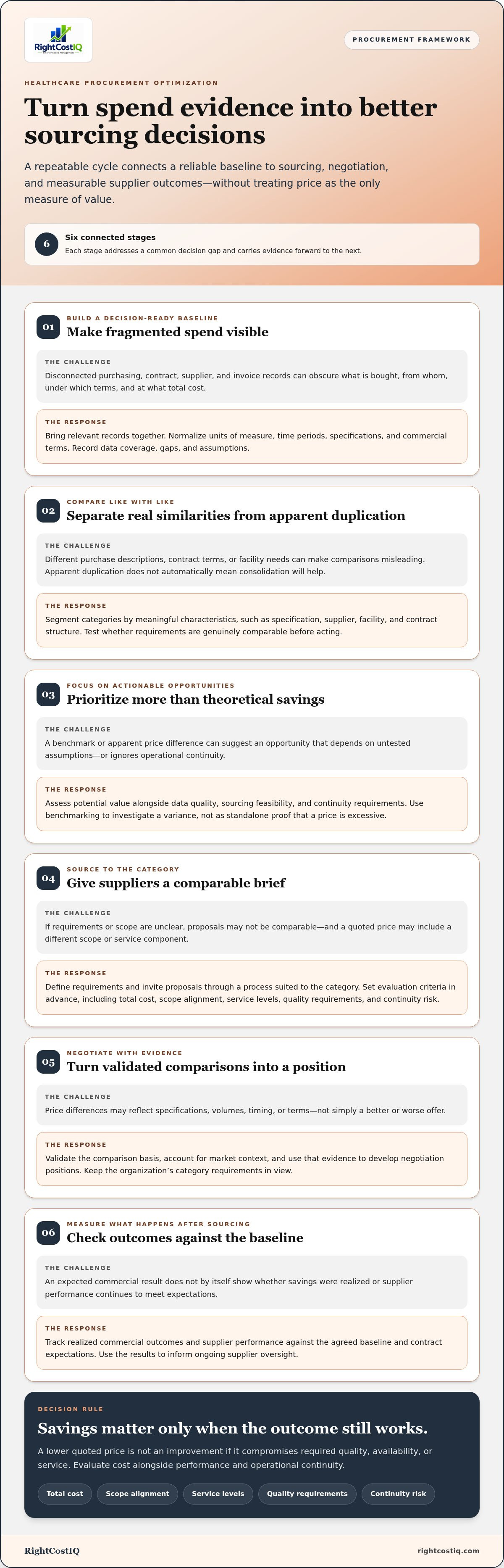
A repeatable cycle turns spend analysis into sourcing decisions and measurable follow-through. Comparable baseline data is essential because a benchmark can guide a decision only when the underlying purchases, terms, and requirements are genuinely comparable. Healthcare procurement optimization should distinguish an addressable opportunity, one the organization can act on, from theoretical savings that depend on untested assumptions.
- Establish the baseline. Bring together relevant purchasing, contract, supplier, and category records. Document coverage, gaps, and assumptions.
- Segment categories. Group spend by meaningful characteristics, such as specification, supplier, facility, and contract structure.
- Prioritize. Assess potential value alongside data quality, sourcing feasibility, and continuity requirements.
- Source. Define requirements and invite proposals through a process suited to the category.
- Negotiate. Use validated comparisons and market context to develop evidence-based negotiation positions.
- Measure. Track realized commercial outcomes and supplier performance against the agreed baseline and contract expectations.
How should teams build a reliable procurement baseline?
Before comparing suppliers, facilities, contract terms, or utilization, normalize the data. Align units of measure, time periods, specifications, and commercial terms. For example, a unit-price comparison can mislead when one quote includes a different scope or service component. Keep the source and definition of each measure visible, and record missing data or assumptions rather than presenting uncertain comparisons as facts.
A baseline is a decision tool, not a claim that every record is complete. The Association for Health Care Resource & Materials Management (AHRMM) provides a professional resource for healthcare supply chain and materials management education.
How do benchmarking and RFPs turn analysis into action?
Use category cost benchmarking as an input to investigation, not standalone proof that a price is excessive. Differences in specifications, volumes, timing, and terms may explain a variance. Document the comparison basis, then test whether the opportunity remains valid under the organization’s requirements.
Translate validated needs into an RFP scope that lets suppliers respond on a comparable basis. Set evaluation criteria in advance, covering commercial terms and relevant service or quality requirements. Structured RFP management and negotiation assistance can carry the analysis into disciplined sourcing. After award, measurement closes the loop by showing whether negotiated terms and expected performance are being realized.
How to balance procurement savings with supplier quality and continuity
A lower price isn’t a successful outcome if supplier performance deteriorates or essential operations are disrupted. Effective healthcare procurement optimization treats cost, quality, service, and continuity as connected decision criteria. The goal isn’t to select the lowest bid by default, but to identify the proposal that best meets documented requirements at an acceptable total cost and level of risk.
Set evaluation criteria before reviewing bids, and assign weights that reflect the category’s operational importance. Depending on the purchase, teams may assess:
- Total cost: Consider relevant charges and contract terms, not just the quoted unit price.
- Scope alignment: Confirm each proposal addresses the same specifications, volumes, assumptions, and contract period.
- Service and quality: Compare suppliers against defined requirements and measurable service expectations.
- Supplier capability and implementation risk: Assess the proposed transition, operational dependencies, and ability to meet the agreed scope.
Document the rationale behind the weighting and any trade-offs. If a proposal offers a lower price but requires a more complex transition, record how stakeholders assessed that risk and why the decision supports the organization’s priorities. A clear approval trail makes the outcome easier to explain and review.
What should a healthcare procurement evaluation compare?
Compare bids on a like-for-like basis. Align specifications, units, assumptions, included services, and contract periods before scoring. If a supplier’s offer differs from the requested scope, identify the variance rather than treating the price as directly comparable. Use a consistent evaluation matrix and involve operational stakeholders who can assess whether proposed service levels fit actual requirements.
Keep forecasted savings separate from measurable contract changes. A negotiated rate or revised term can be documented at award, but projected savings remain estimates until validated against actual purchasing and contract performance. State the baseline, calculation method, and assumptions, then compare realized results after implementation.
How can teams manage supplier and market-price risk?
After award, track agreed supplier measures, contract obligations, exceptions, and corrective actions. Use regular reviews to identify recurring gaps and assign follow-up ownership. This makes supplier governance an operating discipline, not a one-time award check.
Market-price trends can inform negotiation timing and help explain changes in supplier proposals, but they provide context, not guaranteed forecasts. Pair them with contract terms and observed supplier performance. Consistent RFP evaluation and negotiation helps teams compare offers systematically, document decisions, and maintain a clear link between sourcing assumptions and post-award results.
How to implement healthcare procurement optimization across teams
Start with a bounded pilot, not an organization-wide mandate. Select a category with material spend, usable data, and manageable implementation risk. A focused scope gives teams a practical way to test sourcing assumptions, clarify decision rights, and identify adoption barriers before expanding the approach.
Assign ownership before work begins. An executive sponsor can resolve cross-functional barriers; a category owner coordinates analysis and sourcing; finance validates baseline and outcome definitions; operational stakeholders confirm requirements and assess implementation impacts. Set the baseline, milestones, approval points, supplier communication plan, and post-award review cadence at the outset. Clear roles turn healthcare procurement optimization into an operating process rather than a one-time project.
Which procurement opportunities should teams prioritize first?
Rank candidate categories against four factors: spend exposure, data readiness, business impact, and execution complexity. A large apparent opportunity may rely on incomplete records or involve substantial implementation risk. Don’t select a pilot solely because its estimated savings look highest.
Separate near-term process improvements, such as improving purchasing compliance with existing terms, from longer sourcing or contract initiatives. This helps teams sequence work realistically and avoid treating projected savings as immediately achievable. Choose a first category where the team can establish a credible baseline, engage the right stakeholders, and track the effects of a defined change.
How should leaders measure adoption and realized outcomes?
Measure more than the negotiated terms. A practical scorecard can track:
- Baseline: The spend period, scope, data sources, and assumptions used for comparison.
- Adoption: Whether purchasing activity follows the agreed contract and sourcing approach.
- Supplier performance: Relevant measures, exceptions, corrective actions, and follow-up ownership.
- Results: Value committed at award, value forecast under stated assumptions, and value verified through actual purchasing.
Review these measures on a defined cadence with procurement, finance, and operational stakeholders. If adoption falls short, investigate whether the cause is unclear guidance, a process barrier, or a mismatch between the agreement and operational needs. Use findings to adjust category plans and shape the next sourcing cycle. A procurement diagnostic can help structure the review.
How RightCostIQ supports healthcare procurement optimization
RightCostIQ connects procurement analysis with sourcing execution through RFP management and negotiation assistance. Category cost benchmarking and analytics help teams assess spend and identify questions to investigate; market-price trends provide additional context for negotiation planning. After award, vendor performance tracking supports ongoing review of supplier outcomes against agreed expectations.
These capabilities support healthcare procurement optimization as a procurement and financial analytics process. They don’t replace organizational judgment: useful decisions depend on the quality and comparability of available data, the conditions of each category, and how sourcing decisions are implemented and adopted.
How do RightCostIQ services connect analysis to execution?
Category analysis can help define where deeper sourcing work may be warranted. Once requirements and opportunity assumptions are established, structured RFP management creates a consistent process for gathering and evaluating proposals. Negotiation assistance helps teams prepare positions grounded in category comparisons and relevant market context, rather than relying on price targets alone.
Execution continues after the contract is awarded. Vendor performance tracking helps procurement teams monitor agreed measures, identify exceptions, and review whether supplier outcomes align with expectations. This creates a feedback loop between the original sourcing rationale and post-award performance, while keeping financial analysis distinct from clinical or medical decision-making.
What is the next step for procurement leaders?
Start with a specific spend question. Identify the category or purchasing pattern under review, the decision you need to make, and the baseline information available. Relevant context may include supplier and contract records, purchasing history, category definitions, and operational requirements. Clear inputs make it easier to distinguish a measurable opportunity from an assumption that needs further validation.
A diagnostic can provide a practical starting point for assessing procurement opportunities, not a guaranteed savings commitment. Define the issue, assemble relevant data, and identify the sourcing or analytics questions that should guide the next decision.
Turn procurement insight into measurable action
Stronger healthcare procurement optimization links reliable spend visibility to disciplined sourcing and post-award accountability. Comparable data helps teams identify realistic opportunities, while evaluations that weigh total cost, supplier performance, and continuity keep savings goals grounded in operational needs.
RightCostIQ supports this process through RFP management and negotiation assistance, backed by category cost benchmarking, market-price analysis, and vendor performance tracking. These capabilities help procurement teams move from analysis to structured decisions and monitor outcomes after award. Results depend on the organization’s data, category conditions, and implementation, so a clear baseline and defined objectives matter from the start.
Take the next step by identifying a spend question, gathering relevant baseline information, and assessing where sourcing or supplier analysis could add value. Start your free procurement diagnostic to evaluate potential opportunities and clarify what to examine next.
With a focused, evidence-led approach, your team can build procurement decisions that support both financial discipline and operational continuity.
Frequently Asked Questions
What is healthcare procurement optimization?
Healthcare procurement optimization is a coordinated approach to improving purchasing cost, process efficiency, supplier outcomes, and risk management. It isn’t indiscriminate price reduction: decisions should account for operational needs and continuity, not just the lowest quote. Priorities depend on an organization’s operating model, procurement categories, data quality, and continuity requirements. The focus is procurement and financial operations, including sourcing and supplier oversight, rather than clinical care or medical decision-making.
How can healthcare organizations reduce procurement costs without compromising patient care?
Organizations can pursue cost improvements by validating specifications and spend baselines, then comparing proposals that meet equivalent requirements. Evaluate total cost alongside quality, service, and continuity considerations, and involve operational stakeholders who understand the requirements. After award, monitor contract adoption and supplier performance to check whether negotiated terms and expectations hold in practice. Document trade-offs and validate results against actual purchasing; no single sourcing tactic suits every category or guarantees savings.
What are the biggest challenges in healthcare procurement optimization?
Common challenges include fragmented purchasing and contract data, decentralized facility decisions, inconsistent terms, limited comparability between benchmarks, and supplier or market uncertainty. These conditions make it harder to establish a reliable spend baseline, assess opportunities, and coordinate sourcing across teams. The issues vary by organization and category. Teams can improve decision quality by aligning data definitions, documenting limitations, and distinguishing verified comparisons from assumptions before setting sourcing priorities.
How do RFPs improve healthcare procurement outcomes?
A well-defined request for proposal (RFP) makes requirements, supplier responses, commercial terms, and evaluation criteria easier to compare. Consistent scoring helps stakeholders explain decisions and gives negotiators a clearer basis for follow-up. An RFP alone doesn’t ensure savings or continuity. Outcomes depend on scope quality, relevant data, stakeholder participation, and post-award contract management. Clear requirements and documented evaluation criteria help make the process more disciplined and accountable.
How can healthcare organizations benchmark procurement costs?
Before comparing costs, normalize units, specifications, contract periods, service scope, and relevant commercial terms. Then interpret benchmarks in light of the organization’s requirements and market context, rather than treating a variance as proof that a price is excessive. Record data sources, assumptions, and limitations so decision-makers can understand how comparisons were made. Reliable benchmarking informs further analysis and negotiation, but it doesn’t replace category-specific evaluation or stakeholder judgment.
What role does supplier performance tracking play in procurement optimization?
Supplier performance tracking tests whether agreed service, commercial, and operational commitments are being met after award. Teams can monitor relevant measures, document exceptions, assign corrective actions, and review progress on a consistent cadence. Findings can inform supplier discussions, contract reviews, renewal planning, and future sourcing decisions. Measures should reflect the agreement and category requirements; tracking supports oversight, but by itself it can’t prevent service disruption or guarantee supplier performance.
Can healthcare procurement optimization work across multiple facilities?
Yes. Cross-facility analysis can reveal inconsistent terms, duplicated purchasing, and options for coordinated sourcing. Standardization should still account for local operational needs, category requirements, and implementation capacity; identical suppliers or processes won’t necessarily suit every facility. A phased approach can establish shared data definitions, clear ownership, and measurable adoption while allowing teams to assess local impacts. Use the findings to determine where coordination adds value and where distinct requirements justify variation.


