

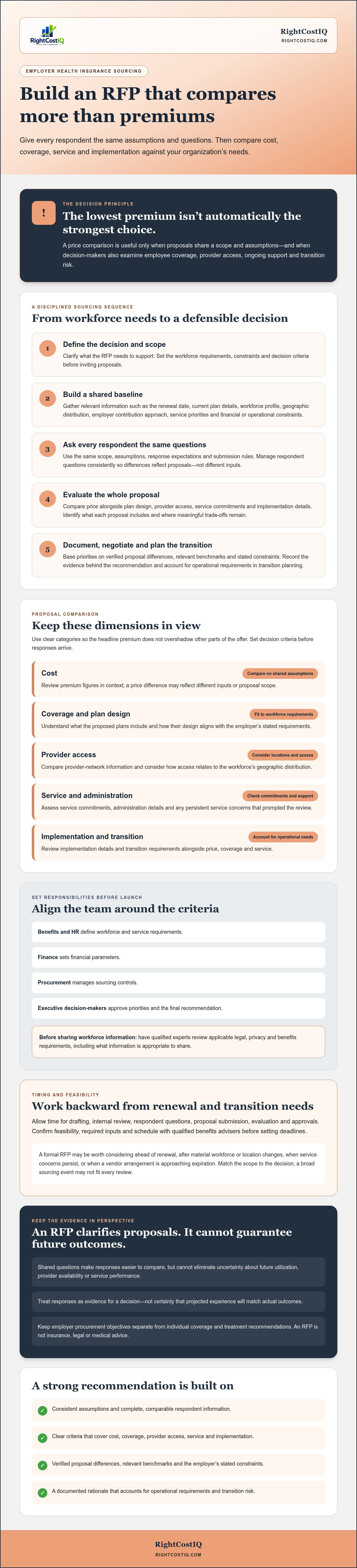
The lowest-premium proposal isn’t automatically the strongest choice. A health insurance RFP for employers should give every respondent the same assumptions and questions, so decision-makers can compare more than headline costs.
That’s harder than it sounds. Proposals may differ in plan design, provider networks, service commitments, and implementation details, while HR, finance, procurement, and leadership weigh those factors differently. If the process focuses mainly on premiums, important differences in employee coverage, ongoing support, and transition risk can be overlooked.
This guide explains how to structure an RFP that qualified respondents can answer clearly and completely, then evaluate proposals on a consistent basis. You’ll learn what information to request, how to assess cost, coverage, service, and implementation, and how to document an evidence-based recommendation. It also covers transition planning, so the decision accounts for operational requirements as well as price. The result is a more disciplined sourcing process that helps your team compare value and risk, align decision criteria, and support a well-documented renewal decision.
Key Takeaways
- Define the RFP’s scope, workforce requirements, constraints, and decision criteria before inviting proposals.
- Use the health insurance rfp for employers process to give respondents consistent assumptions and request complete, comparable information.
- Evaluate proposals across clear categories so premium figures don’t overshadow plan design, provider access, service, or implementation.
- Prepare negotiation priorities using verified proposal differences, relevant benchmarks, and the employer’s stated constraints.
- Assess whether procurement support could help your team structure the process, analyze responses, and prepare for negotiations.
What an Employer Health Insurance RFP Should Accomplish
A health insurance RFP for employers is a structured request that invites eligible benefits providers to respond to the same requirements. A Request for Proposal (RFP) turns workforce needs, financial parameters, service expectations, and evaluation criteria into a defined sourcing process. The goal isn’t simply to collect quotes. It’s to make clear what each proposal includes, which assumptions it uses, and where meaningful differences remain.
An RFP differs from an informal renewal review or a search for the lowest premium. A renewal discussion may focus on an existing arrangement, while an RFP sets common questions and response expectations for multiple respondents. A low premium alone doesn’t show whether plan design, provider access, administration, or implementation fits the employer’s requirements. Set decision criteria before proposals arrive, then use them to support a documented procurement recommendation.
An RFP supports a purchasing decision; it isn’t insurance, legal, or medical advice. It doesn’t determine which coverage or treatment an individual employee should choose. For organizations assessing procurement-focused RFP management, RFP management information can help clarify process considerations without replacing qualified benefits, legal, or clinical expertise.
When an employer should consider a health insurance RFP
Consider a formal process ahead of a renewal, when workforce composition or locations change materially, when service concerns persist, or when a vendor arrangement is approaching expiration. Start by defining the decision the RFP needs to support and the internal effort required to run it. The scope should match the decision: a broad sourcing event may not be practical for every review, and a limited comparison may be more appropriate when timing or requirements constrain participation.
Market participation and workable timelines vary. Confirm feasibility, required inputs, and the schedule with qualified benefits advisers before setting deadlines or assuming providers can respond.
What a health insurance RFP can and cannot resolve
Consistent questions and shared assumptions make proposals easier to compare, but they can’t eliminate uncertainty about future utilization, provider availability, or service performance. An RFP can clarify what respondents are proposing and expose gaps or trade-offs; it can’t guarantee that projected experience will match actual outcomes. Treat responses as evidence for a decision, not certainty about future costs or employee needs.
Keep employer-level procurement objectives separate from individual coverage and treatment recommendations. Before issuing the request, ask qualified experts to review jurisdiction-specific legal, privacy, and benefits requirements, including what workforce information is appropriate to share. This sets clear boundaries for the sourcing process and helps ensure the RFP is evaluated in the right context.
How to Build a Comparable Employer Health Insurance RFP
A health insurance RFP for employers works best when every respondent receives the same scope, baseline information, questions, and submission rules. Proposal comparability means evaluating responses built on the same scope and assumptions. Without that foundation, apparent differences in price or service may reflect different inputs rather than meaningful distinctions between proposals.
Build the process in sequence: define the scope, collect baseline data, draft the request, validate it with stakeholders, issue it to eligible respondents, and manage questions consistently. Gather the renewal date, current plan details, workforce profile, geographic distribution, employer contribution approach, service priorities, and financial or operational constraints. Share only information that has been reviewed for appropriateness and privacy.
Define requirements before contacting respondents
Separate mandatory requirements from preferences. Identify essential service capabilities independently from features the employer would value but doesn’t require. Avoid assumptions about employee needs or future usage unless the available information supports them. Assign clear roles: benefits and HR define workforce and service requirements, finance sets financial parameters, procurement manages sourcing controls, and executive decision-makers approve priorities and the final recommendation.
Set a realistic schedule by working backward from the renewal date and any transition needs. Allow time for drafting, internal review, respondent questions, proposal submission, evaluation, approvals, and implementation planning. Confirm feasibility with qualified advisers, since respondent participation and timelines can vary.
Standardize RFP questions and submission rules
Use consistent question numbering and a common response template. Request the same categories of information from each respondent, such as plan design, provider networks, funding structure, administration, and employee support. Specify the format for requested data, identify required supporting documents, and explain how respondents should submit questions, receive clarifications, and deliver final proposals. Name one employer contact to manage submissions and distribute shared answers.
- Scope: State which workforce groups, locations, and coverage options are included.
- Assumptions: Provide common, approved baseline information and explain how respondents should handle missing data.
- Responses: Require each answer to follow the same structure, with explanations for exclusions, qualifications, or deviations.
- Process: Publish key dates and a consistent channel for questions and updates.
Before release, ask benefits, HR, finance, procurement, and legal reviewers to check that requirements are clear, answerable, and aligned. A procurement-focused RFP management resource can provide process context as you organize the solicitation; it doesn’t replace benefits or legal advice.
How to Evaluate Health Insurance RFP Proposals Beyond Premiums
A useful comparison matrix separates financial terms from plan design, provider access, service, and implementation. Set category weights before evaluation begins. HR may prioritize employee access, finance may focus on budget predictability, and procurement may assess response completeness. Agreeing on criteria and weights in advance reduces the risk of changing the standards to favor a particular proposal.
For each score, record both the rating and its basis. Distinguish documented evidence, such as a completed response or stated service commitment, from an unsupported assertion. Mark missing, unclear, or qualified responses for follow-up rather than treating them as confirmed capabilities. The matrix should show not only which proposal scores higher, but why.
Compare financial terms and assumptions consistently
Normalize proposals against the same workforce profile, coverage assumptions, and employer contribution approach. Review quoted cost components and confirm whether figures reflect the same coverage levels and population assumptions. If a respondent uses different inputs, request a revised response or clearly flag the variance. Otherwise, the comparison may reflect mismatched assumptions rather than a meaningful cost difference.
Record exclusions, qualifications, renewal assumptions, and data limitations alongside each financial figure. Use external benchmarks only when scope, geography, population, and timing align closely enough to support a valid comparison. If the basis differs, label the benchmark as directional rather than presenting it as a direct equivalent.
The lowest quoted premium alone does not establish the best overall value. A lower figure may rely on different plan terms, assumptions, or service commitments. Make those trade-offs visible before decision-makers reach a conclusion.
Evaluate networks, service, and implementation evidence
Assess provider access against the employer’s stated workforce requirements, including relevant locations and any network criteria defined in the RFP. Compare service responses against specific expectations: who handles employee questions, how issues are escalated, and what reporting is described. Don’t award a strong score for broad claims unless the proposal explains the commitment and how it will be delivered.
Give implementation its own category in the matrix. Review proposed ownership, major transition responsibilities, employee communications, reporting, and ongoing issue escalation. Note dependencies and unanswered questions. A detailed proposal may provide stronger evidence than a brief response, but detail alone doesn’t prove performance. Apply the same criteria to every respondent.
For a health insurance RFP for employers, the final evaluation should connect scores to employer-approved requirements, proposal evidence, and documented follow-up. Keep assumptions and unresolved items visible in the decision record. This gives leadership a clearer basis for weighing cost, coverage, service, and transition considerations without claiming a provider is superior where the evidence doesn’t support that conclusion.
How to Run Negotiations and Make a Defensible Selection
Start negotiation with evidence, not a general request for a lower price. Use the evaluation record to identify material proposal differences, gaps that need clarification, employer constraints, and any genuinely comparable benchmarks. Rank priorities by business impact, feasibility, and relevance to workforce requirements. This gives the team a focused agenda and separates negotiable terms from requirements that must remain fixed.
Turn proposal analysis into a negotiation plan
Before contacting finalists, define the outcome sought for each priority and the internal boundary for acceptable changes. If a proposal leaves implementation ownership unclear, for example, ask who is responsible for each transition task and request a written commitment. If a cost assumption differs from the RFP baseline, seek clarification or a corrected proposal before treating it as a confirmed term.
Use a controlled finalist process. Send the same core questions to each finalist, provide equivalent response time, and route communications through an authorized employer contact. Share clarifications consistently when they affect the process. Keep a record of responses and revised terms, including who approved changes. Procurement negotiation assistance can help structure this work; see the negotiation assistance overview for related procurement context.
Set approval boundaries before discussions begin. Confirm who can request changes, evaluate revised terms, and approve a final position. Don’t promise savings or concessions before they’re supported by documented proposal differences and approved analysis. A disciplined health insurance RFP for employers treats negotiation as a way to clarify and test terms, not as proof that a particular financial outcome will be achieved.
Document selection and prepare for transition
Use the approved scorecard and meeting record to explain the recommendation. Document the criteria, evidence, clarifications, material assumptions, trade-offs, and approvals behind the decision. If the selected proposal doesn’t score highest in every category, explain why its overall fit better reflects the employer’s priorities. A clear record gives leadership a consistent rationale and makes unresolved issues visible.
Selection isn’t the end of the sourcing process. Assign owners for implementation milestones, employee communications, and open transition risks. Track dependencies and decisions that must be completed before the new arrangement takes effect, and escalate issues through the agreed governance process. Have qualified professionals review applicable contract, privacy, and benefits obligations before commitments are finalized.
For procurement-focused support with RFP management or negotiation preparation, consider whether an external resource fits your process needs. Keep any support role distinct from insurance brokerage, benefits advice, and legal review, which require the appropriate qualified professionals.
When to Use RFP Management Support for Employer Health Insurance
External procurement support may be worth assessing when the internal team lacks capacity to coordinate sourcing, respondent proposals use inconsistent assumptions, or decision-makers have limited comparable data. A complex scope, multiple stakeholder groups, tight renewal timing, or a need for an auditable decision record can also increase the workload. Base the decision on the sourcing challenge, not on an assumption that outside support will produce a particular insurance outcome.
Assess whether external RFP support fits the sourcing challenge
Review the RFP’s complexity, stakeholder availability, baseline data readiness, and the importance of consistent evaluation and documentation. Then ask prospective providers to define their deliverables, responsibilities, data-handling practices, and limitations. Confirm who owns decisions and which activities remain with your benefits, legal, or other qualified advisers.
Verify relevant health insurance RFP experience and references before selecting a provider or making claims about its capabilities. Don’t assume general procurement experience establishes insurance-specific expertise. Ask for evidence that matches the intended scope, and confirm how the provider will handle information gaps, respondent questions, and proposal differences.
Set expectations for procurement and negotiation assistance
Depending on the agreed scope, procurement support may include process design, response normalization, analytics, and negotiation preparation. These activities can help organize information and make proposal differences clearer; they don’t replace brokerage, insurance placement, benefits advice, legal review, or medical services. Clarify this boundary before work begins.
RightCostIQ provides RFP management, negotiation assistance, procurement cost benchmarking, and analytics. These are procurement capabilities, not confirmation of established health insurance RFP experience or a promise of insurance savings. Employers considering support should verify whether the specific scope fits their benefits sourcing requirements. The RFP management overview provides information about the company’s procurement offering. For broader sourcing context, review this RFP management framework.
Before engaging support, document what success means for the process: consistent responses, clear analysis, prepared negotiation priorities, or stronger decision records. Confirm the data, roles, and approvals required for that scope. To assess whether procurement support may fit your sourcing needs, review RFP management options and define the assistance your team requires. No procurement process can guarantee insurance savings or a specific proposal outcome.
Make Your Next RFP a Better-Managed Decision
A strong health insurance RFP for employers is a controlled procurement process, not a premium-shopping exercise. Define requirements and shared assumptions before proposals arrive, then compare financial terms, plan design, access, service, and implementation using criteria your stakeholders approve. Base negotiation priorities on verified differences, and document the evidence and trade-offs behind the final recommendation.
RightCostIQ provides RFP management and negotiation assistance, along with procurement cost benchmarking, analytics, and vendor performance tracking. These are procurement capabilities, not insurance brokerage or benefits advice. Confirm that any proposed support fits your specific sourcing needs, and verify relevant health insurance RFP experience before engaging a provider.
Ready to assess your procurement process? Start a free procurement diagnostic to explore potential areas for process improvement. With clear requirements, consistent comparisons, and documented decisions, your team can move forward with greater confidence and a more manageable path to implementation.
Frequently Asked Questions
What should an employer health insurance RFP include?
An employer health insurance RFP should define the sourcing scope, workforce profile, current plan information, financial parameters, service requirements, and evaluation criteria. Include renewal dates, response instructions, deadlines, and a consistent format for requested data. Ask respondents to explain assumptions, exclusions, qualifications, and supporting evidence. Before sharing workforce information, have qualified professionals review what’s appropriate to disclose and identify applicable privacy or benefits requirements.
How do employers compare health insurance proposals fairly?
Employers compare proposals fairly by giving respondents the same requirements, workforce information, coverage assumptions, and contribution assumptions. Use a scorecard with pre-approved criteria for financial terms, plan design, provider access, service, and implementation. Record the evidence behind each score, and flag missing or qualified responses for clarification. If proposals rely on different assumptions, request consistent revisions or document the limitations before drawing conclusions.
When should an employer issue a health insurance RFP?
Consider issuing an RFP ahead of a renewal, after a material workforce change, when service concerns need review, or as a vendor arrangement approaches expiration. Work backward from the decision date and account for drafting, respondent questions, evaluation, approvals, and transition planning. Timelines and provider participation vary, so confirm feasibility with qualified benefits advisers before publishing deadlines or assuming a competitive process can be completed on a particular schedule.
Should employers choose the lowest-premium health insurance proposal?
No. The lowest quoted premium doesn’t establish the best overall value. A proposal may use different assumptions or offer different plan design, provider access, service commitments, or implementation terms. Compare each response against employer-approved criteria and a consistent baseline. Then document the trade-offs and evidence behind the recommendation. This helps decision-makers assess cost alongside coverage and operational considerations, rather than treating a single price as the complete evaluation.
How long does an employer health insurance RFP take?
There’s no single timeline that fits every employer health insurance RFP. The duration depends on scope, data readiness, stakeholder availability, respondent timelines, evaluation needs, approvals, and transition requirements. Build a schedule that includes time to prepare and validate the request, answer respondent questions, review proposals, clarify gaps, negotiate, and plan implementation. Confirm the schedule with qualified advisers and respondents before setting final dates, especially when renewal timing is fixed.
Can an employer use outside support to manage a health insurance RFP?
Yes, an employer can assess outside procurement support when internal capacity is limited, responses are difficult to compare, or the process needs more structure. Define deliverables, responsibilities, data handling, and limitations before engaging a provider. Verify relevant health insurance RFP experience and references. RightCostIQ provides RFP management, negotiation assistance, procurement cost benchmarking, analytics, and vendor performance tracking; these services aren’t insurance brokerage or benefits advice.


