

A lower vendor price can still result in a higher-cost, higher-risk healthcare agreement. Effective healthcare vendor contract negotiation looks beyond the quoted rate to the cost drivers, renewal terms, escalation provisions, performance commitments, and operational dependencies that shape value over the full contract term.
Procurement teams face pressure to secure savings without disrupting services or overlooking stakeholder requirements. Yet comparable pricing can be difficult to establish, and contract terms rarely fit neatly into one spreadsheet. The answer is not to negotiate price in isolation. Enter discussions with credible cost evidence, clear priorities, and a practical understanding of risk.
This guide explains how to build a negotiation strategy that balances cost, contract exposure, continuity, and measurable vendor performance. Learn how benchmarking and analytics can inform negotiation targets, how structured RFP management can strengthen preparation, and how renewal, escalation, and performance terms can support accountability after signing. The goal is stronger commercial terms without sacrificing the operational value your organization depends on.
Key Takeaways
- Assess total contract value, not just the quoted rate. Service levels, implementation needs, and risk allocation can change the economics.
- Prepare for healthcare vendor contract negotiation with a spend inventory, contract scope, renewal calendar, and a clear separation of verified facts from assumptions.
- Evaluate concessions across price, scope, timing, flexibility, and service commitments against operational needs and implementation effort.
- Align procurement, finance, operational stakeholders, and authorized reviewers on priorities, decision rights, and approval steps.
- Turn contract commitments into assigned owners, measurable indicators, reporting routines, and escalation paths to guide oversight and renewal decisions.
Why healthcare vendor contract negotiation requires more than a lower price
A lower rate is a win only if the agreement continues to meet operational requirements and delivers value over its full term. Healthcare vendor contract negotiation is the structured alignment of commercial, operational, and performance terms to achieve measurable procurement outcomes. That means assessing more than price: service levels, implementation effort, renewal terms, risk allocation, and the resources required to manage the agreement all affect its total value.
Contract management connects negotiation to the documentation, implementation, and oversight that follow. The broader Contract Management framework helps explain why terms should be evaluated as part of an ongoing relationship, not as isolated clauses. A concession that lowers the quoted rate may be offset by limited flexibility, additional implementation work, or service commitments that do not match operational needs.
Sourcing identifies needs and evaluates potential options; an RFP structures requirements and supplier responses; negotiation shapes commercial and operational terms before an agreement is reached. These processes are connected, but they are not interchangeable. Cost benchmarking and analytics, including a structured should-cost analysis, can help procurement teams test assumptions and define credible negotiation positions without turning this discussion into a full RFP guide.
Which healthcare vendor relationships may require negotiation?
Negotiation can apply to technology agreements, outsourced services, and supply categories purchased by healthcare organizations. The priorities differ by scope. A technology agreement may involve implementation dependencies and support expectations, while an outsourced service may require clearly assigned responsibilities and service measures. Supply agreements may call for closer attention to pricing structures, ordering terms, and continuity needs. The focus here is commercial procurement, not clinical treatment decisions.
What makes healthcare negotiations operationally sensitive?
Vendor terms can affect how teams work, how a service is implemented, and whether an organization can maintain continuity through a transition or change in scope. Before negotiating, identify dependencies, service requirements, implementation responsibilities, and decision owners. Procurement can lead the commercial process, while finance and operational teams clarify cost assumptions and business needs. Have appropriate reviewers assess jurisdiction-specific compliance obligations rather than assuming the same requirements apply everywhere.
These considerations do not make negotiation optional. They define the boundaries of a sound agreement. A disciplined healthcare vendor contract negotiation weighs proposed savings against operational impact, allocates risks clearly, and sets performance expectations that can be monitored after signing. That balance connects commercial decisions to the services the organization needs to sustain.
Prepare healthcare vendor negotiations with cost and contract evidence
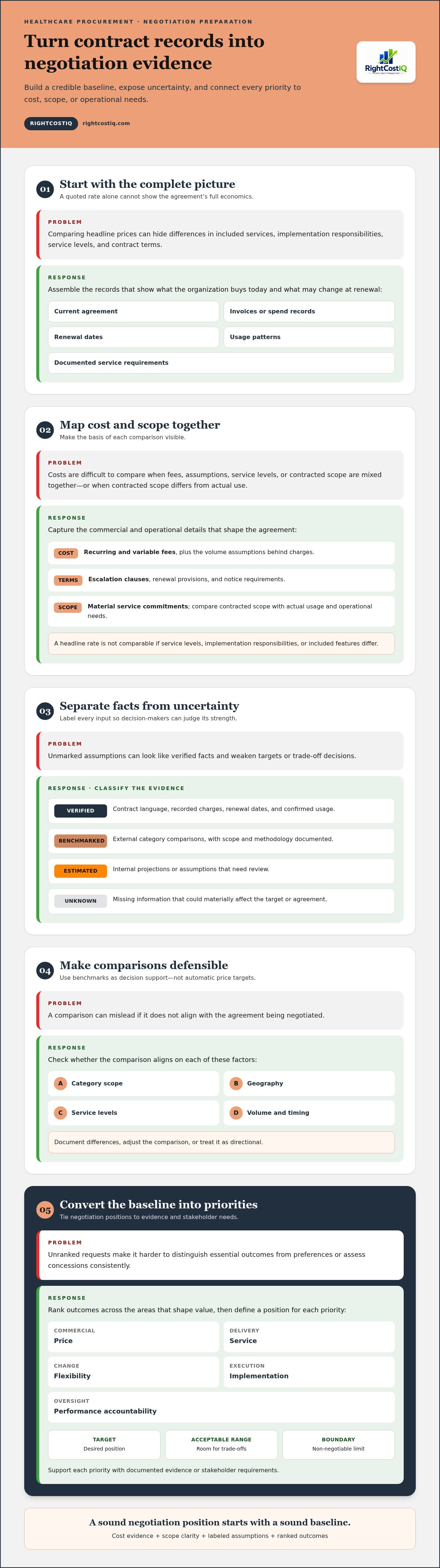
Negotiation targets are only as credible as the baseline behind them. Before setting a position, assemble the current agreement, invoices or spend records, renewal dates, usage patterns, and documented service requirements. This gives the team a clear view of what it buys today, how charges are calculated, and which terms may change at renewal. For healthcare vendor contract negotiation, this preparation turns fragmented records into evidence for specific requests and informed trade-offs.
Build a reliable commercial baseline before the negotiation
Map cost and scope together. Capture recurring and variable fees, volume assumptions, escalation clauses, renewal and notice provisions, and material service commitments. Then compare the contracted scope with actual usage and operational needs. A headline rate is not comparable if service levels, implementation responsibilities, or included features differ.
Label each input so decision-makers can distinguish evidence from uncertainty:
- Verified: Contract language, recorded charges, renewal dates, and confirmed usage.
- Benchmarked: External category comparisons, with scope and methodology documented.
- Estimated: Internal projections or assumptions that need review.
- Unknown: Missing information that could materially affect the target or agreement.
Use benchmarks as decision support, not automatic price targets. Check whether comparisons align on category scope, geography, service levels, volume, and timing. Document differences, then adjust the comparison or treat it as directional. Procurement cost benchmarking can help teams assess category cost evidence and develop a more defensible basis for negotiation.
Set priorities, targets, and acceptable trade-offs
Turn the baseline into ranked outcomes. Separate must-haves from preferences across price, service, flexibility, implementation, and performance accountability. For each priority, define a target position, an acceptable range, and a non-negotiable boundary. Tie each one to documented evidence or stakeholder requirements.
Model trade-offs without assuming a guaranteed saving. For example, assess whether a change in scope, timing, or flexibility could improve value while preserving required service levels. Record the financial and operational implications of each option, including implementation effort. This helps the negotiation team respond consistently instead of making concessions under pressure.
A clear evidence pack also exposes gaps before they become negotiating risks. Assign owners to validate uncertain usage, charges, or requirements, and flag unresolved assumptions in the negotiation brief. The result is a more disciplined position: supported by comparable data, grounded in the contract, and flexible where the evidence allows.
Negotiate healthcare vendor terms without sacrificing value or continuity
Complexity calls for disciplined negotiation, not automatic acceptance of existing terms. A price-only concession may look attractive but fail to account for service levels, implementation effort, or the cost of changing a process. In healthcare vendor contract negotiation, assess each proposal against its financial impact, operational requirements, and delivery dependencies before treating it as a win.
The available levers depend on the agreement, category, and organizational requirements. Teams may discuss pricing structure, volume assumptions, escalation language, renewal flexibility, and payment terms. They can also examine scope clarity, transition support, reporting, and service commitments. A useful comparison makes the trade-offs visible:
| Negotiation lever | Potential value | Key dependencies | Validation question |
|---|---|---|---|
| Pricing structure or volume assumptions | Align charges more closely with expected use | Reliable usage data and clear scope | Does the proposed structure reflect actual demand? |
| Escalation language | Improve predictability of future charges | Defined calculation method and timing | Can the basis and application of each increase be understood? |
| Renewal flexibility | Create more control over future decisions | Notice dates, decision gates, and transition options | Does the timeline allow a practical review before renewal? |
| Scope and service commitments | Clarify what delivery and support include | Operational requirements and accountable owners | Are expectations measurable and aligned with actual needs? |
| Transition support or payment terms | Reduce friction or improve commercial fit | Implementation capacity and internal approval | What effort, risk, or process change does this create? |
Compare concessions against operational impact
Evaluate a proposed concession as a package, not in isolation. A revised price may require a different volume commitment; expanded flexibility may depend on advance notice; a service change may require internal implementation work. For each option, record the financial effect, operational consequence, and effort required. This keeps negotiation anchored to evidence rather than headline figures.
Protect continuity while pursuing better terms
Before proposing material changes, map dependencies, transition constraints, stakeholders, and decision gates. Separate essential operating requirements from incumbent preferences or historical contract language. Assign risk owners, document contingency assumptions, and define approval paths so unresolved questions reach the right decision-makers. These steps support negotiation planning, but do not replace review by authorized contract or legal reviewers.
Continuity and compliance considerations should shape the negotiation, not end it. Clear requirements and documented trade-offs help teams pursue better terms while understanding what a change would take to implement. The strongest proposal is one the organization can support financially and operationally.
Run a disciplined negotiation from stakeholder alignment to final approval
A clear process connects negotiation decisions to organizational priorities and helps prevent agreed terms from being lost during contract review. In healthcare vendor contract negotiation, define who can recommend, decide, review, and approve before discussions begin. Procurement coordinates the process; finance assesses commercial implications; operational stakeholders define service and implementation needs; authorized contract reviewers assess language within the organization’s governance process.
Structure negotiation rounds around evidence and decisions
Give each negotiation round a defined objective, required participants, decision rights, and supporting evidence. Resolve material commercial and operational issues deliberately instead of allowing individual topics to drift between meetings. Maintain a decision log throughout, capturing offers, counteroffers, assumptions, approvals, open issues, and the person responsible for each follow-up. After each round, reconcile written commitments against the latest draft.
A practical sequence moves from mandate to execution:
- Align the mandate: Procurement confirms goals, boundaries, stakeholders, and approval authority.
- Confirm the position: Finance and operational teams validate priorities, assumptions, and requirements.
- Negotiate in planned rounds: The lead negotiator presents evidence, records responses, and escalates decisions beyond their authority.
- Reconcile the draft: Procurement checks that agreed commercial and operational commitments appear accurately in the contract language.
- Complete review and approval: Route the document through the organization’s applicable commercial, operational, and authorized contract review paths.
- Hand off for execution: Transfer obligations, owners, reporting expectations, and open actions to the teams managing the agreement.
Coordinate review, approval, and contract handoff
Keep review tied to the negotiated record. Reviewers need the latest draft and a clear account of the decisions it should reflect. Confirm that final language aligns with the agreed scope, pricing structure, responsibilities, service expectations, and measurement approach. If a revision changes a negotiated point, return it to the appropriate decision-maker instead of treating it as an administrative edit.
Approval is not the finish line. At handoff, identify who owns each obligation, who monitors reporting, where key dates are tracked, and how unresolved implementation actions will be managed. This gives operational teams a usable record of what was agreed and connects negotiation to ongoing vendor oversight.
For structured support with procurement priorities and negotiation preparation, start a free procurement diagnostic.
Turn negotiated healthcare contracts into measurable vendor performance
A signed agreement creates value only when its commitments are visible in day-to-day performance. Translate each material term into an accountable owner, a data source, a review cadence, and a defined response when results fall outside expectations. This connects healthcare vendor contract negotiation to ongoing oversight instead of leaving negotiated service and commercial terms in the contract file.
Create a contract-to-performance scorecard
Build the scorecard from obligations that matter to the agreement and the organization’s priorities. Choose measures that can be evidenced, not just broad impressions. For example, if the contract defines response times, compare reported response data with that commitment. If it specifies reporting deliverables, record whether they were submitted as agreed.
- Commitment: What does the contract require?
- Measure and source: What evidence shows whether the requirement was met?
- Owner and cadence: Who reviews the evidence, and how often?
- Threshold and escalation: What variance prompts investigation, and who resolves it?
Keep measured results distinct from stakeholder perceptions. A service team’s concern may signal a problem, but log it separately from verified performance data until it has been investigated. Document missing reports, disputed measures, and data-quality limitations; otherwise, a scorecard may imply more certainty than the evidence supports.
Use ongoing evidence to strengthen future negotiations
Review performance alongside spend patterns, scope changes, and documented service issues. Investigate variances while there is time to resolve them, then carry the findings into renewal planning. Market price trends and category analytics can inform timing and future negotiation positions, but assess their relevance to the contract’s scope and terms rather than treating them as automatic targets.
This creates a connected procurement cycle: benchmarking and analytics inform negotiation; negotiation establishes measurable commitments; vendor tracking shows whether those commitments deliver operational value. RightCostIQ supports these activities with cost benchmarking, negotiation assistance, vendor performance tracking, and market price trending. For broader sourcing context, the RFP management framework explains how structured sourcing can support disciplined procurement decisions.
Before renewal, bring together the scorecard, validated spend data, documented issues, and relevant market evidence. That record helps teams distinguish a vendor relationship that is meeting its commitments from one that needs corrective action or different terms. It also gives the next negotiation a stronger evidence base than memory or anecdotal feedback alone.
Make every vendor agreement work harder
Strong healthcare vendor contract negotiation balances commercial outcomes with the operational requirements that keep services running. Credible cost evidence helps teams set defensible targets, while clear priorities and decision rights keep concessions aligned with organizational needs. After signing, measurable commitments and ongoing vendor tracking show whether the agreement is delivering the value negotiated.
RightCostIQ connects these steps through RFP management and negotiation assistance, cost benchmarking and analytics, and vendor performance tracking. Together, these capabilities support evidence-led procurement decisions and ongoing oversight of contract commitments.
Build a clearer starting point for your next negotiation. Start your free procurement diagnostic and take the next step toward a more disciplined, accountable procurement strategy.
Frequently Asked Questions
What is healthcare vendor contract negotiation?
Healthcare vendor contract negotiation is the structured process of agreeing on commercial, operational, and performance terms with a supplier or service provider. Teams assess more than the quoted price: scope, renewal provisions, service expectations, implementation dependencies, and risk allocation all influence value. Priorities vary by category and agreement, so negotiation targets should reflect organizational requirements and established review processes rather than a generic checklist.
How do healthcare organizations prepare for vendor contract negotiations?
Start with the current agreement, spend records, scope, renewal dates, usage patterns, and performance evidence. Establish comparable cost data where available, then confirm priorities with finance and operational stakeholders. Separate verified facts from estimates, assumptions, and information gaps. Before discussions begin, document target outcomes, acceptable trade-offs, decision authority, and operational constraints. Use benchmarks carefully because unrelated comparisons or incomplete scope data can create misleading negotiation targets.
What should healthcare organizations negotiate besides price?
Review the full contract structure, including scope definitions, renewal and escalation language, service expectations, reporting, flexibility, implementation support, and assigned responsibilities. Relevant terms depend on the vendor category and agreement. Evaluate each proposed concession against its financial effect, operational dependencies, and measurability. A lower rate may not represent better value if delivery expectations become less clear. Authorized reviewers should assess final contract language and requirements before approval.
How can a healthcare organization negotiate better terms without disrupting operations?
Map service dependencies, essential requirements, transition constraints, and stakeholder responsibilities before proposing material changes. Separate non-negotiable operating needs from preferences, then sequence discussions so commercial changes keep pace with operational planning. Record risk owners, contingencies, and approval paths. For example, assess a proposed scope change alongside the teams, systems, or processes that depend on the current arrangement. Negotiation can improve value while keeping continuity risks visible and actively managed.
When should a healthcare organization renegotiate a vendor contract?
Begin reviewing the agreement well before a renewal or decision deadline. Allow time to analyze spend, performance, market evidence, stakeholder needs, and approval requirements. An early review can also surface scope changes or emerging cost risks that may affect the next negotiation. Timing depends on contract terms and internal governance. Verify the actual language rather than assuming a renewal date or notice period, and track relevant dates so the team can act deliberately.
How can healthcare teams measure whether a negotiated contract is delivering value?
Translate material commitments into defined measures, owners, data sources, reporting cadence, and escalation paths. Track actual performance against agreed requirements, review spend and scope changes, and investigate variances with relevant stakeholders. Combine financial measures with suitable operational indicators instead of relying on price alone. Keep measured results distinct from stakeholder feedback while documenting both. Use the findings to guide contract oversight, corrective action, and future negotiation priorities.
Can cost benchmarking improve healthcare vendor negotiations?
Yes. Cost benchmarking can give teams a reference point for evaluating category costs and proposed terms, strengthening preparation with evidence. Comparisons are most useful when scope, service levels, timing, geography, and relevant assumptions align. Document the basis and limitations of each comparison, and do not treat a benchmark as a guaranteed achievable price. Pair cost evidence with contract and performance review to develop negotiation positions that reflect commercial conditions and operational requirements.


