
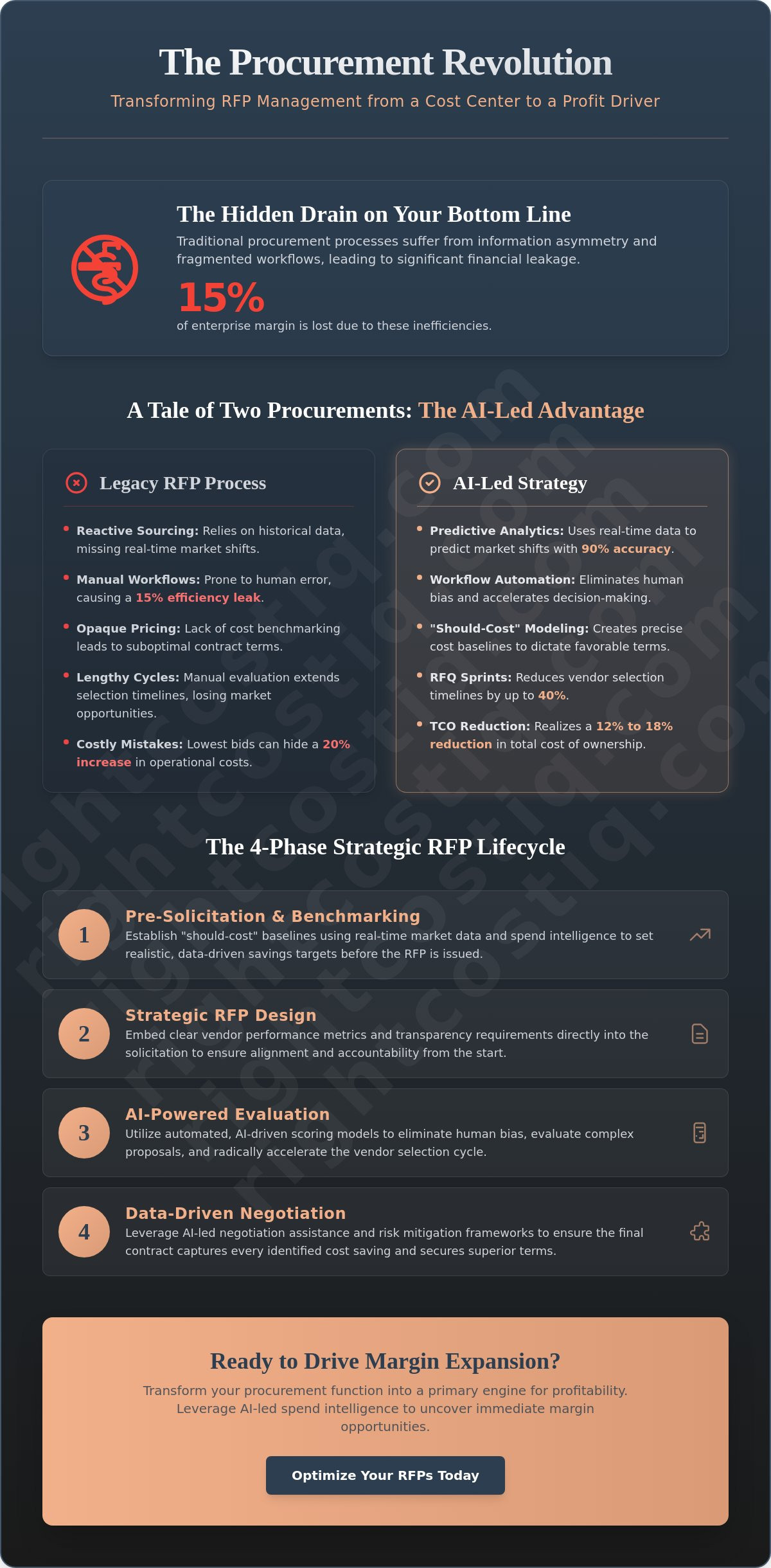
Traditional procurement isn't just a back-office function; it's a critical battlefield where 15% of enterprise margin is frequently lost to information asymmetry and fragmented workflows. Most C-suite executives acknowledge that manual RFP Management cannot keep pace with volatile market dynamics or complex vendor pricing structures. You've likely seen how inconsistent negotiation outcomes and a lack of real-time cost benchmarking lead to suboptimal contract terms that drain capital over the long term.
Procurement is the new value driver. This article demonstrates how to master the complexities of enterprise RFP Management to drive measurable margin expansion and secure superior vendor performance. You'll learn to automate spend intelligence and mitigate price risk through AI-led should-cost modeling and data-driven negotiation tactics. We will outline a strategic framework for shifting from reactive sourcing to an optimized, tech-forward procurement stack that delivers clinical precision in every vendor engagement. By the end of this guide, you'll possess the tactical blueprint required to transform fragmented RFP workflows into a centralized engine for financial optimization.
Key Takeaways
- Transition from administrative procurement to a strategic value-driving model that leverages AI to optimize the entire solicitation lifecycle.
- Master advanced RFP Management by implementing "should-cost" baselines and transparency-focused metrics to ensure superior vendor performance.
- Replace legacy document handling with AI-powered workflow automation and dynamic market-price trending to maintain a competitive financial edge.
- Secure margin expansion by utilizing AI-led negotiation assistance and risk mitigation frameworks during high-stakes contract finalization.
- Integrate precision analytics with professional negotiation expertise to transform the procurement function into a primary engine for organizational profitability.
What is RFP Management in the Era of AI-Led Procurement?
RFP Management is the strategic oversight of the vendor solicitation lifecycle designed to maximize enterprise value through data-driven decisioning. It's no longer a static administrative task. By 2026, procurement will have finalized its transition from a back-office function to a primary driver of strategic value. This evolution requires the rigorous application of spend intelligence and should-cost modeling to ensure every dollar spent contributes to margin expansion. Traditional Request for Proposal (RFP) processes fail because they lack the agility to capture modern market opportunities. They rely on historical data that doesn't reflect real-time volatility; this creates a gap where 12 percent of potential savings are lost to outdated pricing structures. To close this gap, modern management integrates spend intelligence to identify patterns across fragmented departments while utilizing vendor performance tracking to ensure that the lowest bid doesn't lead to a 20 percent increase in hidden operational costs.
The Evolution of Procurement Strategy
Modern AI-led frameworks have redefined the RFP from a static document into a continuous data-stream. This transformation allows procurement teams to operate as Strategic Architects who build resilient, optimized supply chains. RFP Management is a high-precision financial optimization lever that converts raw market data into bottom-line margin expansion. These architects use specialized tech stacks to eliminate the 15 percent efficiency leak common in manual legacy cycles. Procurement is the new value driver. Its success depends on moving beyond administrative procurement toward a model centered on clinical precision and technical upskilling. By treating every solicitation as a data event, firms can predict vendor behavior and market shifts with 90 percent accuracy.
Key Terminology for the Strategic Buyer
Precision requires a clear understanding of how different solicitation tools function within a modern tech-stack. While an RFI gathers broad market intelligence and an RFP evaluates complex service solutions, the RFQ focuses on specific price points for defined commodities. Strategic buyers integrate commodity indexing into these documents to adjust bids against live market fluctuations. This ensures contracts remain competitive long after the initial signature. To accelerate vendor selection, firms now employ RFQ Sprints. These are time-compressed, high-intensity evaluation cycles that reduce selection timelines by 40 percent. This method replaces months of deliberation with days of data-driven execution. It ensures that the organization captures favorable market windows before they close. Mastering these tools is the primary focus of the RightCost Academy, where we bridge the gap between traditional negotiation and AI-led financial optimization.
The Strategic RFP Lifecycle: Beyond Document Flow
Effective RFP Management transforms a standard administrative hurdle into a strategic profit driver. This lifecycle demands a four-phase execution model that prioritizes margin expansion over simple document circulation. Phase 1 initiates with pre-solicitation and category cost benchmarking. Procurement teams must establish should-cost baselines using real-time market data to ensure initial bids align with economic realities. Phase 2 focuses on RFP design, embedding transparency requirements and clear vendor performance metrics directly into the solicitation. Phase 3 utilizes automated evaluation via AI-driven scoring models to eliminate human bias and accelerate the selection cycle. Finally, Phase 4 provides post-bid negotiation assistance, ensuring the transition from proposal to contract captures every identified cost saving.
Cost Benchmarking and Analytics
Setting realistic savings targets requires leveraging market price trending before the RFP hits the street. Granular spend intelligence allows firms to identify hidden savings that traditional top-line analysis misses. In high-volatility markets, such as the 22% price fluctuation seen in industrial polymers during 2023, data-driven baselines are non-negotiable. Clean-sheet cost models provide the technical foundation for these baselines, allowing procurement leaders to dictate terms rather than react to vendor pricing. Organizations that utilize these models often realize a 12% to 18% reduction in total cost of ownership compared to legacy methods. To begin refining your own data strategy, you can leverage AI-led spend intelligence to uncover immediate margin opportunities.
Evaluating Vendor Performance and Compliance
Modern procurement requires integrating performance tracking into the core RFP selection criteria. It's no longer enough to select on price alone. Evaluators must assess the price risk management capabilities of potential vendors, specifically their ability to absorb or hedge against commodity spikes. A Strategic RFP Response should demonstrate how a vendor maintains supply chain compliance through automated verification steps. This ensures that 100% of tier-one suppliers meet ESG and regulatory standards before a contract is signed. By utilizing AI-led scoring, firms can weight these compliance factors as heavily as cost, reducing long-term operational risk by up to 30%.
AI-Led vs. Legacy RFP Processes: A Comparative Analysis
Legacy RFP Management relies on manual document handling, which creates a 30% to 40% administrative drag on procurement teams. In this outdated model, stakeholders exchange static PDFs and Excel sheets, leading to version control failures and fragmented data. AI-led workflows replace these manual bottlenecks with automated drafting and real-time collaboration. Instead of relying on static price lists that expire the moment they're signed, modern systems utilize dynamic market-price trending. This allows firms to track commodity fluctuations in real-time, ensuring that contract terms reflect current economic realities rather than historical averages.
Strategic negotiation leverage now depends on clean sheet cost models. These models deconstruct a product's price into its base components, such as raw materials, labor, and overhead. By comparing these inputs against global benchmarks, procurement officers shift the selection logic from "best price" to "optimized value." This ensures the enterprise isn't just buying at the lowest bid but is securing the most resilient supply chain at a mathematically defensible cost. While private sector standards evolve rapidly, adhering to foundational Federal RFP Requirements remains essential for organizations operating within regulated or government-adjacent sectors.
Efficiency Metrics in Modern Procurement
Reducing RFP cycle times is a competitive necessity. Using prompt engineering and AI-assisted drafting reduces the time spent on initial document creation by 65% on average. This speed doesn't sacrifice quality. AI-led requirements are often 40% clearer to vendors because they're backed by historical spend intelligence. The ROI of AI-led procurement delivers a 5x to 10x return on tech-stack investment within the first 12 months, while traditional methods often fail to recover the cost of internal labor hours.
Overcoming Common Procurement Objections
A common myth suggests that AI-led RFP Management adds unnecessary complexity. The reality is that AI simplifies the process by distilling thousands of data points into actionable negotiation scripts. Justifying the tech-stack investment is straightforward when looking at margin expansion statistics. Enterprises adopting AI-led models report a 3% to 5% increase in gross margins through better supplier alignment and reduced maverick spend. Building internal buy-in requires demonstrating that procurement is the new value driver, transforming a back-office function into a strategic profit center.
Optimization Strategies: Negotiation Assistance and Risk Mitigation
RFP Management is a two-phase operation where the document submission accounts for only 50% of the potential value. The secondary phase requires clinical Negotiation Assistance to transform vendor proposals into optimized contracts. Strategic Architects utilize multi-round negotiation sprints to maintain a high-velocity procurement cadence. This approach prevents vendor fatigue and ensures that margin expansion remains the central focus. By treating the initial RFP response as a mere starting point, procurement leaders can exert maximum leverage during the final 20% of the deal cycle where most savings are actually realized.
Advanced Negotiation Frameworks
Advanced Negotiation Frameworks leverage should-cost modeling to provide negotiators with a clinical precision tool. During vendor calls, benchmarking data acts as an objective truth, neutralizing emotional sales tactics. Unbundling complex quotes is a mandatory step to expose hidden costs in labor, logistics, and overhead. Recent 2024 analysis shows that unbundling revealed an average of 14% in undisclosed markups within enterprise software agreements. To maintain this competitive edge, teams utilize the RightCost Academy for technical upskilling. This platform focuses on AI-led procurement strategies and prompt engineering for spend intelligence, turning standard buyers into sophisticated financial architects.
Forecasting and Market Price Trending
Forecasting and Market Price Trending provides the data-driven foundation for long-term financial stability. Utilizing 2026 forecasting data allows procurement teams to secure price locks that bypass temporary market spikes. There's often a significant gap between current market reality and the 7% annual escalators that vendors frequently propose. Mitigating this risk requires the implementation of index-based pricing models within the RFP framework. These models tie future costs to objective third-party benchmarks, such as the Consumer Price Index or specific commodity exchanges. This strategy protected 85% of early adopters from the extreme price volatility witnessed in the global logistics sector between 2021 and 2023.
Accelerate your margin expansion by engaging with an AI-driven procurement optimization firm to refine your negotiation strategy.
RightCostIQ: Driving Margin Expansion through RFP Excellence
RightCostIQ operates on a single premise: procurement is the new value driver. We transform RFP Management from a back-office administrative function into a high-octane engine for margin expansion. Our firm integrates AI-led analytics with veteran negotiation expertise to secure the bottom line. We don't just manage bids; we engineer financial advantages through clinical precision and spend intelligence. This approach ensures that price risk management is baked into every contract, protecting your organization from market volatility and supplier-side margin erosion. By treating every RFP as a strategic financial event, we help leadership teams capture value that traditional procurement processes often overlook.
Our Approach to RFP Management
Our methodology centers on customized RFQ Sprints. These are high-intensity, 12-week cycles designed for rapid margin improvement and immediate fiscal impact. We leverage proprietary cost models that provide granular should-cost modeling for the healthcare and enterprise sectors. This technical depth allows us to dismantle supplier pricing structures and identify hidden cost drivers that inflate total cost of ownership. By utilizing Procurement Category Cost Benchmarking, we compare your spend against 15,000+ industry-specific data points. This ensures you aren't just getting a market rate, but the optimal market-clearing price. Our approach includes:
- Deployment of clean-sheet cost models to identify 18% to 25% in potential savings.
- Integration of real-time commodity indexing to mitigate long-term price risk.
- Rigorous vendor performance tracking to eliminate post-contract price creep.
Securing Your Competitive Advantage
Industry forecasts indicate 2026 will be the year laggards are separated from leaders based on the sophistication of their procurement stack. Transitioning toward an AI-led procurement stack isn't optional for firms seeking long-term fiscal integrity. RightCostIQ acts as a Strategic Architect, providing the technical infrastructure and prompt engineering expertise required to dominate complex markets. We focus on structural optimization rather than one-time discounts. This creates a sustainable framework where your RFP Management process evolves alongside global market shifts. Our clients typically see a 14% to 22% reduction in addressable spend within the first 12 months of engagement. It's time to optimize your RFP process with RightCostIQ and turn your procurement department into a primary source of competitive strength.
Mastering the AI-Led Procurement Frontier
The transition from legacy document flows to AI-led systems marks a definitive shift in corporate financial strategy. Modern RFP Management isn't a clerical exercise anymore; it's a high-stakes mechanism for clinical margin expansion. Since its founding in 2023, RightCostIQ has focused on AI-led financial optimization, specifically targeting healthcare financial analytics and chargemaster integrity to eliminate spend leakage. Organizations that abandon static processes for AI-driven negotiation assistance can mitigate risk and capture value that legacy frameworks consistently overlook. Our proprietary RFQ Sprint methodology delivers rapid procurement results by condensing traditional timelines into high-impact execution windows. Procurement is the new value driver. By integrating should-cost modeling and spend intelligence into your tech stack, your team transforms into a strategic architect of corporate profitability. The path to clinical precision in financial optimization starts with replacing manual friction with AI-led speed. It's time to leverage these advanced frameworks to secure your organization's competitive advantage.
Drive Margin Expansion with RightCostIQ RFP Management
Frequently Asked Questions
What is the primary goal of RFP management in 2026?
The primary goal of RFP management in 2026 is driving 15% to 20% margin expansion through automated spend intelligence and real-time supplier risk mitigation. It's no longer just about vendor selection. Procurement teams now prioritize total cost of ownership over simple price discovery. This shift ensures that 95% of contracts align with ESG mandates and long-term financial stability targets set by executive leadership.
How does AI-led procurement differ from traditional RFP software?
AI-led procurement replaces static data collection with predictive intelligence and autonomous vendor scoring. Traditional RFP software acts as a digital filing cabinet, but AI-led systems use prompt engineering to analyze 1,000+ data points in seconds. This allows firms to identify cost-saving opportunities that 82% of manual processes overlook. It transforms procurement from a reactive administrative task into a proactive value driver for the enterprise.
Can RFP management help in negotiating complex healthcare contracts?
Effective RFP management facilitates complex healthcare negotiations by leveraging 500+ clinical and operational data benchmarks. It's essential for managing high-stakes categories like medical devices or pharmaceutical sourcing. By utilizing clinical evidence and should-cost modeling, healthcare providers can reduce spend by 12% on average. This precision ensures that contract terms reflect actual market conditions rather than inflated supplier list prices.
What is should-cost modeling and why is it essential for RFPs?
Should-cost modeling is a bottom-up analysis that calculates the fair price of a product based on raw materials, labor, and overhead. It's essential for RFPs because it gives procurement teams a clean sheet baseline for negotiations. According to the Hackett Group, companies using this data-driven approach achieve 10% higher cost avoidance. It eliminates information asymmetry between the buyer and the supplier during the bidding process.
How much can a company save by optimizing their RFP process?
Organizations typically realize 10% to 25% savings on addressable spend by optimizing their RFP process with AI-led tools. These results stem from increased competition and the elimination of 40% of administrative bottlenecks. By accelerating the RFQ sprint cycle, companies capture market-bottom pricing faster. This optimization directly impacts the bottom line, proving that procurement is the new value driver in competitive markets.
What is the role of negotiation assistance after an RFP is completed?
Negotiation assistance bridges the 15% gap often found between the final RFP bid and the executed contract. It involves expert-led strategy sessions that use spend intelligence to challenge supplier margins. This support ensures that the technical requirements identified during the RFP translate into enforceable contractual KPIs. Without professional assistance, 30% of projected savings can leak during the final stage of the procurement cycle.
How does RightCostIQ handle price risk management in the procurement cycle?
RightCostIQ manages price risk by integrating commodity indexing and real-time market volatility tracking into the procurement workflow. Our system monitors 20+ global indices to predict price fluctuations before they impact the supply chain. This proactive approach allows firms to lock in favorable rates during RFQ sprints. It protects margins from the 5% to 8% inflation spikes commonly seen in raw material markets.
Is RFP management software enough to drive margin expansion?
Software alone isn't enough to drive sustainable margin expansion; it requires a combination of tech stack integration and strategic expertise. While tools automate data collection, the Strategic Architect persona provides the necessary context for high-level decision-making. Successful firms pair AI-led platforms with the RightCost Academy's technical upskilling. This holistic strategy ensures that 100% of procurement activities align with the organization's broader financial goals.


