

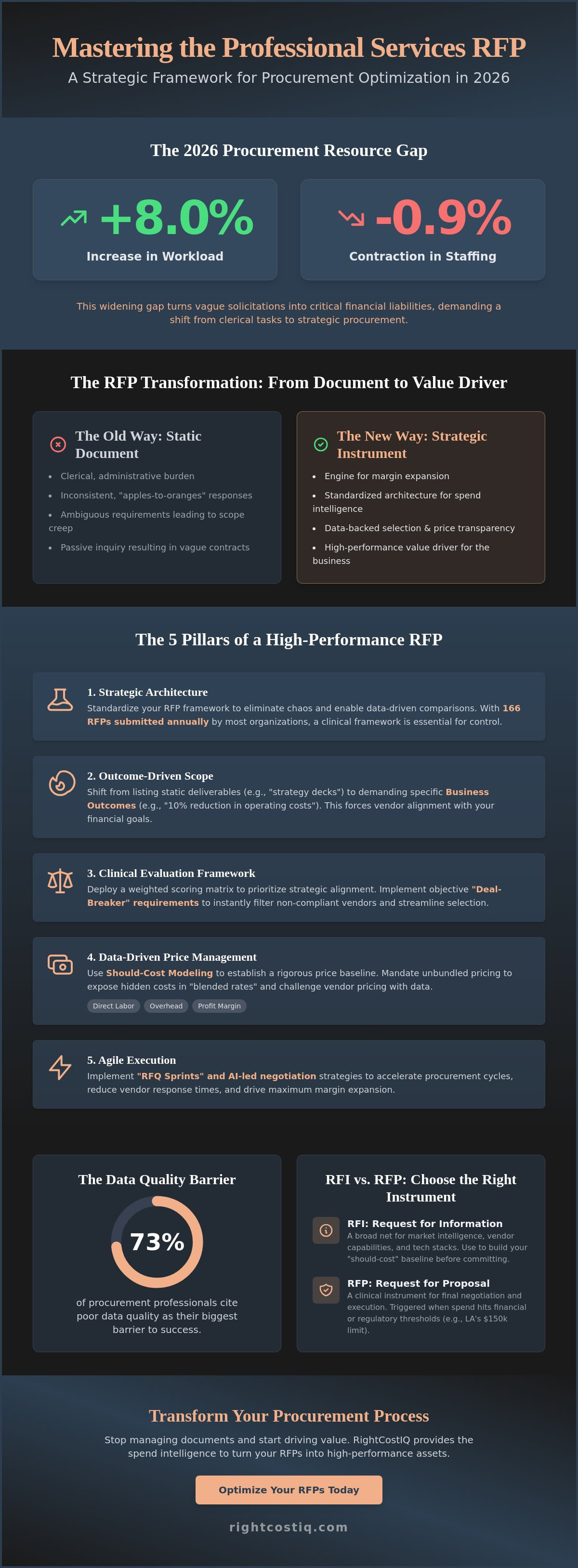
In 2026, procurement teams face a 8.0% increase in workload while staffing levels have contracted by 0.9%. This resource gap turns vague solicitations into financial liabilities. Mastering how to write an RFP for professional services is no longer a clerical task; it is a clinical mandate for margin expansion and price risk mitigation. A professional services RFP is not just a document. It is a strategic instrument for procurement optimization and spend intelligence.
You've likely struggled with inconsistent vendor responses that are impossible to compare or scope creep resulting from ambiguous requirements. This article provides a precision framework to eliminate selection chaos and drive bottom line results. We will examine how to implement the April 30, 2026, federal default for fixed-price contracts and use should-cost modeling to ensure total price transparency. You will learn to integrate clear KPIs for post-award tracking, ensuring that every professional service agreement functions as a high-performance value driver rather than a drain on corporate resources.
Key Takeaways
- Transform the RFP from a static document into a strategic instrument for spend intelligence and standardized vendor architecture.
- Discover how to write an RFP for professional services that utilizes should-cost modeling to establish rigorous baseline expectations for service delivery.
- Deploy a clinical weighted scoring matrix to prioritize strategic alignment and filter non-compliant vendors through objective "Deal-Breaker" requirements.
- Embed market price trending and commodity indexing into your solicitations to forecast cost variances and challenge vendor pricing with data-backed analytics.
- Implement "RFQ Sprints" and AI-led negotiation strategies to accelerate procurement cycles while driving maximum margin expansion.
The Strategic Architecture of a Professional Services RFP
The current procurement environment is unforgiving. With budgets contracting by 0.4% and workloads rising by 8.0% in 2026, you can't afford the chaos of non-comparable vendor responses. Standardizing your Request for Proposal (RFP) architecture is the only way to eliminate scope creep and hidden costs. Most organizations submit 166 RFPs annually; however, without a clinical framework, these documents often result in "apples-to-oranges" comparisons that paralyze decision-making. Learning how to write an RFP for professional services requires shifting from a passive inquiry to a data-backed selection process that prioritizes spend intelligence.
Procurement as the New Value Driver
Modern procurement has evolved beyond simple cost containment. It's now a primary engine for financial health. Procurement is the new value driver. By applying clinical precision to professional services, firms can capture "spend under management" that previously leaked through vague contracts and unmonitored renewals. This shift requires treating every solicitation as a strategic asset rather than an administrative burden. RFP optimization functions as a high-velocity catalyst for margin expansion by forcing price transparency and performance accountability. When you define the architecture of the response, you regain control over the negotiation table.
RFI vs. RFP: When to Use Clinical Precision
Precision starts with choosing the right instrument. A Request for Information (RFI) serves as your market-intelligence gathering phase. It's a broad net designed to understand vendor capabilities, tech stacks, and general market positioning. It's not a commitment. Contrast this with the RFP, which is built for final negotiation and execution. Trigger points for a full RFP cycle are often financial or regulatory. For instance, in Louisiana, Act 5 of 2025 raised the competition threshold for consulting services to $150,000. Once spend hits these benchmarks, the RFI's generalities must give way to the RFP's clinical requirements. Use the RFI to build your "should-cost" baseline; then use the RFP to secure it.
A clinical selection process demands objectivity. In 2026, 73% of procurement professionals cite poor data quality as their biggest barrier to success. By establishing a standardized response architecture early, you eliminate the "vendor fluff" that obscures actual costs. This structured approach ensures that every proposal you receive is formatted for immediate, data-driven comparison, allowing you to identify the most efficient partner for margin expansion.
Engineering the Scope: Business Outcomes vs. Static Deliverables
Static deliverables like "quarterly business reviews" or "strategy decks" are procurement liabilities. They don't guarantee ROI. To master how to write an RFP for professional services, you must adopt a Service-Outcome framework. This methodology forces vendors to align their technical execution with your financial objectives. Instead of asking for a list of activities, you demand specific business transformations. This shift eliminates the ambiguity that leads to scope creep. You can write an effective RFP by centering the document on these high-level strategic requirements. By defining the "what" rather than the "how," you allow vendors to innovate while holding them strictly accountable to the bottom line.
The Clean Sheet Cost Model Approach
Transparency is non-negotiable. We utilize should-cost modeling to establish baseline expectations for service delivery before a single bid arrives. A clean sheet model breaks down professional service pricing into its atomic parts: direct labor hours, overhead allocations, and net profit margins. When you mandate that vendors unbundle their pricing structures, you expose the hidden costs often buried in "blended rates." This level of granularity allows for objective benchmarking against industry standards. It's the difference between accepting a quote and engineering a price. Developing a clinical understanding of how to write an RFP for professional services ensures your cost models are based on market reality rather than vendor assumptions.
Defining Measurable Success Metrics
Vague goals produce vague results. Every RFP must include quantitative performance indicators that link directly to your margin expansion targets. If a vendor can't commit to a specific cost-savings threshold or a measurable improvement in efficiency, they're a risk. Establish these baseline metrics early to facilitate future vendor performance tracking. Linking these requirements to the initial scope ensures that accountability is baked into the contract from day one. You also need to define the consequences of failure. Financial penalties or contract termination clauses for missing KPIs aren't aggressive; they're clinical. They ensure the vendor remains focused on the outcomes you've paid for. This structure turns the RFP into a living performance agreement that protects your margins long after the contract is signed.
Constructing a Clinical Evaluation Framework & Weighted Scoring
Selection is the most vulnerable phase of the procurement cycle. Without a clinical framework, subjectivity leads to margin erosion and vendor selection chaos. Standardizing response templates is the only way to force vendors into the Service-Outcome structure established during the scope engineering phase. This approach ensures that every proposal is a direct mirror of your strategic requirements. Mastering how to write an RFP for professional services requires moving beyond "gut feelings" toward a data-driven matrix that prioritizes price risk and strategic alignment. We establish "Deal-Breaker" requirements early to filter non-compliant vendors. For example, any vendor failing to adhere to the April 30, 2026 federal mandate for fixed-price contracts or the FAR 52.222-90 clause issued on April 17, 2026, is disqualified before the scoring begins.
Developing Weighted Scoring Criteria
A precision scoring matrix balances technical competence with financial efficiency. We recommend a standardized breakdown: Technical Approach (35%), Cost/Value (30%), Experience (25%), and Risk (10%). These weights aren't static; they must be adjusted based on the criticality of the professional service. For high-stakes consulting, you might increase the weight of the Technical Approach to 45%. Normalizing disparate cost proposals is essential here. You must convert "blended rates" and "estimated expenses" into a single total-cost-of-ownership (TCO) figure for objective comparison. This normalization process prevents vendors from hiding margin through vague overhead allocations. Incorporating vendor performance history and compliance tracking into the score ensures that past failures aren't rewarded with new contracts.
The RFP Evaluation Committee
Objectivity is the primary goal of the evaluation committee. You need a cross-functional team of high-level decision-makers, including technical evaluators, financial analysts, and procurement leads. Each member brings a specific lens to the selection process. To ensure clinical objectivity, we implement a blind scoring system where evaluators review technical responses without seeing the cost proposals. This prevents "price anchoring," where a low bid might subconsciously bias the technical evaluation. By separating the "how" from the "how much," you ensure the vendor is selected based on their ability to deliver outcomes. This methodical approach to how to write an RFP for professional services transforms procurement from a cost center into a high-performance value driver. Once the scores are tallied, the committee can move into the final negotiation phase with a clear, data-backed mandate.
Integrating Price Risk Management and Market Trending
Static pricing models in professional services are financial liabilities. In an era where procurement budgets are contracting by 0.4% annually, you can't afford to ignore market volatility. You must embed market price trending directly into your solicitation to forecast future cost variances effectively. This proactive approach is a core component of how to write an RFP for professional services that protects corporate margins. Don't just accept a vendor's quote. Challenge it using spend intelligence and data-backed analytics. By forcing vendors to disclose their own risk mitigation strategies within their response, you shift the burden of economic uncertainty back to the service provider.
Commodity Indexing in Service Contracts
Professional service rates shouldn't remain frozen while the economy shifts. Link your service rates to relevant economic indices to prevent inflation-driven price creep. This ensures that your initial "should-cost" model remains accurate throughout the entire contract lifecycle. You can mitigate these risks by including specific RFP clauses that trigger rate adjustments based on verified index fluctuations. Price risk management serves as the strategic anchor for maintaining margin expansion in long-term agreements. It's about building a contract that breathes with the market rather than one that suffocates your budget.
Leveraging Market Price Trends
Market intelligence is your primary lever in the final negotiation phase. Use clinical spend analytics to benchmark vendor quotes against current market averages. If a vendor's proposed rate is 12% above the industry mean, your RFP framework must force a data-backed justification. We identify "price risk" as a standard evaluation category for all high-value solicitations. Integrating forecasting models into the sourcing lifecycle allows you to anticipate cost variances before they impact the P&L. To secure these strategic advantages, leverage our market price trending and forecasting service to build a rigorous baseline for every bid.
Execution requires precision. Digital transformation has reached 80% of procurement teams, yet many still fail to integrate market data into their RFPs. High-level decision-makers must treat market intelligence as a non-negotiable requirement. When you master how to write an RFP for professional services with this level of clinical detail, you eliminate the guesswork that leads to budget overruns. Every data point becomes a weapon for negotiation. Every trend becomes a tool for optimization. This is how procurement functions as a value driver. To see how elite law firms utilize specialized intelligence platforms to maintain this same level of precision, you can visit LexQuest AI.
Executing the RFP Sprint: Optimization and Final Negotiation
Speed serves as a competitive advantage when paired with clinical precision. Traditional procurement cycles often languish for months, resulting in missed market opportunities and stale pricing. To truly master how to write an RFP for professional services, you must implement the RFQ Sprint. This methodology compresses the timeline while utilizing high-level spend intelligence to ensure no detail is overlooked. By the final shortlist phase, your focus shifts toward AI-led margin expansion strategies that force vendors to defend every dollar of their proposed fee structure.
The RFQ Sprint Methodology
A standard RFQ Sprint operates on an accelerated 4 to 6 week timeline. This pace is achievable through the use of prompt engineering to refine requirement definitions and automate the drafting of standardized response architectures. We maintain clinical precision by focusing on the Service-Outcome framework established in earlier stages. Urgency doesn't excuse ambiguity. Instead, it demands a "Strategic Architect" approach where every stakeholder role is clearly defined and every evaluation milestone is strictly enforced. This high-velocity model allows procurement teams to handle the 8.0% workload increase projected for 2026 without sacrificing the quality of vendor selection.
Final Negotiation Assistance
The final negotiation is where spend intelligence transforms into actualized savings. Use the should-cost modeling data developed during the scoping phase to close the gap between vendor bids and market reality. Many professional service proposals contain hidden margins buried in "management fees" or "contingency buffers." By unbundling these costs, you gain the leverage needed to optimize the contract for maximum margin expansion. If a vendor's labor rates deviate from the benchmarks identified in your market price trending analysis, demand a clinical justification. You can optimize your next RFP with RightCostIQ’s Negotiation Assistance to ensure your final agreements are data-backed and performance-aligned.
Post-award execution is the final frontier of the RFP process. The winning response shouldn't sit in a drawer; it must transition into a formal Vendor Performance Tracking system. By linking the measurable KPIs defined in your original scope directly to a tracking service, you ensure ongoing vendor accountability. Procurement is the new value driver. When you treat the RFP as a living performance agreement, you secure the bottom-line results promised during the negotiation phase. This holistic approach ensures that every professional services engagement remains a high-performance asset for the organization.
Optimizing Procurement for Strategic Value
Mastering how to write an RFP for professional services is the only way to bridge the gap between an 8.0% increase in workload and shrinking corporate budgets. You've learned to replace vague deliverables with a clinical Service-Outcome framework and utilize should-cost modeling to expose hidden vendor margins. These methodical steps ensure every selection is data-backed and every contract is engineered for margin expansion. By implementing RFQ Sprints and weighted scoring, you eliminate the chaos of non-comparable proposals. Procurement is the new value driver. It's time to treat every solicitation as a strategic asset that protects the bottom line.
Execution requires the right tech stack and expertise. RightCostIQ provides the high-level tools needed for complex vendor negotiations. Our platform delivers AI-Driven Margin Expansion and Proprietary Should-Cost Modeling to ensure you never overpay for expertise. We also provide Specialized Healthcare Financial Analytics for organizations navigating high-stakes professional service agreements. Maximize your procurement ROI with RightCostIQ RFP Management. Start building your precision framework today and turn procurement into your most powerful strategic lever.
Frequently Asked Questions
How long should an RFP for professional services be?
An RFP must be as concise as possible while maintaining structural density. Most complex professional service solicitations range from 20 to 35 pages to ensure a clinical definition of the Service-Outcome framework. Efficiency is the priority. Avoid administrative bloat that obscures the core requirements. Focus on structured response templates that force vendors to provide granular, comparable data for your evaluation committee.
What is the difference between a deliverable and a business outcome in an RFP?
Deliverables are tactical outputs like a strategy deck or a quarterly report. Business outcomes are the actualized financial or operational results, such as a 12% reduction in operating costs or specific margin expansion targets. Shifting your focus to outcomes ensures that procurement functions as a value driver rather than a cost center. It holds vendors strictly accountable for the bottom-line impact they promised during the negotiation.
Can I use an RFP for small, tactical professional service projects?
Use an RFQ Sprint for tactical projects that exceed your organization's competitive threshold. For example, Act 5 of 2025 in Louisiana mandates competition for consulting contracts over $150,000. These accelerated cycles maintain clinical precision while ensuring you don't sacrifice months of time for a lower-complexity engagement. It's about optimizing the sourcing lifecycle for speed without losing spend intelligence.
How do I handle price risk in a multi-year service contract?
Mitigate price risk by embedding commodity indexing and market price trending clauses into the formal agreement. These mechanisms allow for rate adjustments based on objective economic data rather than vendor assumptions. It's a critical component of how to write an RFP for professional services that protects long-term margins. This proactive approach prevents inflation-driven price creep from eroding your project's ROI over a three-year or five-year term.
What are the most common mistakes in professional services RFPs?
The most frequent failure is utilizing vague requirement definitions that lead to inevitable scope creep. Another common error is accepting "blended rates" without requiring vendors to unbundle their pricing structures into labor, overhead, and margin. Without a clinical evaluation framework, you invite selection chaos. These mistakes result in hidden costs and a lack of price transparency that directly damages the P&L.
How can AI-led procurement tools speed up the RFP creation process?
AI-led procurement tools utilize prompt engineering to refine complex requirements and automate standardized response architectures. While the average time to draft a traditional RFP response is 25 hours, Agentic AI can execute these entire workflows in a fraction of that time. This technology allows procurement teams to handle the 8.0% increase in workload projected for 2026 even as staffing levels contract by 0.9%.
Is weighted scoring necessary for every professional services RFP?
Weighted scoring is mandatory for any high-stakes vendor selection because it provides the data-driven objectivity needed to compare intangible services. By assigning specific weights to technical approach, cost, and risk, you ensure strategic alignment with corporate goals. This methodical approach is central to how to write an RFP for professional services that eliminates the bias and "gut feelings" inherent in subjective evaluations.
What is should-cost modeling in the context of professional services?
Should-cost modeling is a bottom-up analytical method that calculates the direct labor, overhead, and margin of a specific service. It establishes a clinical baseline for negotiation before you receive a single vendor bid. By understanding the "clean sheet" cost of the expertise you're buying, you gain the spend intelligence required to challenge inflated quotes and drive maximum margin expansion during the final award phase.


