

The hidden 20% of your unmanaged spend isn't a volume problem to be ignored; it's a margin expansion opportunity requiring clinical tail spend management. While traditional procurement strategies focus on the top tier of suppliers, the reality is that maverick spend across thousands of low-value transactions erodes your bottom line by up to 15% annually. You likely agree that high transaction volumes currently overwhelm your procurement team, leaving indirect categories largely invisible and unoptimized. This lack of control isn't just an administrative burden; it's a direct leak in your financial performance.
Executing a precision-led strategy allows you to reclaim this lost value and drive immediate, quantifiable ROI. This article delivers a strategic roadmap for deploying AI-led visibility and RFQ sprints to eliminate maverick buying and consolidate fragmented vendor bases. We'll outline the exact steps to transition from reactive purchasing to a sophisticated, automated framework that treats every indirect dollar as a critical lever for financial optimization. Procurement is the new value driver, and it's time to leverage it for competitive advantage.
Key Takeaways
- Identify the high-stakes impact of the Pareto Principle on corporate EBITDA by capturing the 20% of spend currently bypassing procurement controls.
- Execute a 5-step precision audit to consolidate fragmented data from ERPs and P-cards into a unified spend intelligence framework.
- Deploy a strategic tail spend management architecture that leverages AI-led automation to outperform manual, resource-intensive procurement workflows.
- Implement high-intensity RFQ Sprints to secure competitive quotes within 48 hours, driving immediate margin expansion across indirect categories.
- Build long-term organizational resilience by integrating continuous vendor performance tracking and market price forecasting into your core tech stack.
The Clinical Reality of Tail Spend: Why the Hidden 20% Matters
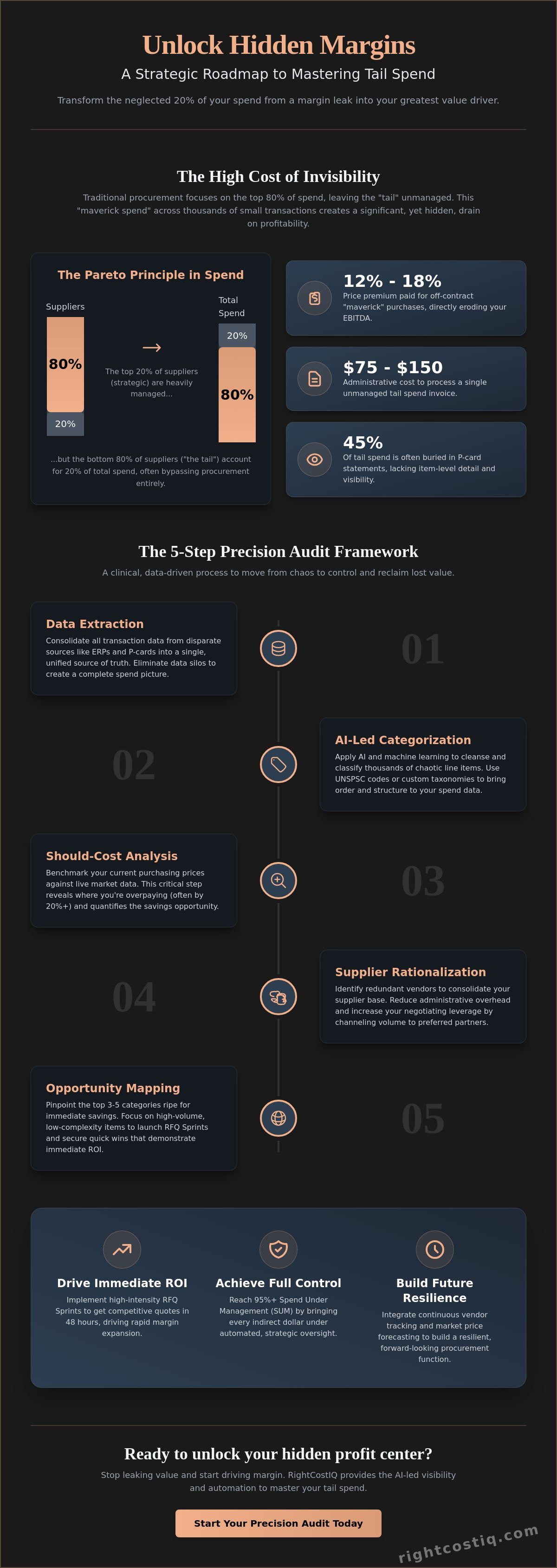
The Pareto Principle dictates that 80% of an organization's suppliers typically account for only 20% of its total spend volume. This fragmented segment, known as tail spend, is characterized by high-frequency, low-value transactions that often bypass formal oversight. While procurement teams prioritize the "critical few" high-value contracts, this unmanaged tail becomes a breeding ground for inefficiency. Organizations that fail to implement a disciplined tail spend management framework effectively concede a significant portion of their potential EBITDA to market volatility and internal non-compliance.
Traditional sourcing methodologies are ill-equipped for this volume. A standard procurement process involves lengthy RFP cycles and deep vendor vetting that, while necessary for million-dollar contracts, are economically unviable for a $500 purchase. When the cost of the sourcing process exceeds the value of the potential savings, procurement teams naturally retreat. This creates a visibility gap that erodes margins and complicates financial forecasting across the entire enterprise.
Looking toward 2026, "Spend Under Management" (SUM) is emerging as the definitive KPI for high-performing finance departments. Achieving 95% or higher SUM requires a clinical approach to the tail. It's no longer acceptable to leave 20% of spend to chance. Sophisticated leaders are now deploying spend intelligence tools to bring every indirect dollar under automated control, ensuring that tail spend management is treated with the same rigor as strategic sourcing.
The Economic Cost of Maverick Spend
Maverick spend acts as an invisible tax on corporate profitability. When decentralized buyers purchase off-contract, they trigger a 12% to 18% price premium compared to negotiated rates. Beyond the price delta, the administrative burden is staggering. Industry data indicates that processing a single tail invoice costs between $75 and $150 in labor and system overhead. For a mid-sized enterprise processing 10,000 unmanaged transactions, this translates to over $1 million in wasted operational expenditure. This friction doesn't just cost money; it distracts the procurement team from high-value strategic initiatives.
Tail Spend as a Strategic Value Driver
Shifting the perception of the tail from an administrative nuisance to a strategic margin opportunity is essential for modern financial optimization. By applying clinical precision to these unclassified transactions, firms gain the spend intelligence required for accurate C-suite reporting and risk mitigation. Controlling the tail provides a clean data set that reveals hidden patterns in vendor performance and price fluctuations. Tail spend is the strategic frontier for margin expansion in 2026 where clinical execution meets automated spend intelligence.
Executing a Precision Tail Spend Audit: A 5-Step How-To
Effective tail spend management begins with a clinical diagnostic of your current unmanaged expenditure. You can't optimize what you can't see. This audit phase isn't a simple cleanup task; it's a strategic extraction of value from fragmented data silos that typically hide significant margin leaks. A Q3 2024 analysis of enterprise procurement data indicates that 45% of tail spend is often buried in P-card statements lacking item-level detail, making precise data extraction the primary hurdle for margin expansion.
- Data Extraction: Consolidate every transaction from your ERPs and P-cards. This requires pulling raw data from disparate systems to create a single source of truth.
- Categorization: Apply clinical precision to group "unclassified" transactions. Use UNSPSC codes or custom internal taxonomies to bring order to the chaos of thousands of line items.
- Should-Cost Analysis: This is the critical differentiator. Compare your current tail prices against live market trending data. Most firms accept "market price" without verification, but a should-cost model reveals where you're overpaying by 20% or more.
- Supplier Rationalization: Identify redundant vendors. If you're managing 50 suppliers for office consumables, you're losing leverage and increasing administrative overhead.
- Opportunity Mapping: Highlight the top 3 categories for immediate RFQ sprints. Focus on high-volume, low-complexity items to capture immediate ROI and prove the framework's efficacy.
Data Normalization and Spend Intelligence
Cleansing "dirty" vendor data is the first barrier to clinical execution. Duplicate entries and mislabeled line items distort your spend intelligence and lead to flawed decision-making. By applying commodity indexing, you can identify price variances that occur when different departments buy the same item at different rates. Implementing a "Clean Sheet" cost model for indirect categories allows you to calculate what an item should cost based on raw material and logistics data. Utilizing procurement category cost benchmarking and analytics ensures your should-cost models are grounded in real-time market reality rather than historical averages.
Identifying the "Head of the Tail"
Not all tail spend is created equal. Segment your data into "Tactical" spend, which is necessary but low value, and "Maverick" spend, which is unauthorized and non-compliant. Focus your initial efforts on the "Head of the Tail." This represents the top 20% of tail transactions that account for 80% of the tail's total value. These high-frequency categories offer the fastest path to margin expansion. Establishing a baseline for price risk management within these categories prevents future margin erosion as market conditions shift. It's about precision, not just volume.
Tactical vs. Strategic Management: Selecting Your Framework
Deciding between an internal procurement resource and an AI-led automation suite is a calculation of pure financial efficiency. In-house teams often struggle with the 80/20 volume split because the labor cost of manually sourcing a $2,000 item frequently offsets the 5% savings achieved. Strategic tail spend management requires a shift toward technology that scales without increasing headcount. A digital catalog framework serves as a clinical preventative measure, locking in negotiated rates before a purchase occurs and effectively eliminating maverick spend at the point of entry.
Financial leaders often question the tech stack investment for low-value categories. This is a fundamental misunderstanding of margin expansion. The investment isn't merely for the transaction; it's for the visibility and the removal of the 15% invisible tax identified in the audit phase. By Q4 2024, firms utilizing automated platforms reported a 22% increase in EBITDA contribution from indirect spend compared to those using manual processes. Procurement is the new value driver, and it demands a modern infrastructure.
The AI-Led Procurement Advantage
AI-led models utilize prompt engineering and Large Language Models (LLMs) to scan thousands of unclassified line items and categorize them with 98% accuracy. This transition moves the department from manual, weeks-long RFQ cycles to high-intensity RFQ Sprints. These sprints automate vendor outreach and quote comparison, reducing procurement cycle times by 40%. Automated vendor performance tracking further ensures that the tail remains a dynamic contributor to the bottom line rather than a "set it and forget it" liability. Clinical execution in this space turns high-volume noise into actionable spend intelligence.
Hybrid Models: Balancing Headcount and Tech
Total outsourcing isn't always the optimal path for every enterprise. A hybrid model combines internal strategic oversight with professional negotiation assistance for complex tail spend management requirements. Utilizing specialized category cost benchmarking allows your team to validate internal performance against broader market shifts. Professional category management ensures your tail strategy remains resilient against supply chain shocks, providing the specialized expertise required for niche indirect categories that internal teams lack the bandwidth to master. This balanced approach provides the flexibility needed to optimize margins without sacrificing control.
The RFQ Sprint Framework: Rapid Optimization for Indirect Spend
The RFQ Sprint is a time-boxed, high-intensity sourcing event designed to bypass the bureaucratic inertia of traditional procurement cycles. While a standard RFP might consume 90 days of internal resources, a sprint compresses the timeline into a surgical 48-hour to 72-hour window. This speed is essential for effective tail spend management, where the administrative cost of a slow process often exceeds the potential savings. By setting a hard 48-hour turnaround for quotes, you force immediate competitive tension among suppliers who recognize that hesitation results in a lost award.
Automation serves as the backbone of this framework. By leveraging real-time market price trending, procurement leaders can set pre-defined "Should-Cost" thresholds within their sourcing platform. If a supplier's bid falls within the clinical parameters of the clean sheet model, the award is triggered automatically. This eliminates the need for manual review of low-value transactions, allowing the team to focus on strategic exceptions rather than routine approvals. It's a methodical transition from reactive purchasing to proactive margin capture.
Step 1: Scoping the Sprint
Precision scoping is the prerequisite for speed. Select a cohort of 5 to 10 high-volume tail vendors within a specific category, such as industrial MRO or office peripherals. Define minimum viable requirements to ensure quality without over-specifying, which often leads to vendor drop-off. Utilizing market price trending and forecasting services allows you to time your sprint for Q1 2025, capturing maximum leverage before seasonal price adjustments occur. This data-driven timing ensures you aren't just buying fast; you're buying at the optimal market trough.
Step 2: Execution and Negotiation
Execution relies on automated platforms to reach a diverse supplier pool beyond your incumbent base. This expansion increases the probability of identifying disruptive pricing models that incumbents often hide. For the top 3 finalists in a high-value sprint, apply professional negotiation assistance to finalize terms and secure additional value-adds. Clinical precision in RFQ sprints guarantees margin expansion by removing human bias and operational friction from the sourcing equation. To begin optimizing your indirect categories, explore our request for proposal (RFP) management and negotiation assistance to drive immediate results.
Scaling Your Tail Spend Strategy for 2026 Resilience
Scaling tail spend management requires a permanent architectural shift within the procurement tech stack. It's not a one-time project but a perpetual state of margin expansion. Integrating tail spend data back into your core procurement analytics platform ensures the 20% of unmanaged spend remains visible and optimized. A 2024 industry report indicates that 68% of enterprise firms plan to fully integrate indirect spend intelligence into their primary ERP by 2026. This integration facilitates a transition from reactive cleanup to proactive Price Risk Management and Tracking Service, where clinical precision protects margins against inflationary shocks. RightCostIQ positions itself as the strategic architect for this infrastructure, ensuring your tail strategy is built for long-term resilience through continuous Procurement and Vendor Performance Tracking Service protocols.
Building a Value-Driven Procurement Culture
Procurement is the new value driver. Achieving 95% Spend Under Management through disciplined tail spend management requires a cultural shift where every stakeholder understands the margin impact of maverick buying. The RightCost Academy approach upskills internal teams, moving them away from manual transaction processing toward high-level spend intelligence and strategic vendor management. Implementing a robust RFP Management and Negotiation Assistance framework ensures that even indirect categories benefit from professional-grade sourcing standards. This educational foundation prevents the return of unmanaged spend and cements the gains achieved during initial RFQ sprints. When teams view procurement through a clinical lens, every dollar saved in the tail contributes directly to corporate EBITDA.
The Future of Tail Spend: Autonomous Sourcing
The trajectory of procurement points toward 100% autonomous tail management by 2030. In this future state, AI-led platforms will execute real-time adjustments based on Market Price Trending and Forecasting Service data without human intervention. Clinical execution will be handled by algorithms that trigger sourcing events when price risk exceeds pre-set thresholds. This evolution transforms procurement from a cost center into a dynamic value driver. Organizations that adopt these technologies now will possess a significant competitive advantage in market responsiveness and financial agility. Optimize your tail spend with RightCostIQ’s AI-led analytics.
Operationalizing Margin Expansion for the 2026 Fiscal Cycle
Mastering the unmanaged 20% of your expenditure isn't a mere administrative cleanup; it's a fundamental requirement for EBITDA protection. Transitioning to a clinical tail spend management architecture ensures that maverick buying no longer erodes the 15% of negotiated contract value typically lost to non-compliance. By deploying our proprietary RFQ Sprint framework and utilizing clinical category benchmarking data, your organization moves from fragmented visibility to total spend intelligence. Data from Q4 2024 indicates that firms adopting automated sourcing reduce cycle times by 40%, proving that efficiency and margin expansion are inextricably linked. Procurement is the new value driver, and the path to competitive advantage lies in automating high-volume transactions through an AI-led margin expansion methodology.
The era of reactive procurement has ended. Leaders who implement these precision-led frameworks today will enter the 2026 market with a resilient, optimized supply chain capable of withstanding global volatility. It's time to reclaim your lost margins and transform the tail into a strategic asset. Your organization possesses the data; we provide the architecture to unlock its latent value.
Execute your tail spend audit with RightCostIQ’s precision frameworks.
Frequently Asked Questions
What is tail spend management and why is it important for 2026?
Tail spend management is the clinical framework for capturing the 20% of unmanaged indirect spend that bypasses formal procurement controls. By 2026, market volatility and supply chain fragmentation will make this segment a critical lever for EBITDA protection. Organizations that ignore this volume face an average 15% margin erosion due to unoptimized pricing and administrative friction. It's a strategic necessity for maintaining a competitive cost structure.
How do you identify tail spend in a complex enterprise ERP?
Identification requires a data extraction process that filters transactions by volume and value, typically isolating the bottom 80% of vendors by total spend. Clinical categorization then groups unclassified line items using UNSPSC codes to reveal hidden patterns. A Q3 2024 analysis showed that 45% of this spend is often obscured within P-card statements or generic miscellaneous ERP entries, requiring spend intelligence tools to surface the data.
Can tail spend management be automated with AI?
AI-led automation suites utilize prompt engineering and LLMs to categorize transactions and execute high-intensity RFQ Sprints. These platforms scan thousands of line items with 98% accuracy, reducing procurement cycle times by 40%. Automated systems eliminate the manual labor costs that previously made managing low-value transactions economically unviable. This shift allows the procurement team to focus on strategic exceptions rather than routine approvals.
What is the typical ROI for a tail spend optimization project?
Typical ROI ranges from 7% to 15% in direct cost savings within the first 12 months of implementation. Beyond price reduction, firms realize a 22% increase in EBITDA contribution from indirect categories through reduced administrative overhead. A 2024 benchmark study confirms that organizations recoup their tech stack investment within 6 to 9 months of active management by eliminating maverick spend and consolidating vendor bases.
What is the difference between maverick spend and tail spend?
Tail spend refers to the high-volume, low-value transactions representing the bottom 20% of total expenditure, while maverick spend is specifically unauthorized purchasing outside of negotiated contracts. While all maverick spend is usually part of the tail, not all tail spend is maverick. Clinical tail spend management aims to convert maverick behavior into compliant, catalog-driven purchasing to ensure every dollar aligns with corporate financial strategy.
How does tail spend management improve supplier diversity?
The framework utilizes automated sourcing platforms to reach a wider supplier pool beyond incumbent vendors. This process identifies small and diverse suppliers that are often excluded from high-value RFP cycles due to their size. Organizations using AI-led sourcing reported a 25% increase in diverse vendor participation in indirect categories during the 2024 fiscal year. It's a methodical way to meet ESG goals without sacrificing cost efficiency.
How often should a company perform a tail spend audit?
A comprehensive tail spend audit should be performed annually, with continuous monitoring integrated into the core procurement analytics platform. Quarterly reviews are necessary for high-volatility categories to maintain price risk management. Regular audits prevent the spend creep that typically occurs when procurement oversight remains static for more than 12 months. This cadence ensures that margin expansion gains are preserved over multiple fiscal cycles.
What are the best cost transparency tools for managing the tail in 2026?
The most effective tools combine AI-led spend intelligence with real-time market price trending and should-cost modeling. Integrating proprietary RFQ Sprint frameworks into your existing ERP provides the granular visibility needed for margin expansion. High-performing firms in 2026 will prioritize platforms that offer continuous vendor performance tracking and clean-sheet cost analytics to ensure data-driven decision-making across all indirect spend categories.


