
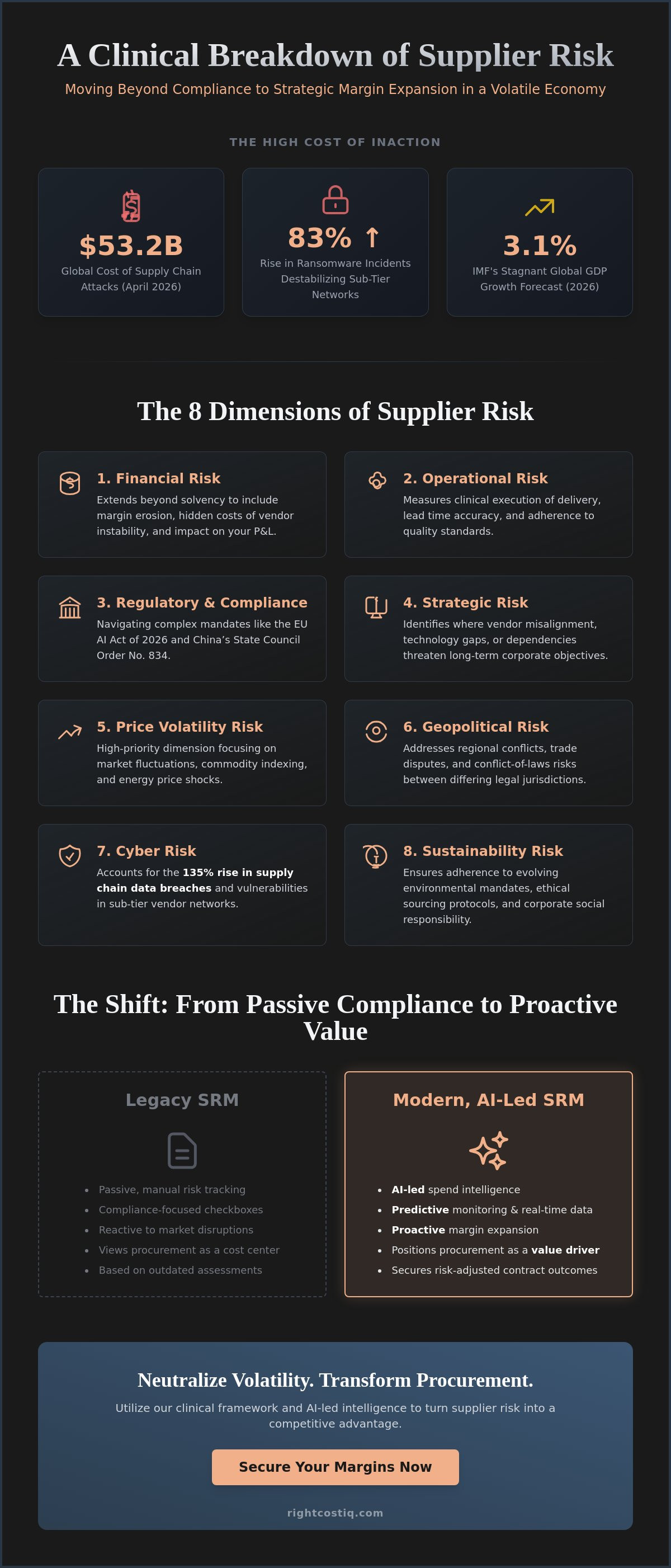
The global cost of supply chain attacks reached an estimated $53.2 billion in April 2026, proving that legacy procurement models are failing to protect corporate bottom lines. Most executives recognize that unmanaged price risk and a lack of vendor transparency are direct threats to profitability. However, treating supplier risk management as a mere compliance exercise is a strategic error that ignores the 83% rise in ransomware incidents currently destabilizing sub-tier networks.
You've likely experienced the margin erosion caused by inefficient RFP processes and the regulatory complexity of China's State Council Order 834. It's a reality that procurement is the new value driver, yet achieving clinical precision in vendor performance remains elusive while the IMF forecasts global growth at a stagnant 3.1%. This guide provides the strategic framework you need to mitigate financial volatility and transform your procurement function into a primary engine for margin expansion. We'll analyze how to leverage the NIST CSF 2.0 Govern function and ANSI/ASSP Z310.1-2026 standards to gain predictive visibility into supplier failure before it impacts your P&L.
Key Takeaways
- Establish a clinical framework that identifies and neutralizes third-party volatility to transform procurement into a primary value driver for the organization.
- Analyze the eight dimensions of risk to move beyond basic compliance and address the root causes of margin erosion and sub-optimal vendor performance.
- Deploy a multi-tiered supplier risk management framework that utilizes clinical data aggregation to categorize vendors by their strategic criticality and financial impact.
- Integrate AI-led spend intelligence and predictive monitoring to transform passive risk tracking into a proactive engine for continuous margin expansion.
- Utilize professional RFP management and negotiation assistance as high-leverage tools to secure risk-adjusted contract outcomes and operational resilience.
What is Supplier Risk Management (SRM) in a Volatile Economy?
The International Monetary Fund revised its global GDP growth forecast to 3.1% for 2026, signaling a period of high uncertainty for multinational corporations. In this environment, Supplier risk management (SRM) serves as a clinical framework for identifying, assessing, and neutralizing third-party volatility. It's no longer enough to maintain a passive list of backup vendors. Modern SRM requires the clinical execution of data-driven strategies to protect the bottom line from energy price shocks and regional conflicts that destabilize global trade.
Procurement is the new value driver in the 2026 economic landscape. While traditional models focused on simple risk avoidance, sophisticated firms now prioritize proactive margin expansion. This shift transforms procurement from a back-office cost center into a strategic engine that captures value during market fluctuations. By utilizing spend intelligence and commodity indexing, organizations can turn potential disruptions into competitive advantages. Supplier risk management is the clinical intersection of high-fidelity spend intelligence and operational supply chain resilience.
The Shift from Compliance to Strategic Optimization
Administrative SRM is failing modern enterprises because it prioritizes checkboxes over financial outcomes. With ransomware incidents rising 83% as of January 2026, a compliance-only approach leaves the supply chain vulnerable to catastrophic failure. Strategic urgency is required to manage high-stakes vendor relationships. Decision-makers must align risk thresholds with corporate financial goals to ensure that every contract contributes to overall margin expansion. Relying on outdated assessments is a liability; optimization requires continuous monitoring and real-time data integration.
SRM vs. Supplier Relationship Management
It's vital to distinguish between risk management and relationship management. SRM focuses on protection and the clinical mitigation of external threats. Relationship management centers on collaboration and long-term partnership growth. These two disciplines must integrate for total category mastery, yet they serve different functions. Don't confuse conversational warmth with vendor reliability. A friendly account manager can't compensate for a supplier's failing financial stability or a 135% increase in data breach risks. Clinical precision in performance tracking ensures that partnerships are built on verified data rather than subjective sentiment.
The 8 Dimensions of Supplier Risk: A Clinical Breakdown
Effective supplier risk management requires a granular deconstruction of the vendor ecosystem into eight distinct vectors. While legacy models focus on surface-level logistics, a sophisticated framework treats risk as a multi-dimensional threat to capital efficiency. Procurement is the new value driver, and mastering these dimensions is the only way to protect margins from the 3.1% global GDP growth slowdown forecasted by the IMF in April 2026. To maintain a competitive advantage, decision-makers must look beyond simple bankruptcy and analyze the following dimensions with clinical precision.
- Financial Risk: This extends beyond solvency to include margin erosion and the hidden costs of vendor instability.
- Operational Risk: This measures the clinical execution of delivery, lead times, and quality standards.
- Regulatory & Compliance Risk: This involves navigating the EU AI Act of 2026 and China’s State Council Order No. 834, which grants broad powers to counter foreign due diligence.
- Strategic Risk: This identifies where vendor misalignment threatens long-term corporate objectives.
- Price Volatility: A high-priority dimension focused on market fluctuations and energy price shocks.
- Geopolitical Risk: This addresses conflict-of-laws risks, such as the tension between Western due diligence laws and China’s April 7, 2026, security regulations.
- Cyber Risk: This accounts for the 135% rise in supply chain data breaches reported in early 2026.
- Sustainability Risk: This ensures adherence to evolving environmental mandates and ethical sourcing protocols.
Financial and Price Volatility Risk
Price risk is profit risk. Organizations utilizing commodity indexing can preemptively adjust procurement strategies before energy price shocks ripple through the supply chain. Should-cost modeling is essential here; it identifies hidden financial vulnerabilities in vendor quotes by deconstructing the actual cost of components. This analytical depth prevents suppliers from passing on unjustified price hikes under the guise of general inflation. To gain predictive visibility, many firms are turning to specialized market price trending and forecasting services to stabilize their cost structures.
Operational and Performance Tracking
Operational failure is a primary driver of margin contraction. When a supplier fails to execute, the resulting production delays and expedited shipping fees erode profitability instantly. Implementing a vendor performance tracking service provides real-time risk visibility, allowing procurement teams to intervene before a minor delay becomes a systemic failure. Quantifying these metrics is no longer optional; it's a requirement for C-suite reporting. By mapping operational performance to financial outcomes, procurement leaders demonstrate exactly how clinical precision in vendor management preserves the bottom line.
Implementing a Multi-Tiered SRM Framework
Transitioning from reactive firefighting to a proactive value driver requires a methodical implementation of a multi-tiered framework. This is the clinical execution phase where strategy meets the bottom line. Most organizations fail because they treat supplier risk management as a static project rather than a dynamic architecture. To achieve margin expansion in 2026, firms must follow a precise five-step sequence that integrates spend intelligence with rapid market validation.
- Step 1: Clinical Data Aggregation. Centralize all spend intelligence across every category to eliminate data silos and hidden risks.
- Step 2: Risk Stratification. Categorize vendors based on their strategic criticality and potential financial impact on the P&L.
- Step 3: RFQ Sprints. Execute rapid assessment cycles to validate current market pricing and uncover supplier instability.
- Step 4: Negotiation Alignment. Integrate real-time risk data into professional negotiation assistance to secure risk-adjusted contracts.
- Step 5: Continuous Monitoring. Shift from annual audits to real-time performance tracking for immediate visibility into failure points.
Clinical Data Aggregation and Spend Intelligence
Breaking down internal silos is the first requirement for achieving a single source of truth. Automated tracking architectures identify risks by normalizing spend data across disparate systems. This process isn't merely administrative; it's a strategic necessity. Without clean data, benchmarking is impossible. By centralizing intelligence, procurement teams can identify where 30% of data breaches involving third parties might originate within their own sub-tier networks. This baseline allows for the clinical identification of vulnerabilities before they escalate into financial volatility.
Executing RFQ Sprints for Risk Validation
The RFQ Sprint is a high-velocity tool designed for market price trending and risk validation. Unlike traditional sourcing cycles that take months, these sprints deliver rapid insights into current market realities. They reveal supplier instability long before it impacts production schedules. When a vendor's quote deviates significantly from should-cost models, it's a clinical indicator of internal distress or inefficiency. Merging speed with precision allows procurement to pivot quickly. This ensures that category RFPs are always optimized for the current economic climate. This agility is essential when navigating the IMF's predicted energy price shocks and regional disruptions. Procurement is the new value driver, and RFQ sprints are the engine of that value.
AI-Led Procurement: The Future of Risk Mitigation
AI transforms passive monitoring into predictive margin expansion by identifying patterns in vendor behavior before they manifest as financial losses. Legacy systems rely on historical data; however, AI-led procurement utilizes real-time spend intelligence to anticipate disruptions. Leveraging prompt engineering allows procurement leaders to query complex datasets with clinical precision, extracting actionable insights from millions of line items in seconds. Integrating an AI-driven margin expansion firm into your existing tech stack creates a self-optimizing ecosystem that prioritizes capital efficiency. AI-Led SRM represents the pinnacle of modern procurement strategy, enabling autonomous risk neutralization and continuous value creation.
Predictive Market Price Trending
Predictive market price trending moves the organization from reactive cost management to proactive price risk management. By utilizing AI to forecast commodity shifts, firms can lock in contracts before vendor price hikes materialize. This approach provides a significant economic advantage, especially when navigating the energy price volatility highlighted in the IMF’s April 2026 outlook. Accurate forecasting ensures that your cost models remain resilient against external shocks, preserving margins that would otherwise be eroded by market fluctuations. Procurement is the new value driver, and AI is the engine that powers its predictive capabilities.
Automating Vendor Compliance Architectures
Administrative friction is a primary barrier to effective supplier risk management. AI-driven compliance tracking reduces this burden by automating the real-time auditing of supplier diversity, ESG standards, and regulatory requirements. As the EU AI Act becomes fully enforceable in 2026, manual tracking is no longer a viable option for high-risk logistics and warehouse operations. Automated architectures ensure total supply chain integrity, a necessity given that the global cost of supply chain attacks reached $53.2 billion by April 2026. This clinical approach to compliance minimizes legal exposure and operational downtime, allowing the team to focus on high-level strategic optimization. To see how these architectures protect your bottom line, explore our price risk management and tracking service today.
Optimizing Resilience through Professional RFP Management
Professional RFP management serves as the terminal phase of the risk mitigation cycle. It's the point where theoretical risk assessments transform into binding contractual obligations. Treating the RFP process as a mere administrative hurdle ignores its power as the ultimate tool for supplier risk management. Clinical execution of sourcing ensures that every vendor engagement is filtered through a lens of financial stability and operational reliability. Integrating professional negotiation assistance into your tech stack provides a measurable ROI by shielding the organization from the margin erosion typically caused by sub-optimal, high-risk contracts.
RightCostIQ approaches procurement as a strategic architecture rather than a series of transactions. By aligning RFP management with real-time spend intelligence, we ensure that your supply chain remains resilient against the energy price shocks and geopolitical conflicts cited in the IMF’s April 2026 World Economic Outlook. This methodical approach to sourcing prevents the sub-optimal outcomes that lead to financial volatility. Procurement is the new value driver, and professional RFP management is the engine that secures that value for the long term.
Negotiation as a Risk Mitigation Lever
Negotiation is a high-leverage tool for embedding protection directly into the supply chain. Incorporating risk-sharing clauses into high-value contracts is no longer optional; it's a necessity given that 30% of data breaches involve third-party suppliers as of March 2026. Using procurement category cost benchmarking as a clinical baseline allows for data-backed discussions that prevent opportunistic price hikes. These negotiations ensure that margin expansion is secured through verified commodity indexing rather than vendor sentiment. When you negotiate with precision, you lock in outcomes that are adjusted for the 3.1% global growth slowdown forecasted for 2026.
The RightCostIQ Advantage
RightCostIQ provides the sophisticated analytics and expert-led strategy required to navigate the current conflict-of-laws landscape. Our AI-led procurement analytics and vendor performance tracking services offer the predictive visibility needed to identify failure points before they impact the P&L. We don't just provide software; we provide a holistic framework for financial optimization. Through our RightCost Academy, we also take on the role of a strategic mentor, upskilling your internal teams to master advanced risk management and technical negotiation. This ensures your organization possesses the competitive advantage needed to thrive in a volatile economy.
Optimize your supplier risk management with RightCostIQ to secure your margins and drive clinical procurement execution across every category.
Master the Clinical Architecture of Margin Expansion
The economic landscape of 2026 demands a shift from passive compliance to high-stakes strategic optimization. With global GDP growth stalling at 3.1% according to the IMF's April 2026 forecast, procurement is the new value driver for corporate resilience. Success requires the clinical execution of supplier risk management to neutralize third-party volatility before it erodes the bottom line. By integrating AI-led spend intelligence with real-time performance tracking, organizations transform a cost center into a primary engine for financial stability.
RightCostIQ operates as an AI-Driven Margin Expansion Firm founded by healthcare financial analytics experts. We specialize in should-cost modeling and commodity indexing to provide the precision required for risk-adjusted contract outcomes. Our framework ensures that every RFP cycle and negotiation sprint contributes directly to your capital efficiency. It's time to move beyond administrative tracking and adopt a data-driven architecture that prioritizes margin expansion above all else. Transforming market volatility into a competitive advantage is the hallmark of a strategic architect.
Optimize your procurement strategy and mitigate supplier risk with RightCostIQ
Frequently Asked Questions
What is the primary difference between supplier risk management and vendor performance tracking?
Supplier risk management is the overarching clinical framework used to identify and neutralize third-party volatility before it impacts the P&L. It focuses on systemic threats like geopolitical shifts and cyber vulnerabilities. Vendor performance tracking is a granular component of this framework that monitors real-time execution, such as delivery precision and quality standards. While SRM protects the organization from catastrophic failure, performance tracking prevents the incremental margin erosion caused by operational inefficiency.
How does price risk management contribute to margin expansion?
Price risk management neutralizes financial volatility by using commodity indexing and should-cost modeling to forecast market shifts. This proactive approach allows procurement teams to lock in favorable rates before vendor price hikes materialize. By stabilizing cost structures against energy price shocks predicted by the IMF in April 2026, organizations capture value that competitors lose to market fluctuations. It transforms procurement into a strategic engine that preserves capital and expands margins during periods of high inflation.
Can AI-led procurement tools replace traditional risk assessment teams?
AI-led tools don't replace human teams; they augment them by automating data aggregation and providing predictive visibility. These systems process millions of data points to identify patterns that manual audits might miss, such as sub-tier financial distress. This automation allows procurement architects to focus on high-stakes negotiation and strategic optimization. The tech stack functions as a force multiplier, enabling the clinical execution of risk strategies without increasing administrative headcount.
What are the most critical KPIs for measuring supplier risk in 2026?
The 135% rise in supply chain data breaches makes cyber-resilience scores the most critical KPI in 2026. Organizations must also track compliance with China’s State Council Order No. 834 and the EU AI Act to avoid legal exposure. Other vital metrics include the delta between actual vendor quotes and should-cost models, as well as real-time financial solvency ratios. These KPIs provide the clinical precision needed to maintain a resilient and profitable supply chain architecture.
How often should a business execute an RFQ sprint for risk validation?
Businesses should execute an RFQ sprint at least every 90 days for high-impact categories or whenever commodity indexing signals a 5% market shift. These high-velocity cycles validate that current pricing remains competitive and that suppliers aren't hiding financial instability. Regular sprints provide the market price trending data necessary to pivot sourcing strategies quickly. This agility is essential for navigating the 3.1% global growth slowdown forecasted for the 2026 fiscal year.
What role does should-cost modeling play in identifying supplier financial risk?
Should-cost modeling deconstructs vendor quotes into their fundamental components to identify unjustified price increases. When a supplier’s quote deviates significantly from the clean-sheet model, it serves as a clinical indicator of internal distress or operational inefficiency. This data allows procurement teams to challenge vendor claims with authority during negotiations. It acts as a financial baseline that protects the bottom line from being exploited by suppliers attempting to pass on their own risk-related costs.
How can a supplier diversity program be integrated into a risk management framework?
A supplier diversity program functions as a geographic and operational resilience strategy within the supplier risk management framework. Broadening the vendor base reduces reliance on single-source regions, mitigating the impact of regional conflicts or localized regulatory changes like China’s April 7, 2026, security laws. Diversification ensures that a failure in one tier doesn't lead to a systemic shutdown. This approach aligns social responsibility goals with the pragmatic necessity of maintaining an uninterrupted supply chain.
What is the economic impact of unmanaged tail spend on supplier risk?
Unmanaged tail spend often accounts for 20% of total expenditure but contains 80% of an organization’s unmonitored vendors. These low-spend suppliers are frequent entry points for cyberattacks, contributing to the 83% rise in ransomware incidents reported in January 2026. Fragmented tail spend hides sub-tier risks and creates significant margin leakages through unnegotiated pricing. Bringing this spend under an automated tracking architecture is essential for achieving total category mastery and protecting the corporate bottom line.


