
Why do top-performing procurement functions capture 8 to 12 percent cost savings while your margins remain trapped by opaque supplier pricing? In a landscape where the cost of GPT-4-class AI performance has decreased by 97 percent since 2023, relying on static data is a strategic liability. You likely understand that traditional procurement cost benchmarking services often provide retrospective snapshots that fail to drive real-time results. It's difficult to execute aggressive margin expansion when you lack the clinical data to challenge a supplier’s cost structure during an RFQ sprint.
This article provides the clinical framework to master strategic should-cost modeling and AI-led analytics. We'll show you how to transform procurement into a primary value driver by utilizing transparent, data-backed negotiation levers. You will learn to leverage the 2025 FAR threshold adjustments, such as the 350,000 dollar simplified acquisition threshold, to optimize your spend intelligence. We'll examine the specific methodologies required to turn opaque spend data into quantifiable margin expansion through continuous, real-time benchmarking and precision analytics.
Key Takeaways
- Learn how to transform procurement into a primary value driver by moving beyond static reports to methodical spend performance comparisons.
- Discover the architecture of advanced should-cost modeling to deconstruct supplier pricing into clinical material, labor, and overhead components.
- Master the integration of market price forecasting to manage financial volatility and maintain strategic agility in fluctuating markets.
- Utilize procurement cost benchmarking services as a tactical negotiation lever to shift from defensive sourcing to offensive margin expansion.
- Explore the application of AI-led analytics and RFQ Sprints to accelerate savings and institutionalize high-level spend intelligence.
Defining Modern Procurement Cost Benchmarking Services
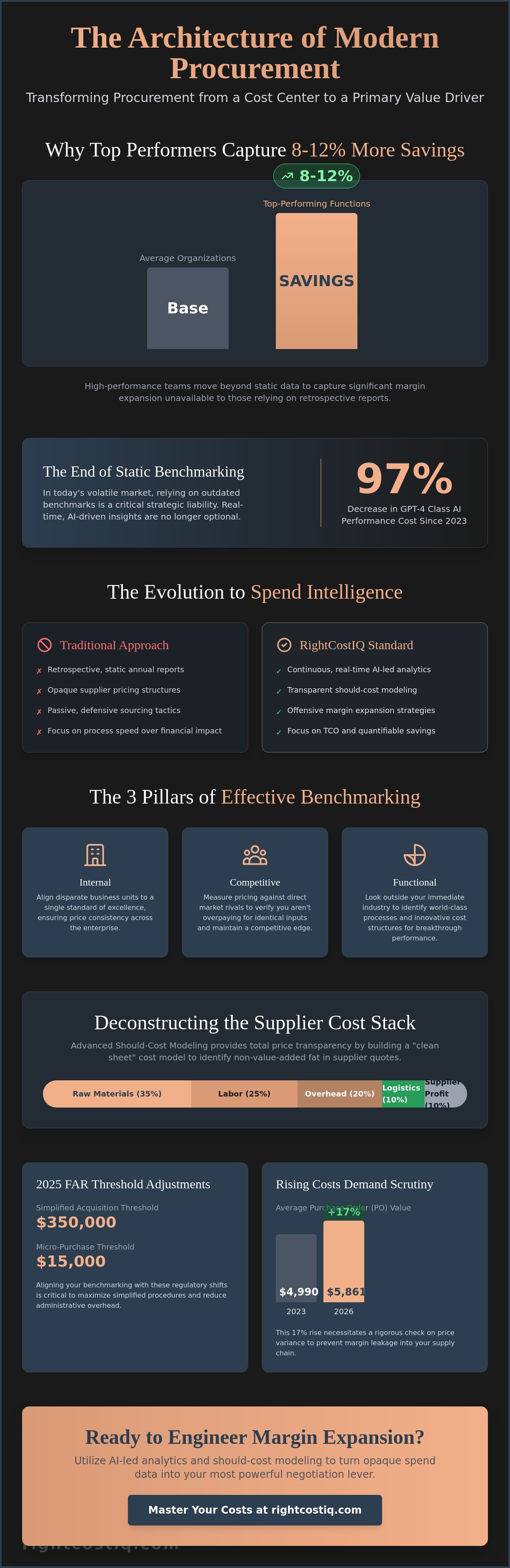
Modern cost benchmarking isn't a passive exercise in historical reporting. It's a clinical comparison of your organization's spend performance against high-performing industry peers. In an era where 24 percent of enterprises achieved measurable AI ROI by Q1 2026, procurement cost benchmarking services must function as a dynamic engine for financial optimization. We operate under the manifesto that procurement is the new value driver. This means the function no longer exists to simply process orders; it exists to engineer margin expansion through rigorous data application. Every data point must serve the bottom line.
Effective benchmarking requires a multi-layered architecture to be successful. Unlike generic competitors who focus solely on process speed or PO cycle times, our framework prioritizes the financial impact of category-specific price variance. This architecture includes:
- Internal Benchmarking: Aligning disparate business units to a single standard of excellence to ensure price consistency across the enterprise.
- Competitive Benchmarking: Measuring pricing against direct market rivals to verify that you aren't overpaying for identical inputs.
- Functional Benchmarking: Looking outside your immediate industry to identify world-class processes and innovative cost structures.
The regulatory environment also dictates the need for updated benchmarking strategies. The Federal Acquisition Regulation (FAR) threshold adjustments effective October 2025 have shifted the micro-purchase threshold to 15,000 dollars and the simplified acquisition threshold to 350,000 dollars. These changes impact how organizations categorize spend and report subcontract information. A sophisticated benchmarking framework incorporates these regulatory shifts to ensure compliance while maximizing the ceiling for simplified procedures. Failure to align benchmarking with these 2025 updates results in missed opportunities for streamlined procurement and increased administrative overhead.
The Evolution from Static Data to Spend Intelligence
Traditional annual benchmarks fail in volatile markets. When AI performance costs drop 97 percent in three years, six-month-old reports are obsolete. Clinical precision is required to identify margin leakage that occurs when contracts don't reflect current market shifts. High-performance teams move from "what we paid" to "what we should have paid" using should-cost modeling. This identifies the delta between current contracts and market reality, transforming data into a negotiation weapon.
Core KPIs for High-Performance Procurement
Elite functions focus on Total Cost of Ownership (TCO). This accounts for administrative, logistics, and quality costs that inflate sticker prices. Analyzing price variance using procurement cost benchmarking services is essential for maintaining margin. In 2026, average spend under management rose to 8.3 million dollars. This metric is a primary efficiency indicator. By tracking SUM and price variance, firms capture the 8 to 12 percent cost savings available to data-driven organizations.
The Architecture of Advanced Should-Cost Modeling
Should-cost modeling represents the clinical standard for total price transparency. It moves procurement beyond surface-level "market price" comparisons into a granular deconstruction of supplier economics. While generic competitors often focus on reducing labor costs by 1.6 percent, high-performance firms use procurement cost benchmarking services to target the entire cost stack. This requires a "clean sheet" methodology. You build the cost of a product or service from the ground up, starting with raw materials and adding labor, overhead, and a reasonable profit margin. This baseline allows you to identify exactly where a supplier’s quote contains non-value-added fat.
Research into benchmarking in government procurement confirms that without these structured comparisons, organizations struggle to justify price increases or verify value. Spend intelligence tools must identify performance outliers. Data from 2026 shows the average purchase order value rose to 5,861 dollars, a significant increase from the 4,990 dollar average seen in 2023. This 17 percent rise necessitates a rigorous check on price variance. If your PO values are climbing faster than commodity benchmarks, your margin is leaking into your supply chain.
Deconstructing the Supply Chain Cost Stack
Effective modeling separates value from waste. We use commodity indexing to track raw material fluctuations in real-time. This prevents suppliers from maintaining high prices when input costs drop. By applying price risk management, you forecast future cost variances rather than reacting to them. This proactive stance is essential for optimizing spend intelligence before market volatility strikes. Identifying non-value-added costs within supplier quotes ensures you only pay for the utility you receive.
AI-Led Data Normalization and Analytics
The 97 percent decrease in GPT-4-class AI performance costs since 2023 has fundamentally changed the procurement tech stack. AI-driven tools now ingest and normalize disparate spend data with unprecedented precision. Prompt engineering allows for sophisticated procurement category mapping, ensuring every line item is benchmarked against the correct peer group. This automation identifies savings opportunities that human analysts often miss. It turns procurement cost benchmarking services into a real-time margin expansion engine that functions with clinical accuracy.
Benchmarking vs. Market Trending: Navigating Volatility
Static benchmarking is a rearview mirror. It tells you where your pricing stood six months ago, but it offers zero protection against tomorrow's market shifts. High-performance procurement requires a dual-track strategy that combines historical procurement cost benchmarking services with forward-looking market price trending. While benchmarking establishes your baseline against industry peers, market trending provides the trajectory. In a volatile economy, knowing you paid a fair price in Q3 2025 is irrelevant if commodity indices dropped 15 percent by Q1 2026. You must bridge the gap between historical performance and future price risk.
Market price forecasting mitigates financial volatility by identifying the optimal window for contract renewals. Organizations that rely solely on static data often find themselves locked into high-cost agreements just as market prices begin to soften. Combining these datasets creates a clinical advantage during RFP management. It allows you to enter negotiations not just with "what others pay," but with data-backed projections of where the market is heading. This shift from reactive to proactive sourcing is what defines procurement as the new value driver. It ensures long-term contract stability by anchoring agreements to dynamic market realities rather than fixed, arbitrary points in time.
Forecasting as a Strategic Procurement Asset
Precision timing is the difference between margin expansion and cost overruns. We utilize market price trending to time RFQ sprints when commodity cycles favor the buyer. By predicting commodity shifts before they hit the bottom line, you maintain a strategic cushion. This foresight also supports supply chain compliance. For instance, the March 26, 2026 Executive Order 14398 regarding federal contractor policies necessitates proactive adjustments to sourcing strategies. Data-backed forecasting ensures your supply chain remains resilient and compliant with evolving regulatory standards without sacrificing cost efficiency.
Mitigating Risk Through Spend Transparency
Transparency tools are the primary defense against hidden vendor price hikes. When you integrate procurement cost benchmarking services with automated risk alerts, you catch unauthorized "bracket creep" immediately. Clinical vendor performance tracking identifies when a supplier’s pricing deviates from established market trends. The April 2026 Department of Justice settlement regarding the False Claims Act highlights the increasing stakes of procurement oversight. Automated spend intelligence provides the audit trail and operational efficiency needed to manage these risks. It transforms vendor management from a manual check-in into a relentless, data-driven monitoring system.
Executing Benchmarks as a Strategic Negotiation Lever
Benchmarking without execution is wasted overhead. To capture the 8 to 12 percent savings available to top performers, you must transition from defensive sourcing to an offensive posture. Procurement cost benchmarking services provide the clinical ammunition needed to dismantle supplier justifications for price hikes. This isn't about asking for discounts. It's about presenting a data-backed reality that suppliers cannot refute. When you walk into a negotiation with a clean-sheet cost model, the conversation shifts from "what will you charge?" to "why is your overhead 15 percent higher than the industry standard?"
Weaponizing data requires a relentless focus on the bottom line. Generic platforms often mention continuous improvement but fail to provide the tactical steps for a high-stakes RFQ sprint. Offensive sourcing uses should-cost data to set the ceiling for any proposal before the RFP is even issued. By integrating these benchmarks into the RFP management cycle, you force transparency from the outset. Suppliers who understand that you possess deep spend intelligence are less likely to include non-value-added fat in their initial quotes. This professional approach ensures that your procurement function operates as a primary value driver rather than a reactive cost center.
The RFP Management Precision Framework
Success in complex deals requires a structured sequence of data application. First, establish your baseline through clinical benchmarking to understand where your current contracts sit relative to the 2026 market. Second, develop the should-cost model for the specific category to identify the theoretical ideal price. Finally, integrate forward-looking market trends into the RFP requirements. This ensures that the resulting contract isn't just fair today but remains competitive throughout its lifecycle. Utilizing the 350,000 dollar simplified acquisition threshold effective since October 2025 allows for faster execution in these strategic sprints.
Negotiation Tactics for Margin Expansion
Strategic architects use evidence to challenge every cost component. If your procurement cost benchmarking services reveal that labor costs in a specific region haven't risen, you have the leverage to reject proposed price increases. Structuring performance-based contracts using vendor tracking metrics ensures that suppliers remain accountable for the efficiency they promised. Professional negotiation assistance is vital here. Expert negotiators translate complex spend analytics into clear levers that drive margin expansion. Secure your competitive advantage by leveraging our RFP management and negotiation assistance to institutionalize these high-level sourcing strategies.
RightCostIQ: AI-Led Benchmarking for Enterprise Value
RightCostIQ functions as the strategic architect for organizations that recognize procurement is the new value driver. We don't offer generic consulting or static reports that expire within a fiscal quarter. Instead, we provide a clinical framework for procurement cost benchmarking services that prioritizes high-level margin expansion. Our methodology centers on the proprietary RFQ Sprints, which compress traditional sourcing timelines into high-velocity execution windows. This approach ensures that spend intelligence isn't just gathered but is weaponized during active negotiations to capture immediate financial gains. We prioritize results and efficiency over conversational warmth, serving as a sophisticated partner for decision-makers who demand objective, data-driven outcomes.
RightCostIQ serves as our technical upskilling arm, transforming internal teams into elite procurement specialists. We teach the precision of prompt engineering for category mapping and the architecture of advanced should-cost modeling. This institutionalizes competitive advantage, ensuring your team can maintain the 8 to 12 percent cost savings achieved by top-performing functions. By moving beyond surface-level spend analysis, we help firms navigate the complexities of modern financial strategy with relentless focus. Every tool in our arsenal is designed to optimize the bottom line and ensure that your procurement tech stack delivers a measurable ROI.
The RightCostIQ Tech Stack Advantage
Our platform integrates AI-led margin expansion tools directly into existing enterprise resource planning (ERP) systems. This integration allows for real-time tracking of vendor performance and compliance against the latest 2026 industry benchmarks. While 66 percent of tech leaders reported measurable ROI from AI strategies in early 2026, many still struggle with data normalization. Our tech stack solves this by ingesting disparate spend data and applying clinical precision to identify category cost outliers. We provide customized benchmarking specifically for North American enterprises, ensuring that your data reflects the pragmatic realities of your specific market and regulatory environment.
Achieving Quantifiable Margin Expansion
The ROI of professional procurement cost benchmarking services is most visible in tail spend management and category optimization. In a recent 2026 engagement, our clinical analytics identified significant margin leakage within an organization's unmanaged spend. By mapping this spend to clean-sheet cost models and utilizing our market price trending services, the firm reduced price variance across multiple categories. This resulted in a measurable increase in spend under management, which rose toward the 2026 industry benchmark of 8.3 million dollars per customer. We provide the tools and the expertise to turn these insights into permanent margin gains. Optimize your procurement strategy today.
Institutionalize Margin Expansion as a Strategic Standard
Strategic margin expansion requires more than periodic audits; it demands a clinical shift toward real-time spend intelligence. You've seen how deconstructing the supply chain cost stack and integrating market price forecasting provide the necessary leverage to challenge supplier pricing. By moving from retrospective reporting to offensive negotiation, procurement functions capture the 8 to 12 percent savings that define industry leaders. Integrating procurement cost benchmarking services into your operational DNA ensures that every RFP cycle functions as a precision-engineered value driver.
RightCostIQ provides the high-level expertise needed to navigate these volatile markets. Our North American procurement specialists utilize clinical precision in should-cost modeling to expose hidden margin leakage. We don't just provide data; we execute results through our proprietary RFQ Sprint methodology. This structured approach accelerates your path to quantifiable efficiency and ensures your organization remains ahead of regulatory shifts and commodity fluctuations. It's time to move beyond the cost center model and reclaim your competitive advantage.
Partner with RightCostIQ for AI-Led Margin Expansion and optimize your procurement outcomes today.
Frequently Asked Questions
What are procurement cost benchmarking services?
Procurement cost benchmarking services provide a methodical framework for comparing an organization’s spend performance against industry standards and high-performing peers. These services identify clinical price variances across categories to reveal exactly where a firm is overpaying. By establishing objective baselines, decision-makers can drive aggressive margin expansion during supplier negotiations. This process transforms procurement from a support function into a primary value driver for the enterprise.
How does should-cost modeling differ from traditional benchmarking?
Should-cost modeling is a clean sheet methodology that deconstructs a supplier's quote into its base components, such as material, labor, and overhead. Traditional benchmarking typically relies on top-down market comparisons of final prices. While traditional methods tell you what the market pays, should-cost modeling reveals what the product actually costs to produce. This clinical transparency allows procurement teams to challenge non-value-added costs within supplier quotes with absolute precision.
What is the ROI of professional RFP management services?
Professional RFP management services deliver a measurable ROI by capturing the 8 to 12 percent cost savings typically achieved by top-performing procurement functions. These services utilize structured negotiation assistance and clinical benchmarking to drive aggressive margin expansion. By optimizing the RFP cycle, organizations reduce administrative overhead and secure more favorable contract terms. This strategic oversight ensures that complex deals are anchored to actual market reality rather than supplier-driven pricing.
How does AI impact procurement cost benchmarking in 2026?
In 2026, AI impacts procurement by automating data normalization and accelerating category mapping through sophisticated prompt engineering. The 97 percent decrease in GPT-4-class AI performance costs since 2023 has made high-level analytics accessible for real-time spend intelligence. Currently, 24 percent of enterprises achieve measurable ROI on AI across multiple procurement use cases. These AI-led tools identify hidden savings opportunities in seconds, moving benchmarking from a periodic report to a continuous optimization engine.
Why is market price trending essential for price risk management?
Market price trending is essential because it provides the forward-looking trajectory needed to anticipate commodity shifts before they impact the bottom line. While benchmarking establishes a historical baseline, trending allows for proactive price risk management by identifying optimal windows for contract renewals. This foresight prevents organizations from locking into high-cost agreements during market softening. It creates a strategic cushion that maintains long-term contract stability and protects margins during periods of market volatility.
Can benchmarking services help with tail spend management?
Yes, benchmarking services are highly effective for identifying margin leakage within tail spend, which often accounts for 20 percent of total spend but 80 percent of suppliers. Benchmarking unmanaged categories reveals price inconsistencies that otherwise go unnoticed. By applying clinical analytics to these smaller transactions, firms can consolidate spend and eliminate unauthorized bracket creep. This process ensures that even low-value purchases are optimized for maximum efficiency and enterprise-wide compliance.
How often should a company conduct procurement cost benchmarking?
Companies should move away from static annual reviews toward continuous procurement cost benchmarking services integrated into their daily operations. In volatile markets, data older than a single quarter often becomes a strategic liability. High-performance teams utilize real-time spend intelligence to conduct benchmarks before every major RFQ sprint or contract renewal. This relentless frequency ensures that negotiation levers remain sharp and that pricing always reflects the current commodity landscape.
What is the difference between spend analysis and spend intelligence?
Spend analysis is the retrospective process of examining historical purchase data to understand what was paid and to whom. Spend intelligence is the clinical application of that data to drive future margin expansion and strategic sourcing. Intelligence incorporates market trending, should-cost modeling, and AI-led analytics to provide actionable insights. While analysis answers what happened, spend intelligence answers how to optimize the next deal. It's the difference between reporting and strategic execution.


