

What if the lowest TPA quote leads to the highest total cost? When negotiating TPA contracts, comparing headline rates alone can leave important fees, service gaps, and operational risks out of view. Proposals are difficult to compare when fee schedules use different assumptions, service commitments lack measurable standards, and the consequences of poor performance are unclear.
A stronger negotiation starts with evidence and focuses on outcomes. This guide explains how to benchmark fees, build comparable proposals through a structured RFP, and define service levels, reporting requirements, and remedies for missed commitments. It also covers data access, transition support, fee transparency, and risk allocation, so your agreement reflects operational needs as well as cost. You’ll have a practical framework for evaluating total value, documenting expectations, and tracking vendor performance after signing. The goal isn’t simply a lower rate. It’s a defensible position and terms that support your organization’s financial and operational priorities.
Key Takeaways
- Define the TPA’s scope, service category, and operating context before evaluating proposals, so each offer is measured against the same business outcomes.
- Build a comparable cost baseline by aligning proposal assumptions and identifying which charges apply to your requirements.
- When negotiating tpa contracts, assess service accountability and operational risk alongside the administrative fee.
- Set negotiation priorities in advance by separating essential terms from tradeable items and establishing approval limits.
- Make contract value measurable after signing with named owners, regular reviews, and documented follow-up actions.
Negotiating TPA Contracts Starts with Defining Scope and Business Outcomes
A third-party administrator (TPA) performs administrative functions for an organization under an agreed arrangement. Depending on the service category, that work may include processing insurance claims or administering employee benefit plans. The Third-party administrator (TPA) overview offers a general starting point, but the contract must define the provider’s exact role, applicable jurisdiction, and boundaries. Terms vary across service types and agreements, so validate definitions and obligations with internal subject-matter experts.
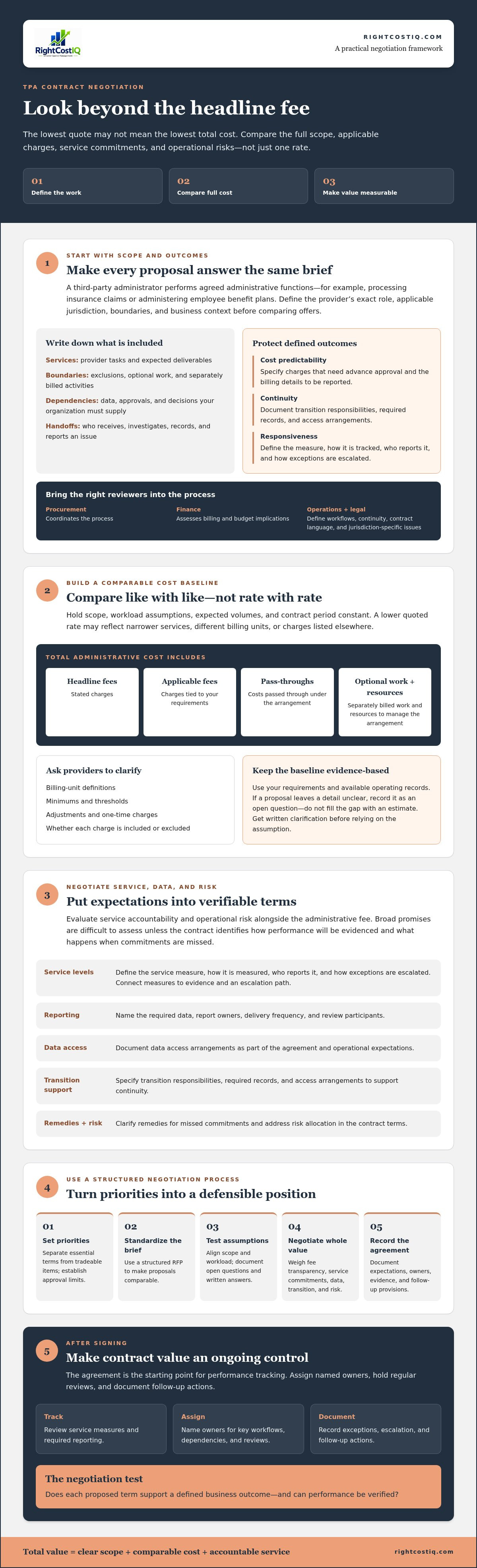
Scope is the foundation for negotiating tpa contracts. When responsibilities, exclusions, or dependencies are unclear, it becomes harder to compare proposals, assess service quality, and identify who owns an operational issue. Procurement can coordinate the process, but requirements should also come from finance, operations, and legal reviewers. Finance can assess billing and budget implications; operations can define workflows and continuity needs; legal reviewers can assess contract language and jurisdiction-specific issues.
Headline fees are the stated charges; full administrative cost includes all applicable fees, pass-throughs, optional work, and the resources required to manage the arrangement. Keep negotiations focused on the complete scope and its cost drivers, not just one rate.
What services and responsibilities does the TPA contract cover?
List the work the provider will perform, the deliverables your organization expects, and the tasks that remain with your team or another vendor. Separate standard services from optional work, pass-through charges, and separately billed activities. Identify dependencies too, such as the data, approvals, or decisions your organization must provide for the administrator to meet its commitments.
Define handoffs clearly. For example, specify who receives an issue, who investigates it, and what information must be recorded and reported. Avoid relying on labels such as “claims support” or “benefits administration” without listing the included activities. Those phrases can describe different responsibilities in different contracts.
Which business outcomes should negotiation protect?
Turn priorities into evidence-based commitments rather than broad promises. If cost predictability matters, specify which charges require advance approval and what billing details the provider must report. If continuity is essential, document transition responsibilities, required records, and access arrangements. For responsiveness, define the metric, how it is measured, who reports it, and how exceptions are escalated.
- Reporting: Name required data, report owners, delivery frequency, and review participants.
- Accountability: Connect each service measure to a contract provision, evidence source, and escalation path.
- Operational fit: Assign internal and provider owners to key workflows and dependencies.
This gives the negotiation team a clear test for each proposed term: does it support a defined outcome, and can performance be verified? Category cost benchmarking and analytics can strengthen the evidence behind commercial decisions, while documented requirements make proposals easier to compare.
Build a TPA Contract Cost Baseline Before Negotiating Fees
A quoted administrative fee is meaningful only when you know what it covers. To compare proposals fairly, hold the service scope, workload assumptions, expected volumes, and contract period constant. Otherwise, a lower rate may reflect narrower services, different billing units, or charges listed elsewhere in the schedule.
Build a baseline from your requirements and available operating records, then compare expected charges alongside service needs. Include only fee categories that apply to the arrangement. A fee schedule may combine fixed charges with variable, transaction-based, implementation, or pass-through costs. Don’t assume a charge is included or excluded. Ask the provider to confirm it in writing.
How do you compare TPA fee schedules fairly?
Give each provider the same scope and workload assumptions. Ask for definitions of billing units, minimums, thresholds, adjustments, and one-time charges. If a proposal leaves a detail unclear, record it as an open question instead of filling the gap with an estimate. Written clarification exposes differences before negotiation and keeps assumptions out of your forecast.
Use a comparison matrix to isolate those differences:
| Fee type | Calculation basis | Assumptions to confirm | Exclusions to identify | Negotiation questions |
|---|---|---|---|---|
| Fixed | Flat charge for a defined period or scope | Included services and contract period | Optional or separately billed work | What could change the fixed charge? |
| Variable or transaction-based | Unit, transaction, or activity | Volume, billing unit, minimums, thresholds | Activities outside the stated unit | How are volume changes and adjustments handled? |
| Implementation | One-time project or setup charge | Defined deliverables and dependencies | Additional work or change requests | What triggers extra charges? |
| Pass-through | Third-party or other eligible expense | Approval, documentation, and billing method | Markup or administration charges | What evidence accompanies each charge? |
What evidence can support a stronger price position?
Use historical spend, invoices, service volumes, and prior contract changes where available. These records help test proposal assumptions against actual use and reveal unclear billing patterns. Treat gaps as questions for the provider, not as proof of savings or future costs.
Benchmarks are useful only when service definitions, scope, geography, and timing are sufficiently aligned. A broad comparison can create false confidence if the underlying work differs. For a structured approach to evaluating comparable cost inputs, review procurement category cost benchmarking standards. Use the evidence to ask specific questions and negotiate fees in context, with service requirements and the complete cost picture in view.
Negotiate TPA Service Levels, Data Rights, and Risk Alongside Price
A lower administrative fee doesn’t automatically make a better contract. If the agreement lacks clear performance measures, usable reporting, or workable data and transition terms, your organization may take on operational risk that the quoted rate doesn’t reveal. Effective negotiating tpa contracts means evaluating what the provider will deliver, how performance will be verified, and what happens when commitments aren’t met.
Every negotiated service commitment needs a measurement method and a defined response if it fails. This turns general assurances into terms teams can monitor and act on. Choose metrics that fit the services in scope, such as processing timeliness, accuracy, system availability, or issue resolution. Don’t adopt a metric simply because it appears in a provider’s standard agreement.
Which service-level commitments should buyers make measurable?
For each metric, define the measurement period, calculation method, data source, reporting format, and accountable owner. Specify exclusions and how exceptions will be documented. For example, an issue-resolution measure should clarify when the clock starts, which issues qualify, and where unresolved cases are escalated. These details help prevent disputes about whether the provider met its commitment.
Review proposed service credits or other remedies for clarity, proportionality, and practical value. Confirm how a failure is reported, who validates it, and whether the remedy addresses the operational impact. Ask qualified legal and operational reviewers to assess the contract language and your organization’s available options.
How should contracts address data, transition, and continuity?
Define who owns relevant data and how authorized personnel can access and export it during the relationship and at its end. Specify usable export formats, retention expectations, and processes for returning or deleting data. Address confidentiality, security requirements, permitted use, and audit cooperation in terms that reflect the arrangement. Legal and security teams should verify which obligations apply to the organization, provider, services, and jurisdiction. Don’t assume one regulatory rule covers every TPA contract.
Transition terms need operational detail too. Identify each party’s responsibilities, required inputs, dependencies, expected timelines, and any associated charges. Clarify how records, open work, and reporting will be handled to support continuity if the agreement changes or ends. Vague language such as “reasonable assistance” may not tell either party what work is included or how it will be coordinated.
Finally, ask qualified reviewers to assess how the agreement allocates responsibility for provider errors, service interruptions, and other defined risks. The goal isn’t to insert broad protections without context. It’s to make responsibilities, exclusions, escalation steps, and remedies clear enough for your organization to evaluate and manage. Pair those provisions with routine performance reporting so negotiated commitments stay visible after signing.
Use a Structured Negotiation Process to Improve TPA Contract Terms
Negotiating tpa contracts works better when the team controls the process, not just the meeting agenda. Follow an ordered sequence: prepare evidence, prioritize terms, negotiate, document decisions, and monitor the signed agreement. Set approval limits before supplier discussions begin so negotiators know which changes they can accept and which require escalation.
How should buyers prepare for a TPA contract negotiation?
Gather the current agreement, invoices, performance reports, scope documents, and stakeholder requirements. Use the same service and volume assumptions across proposals, then link each requested change to supporting evidence. Set a target and fallback position for commercial terms, service commitments, data access, and transition provisions.
Separate requirements into two groups: must-haves that protect operational needs, and tradeable terms that can move if the overall agreement remains acceptable. Keep one issues log throughout discussions. For each item, record the provider’s proposal, your counterproposal, the responsible owner, the decision, and any unresolved risk. This creates a traceable record and reduces conflicting instructions across procurement, finance, operations, and legal reviewers.
How can an RFP create better negotiation leverage?
A structured RFP gives suppliers a common specification and evaluation criteria, making differences in scope, price assumptions, and service offers easier to identify. Request itemized commercial assumptions, service descriptions, exceptions, and proposed contract language. If a response departs from the requested terms, log the deviation and ask for clarification rather than treating it as accepted.
Use the RFP management resource to support a disciplined process for documenting requirements and comparing responses. RightCostIQ also lists negotiation assistance among its procurement offerings for complex discussions. Evaluate any engagement against your specific needs and scope.
During supplier discussions, negotiate the package rather than isolated clauses. If a provider resists a requested term, ask what alternative would meet the same operational objective, then assess the trade-off against your approval limits. Before closing, confirm that agreed changes appear in the contract documents, not only in meeting notes or email.
- Prepare: Assemble records, assumptions, priorities, and fallback positions.
- Negotiate: Address each logged issue against evidence and approved limits.
- Document and monitor: Record final terms, owners, open risks, and follow-up actions.
For support with procurement negotiations, explore professional negotiation assistance as part of your evaluation process.
Turn TPA Contract Negotiation into Ongoing Cost and Performance Control
A signed agreement is a control framework, not the end of procurement’s work. Monitor delivery against the agreed scope, fees, service metrics, and reporting requirements to confirm that actual performance matches the contract. Without routine review, billing changes, recurring exceptions, or missed commitments can go unnoticed until renewal discussions begin.
What should buyers monitor after signing?
Assign named owners from procurement, finance, and operations, and set a review cadence that fits the arrangement. At each review, compare billed charges with contracted rates, volumes, assumptions, and approved changes. Examine service reports, recurring exceptions, unresolved issues, and corrective actions as well. Record decisions, owners, and due dates so follow-up doesn’t depend on memory.
Use a clear escalation path when a variance or performance issue persists. For example, route a billing discrepancy to the owner responsible for validating charges, then escalate unresolved items according to your organization’s governance process. Track price and performance trends over time, not just one reporting period at a time. This evidence can inform contract adjustments, supplier discussions, and renewal decisions.
Preparation still matters after signing. Teams anticipating a contract change or renewal can use the Negotiation Coach resource to organize their negotiation approach.
When should you seek structured procurement support?
External procurement support may be useful when internal teams lack comparable benchmarks, negotiation capacity, or visibility into vendor performance. Start by identifying the specific gap: inconsistent proposal assumptions, limited cost analysis, or difficulty tracking agreed terms. Then define what evidence and support would help your team make a more defensible decision.
RightCostIQ lists RFP management and negotiation assistance, procurement category cost benchmarking and analytics, and vendor performance tracking among its offerings. These services can support structured proposal comparisons, evidence-based negotiation decisions, and ongoing performance visibility. They don’t replace your organization’s subject-matter or legal review, and any engagement should be scoped to your requirements.
For organizations assessing where procurement analysis could strengthen their process, explore procurement diagnostic options. Use the findings to identify gaps, clarify priorities, and determine whether additional support fits your needs.
The objective of negotiating tpa contracts is not only to reach acceptable terms. It’s to make those terms trackable, assign responsibility for review, and use actual cost and performance evidence to guide the next decision.
Make Your Next TPA Negotiation More Defensible
Strong TPA agreements start with a defined scope and a cost baseline built from comparable assumptions. Then negotiate service levels, data rights, and risk allocation alongside fees, and document who owns each commitment and how performance will be measured. This turns contract terms into controls your team can monitor, not promises that fade after signing.
Effective negotiating tpa contracts is an ongoing discipline. Track charges against agreed terms, review service trends, and use documented performance to inform future decisions. RightCostIQ lists RFP management and negotiation assistance among its offerings, along with procurement category cost benchmarking and vendor performance tracking. These capabilities can help teams strengthen the evidence behind decisions and maintain visibility after award, without assuming a particular outcome.
If your team needs a clearer view of its procurement priorities, request a free procurement diagnostic. Use the insight to identify gaps, focus your next steps, and move forward with a more defensible contract strategy.
Frequently Asked Questions
What does TPA mean in a contract?
TPA commonly means third-party administrator, but the services covered vary by industry and agreement. Check the contract’s defined terms, scope, assigned responsibilities, and exclusions instead of assuming every TPA arrangement is alike. For example, confirm which administrative activities the provider performs and which remain with your organization. In healthcare-related settings, have appropriate legal, security, and operational reviewers assess the specific services and applicable obligations.
How do you negotiate a TPA contract?
Start with a defined scope, available spend and service data, and input from relevant stakeholders. For negotiating tpa contracts, compare proposals using consistent workload and billing assumptions, then address fees alongside service levels, reporting, data access, transition, and renewal terms. Record the rationale, owners, and approvals for proposed changes. After signing, compare invoices and performance with the agreement so the contract remains an active management tool.
What should be included in a TPA contract?
A TPA contract should define the services, exclusions, responsibilities, fees, billing assumptions, reporting, service measures, escalation procedures, and contract duration. Depending on the arrangement, it may also need terms for data access, security, audit cooperation, transition, and termination. Specify who owns each deliverable and how performance will be evidenced. Qualified legal and subject-matter reviewers should confirm which terms and obligations apply to your organization and jurisdiction.
How can I compare TPA contract fees?
Compare proposals using the same service scope, workload assumptions, contract period, and billing units. Separate recurring charges from implementation, variable, pass-through, or other applicable fees, and request written clarification for unclear items. Assess total cost alongside service quality and operational requirements instead of choosing a provider based only on its headline rate. Use benchmarks only when scope, service definitions, timing, and assumptions are sufficiently comparable.
What service levels should a TPA contract specify?
Choose service measures that reflect the administrator’s actual responsibilities, then define how each is calculated, reported, and reviewed. Depending on scope, measures might address timeliness, accuracy, availability, or issue resolution. Specify reporting frequency, data sources, exclusions, accountable owners, and escalation contacts. Avoid broad promises that can’t be verified. Ask legal and operational reviewers to assess proposed remedies and confirm they’re clear and practical for the arrangement.
When should a TPA contract be renegotiated?
Review a TPA agreement before renewal, after changes to service scope or volumes, when performance repeatedly misses agreed expectations, or when pricing assumptions no longer reflect actual use. Check the existing contract for notice periods and amendment requirements before starting discussions. Prepare supporting records, confirm who has decision authority, and assess transition implications. Early planning helps the organization negotiate from evidence without creating avoidable continuity risks.
How can an RFP help negotiate a TPA contract?
An RFP can establish consistent requirements and evaluation criteria before providers submit proposals. Ask for comparable service descriptions, fee assumptions, performance commitments, exceptions, and proposed contract terms. This makes differences easier to assess and gives the negotiation team a documented basis for follow-up questions and counterproposals. An RFP doesn’t guarantee lower fees. Results depend on competition, data quality, the clarity of requirements, and the organization’s negotiating position.


