

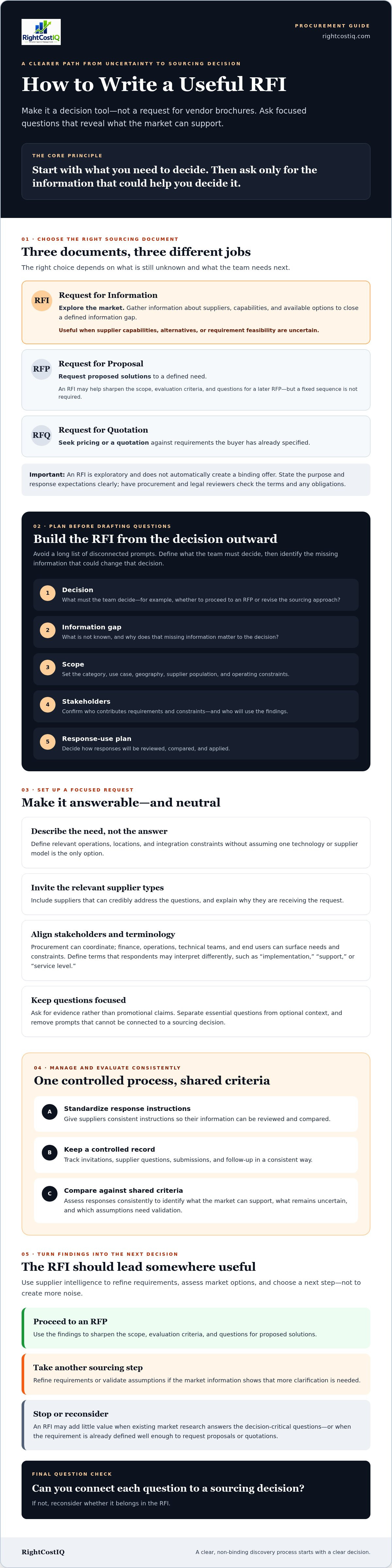
A useful RFI isn’t a request for vendor brochures; it’s a decision tool. If you’re unsure how to write a request for information (RFI), start with the questions: vague prompts invite generic answers, while an unfocused questionnaire makes supplier responses difficult to compare. It’s also easy to confuse an RFI with an RFP or an RFQ, even though each supports a different sourcing decision.
This guide shows you how to define the decision your RFI must inform, turn stakeholder needs into focused questions, distribute the document, and evaluate responses consistently. You’ll learn how an RFI differs from an RFP, which requests detailed solutions, and an RFQ, which seeks pricing against defined requirements. You’ll also see how to use supplier intelligence to refine requirements, assess the market, and decide whether to proceed to an RFP or another sourcing step. The goal is a clear, non-binding discovery process that produces actionable insight, not more noise.
Key Takeaways
- Start with the sourcing decision and information gap, then define the category scope, supplier population, stakeholders, and constraints.
- Learn how to write a request for information (RFI) with focused sections and neutral questions that ask suppliers for evidence, not promotional claims.
- Use consistent response instructions and a controlled record to manage invitations, supplier questions, submissions, and follow-up.
- Evaluate responses against shared criteria to identify what the market can support, what remains uncertain, and which assumptions need validation.
- Use the findings to refine requirements and decide whether to proceed to an RFP, take another sourcing step, or stop.
What Is a Procurement RFI, and When Should You Write One?
A procurement request for information (RFI) gathers information about suppliers, capabilities, or available market options. Use it to close a defined information gap before deciding which formal sourcing approach, if any, fits the requirement. For example, if your team knows it needs a new inventory system but hasn’t established which capabilities suppliers can provide, an RFI can help map the market before requirements are finalized.
The term also appears in construction, where an RFI commonly refers to a project communication used to clarify drawings, specifications, or site conditions. That is different from procurement market research. The broader Request for Information (RFI) overview describes its use across industries. In sourcing, the key is to define what you need to learn and which decision that information will support.
How an RFI differs from an RFP or RFQ
An RFI is exploratory. It asks suppliers for information, not automatically for a binding offer. An RFP requests proposed solutions to a defined need, while an RFQ focuses on price or a quotation for requirements the buyer has already specified. These documents serve different purposes, but they don’t have to follow a fixed sequence. A buyer may know enough about the market to issue an RFP directly, or may need another step to clarify requirements first.
State the document’s purpose, response expectations, and status clearly. Don’t assume the label “RFI” alone establishes its legal effect. Have procurement and legal reviewers check the terms, including whether responses create any obligations for either party.
When an RFI is useful, and when it is not
Write an RFI when uncertainty could materially affect the sourcing strategy. That might include unclear supplier capabilities, limited understanding of market alternatives, or uncertainty about which requirements are feasible. The findings can inform a later RFP by sharpening the scope, evaluation criteria, and questions suppliers will need to answer. They can also help teams assess supplier responses against cost benchmarks and prepare for negotiation, without assuming the RFI itself will produce savings.
An RFI may add little value if current market research already answers the decision-critical questions or if the requirement is sufficiently defined to request proposals or quotations. Before deciding how to write a request for information (RFI), identify what you still need to learn. If you can’t connect a question to a sourcing decision, reconsider whether it belongs in the document.
In short: A procurement RFI is a market-research document used to gather supplier and market information that can guide a sourcing decision. Its terms determine the obligations, if any, created by the process.
Plan the RFI Before Writing Supplier Questions
Start with the decision, not a blank questionnaire. An RFI designed to “learn more about the market” can quickly become a long list of disconnected questions. Define the decision the team needs to make, then identify the missing information that could change it. For example, if you’re deciding whether to replace a service model, you may need to learn which supplier types can meet your operating needs before drafting detailed requirements.
Use this planning sequence before writing supplier questions:
- Decision: State what the team must decide, such as whether to proceed to an RFP or revise the sourcing approach.
- Information gap: Identify what isn’t known and why it matters to that decision.
- Scope: Set the category, use case, geography, supplier population, and operating constraints.
- Stakeholders: Confirm who needs to contribute and who will use the findings.
- Response-use plan: Decide how you’ll review, compare, and apply supplier information.
Set the objective, scope, and respondent audience
Describe the need without prescribing the answer. If you’re researching warehouse technology, define the relevant operations, locations, and integration constraints, but don’t assume a particular technology or supplier model is the only option. Invite supplier types that can credibly address the questions, and explain why they’re receiving the request. Procurement can coordinate the process, while finance, operations, technical teams, and end users can identify requirements and constraints that procurement may not see alone.
Agree on terminology before distribution. Words such as “implementation,” “support,” or “service level” can mean different things to different respondents. Define terms where needed, and separate essential questions from optional context. This keeps the request focused and makes it easier for suppliers to provide useful, answerable responses.
Decide how responses will inform the next step
Set the review method before responses arrive. Decide how the team will summarize supplier capabilities, implementation considerations, market options, and commercial information. Specify the response format, deadline, contact channel, and how questions or clarifications will be handled. If information will be compared, ask suppliers to answer common questions in a consistent structure. Keep a record of assumptions and unresolved issues so they don’t get lost in narrative responses.
A disciplined plan creates stronger inputs for a later RFP management framework, including clearer requirements and evaluation criteria. If your team is assessing procurement opportunities, RightCostIQ’s free procurement diagnostic is an optional way to explore where additional analysis may help. These planning choices are the foundation of how to write a request for information (RFI) that supports a defined sourcing decision.
How to Write Clear RFI Sections and Supplier Questions
A well-structured RFI makes its purpose and expected response clear from the first page. Include only background that helps suppliers answer accurately, and use the same terms throughout. State assumptions, scope boundaries, definitions, and the type of evidence requested. Avoid presenting unconfirmed requirements as settled; the RFI is an opportunity to learn what the market can support.
A practical outline includes:
- Purpose and background: Explain the information need and the decision it will inform.
- Scope: Describe the use case, relevant operating context, and boundaries.
- Questions: Group prompts by capability, delivery model, implementation, risk, support, and commercial information as relevant.
- Response instructions: Specify the format, any length or field limits, and how to submit.
- Timeline and contact: State key dates and the channel for questions or clarifications.
Provide a response template when it will make answers easier to compare. It can be a simple table or set of defined fields, rather than a rigid, client-specific form. Leave room for suppliers to explain relevant context, while asking them to distinguish facts from estimates and assumptions.
Write questions suppliers can answer consistently
Replace broad prompts with bounded questions. Instead of “Describe your solution,” ask, “Which functions support the stated use case? Identify each function and provide a relevant example or supporting documentation.” Group related prompts so suppliers can answer efficiently, but keep each question focused on one information need.
Use tables or defined fields for facts you expect to compare, such as supplier experience, delivery model, implementation approach, or support arrangements. Reserve open responses for context that won’t fit a fixed field. For commercial information, specify what you’re seeking, such as pricing structure or key cost drivers, and ask suppliers to label estimates, exclusions, assumptions, and the basis for any figures. This keeps exploratory information distinct from a formal quotation.
Consistent question wording makes supplier responses easier to compare because each respondent is answering the same defined information request. Comparisons are more useful when each question has a clear purpose and asks for evidence or examples rather than promotional claims.
Before release, test the draft with stakeholders who will assess the responses. Ask whether each question is understandable, answerable, and relevant to the sourcing decision. Remove duplicates and prompts that won’t affect the analysis. If the RFI findings will feed a later solicitation, organize them so they can translate into clearer requirements and evaluation criteria within an RFP management framework. This is the practical core of how to write a request for information (RFI) that generates structured, decision-useful supplier intelligence.
Distribute the RFI and Evaluate Supplier Responses Consistently
Distribution choices shape response quality. Send the same version, instructions, and deadlines to every invited supplier. Set a response window that reflects the request’s complexity and the effort required to prepare a useful answer. Track invitations, acknowledgments, supplier questions, submissions, and follow-up in one controlled record so the team can see what has arrived and where action is needed.
Manage communication and response integrity
Establish one contact channel for questions and document each clarification. If an answer could affect how suppliers respond, share it consistently with all relevant invitees rather than giving one respondent a private advantage. State the RFI’s document status, confidentiality expectations, and permitted use of submitted information, subject to internal procurement and legal review. Clear communication reduces inconsistent assumptions before evaluation begins.
Analyze responses and identify information gaps
Compare each response against the information needs defined before distribution, not as an automatic award score. Use common categories for capabilities, delivery assumptions, implementation, risks, support, and commercial inputs. Flag missing answers, claims without supporting evidence, inconsistent units, and assumptions that need clarification. Treat these exceptions as findings, not as gaps to fill with guesswork.
A simple comparison record can keep the review focused:
| Criteria | Requested evidence | Response summary | Unresolved questions |
|---|---|---|---|
| Implementation approach | Relevant examples and stated dependencies | Summarize the supplier’s response | Which dependencies need validation? |
| Commercial inputs | Pricing structure, assumptions, and exclusions | Record figures and stated basis | Are units or assumptions consistent? |
| Risk and support | Identified risks and support model | Note evidence provided | What remains unclear? |
For cost-related responses, compare like-for-like inputs and distinguish supplier-provided information from external reference data. Procurement cost benchmarking can provide analytical context for assessing cost assumptions, but an RFI response alone doesn’t establish that a price is competitive.
This disciplined review turns supplier input into clearer requirements and stronger materials for a later RFP. If you’re assessing where procurement analysis could support that next step, request a free procurement diagnostic. Consistent distribution and evaluation are essential to how to write a request for information (RFI) that produces decision-useful intelligence.
Turn RFI Findings into a Stronger Procurement Next Step
Close the RFI with a decision record, not just a stack of supplier responses. Summarize what the market research established, what remains uncertain, and which assumptions need validation. Separate requirements supported by internal stakeholders or credible evidence from supplier suggestions and unverified claims. This prevents a persuasive response from becoming an untested requirement.
Use response patterns to refine the sourcing plan. If suppliers interpret a capability differently, clarify the requirement. If implementation approaches vary, identify which assumptions need testing. If the market can’t meet a desired condition, stakeholders may need to revisit scope or priorities. The findings can also inform supplier eligibility and evaluation criteria, or support a decision to pause or stop if the business need isn’t sufficiently clear.
Convert market intelligence into sourcing requirements
Translate validated findings into precise, outcome-based requirements. Carry forward useful supplier questions, but don’t adopt a proposed specification simply because one respondent recommended it. Review the draft scope and criteria with stakeholders to align operational needs, commercial considerations, and technical constraints. A structured handoff helps turn RFI insight into a focused RFP rather than repeating the same discovery work.
For teams moving into formal sourcing, RightCostIQ provides RFP management and negotiation assistance to support the process once the market and requirements are clearer.
Choose the next step without overcommitting
An RFP is appropriate when the organization is ready to define its need, compare structured proposals, and follow a clear decision process. If the RFI exposes unresolved requirements or substantial market uncertainty, conduct further research or stakeholder review first. If existing solutions don’t fit the business case, stopping or revising the approach may be more disciplined than launching a formal competition.
The value of how to write a request for information (RFI) lies in the quality of the decision it enables. Treat supplier input as evidence to assess, not a commitment to buy or a guarantee of better commercial outcomes. If your team is considering a sourcing project, assess procurement priorities and determine which next step the findings actually support.
Make Your Next Sourcing Decision with Confidence
A strong RFI starts with a defined decision, asks focused questions, and gives suppliers a consistent way to respond. The findings should clarify what the market can support, what still needs validation, and whether an RFP is the right next step. That’s the practical value of knowing how to write a request for information (RFI): you turn supplier input into a clearer sourcing path, not an automatic commitment to buy.
Once the market and requirements are clearer, RightCostIQ provides RFP management and negotiation assistance to support formal sourcing. Its procurement cost benchmarking and analytics can also help teams assess commercial inputs alongside their sourcing requirements. These services support informed analysis, not guaranteed savings.
If you’re evaluating procurement priorities or considering a move from market research to a formal RFP, request a free procurement diagnostic as an optional next step. Build on what you’ve learned and move forward with a sourcing decision grounded in evidence.
Frequently Asked Questions
What is an RFI in procurement?
A procurement request for information (RFI) gathers facts about suppliers, capabilities, market options, or delivery models. It helps a buying team investigate an information gap before choosing how to source a need. An RFI isn’t automatically a request for a binding offer. State the document’s purpose, status, and terms clearly, and have the appropriate procurement or legal reviewers assess them before distribution.
What is the difference between an RFI, RFP, and RFQ?
An RFI gathers exploratory information, an RFP asks suppliers to propose approaches to defined needs, and an RFQ generally requests pricing or quotations for specified requirements. The documents serve different purposes, but they don’t have to follow a fixed sequence. An RFI may help shape a later RFP, while a buyer with clear requirements may choose another sourcing method. Explain the purpose and response expectations in each request.
What should be included in a request for information?
Include the objective, relevant background, scope, supplier questions, response format, submission instructions, timeline, and contact details. State applicable document-status and confidentiality terms, subject to internal review. Keep background that helps suppliers respond accurately, and remove details that don’t affect their answers. Tailor questions to the decision the team needs to make, distinguishing required responses from optional context so submissions stay focused and easier to analyze.
How do you write effective RFI questions?
To understand how to write a request for information (RFI), begin with the decision it needs to inform, then ask one clear, neutral question at a time. Define technical terms and specify the format or evidence requested. Instead of asking suppliers to “describe your solution,” ask for relevant capabilities and examples tied to the stated use case. Request the same core information from each respondent, with space to identify assumptions or exceptions.
How many suppliers should receive an RFI?
There’s no universal number of suppliers to invite. Select respondents based on the research objective, the available market, and the range of capabilities the team needs to understand. A broad market scan may call for wider outreach, while a specialized question may be best directed to a focused group. Document the selection rationale, then apply consistent instructions, clarification practices, and response expectations to everyone invited.
Is a supplier required to respond to an RFI?
Usually, an RFI invites suppliers to provide information rather than committing them to a purchase, but obligations depend on the document’s wording and any applicable arrangements. Don’t assume every supplier must respond or that the buyer must proceed afterward. State deadlines, participation expectations, confidentiality terms, and intended use of responses clearly. Have the appropriate procurement or legal reviewer check the terms before issuing the RFI.
What is the difference between a procurement RFI and a construction RFI?
A procurement RFI generally gathers supplier or market information to guide a sourcing decision. In construction project administration, an RFI commonly requests clarification about project documents, design details, or site conditions. The shared acronym can cause confusion, so identify the procurement context in the document title, opening paragraph, and instructions. This helps suppliers understand what information is being requested and how their responses will be used.


