
A supplier scorecard that doesn’t drive a decision is just paperwork. A supplier performance management framework creates value when it connects contract commitments to reliable evidence and assigns someone to act on the results. Without that connection, teams can debate subjective ratings while delivery, quality, or cost issues continue.
Supplier reviews can capture plenty of activity and still leave important questions unanswered: Which expectations matter most? Does the data reflect the contract? Who owns the response when performance falls short? Clear measures and follow-through turn reviews from reporting exercises into practical procurement controls.
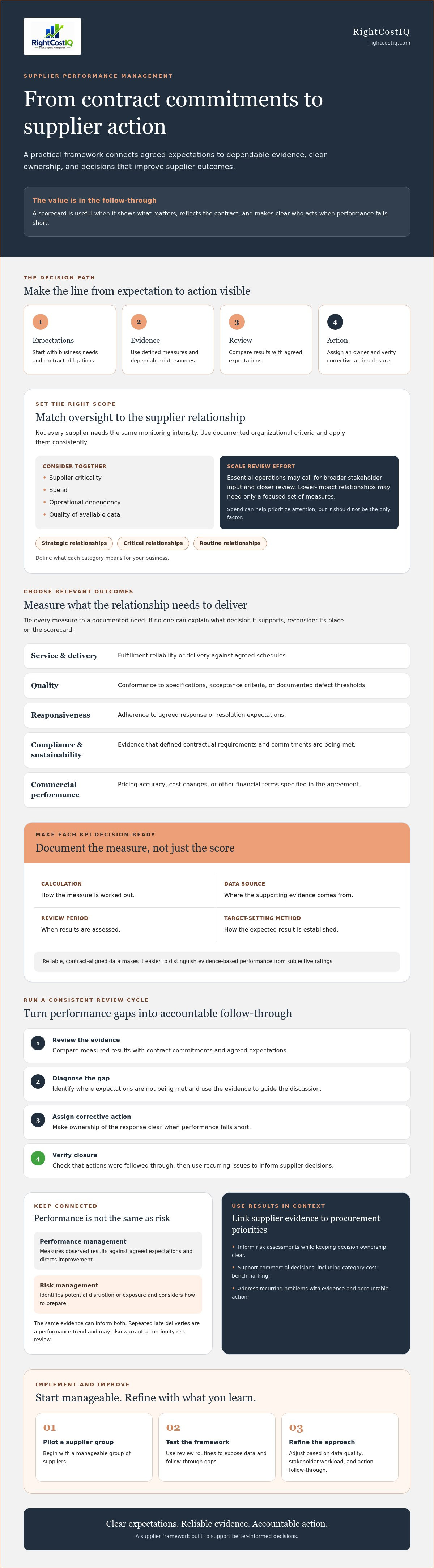
This guide explains how to build a measurable framework that fits each supplier relationship. You’ll learn how to define relevant KPIs, establish dependable data and review routines, spot gaps early, and assign accountable corrective actions. It also covers how to connect performance data with procurement priorities, risk assessments, and commercial decisions such as category cost benchmarking. The goal is a clear line from expectations to evidence to action, so teams can address recurring problems and make better-informed supplier decisions.
Key Takeaways
- Scope supplier oversight according to criticality, spend, operational dependency, and the quality of available data.
- Build a supplier performance management framework around defined outcomes, accountable owners, and evidence-based measures.
- Make each KPI decision-ready by documenting its calculation, data source, review period, and target-setting method.
- Use a consistent review cycle to diagnose performance gaps, assign corrective actions, and verify closure.
- Pilot the approach with a manageable supplier group, then refine it based on data quality, stakeholder workload, and action follow-through.
What a Supplier Performance Management Framework Should Achieve
A supplier performance management framework is the operating structure for governing supplier outcomes. It defines which results matter, how they’re measured, who reviews the evidence, and what happens when performance meets or misses expectations. It turns contract commitments into repeatable management decisions instead of leaving teams to rely on informal feedback or disconnected scorecards. Supplier performance management (SPM) provides a foundation for using supplier results to support cost control, risk reduction, and continuous improvement.
Supplier performance management has a distinct role in the procurement lifecycle. Supplier selection evaluates potential providers before award. Contract administration manages the agreement and its obligations. Performance management tracks actual results against agreed expectations and directs follow-up. Risk monitoring looks for potential threats, including events that could affect future delivery or continuity. These activities should inform one another, but each answers a different question.
Which outcomes should supplier performance management support?
Start with business needs and contract obligations. Then choose outcomes that show whether a supplier is meeting them. Depending on the relationship, relevant measures may include:
- Service continuity and delivery: fulfillment reliability or delivery against agreed schedules.
- Quality: conformance to specifications, acceptance criteria, or documented defect thresholds.
- Responsiveness: adherence to agreed response or resolution expectations.
- Compliance and sustainability: evidence that defined contractual requirements and commitments are being met.
- Commercial performance: pricing accuracy, cost changes, or other financial terms specified in the agreement.
Not every supplier needs the same monitoring intensity. A supplier with high operational dependency may need closer review of continuity and delivery, while a lower-impact relationship may need only a focused set of measures. Tie each metric to a documented need. If no one can explain what decision it supports, reconsider its place on the scorecard.
How is performance management different from supplier risk management?
Supplier performance management measures and improves a supplier’s observed results against agreed expectations; supplier risk management identifies and responds to potential disruption or exposure. One evaluates what has happened against commitments. The other assesses what could happen and how the organization should prepare.
The same evidence can inform both processes without merging them. Repeated late deliveries are a performance trend and may also indicate a continuity concern that warrants risk review. A price change can be assessed against commercial terms and separately considered for its potential financial exposure. Keep the processes connected, with clear ownership for each decision. This distinction helps procurement, operations, and finance understand what action is needed.
Build the Supplier Performance Framework Around Objectives and Governance
A workable supplier performance management framework needs more than a scorecard. It needs a defined sequence that connects business priorities to review decisions: segment suppliers, set outcomes, assign owners, define evidence, and establish review intervals. Each step should make accountability clear and explain how the resulting information will be used.
Set the framework’s scope based on supplier criticality, spend, operational dependency, and available data. A supplier whose failure could interrupt an essential operation may need broader stakeholder input and closer review than a routine provider with limited impact. Spend can help prioritize attention, but it shouldn’t be the only factor. Operational dependence and the quality of available performance evidence also matter. IBM’s proven 5-step framework offers another reference point for structuring supplier oversight.
How should organizations segment suppliers for performance reviews?
Use documented organizational criteria to distinguish strategic, critical, and routine relationships. Define what each category means for your business, then apply the categories consistently. For example, a critical supplier might provide an input with few practical alternatives, while a strategic supplier may play a substantial role in long-term business objectives. Avoid adopting universal spend thresholds without evidence that they fit your organization.
Segmentation should shape the review, not just label the supplier. Higher-priority relationships may call for deeper evidence, cross-functional participation, and clear escalation paths. Routine relationships may need a narrower review focused on essential obligations. Set the cadence to match contract terms, operating requirements, and your ability to collect and validate data.
Who owns supplier performance decisions and follow-up?
Name a relationship owner to consolidate evidence, convene reviews, record decisions, and track follow-up. Procurement can provide governance and commercial context. Operational or service owners should validate whether delivery and quality measures reflect actual requirements. Finance can contribute when cost or pricing outcomes are in scope. Define who can approve actions or escalate issues before a review identifies a gap.
Set each measure’s evidence source and validation responsibility in advance. For example, a delivery metric needs an agreed definition and an owner who can confirm the underlying records. Align review intervals with contract terms and operational needs, and consider additional reviews after material changes. The RFP supplier evaluation process can also help establish expectations before award, giving performance governance a clearer starting point.
Record the operating model in a concise governance plan: supplier category, intended outcomes, owners, evidence, review cadence, and escalation route. This makes responsibilities visible and keeps oversight proportional to the relationship.
Choose Supplier Performance Metrics That Produce Actionable Scorecards
A scorecard should show whether a supplier is meeting defined obligations and what decision the results support. Select measures based on the contract and operating model, not because they’re common elsewhere. A delivery KPI may matter for a supplier responsible for time-sensitive inputs. Responsiveness or sustainability measures belong on the scorecard only when they connect to documented requirements and have accountable owners.
A KPI is decision-ready only when its source, owner, and decision threshold are defined, so teams can trust the result and know when to act. For every measure, document its formula, data source, responsible owner, review period, and target-setting method. For example, calculate on-time delivery as deliveries received by the agreed date divided by total deliveries in the period. Set the target from contract terms or an approved business requirement, not an unsupported benchmark.
Which supplier KPIs belong on a performance scorecard?
Choose measures that reflect the supplier’s obligations and the business outcome at stake. The table presents options, not a universal checklist. Confirm definitions and evidence before comparing suppliers.
| Measure area | Purpose and suitable evidence | Common interpretation risk |
|---|---|---|
| Delivery | Assess schedule adherence using order and receipt records. | Changing the agreed delivery date can distort the result. |
| Quality | Track conformance using inspection, acceptance, or defect records. | Different product or service complexity can make raw counts misleading. |
| Service | Measure responsiveness or issue resolution using case records and agreed timestamps. | Fast closure doesn’t necessarily mean the issue was resolved effectively. |
| Compliance | Confirm defined contractual requirements through review records or submitted evidence. | A completed check may not establish ongoing adherence. |
| Sustainability | Assess specified commitments using evidence required by the organization. | Self-reported information may not be comparable across suppliers. |
| Cost | Monitor performance against agreed pricing or cost terms using invoices and contract records. | Changes in scope or specifications can affect comparisons. |
How can scorecards balance standardization with category-specific needs?
Maintain a small shared core of consistently defined measures for cross-supplier visibility, then add KPIs tied to each category’s service, product, or contract requirements. A shared delivery measure can support portfolio review, while a category-specific quality or response metric captures operational detail. This lets procurement compare results without overlooking important differences. Connect scorecard design to the organization’s category cost benchmarking when commercial performance is relevant, and keep each KPI tied to a clear decision.
Run Supplier Reviews That Turn Performance Gaps Into Corrective Action
A review creates value when it moves from evidence to a decision. Use the same cycle each time: validate the data, compare results with agreed expectations, diagnose causes, agree on corrective actions, and verify that those actions are complete and effective.
How should supplier performance review meetings work?
Share a validated scorecard and prioritized agenda before the meeting. Focus on material variances, recurring patterns, and decisions that need stakeholder input. A delivery miss, for example, may stem from supplier capacity, an inaccurate forecast, or a late internal purchase order. Check the evidence before assigning responsibility.
End each review with a documented decision record. For every action, name an accountable owner, due date, required evidence, and escalation route. Procurement can coordinate follow-up, while operational or service owners confirm whether the proposed response addresses the issue. Make sure the supplier understands what must change and how the organization will verify closure.
When should a performance issue trigger corrective action?
Use pre-agreed thresholds, repeated patterns, contractual duties, and business impact to determine whether a variance needs formal action. A single late delivery may warrant investigation and monitoring. Repeated misses against the same commitment may justify a corrective-action plan or escalation under the contract. Avoid changing supplier status based on one data point unless the impact or contractual terms warrant immediate attention.
Diagnose the cause before choosing a response. Separate supplier-controlled issues from internal process constraints, then set a proportionate action with a clear completion test. For a cost variance, confirm that scope, specifications, and contract terms are comparable before escalating. Supplier cost benchmarking can help inform that analysis. Define in advance what evidence will demonstrate resolution, such as corrected records, verified delivery performance, or confirmation that an agreed process change is in place.
At the next review, verify both completion and outcome. An action marked “done” isn’t closed if the underlying gap continues. If the issue persists, revisit the diagnosis, adjust the response, and escalate according to the agreed criteria. This creates a traceable link between a performance signal and a procurement decision.
Use this cycle to identify where evidence, ownership, or follow-up breaks down. Then prioritize the gaps that most affect supplier decisions and procurement visibility.
Implement and Improve a Supplier Performance Management Framework
Pilot the supplier performance management framework before expanding it across the portfolio. Choose a manageable group that represents different supplier relationships, such as a business-critical provider and a routine supplier. The goal is to test whether the framework works in practice, not simply whether teams can complete a scorecard.
What should a supplier performance framework pilot test?
During the pilot, check that each selected measure has reliable evidence, a clear owner, and an interpretation stakeholders understand consistently. Confirm that scorecards support decisions rather than duplicate existing reporting. Track whether identified gaps lead to actions with accountable owners, deadlines, and documented closure.
Ask the people doing the work what needs adjustment. If a data source is difficult to validate, a KPI doesn’t reflect the contract, or meetings require more preparation than the decisions warrant, revise the process. Review:
- Data quality: Are records complete, consistent, and traceable to an agreed source?
- Stakeholder workload: Can owners prepare for reviews without creating duplicative reporting?
- KPI relevance: Do measures reflect supplier obligations and inform a real procurement decision?
- Action closure: Are follow-ups completed on time, with evidence that the issue was addressed?
How can procurement analytics support framework improvement?
Consistent supplier data helps procurement distinguish isolated exceptions from recurring patterns. Reviewing results over time can show where performance is weakening, where agreed actions aren’t resolving issues, or where a measure needs recalibration. Use these findings to refine thresholds, governance, and review cadence, and document why each change was made. Keep the framework proportionate as it expands. Adding suppliers shouldn’t mean adding measures that don’t support decisions.
Procurement and vendor performance tracking, paired with category cost benchmarking and analytics, can help organizations assess supplier results alongside commercial priorities. When performance evidence informs a supplier discussion, teams can also consider negotiation support for supplier discussions as part of follow-up planning. Any analytics process should rely on evidence the organization can validate. Don’t assume a tool supports particular integrations or automated functions without confirming them.
Once the pilot shows that measures are usable, owners are accountable, and actions close with evidence, expand in stages and carry forward the lessons learned. To assess where supplier tracking and procurement visibility need attention, use RightCostIQ’s free diagnostic to evaluate your procurement needs.
Turn Supplier Data Into Better Procurement Decisions
A supplier performance management framework works when it connects contract expectations to dependable evidence and accountable action. Keep oversight proportional to each supplier’s importance, choose measures that support real decisions, and use review findings to resolve gaps rather than simply record them.
Start with a focused pilot, then refine the framework based on what you learn about data quality, KPI relevance, ownership, and action closure. Consistent supplier information can also help procurement teams assess performance alongside commercial priorities, including category costs.
RightCostIQ provides procurement and vendor performance tracking services, along with procurement category cost benchmarking and analytics. If you’re assessing how to strengthen supplier visibility and follow-up, start your free procurement diagnostic.
Clear measures and well-owned actions give your team a practical foundation for stronger supplier decisions. Build the process step by step, and improve it as the evidence develops.
Frequently Asked Questions
What is a supplier performance management framework?
A supplier performance management framework is the governance, measures, review process, and follow-up actions an organization uses to manage supplier results. It links contract commitments to evidence, assigned owners, and decisions. A practical framework defines which suppliers and outcomes matter, how performance is assessed, and how gaps are addressed. Its purpose isn’t just to produce scores, but to support consistent procurement decisions and verify whether corrective actions resolve identified issues.
Which KPIs should a supplier performance scorecard include?
Include KPIs that reflect a supplier’s contract obligations and the business outcomes the relationship supports. Depending on the category, measures may cover on-time delivery, quality conformance, service responsiveness, issue resolution, compliance, sustainability, or commercial performance. Define each KPI’s formula, evidence source, owner, review period, and target. For example, measure delivery against agreed dates using receipt records. Don’t include metrics that lack reliable evidence or won’t inform a decision.
How often should supplier performance be reviewed?
Set review frequency according to supplier criticality, contract terms, operational needs, and the reliability of available data. A business-critical supplier may need closer oversight than a routine provider, but the cadence should reflect actual exposure and organizational capacity. Define the schedule in governance expectations, then consider additional reviews when material changes or performance concerns arise. Consistent review matters more than applying the same frequency to every supplier relationship.
How do you create a supplier performance scorecard?
Start with the contract and the business objectives the supplier supports. Select a focused set of relevant measures, then document each KPI’s definition, calculation, evidence source, accountable owner, target, and review period. Establish how results will be interpreted and which thresholds require follow-up. Validate the data before scoring suppliers, and confirm with stakeholders that the scorecard supports decisions rather than duplicating existing reports.
What is the difference between supplier performance management and supplier risk management?
Supplier performance management evaluates observed results against agreed expectations, while supplier risk management identifies and responds to potential disruption or exposure. A pattern of late deliveries is a performance issue; it may also signal a continuity risk that needs separate assessment. The processes can use shared evidence, but they serve different purposes. Performance reviews focus on results and improvement, while risk work considers potential events and appropriate responses.
What should happen when a supplier misses a performance target?
Validate the result, assess its business impact, and determine whether it is an isolated variance or a recurring pattern. Check the contract and pre-agreed escalation criteria before deciding on a response. Diagnose whether the cause sits with the supplier, internal processes, or both. If corrective action is needed, document the action, owner, deadline, required evidence, and escalation path. Verify not only that the action was completed, but also that performance improved.
Can one supplier performance framework work across every category?
One governance model can support multiple categories, but a single identical scorecard usually won’t capture every relationship’s requirements. Maintain a shared core of consistently defined measures for portfolio visibility, then add category-specific KPIs tied to the contract and operating model. For example, delivery reliability may be relevant across categories, while a specialized service may require distinct response or quality measures. Keep each added metric evidence-based and decision-relevant.


