

What if the supplier with the highest total score isn’t the strongest choice? A total can conceal a serious security concern, an unrealistic implementation plan, or a commercial trade-off that matters more than a few extra points. A well-built RFP scoring rubric makes those trade-offs visible before the team compares suppliers, not after the ranking is set.
It’s a familiar challenge: evaluators interpret the same criteria differently, weights feel difficult to defend, and final scores can look more precise than the judgment behind them. Without clear scoring guidance and a documented rationale, even a capable team can struggle to explain why one proposal ranked ahead of another.
This guide shows you how to build a consistent, defensible evaluation: translate documented requirements and business priorities into criteria, separate mandatory pass/fail gates from scored measures, assign and justify weights, and use scoring anchors to reduce interpretation gaps. You’ll also learn how to compare proposals without letting a single total hide important risks, reconcile evaluator differences, and record the reasoning behind your decision. The result is a decision trail that supports approvals, negotiation, and future review.
Key Takeaways
- Build your rfp scoring rubric around documented requirements and business outcomes, with clear rating guidance evaluators can apply consistently.
- Separate mandatory pass/fail gates from weighted criteria so a strong total score can’t conceal a critical requirement failure.
- Have evaluators score proposals independently, then reconcile material differences using proposal evidence and documented rationale.
- Capture clarifications, assumptions, evidence gaps, and approved scoring changes to create a reliable decision trail.
- Use the final ranking as an input to a sourcing recommendation, checking risks, commercial implications, and approval needs before deciding.
What an RFP scoring rubric does, and why the evaluation needs one
When several evaluators review supplier proposals, each may apply a different standard to the same response. One may prioritize technical detail; another may focus on implementation risk or commercial terms. An rfp scoring rubric gives the team shared decision criteria before evaluation begins, so proposal differences can be assessed consistently and explained later.
A Request for Proposal (RFP) invites suppliers to respond to a buyer’s stated needs. The rubric is the buyer-side framework for comparing those responses. It’s distinct from supplier-side RFP response management, which helps vendors prepare and coordinate their submissions. For buyers, disciplined evaluation can also connect to broader RFP management and negotiation assistance.
Definition: An RFP scoring rubric is a pre-established framework that defines evaluation criteria, scoring guidance, weights, evidence requirements, and documentation expectations for comparing supplier proposals.
What belongs in an RFP scoring rubric?
A usable rubric spells out what evaluators assess and how they record their findings. It should include:
- Criteria: The business needs and proposal requirements against which suppliers will be evaluated.
- Rating scale: Defined score levels, with descriptions that distinguish performance at each level.
- Weighting method: The relative importance assigned to each scored criterion and how scores contribute to the result.
- Evidence rules: What counts as support, such as a response detail, implementation plan, or reference provided in the proposal.
- Documentation expectations: How evaluators record rationale, assumptions, gaps, and clarifications.
Separate mandatory requirements from scored criteria. A mandatory requirement may be assessed as pass/fail, while scored criteria distinguish proposals that meet the threshold. Which requirements are mandatory depends on the specific RFP. In both cases, criteria should map to stated business needs, not preferences introduced after proposals arrive.
What a rubric can, and cannot, make objective
Shared definitions reduce scoring variation, but they don’t erase professional judgment. Evaluators still interpret proposal evidence, assess its relevance, and determine how well it addresses each requirement. The rubric makes that judgment more consistent and traceable by requiring the same standards and rationale across suppliers.
Apparent precision can mislead if criteria are vague, weights lack a clear connection to business priorities, or evidence is incomplete. A numerical score can’t repair a weak evaluation design; it can only make the result look more exact. A rubric structures professional judgment; it doesn’t replace it. A strong rfp scoring rubric makes the reasoning behind scores visible, including where evidence is limited and where evaluators must apply informed judgment.
How to design RFP scoring criteria and weights before proposals arrive
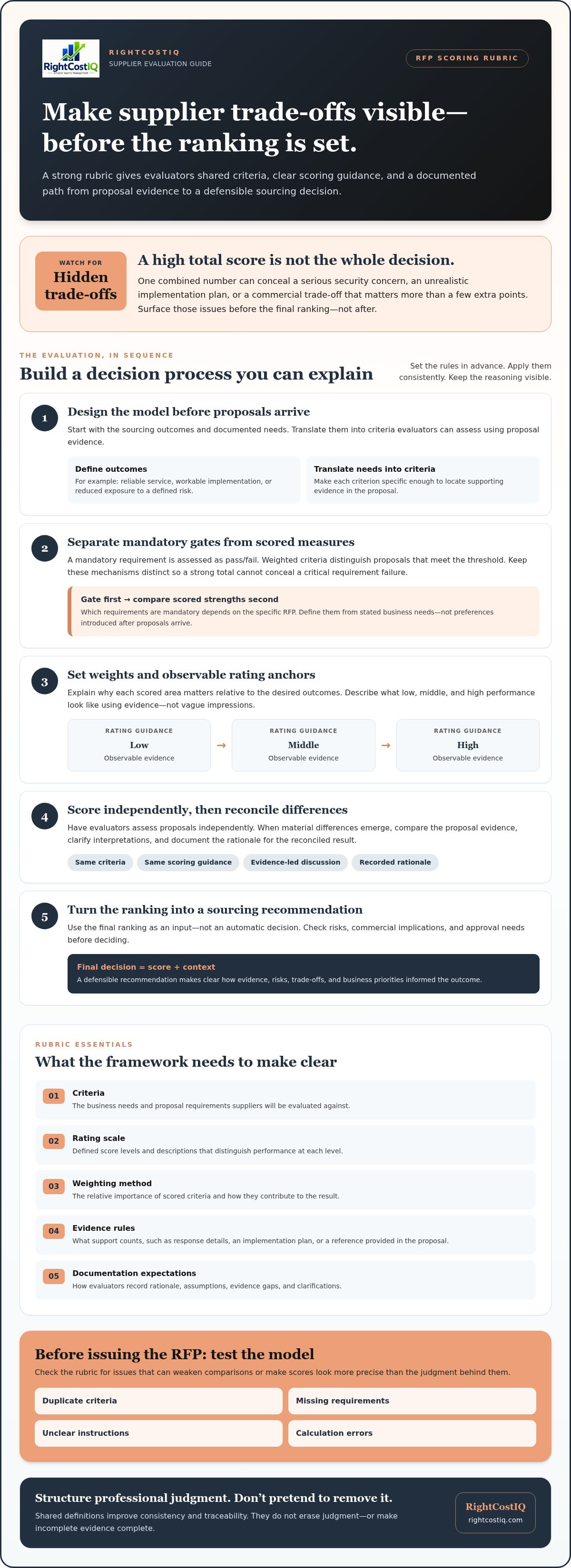
Design the evaluation model before supplier responses can influence what the team values. A defensible rfp scoring rubric connects each score to a documented requirement or business priority, with criteria, weights, and rating guidance set in advance. Use this sequence to build and check the model:
- Define the outcomes. State what the sourcing decision needs to achieve, such as reliable service, a workable implementation, or reduced exposure to a defined risk.
- Translate requirements into criteria. Make each criterion specific enough that evaluators can locate supporting evidence in the proposal.
- Set and justify weights. Document why each scored area matters relative to the desired outcomes.
- Define rating anchors. Describe what low, middle, and high performance look like using observable evidence.
- Test the model. Check for duplicate criteria, missing requirements, unclear instructions, and calculation errors before issuing the RFP.
Depending on the sourcing scope, organize criteria across technical, operational, commercial, implementation, and risk considerations. Not every RFP needs every category. Commercial analysis, including cost benchmarking where appropriate, can add context to price comparisons without replacing technical or operational evaluation. For broader planning, see these strategic RFP frameworks.
Translate requirements into measurable evaluation criteria
Convert broad requirements into observable questions. Instead of scoring “strong implementation,” assess whether the proposal explains accountable roles, milestones, dependencies, and how the supplier will manage stated constraints. Avoid scoring the same capability twice under different labels, which can unintentionally amplify its influence. Keep mandatory requirements separate when appropriate: define how each pass/fail gate is assessed, then compare eligible proposals against scored criteria.
Set weights and rating anchors without false precision
Weights represent the buyer’s priorities, not universal facts. If continuity is critical to the business outcome, document why related operational criteria carry more influence than a lower-priority feature. Define each rating by evidence: a low rating might indicate a material gap, a middle rating may meet stated requirements with limited support, and a high rating may provide clear, relevant evidence beyond the baseline. Weights encode priorities; they don’t prove that one priority is objectively more important in every sourcing decision.
Before evaluation, write a short rationale for every criterion and weight. Then verify that the weighting method is internally consistent, such as confirming that weights total the intended whole and that the scoring scale aligns with the calculation. There’s no universal formula. The defensible model reflects documented needs and can be explained to evaluators and approvers.
Weighted scoring, pass/fail gates, and evaluator calibration compared
These methods serve different purposes. Weighted scoring ranks eligible proposals across priorities; pass/fail gates test mandatory conditions; qualitative evaluation captures evidence and judgment that a number alone may not explain. A robust rfp scoring rubric can combine all three rather than forcing every decision into one total.
Weighted scoring: Assigns relative importance to scored criteria and combines ratings into an overall result. It’s useful for comparing proposals across priorities, but a strong score in one area can offset a serious weakness elsewhere.
Pass/fail gates: Test specified mandatory requirements, such as a required submission component. A proposal that fails a defined gate should not be rescued by a high weighted score unless the RFP’s stated rules provide for another treatment.
Qualitative evaluation: Records evidence, strengths, limitations, and context that scores may not capture. It supports interpretation, but without shared guidance it can produce inconsistent judgments or vague rationales.
When weighted scoring is useful, and when it can mislead
Weighting helps distinguish criteria with different business importance. For example, a buyer may give implementation readiness more influence than a secondary feature because delivery risk is central to the sourcing need. Document the rationale before evaluation, rather than reverse-engineering it to favor a preferred supplier.
Weighted totals are compensatory: a high rating in one category can offset a low rating in another. That can conceal a critical weakness. Show criterion-level scores and notes alongside the overall result, and flag any material shortfall separately. Numeric scores can conceal judgment when criteria or weights lack a clear rationale; the calculation is only as sound as the model behind it.
How to calibrate evaluators and handle disagreement
Before reviewing live proposals, run a brief calibration exercise. Give evaluators the same sample evidence and rating anchors, ask them to score independently, then compare how they interpreted the scale. Clarify ambiguous language before scoring begins. Calibration aligns standards; it shouldn’t pressure reviewers to agree on supplier rankings.
During evaluation, each person should record evidence and rationale before discussing substantial score differences. If two reviewers rate the same implementation plan differently, identify which evidence supports each rating and where interpretations diverge. Reconcile the difference against the published anchors, document the outcome, and preserve the original assessments where the process requires it.
Before scoring starts, evaluators should also disclose potential conflicts of interest. Handle disclosures, recusals, and escalation through the organization’s established process. Clear controls protect the integrity of the comparison without treating disagreement itself as a problem.
How to score RFP responses, compare vendors, and document the decision
Apply the same review sequence to every supplier. This keeps proposal evidence, rather than evaluator preference or presentation style, at the center of the comparison:
- Review the evidence. Locate the proposal details that address each criterion.
- Score independently. Apply the established rating anchors before discussing other evaluators’ scores.
- Record the rationale. Cite the relevant evidence and explain how it supports the rating.
- Reconcile differences. Discuss material score gaps against the rubric, document the reasoning, and follow the agreed process for any approved changes.
Use the same scoring guidance and information set across suppliers. For material ratings, evaluators should cite proposal sections or other evidence permitted by the RFP. Distinguish missing evidence from a weak response according to the RFP’s stated rules; don’t assume an omission means failure unless the evaluation method says so. Record clarifications, assumptions, evidence gaps, and score changes, including who approved them and why.
Score proposal evidence consistently
Keep the basis for each material score visible. For example, a rating on implementation readiness should point to response details that support it, such as proposed milestones or named dependencies, rather than relying on an evaluator’s general impression. If a clarification adds information, record it and apply the same rules to all suppliers. A consistent evidence trail helps distinguish a genuine proposal difference from a difference in how reviewers interpreted the question.
Turn the evaluation record into a decision trail
Present the total score alongside category-level results, rationale, and key risks. A supplier may rank highly overall while showing a notable weakness in a business-critical category; the summary should make that trade-off clear. Include commercial implications separately. Cost benchmarking can provide context for proposal pricing, but it doesn’t replace evaluation of technical fit, operational needs, implementation, or risk.
Retain individual and reconciled scores, supporting evidence, clarifications, assumptions, approved changes, and required decision approvals. Keep the evaluation result distinct from later negotiation outcomes. If negotiations change commercial terms, record those changes separately so decision-makers can see what evaluators assessed and what was agreed afterward.
A structured record also supports a clear handoff from evaluation to negotiation. For help coordinating an evaluation process and negotiation preparation, explore RFP management and negotiation assistance.
Use the RFP scoring rubric to reach a defensible sourcing decision
A completed scorecard informs the sourcing decision, but it doesn’t make the decision automatically. Treat the highest total as evidence to assess, not an award instruction. The recommendation should explain how evaluation results align with stated requirements, business priorities, and decision rules, including any trade-offs that need approval.
What to check before confirming the preferred supplier
Before recommending a supplier, confirm that the record supports the conclusion. Revisit the RFP’s requirements and evaluation method, then check:
- Mandatory requirements: Are the pass/fail results complete and handled as stated in the RFP?
- Evidence quality: Do material ratings cite relevant evidence, and are gaps or assumptions visible?
- Critical risks: Could a weakness in a high-priority area be obscured by the aggregate score?
- Commercial implications: Do proposed terms or pricing raise questions that merit further analysis?
- Approvals: Are the recommendation and supporting records ready for review through the organization’s established process?
The recommendation should state why the preferred supplier best fits the evaluation, identify material risks and trade-offs, and explain how those considerations affect the decision. If the highest-ranked proposal isn’t recommended, document the evidence-based reason. That explanation is part of a defensible rfp scoring rubric process, not an exception to it.
Move from evaluation findings to negotiation priorities
Use the evaluation record to identify negotiation topics. Evidence gaps, commercial considerations, and proposal assumptions can become questions to clarify or terms to discuss. Keep negotiation outcomes in a separate record from evaluation scores. This preserves what the team assessed in the proposals and makes subsequent changes to terms clear.
RightCostIQ’s RFP management and negotiation assistance, along with procurement category cost benchmarking and analytics, may be relevant when teams need support connecting evaluation findings to negotiation preparation. Cost context can inform commercial discussions, but it shouldn’t replace the technical, operational, and risk analysis behind the sourcing recommendation. Learn more about negotiation assistance.
To explore a next step, start the free diagnostic. Review its scope directly with RightCostIQ before relying on it for a specific evaluation need.
Make your next sourcing decision easier to defend
A disciplined rfp scoring rubric gives evaluators a shared method for comparing proposals, while documented evidence and rationale make the recommendation easier to explain. Keep mandatory requirements distinct from weighted results, and review category-level strengths, critical risks, and commercial implications before treating a ranking as a decision.
Carry the evaluation forward carefully. Use evidence-backed gaps and commercial questions to shape negotiation priorities, while keeping negotiation outcomes separate from proposal scores. Procurement category cost benchmarking and analytics can add commercial context, and RFP management and negotiation assistance can support the process from evaluation into negotiation preparation.
RightCostIQ offers these services for teams looking to strengthen their sourcing approach. Start the free diagnostic to explore a potential next step with RightCostIQ. A clear decision trail helps your team move forward with greater confidence and a stronger basis for review.
Frequently Asked Questions
What is an RFP scoring rubric?
An RFP scoring rubric is a framework for evaluating supplier proposals against criteria established before scoring begins. It defines what evaluators assess, how they assign ratings, how criteria are weighted, and what evidence and rationale they must record. A rubric creates a consistent basis for comparing responses and explaining a recommendation. It structures professional judgment; it doesn’t remove the need for evaluators to interpret proposal evidence.
How do you create a scoring rubric for an RFP?
Start with the business outcomes and requirements the RFP is intended to address. Convert them into distinct criteria that evaluators can assess using evidence in supplier responses. Separate mandatory pass/fail requirements from criteria used to compare eligible proposals. Then set and justify weights, define rating anchors, specify documentation rules, and test the scoring model for duplicate criteria or unclear instructions before proposals arrive.
How should criteria be weighted in an RFP?
Weight criteria according to their documented importance to the sourcing decision, not because a template uses familiar percentages. If implementation risk is central to the business need, explain why it carries more influence than a secondary feature. Define the calculation method, check that weights total the intended whole, and apply the method consistently. Record the rationale before evaluation so weights aren’t adjusted to favor a proposal.
Should an RFP use pass/fail requirements or weighted scoring?
Many evaluations use both. Pass/fail gates test requirements suppliers must meet, while weighted scoring differentiates proposals that qualify. Define each mandatory gate and its treatment in the RFP, then score eligible responses against the published criteria. A high weighted total shouldn’t automatically override a failed mandatory requirement unless the stated process allows it. The right design depends on the sourcing scope and the buyer’s requirements.
How do you make RFP scoring more objective?
Use specific criteria, shared rating anchors, and clear evidence rules to reduce differences in how evaluators interpret proposals. Require reviewers to cite response sections or other approved evidence for material scores, and distinguish missing information from a weak response according to the RFP’s rules. Score independently before discussing results. These controls make evaluations more consistent and traceable, but they can’t eliminate judgment or compensate for an unclear rubric.
What should evaluators do when their RFP scores differ?
Evaluators should first record their independent scores and the evidence behind them. Then discuss material differences by comparing the cited proposal evidence with the rubric’s rating anchors. Reconcile scores only when the evidence and rules support a change, and document the reasoning and any approved adjustment. Don’t pressure reviewers to agree for the sake of uniformity. Follow the organization’s process for conflicts of interest and escalation.
Should price be the most heavily weighted RFP criterion?
Not by default. Price weight should reflect the sourcing priorities and the consequences of trade-offs, including performance, implementation, operational fit, and risk. A low-priced proposal may not offer the strongest value if it presents material gaps in other critical areas. Compare commercial proposals using consistent assumptions, and use cost benchmarking where appropriate to add context. Keep that analysis distinct from technical and operational evaluation.
How should an RFP scoring decision be documented?
Keep a record that explains how the recommendation followed the evaluation method. Include criteria and weights, individual and reconciled scores, evidence citations, rationale, clarifications, assumptions, evidence gaps, and approved score changes. Summarize category-level strengths, material risks, and commercial considerations alongside total scores. Record the recommendation and required approvals, then track negotiation outcomes separately so the evaluation record remains clear about what suppliers originally proposed.


