
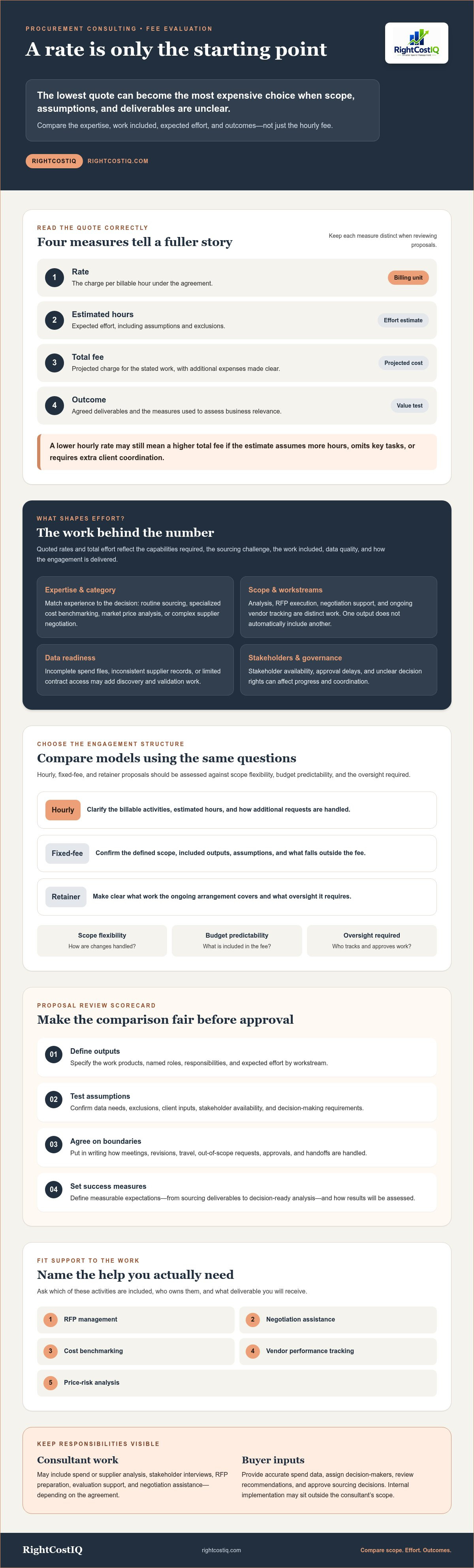
The lowest quote can become the most expensive choice if the scope, assumptions, and deliverables aren’t clear. That’s why procurement consultant hourly rates are a starting point, not a reliable measure of value.
It’s reasonable to compare fees closely, especially when you need to justify the spend internally. But a fair comparison also accounts for the expertise required, the work included, and the outcomes each proposal commits to deliver. Without those details, hourly figures can hide very different levels of effort and impact.
This guide explains what shapes a quoted rate, how to compare hourly, project-based, and other engagement models, and what to clarify before approving the work. You’ll also learn how to set measurable expectations, from defined sourcing deliverables to decision-ready analysis, so you can assess whether the engagement supports financial or operational value.
Key Takeaways
- Treat procurement consultant hourly rates as one billing input, not a complete measure of engagement cost or value.
- Assess how expertise, category complexity, data readiness, and stakeholder requirements may affect the effort required.
- Compare hourly, fixed-fee, and retainer models by scope flexibility, budget predictability, and the oversight each requires.
- Use a proposal scorecard to define outcomes, test assumptions, compare effort, and agree on how results will be measured.
- Match support to the work, from RFP management and negotiation assistance to cost benchmarking, vendor tracking, and price-risk analysis.
What procurement consultant hourly rates represent and what they do not
An hourly consulting rate is a billing unit: the amount charged for each billable hour under a particular agreement. It isn’t a complete estimate of an engagement’s cost, scope, or value. Procurement work may involve sourcing decisions across suppliers, categories, and internal stakeholders. A neutral overview of procurement consultancy can help frame the function, but the proposal determines what a specific consultant will do.
Keep consulting fees separate from other cost measures. An employee’s salary is compensation for an ongoing role, while a recruiter’s fee relates to sourcing or placing talent. Procurement software costs cover technology, not advisory or execution work. These figures answer different questions and shouldn’t be used as direct substitutes for a consultant’s fee.
What does an hourly procurement consulting fee cover?
Depending on the agreement, billable activities might include spend or supplier analysis, stakeholder interviews, RFP preparation, evaluation support, or negotiation assistance. A proposal should specify which activities are included, who will perform them, and what work products the buyer can expect. Confirm in writing how meetings, revisions, travel, and out-of-scope requests are handled rather than assuming they are included.
Consulting work also depends on client inputs. Providing accurate spend data, assigning decision-makers, reviewing recommendations, and approving sourcing decisions are typically buyer responsibilities. Internal implementation may sit outside the consultant’s scope. Clarify ownership, required approvals, and handoffs so consulting hours aren’t mistaken for end-to-end implementation.
Why an hourly rate is not a complete comparison
Two procurement consultant hourly rates aren’t comparable unless the proposed work is comparable. Seniority, category complexity, data quality, stakeholder count, and delivery assumptions can all affect the effort required. One proposal may include analysis and negotiation support; another may cover only sourcing preparation.
A lower rate can still produce a higher total fee if the estimate assumes more hours, leaves key tasks out, or relies on extra client coordination. Compare four separate measures:
- Rate: The charge per billable hour.
- Estimated hours: The expected effort, including assumptions and exclusions.
- Total fee: The projected charge for the stated work, with any additional expenses made clear.
- Outcome: The agreed deliverables and measures used to assess their business relevance.
For a sound decision, evaluate the written scope and expected outputs alongside the fee. Review the provider’s pricing page for the information it publishes, then confirm the terms that apply to your specific engagement directly. This guide focuses on evaluation methods, not unverified market averages.
What drives procurement consultant hourly rates and total engagement effort?
A quoted rate reflects more than a consultant’s experience. Total effort depends on the capabilities required, the category and sourcing challenge, the work included, the quality of available data, and how the engagement is delivered. These factors shape procurement consultant hourly rates and the hours needed to produce useful analysis or execute sourcing work.
How expertise, category, and project scope influence fees
Match the consultant’s experience to the decision at hand. Routine sourcing support differs from specialized category cost benchmarking, market price analysis, or negotiation assistance for a complex supplier environment. The work may also vary depending on whether the buyer needs analysis only, RFP execution, negotiation support, or ongoing vendor performance tracking. Ask for named roles, responsibilities, and estimated effort by workstream, then check that each capability fits the category risk, sourcing complexity, and internal capacity.
A proposal should make the boundary between workstreams visible. An analysis deliverable, for example, does not automatically include an RFP process or ongoing performance monitoring. Confirm which outputs are authorized and what requires a separate decision.
How data readiness and governance affect effort
Data and decision access are practical inputs to the estimate. Incomplete spend files, inconsistent supplier records, limited contract access, or unavailable stakeholders can add discovery and validation work. Approval delays and unclear decision rights can also slow progress, even when the consultant’s tasks remain unchanged.
Before kickoff, identify data owners, client-side responsibilities, review milestones, and who can approve key decisions. For federal procurements, the official government proposal evaluation criteria describe evaluation considerations under that specific process. Commercial buyers can still use clear, documented criteria to assess whether a proposal fits their requirements.
How to keep scope changes from creating fee uncertainty
Cost control starts with a bounded scope and an agreed process for changes. Require the proposal to state assumptions, exclusions, deliverables, client inputs, and how a request affecting effort or timing will be reviewed and approved. That makes it easier to distinguish a genuine scope change from work already included.
Use milestone reviews to compare completed work with remaining priorities and estimated effort. Keep optional follow-on activities, such as expanding analysis to more categories or adding ongoing tracking, separate from the initial authorization. If the procurement challenge is not yet clear, a free procurement diagnostic may help identify an appropriate next step.
Hourly, fixed-fee, and retainer models: compare the full procurement engagement
The billing model determines how fees are calculated, but it doesn’t define the work. Compare the model alongside deliverables, assumptions, and buyer responsibilities. Procurement consultant hourly rates can help compare labor costs, but they don’t show whether one proposal includes more work or provides a better fit.
| Model | Billing basis | Scope flexibility | Budget predictability | Buyer oversight |
|---|---|---|---|---|
| Hourly | Time worked at an agreed rate | High; work can adapt as needs emerge | Depends on hours and scope controls | Regular review of time, priorities, and forecast |
| Fixed fee | Agreed price for defined work | Lower unless changes are approved | Higher for the specified deliverables | Confirm acceptance criteria and change process |
| Retainer | Recurring fee for defined support or capacity | Can support recurring needs within agreed limits | Predictable for the retainer period | Track usage, priorities, and review cadence |
When hourly billing may fit a procurement project
Hourly billing can suit early discovery, uncertain data requirements, or a sourcing effort that may change as supplier and stakeholder needs become clearer. Flexibility needs controls. Ask for estimated hours by workstream, time reporting, an approval threshold before additional effort, and periodic budget reviews. Agree how you can pause work, reprioritize tasks, or authorize an expanded scope before more hours are incurred.
When fixed-fee or retainer structures may fit better
A fixed fee can fit stable deliverables, such as a defined RFP package or a specific category analysis, when assumptions, exclusions, and acceptance criteria are explicit. A retainer may suit recurring advisory or performance-review needs, provided the agreement documents available capacity, priorities, and review expectations. In either case, clarify how scope changes, unused capacity, and additional work are treated.
Don’t assume one model is inherently cheaper. A fixed fee may shift cost uncertainty into narrow scope or exclusions; hourly work may offer adaptability but require active monitoring. Compare each proposal against the work you need, how certain the scope is, and the level of oversight your team can provide. The strongest structure makes both the authorized work and decision points clear.
How to evaluate a procurement consultant proposal beyond the hourly rate
A strong proposal makes the work assessable before you authorize it. Use a five-step scorecard to compare providers on outcomes, scope, assumptions, effort, and measurement. Relevant category experience and a clear method matter more than credentials in isolation. For RFP engagements, review whether the proposed process fits your requirements and consider this RFP management framework as a reference point.
- Define outcomes. Name the business problem and the decision or deliverable the engagement should support.
- Validate scope. Confirm deliverables, owners, timelines, dependencies, exclusions, and acceptance criteria.
- Check assumptions. Identify required data, stakeholder time, approvals, and client-side responsibilities.
- Compare effort. Review estimated hours or another fee basis by workstream, not just the headline rate.
- Agree measurement. Set the baseline, success measures, validation owner, and reporting cadence before kickoff.
Which questions should buyers ask before approving fees?
Ask what business problem the work addresses and how the current state will be established. Clarify what information, stakeholder access, and decisions the consultant needs from your team, and by when. Then establish how progress will be reviewed, how scope changes are approved, and who accepts each final deliverable. These answers reveal whether the proposed effort is practical as well as technically credible.
How to connect consulting work to measurable procurement outcomes
Choose measures that match the work. An RFP engagement might track completion of agreed process milestones; category cost benchmarking may produce validated analysis to inform a sourcing decision. Define measurement before work begins, including the data source, baseline period, timing, and person responsible for validation.
Keep distinct stages of value distinct. An identified opportunity is not the same as a negotiated term, a realized benefit, or an implementation result. Procurement teams and consultants should document which stage the engagement can influence and what depends on internal approvals, supplier action, or implementation outside the consultant’s control. This creates a defensible basis for internal reporting without attributing results prematurely.
Use the scorecard to identify the procurement challenge and clarify a potential next step. Start a free procurement diagnostic.
Choose procurement consulting support that fits the work, not just the rate
A good engagement starts with a defined procurement challenge, not a target hourly figure. Match the work to the support required, then confirm the scope, data inputs, ownership, and success measures before selecting a provider. That makes it easier to assess whether procurement consultant hourly rates reflect relevant expertise and work, rather than treating the rate as a stand-alone decision.
Match the engagement to the procurement challenge
Different needs call for different workstreams. Competitive sourcing may require RFP management, from structuring the process to supporting supplier evaluation. Commercial discussions may call for negotiation assistance and preparation, distinct from the RFP itself. If the issue is limited cost visibility, procurement category cost benchmarking and analytics can support evidence-based decisions without implying a guaranteed savings result.
Other priorities may point to vendor performance tracking, price risk management, or market price trending and forecasting. Before comparing proposals, specify the decision the analysis or support needs to inform, which categories or suppliers are in scope, and what your team will own. This prevents a broad service label from obscuring different deliverables.
Set a disciplined starting point with RightCostIQ
RightCostIQ provides RFP management and negotiation assistance, procurement category cost benchmarking and analytics, procurement and vendor performance tracking, price risk management, and market price trending and forecasting. Buyers can review procurement pricing information for available details, or explore negotiation assistance details when supplier discussions are the central need. Confirm the specific scope, data requirements, responsibilities, and outputs that apply to your proposed engagement.
Bring a clearly framed challenge, the data you can access, and the decision your organization needs to make. For an RFP, that might mean identifying the category, supplier landscape, and internal evaluation needs. For price-risk analysis, clarify which inputs and planning decisions matter. A free diagnostic is a potential next step for identifying the procurement challenge and appropriate direction; confirm its current process and scope before relying on specific deliverables.
Begin a free procurement diagnostic.
Make your next procurement decision with confidence
The right consulting engagement is defined by clear work, not a headline fee. Evaluate procurement consultant hourly rates alongside scope, expertise, estimated effort, and measurable outcomes. Then compare billing models against the certainty of your requirements and the oversight your team can provide.
Before approving a proposal, align on deliverables, required data, ownership, and how results will be validated. RightCostIQ’s procurement support includes RFP management and negotiation assistance, category cost benchmarking and analytics, vendor performance tracking, and price-risk services. Match the support to the challenge, whether you need structured sourcing work, cost visibility, or ongoing monitoring.
Ready to clarify your procurement priorities and identify a potential next step? Start your free procurement diagnostic. A well-defined challenge is a strong foundation for focused work and more confident decisions.
Frequently Asked Questions
How much does a procurement consultant charge per hour?
There isn’t one rate that applies to every procurement engagement. Procurement consultant hourly rates vary with scope, category complexity, required expertise, geography, and engagement terms. A single market figure can mislead if proposals cover different deliverables or rely on different assumptions. Request an itemized proposal showing roles, estimated effort, exclusions, and billing controls. Then compare the total work and expected outputs, not an hourly figure alone.
What factors affect procurement consultant hourly rates?
Rates and total effort can reflect the consultant’s experience, sourcing category, project complexity, data quality, stakeholder requirements, and delivery timeline. The billing model and activities included in the proposal also matter. Ask providers to explain their assumptions, identify client responsibilities, and estimate effort by workstream. That makes proposal differences easier to assess and shows why the rate alone isn’t a complete measure of cost or value.
Is hourly billing better than a fixed fee for procurement consulting?
Neither model is automatically better; the right fit depends on how clearly the work is defined. Hourly billing can accommodate uncertain discovery, but set effort estimates, approval thresholds, time reporting, and budget reviews. A fixed fee can support predictable deliverables when scope, assumptions, and acceptance criteria are clear. Compare flexibility, exclusions, change procedures, and deliverables against your requirements before choosing a structure.
How can I compare procurement consultant proposals fairly?
Give each provider the same brief, then compare scope, deliverables, roles, estimated effort, assumptions, timeline, client inputs, and change-control terms. Assess relevant category experience and the proposed method, not credentials in isolation. Also agree how progress and outcomes will be measured. If proposals use different billing models, compare the work and expected outputs rather than judging hourly figures without their scope and effort context.
What should a procurement consulting proposal include?
A useful proposal identifies the business objective, scope, deliverables, timeline, assigned roles, client responsibilities, assumptions, exclusions, billing terms, and change process. It should also explain progress reporting and how the buyer will accept each deliverable. For outcome-focused work, define the baseline and measurement method before kickoff, and name who will validate results. These details help both parties understand what is authorized and what sits outside the engagement.
Can a procurement consultant guarantee savings?
Don’t assume a consultant can guarantee savings. Results can depend on supplier responses, market conditions, data quality, internal decisions, and implementation. Ask the provider to distinguish identified opportunities from negotiated outcomes and realized benefits. Agree on the baseline, measurement period, attribution method, and person responsible for validating reported results. Review any guarantee language carefully, including its conditions and exclusions, before treating it as a basis for approval.
When should a company hire a procurement consultant?
Consider external support when a sourcing or negotiation effort exceeds internal capacity or calls for analysis your team doesn’t have available. Start with a defined need, such as RFP management and negotiation assistance, category cost benchmarking and analytics, vendor performance tracking, or price-risk analysis. Compare the proposed deliverables, data requirements, internal effort, and measurement approach with your team’s capacity and alternatives before authorizing the engagement.


