

What if the biggest cost gap in your benchmark isn’t a savings opportunity at all, but the result of comparing different specifications, contract terms, or delivery conditions? A defensible procurement cost benchmarking process starts by making the comparison fair. Without consistent spend data and like-for-like inputs, the numbers can point teams toward false savings or leave real opportunities unexplained.
That challenge is familiar: records vary across business units, supplier quotes don’t always align with market references, and a variance alone rarely tells you what to do next. The goal isn’t simply to find the lowest price. It’s to establish an auditable baseline, separate material cost gaps from data noise, and understand what’s driving the difference.
This guide explains how to define the scope, prepare comparable data, normalize costs, assess variances, and turn findings into sourcing, negotiation, and monitoring actions. It also covers how category cost benchmarking and analytics can inform procurement decisions, with RFP management and negotiation assistance supporting the next steps. The result is a practical framework for moving from benchmark numbers to clear, explainable action.
Key Takeaways
- Build a defensible procurement cost benchmarking process by setting a clear category scope, validating spend records, and documenting assumptions.
- Make comparisons meaningful by accounting for differences in specifications, volumes, geography, timing, currency, and commercial terms.
- Separate explained cost variance from potential opportunity before setting savings targets or choosing a sourcing response.
- Prioritize findings using financial relevance, evidence quality, implementation feasibility, and supply risk.
- Assign ownership for data, methodology, approvals, and action tracking, then refresh benchmarks when category conditions or business decisions call for it.
What Is a Procurement Cost Benchmarking Process?
A procurement cost benchmarking process compares normalized costs for a defined category with relevant market, peer, or should-cost references to guide procurement decisions. Its inputs include internal transaction and contract data, comparison criteria, and documented assumptions. Its output is an evidence-based view of cost differences and their likely drivers, not an automatic price target or guaranteed savings figure.
Cost benchmarking offers a useful foundation: a comparison is meaningful only when the costs and conditions being compared are sufficiently aligned. For example, two service rates may differ because one includes implementation support and the other does not. Normalization makes those differences visible before a team interprets the gap.
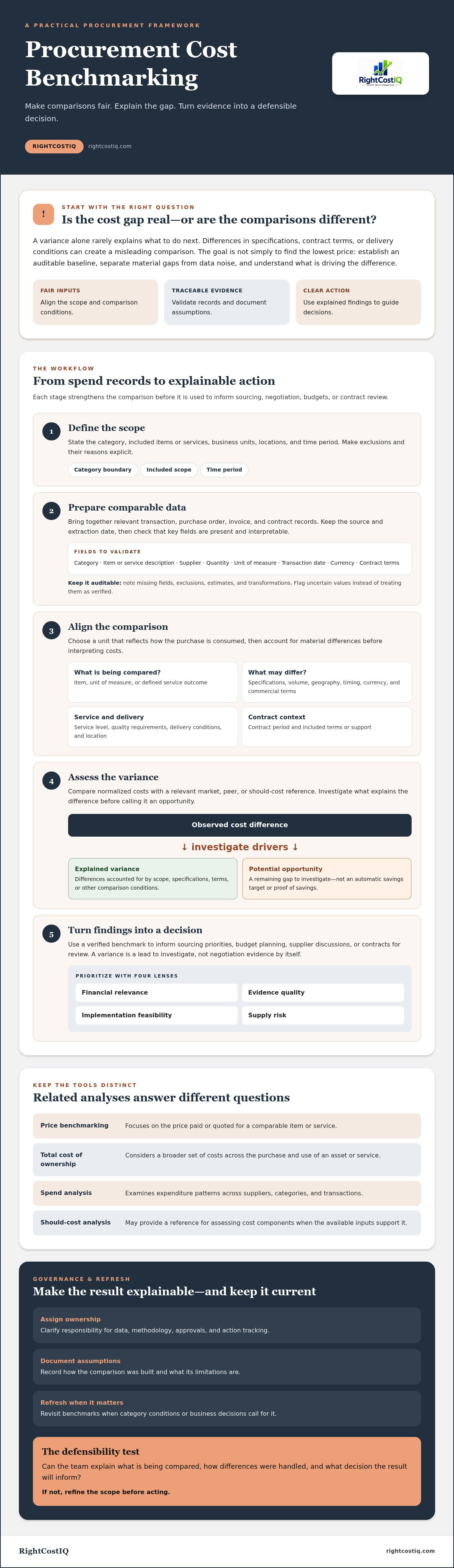
Keep the analysis distinct from related tools. Price benchmarking focuses on the price paid or quoted for a comparable item or service. Total cost of ownership considers a broader set of costs across the purchase and use of an asset or service. Spend analysis examines expenditure patterns across suppliers, categories, and transactions. These approaches can inform one another, but they answer different questions. A should-cost analysis may also provide a reference for assessing cost components when the available inputs support it.
What decisions can procurement cost benchmarking support?
Benchmark findings can help teams set sourcing priorities, inform budget planning, prepare supplier discussions, and identify contracts for review. An initial variance is a lead to investigate, not negotiation evidence by itself. Before using it to support a position, verify that the reference is relevant, the data is comparable, and the assumptions are documented. Depending on the decision, category owners, finance, procurement, and operational stakeholders may need to approve the scope, assumptions, and follow-up actions.
When is a benchmark useful, and when is it misleading?
A benchmark is most useful when the category boundary and comparison criteria can be stated clearly. It becomes less reliable if material differences in specifications, timing, volume, or commercial terms remain unaddressed. A market reference also cannot determine whether a supplier meets operational needs or presents an acceptable level of risk. Treat it as one decision input alongside supplier, operational, and risk assessments, not as a substitute for them.
Use this practical test: can the team explain what is being compared, how differences were handled, and what decision the result will inform? If not, refine the scope before acting. RightCostIQ’s procurement category cost benchmarking and analytics can support teams as they interpret comparisons and connect findings with sourcing and negotiation decisions.
How to Prepare Comparable Data for a Procurement Cost Benchmark
Benchmark quality depends on consistent units and scope. If records describe different things or measure them differently, the comparison can’t support a reliable decision. The Procurement Benchmarking Definition from The Hackett Group provides useful context, but your analysis starts with traceable, comparable inputs.
Use this sequence to establish a usable data set:
- Define the scope. Specify the category, included items or services, business units, locations, and time period. State what’s excluded and why.
- Extract spend records. Pull relevant transaction, purchase order, invoice, and contract data from the systems available to your team. Retain the source and extraction date.
- Validate key fields. Check that category, item or service description, supplier, quantity, unit of measure, transaction date, currency, and contract terms are present and interpretable.
- Document assumptions and limitations. Record how you handled missing fields, exclusions, estimates, and data transformations. Flag uncertain values rather than treating them as verified.
Define the category, specification, and comparison unit
Set boundaries before comparing costs. A category may need to be narrowed by product specification, service level, quality requirement, delivery conditions, location, or contract period. Choose a comparison unit that reflects how the purchase is consumed, such as cost per item, per unit of measure, or per defined service outcome. For example, a price per shipment is not directly comparable if shipment sizes or included services differ.
Use a consistent classification structure to reduce category ambiguity. UNSPSC or an equivalent taxonomy can help map local descriptions and codes to shared categories. Preserve the original description and document the mapping, especially when source systems group items differently.
Validate spend records and document data limitations
Check for duplicate transactions, missing quantities, inconsistent currencies, unclear descriptions, and conflicting units. Confirm whether contract terms affect the observed price, including what is covered by the charge and how volume is treated. If a field is unavailable, mark it as missing or estimated and explain how that limits interpretation. A clean-looking spreadsheet isn’t proof of comparable data.
Keep a short audit record with the data: source systems, extraction dates, category rules, exclusions, currency handling, and assumptions. This lets reviewers trace the comparison and question its boundaries before results inform sourcing or negotiation. A procurement cost benchmarking process is only as defensible as the data preparation behind it.
How to Normalize and Analyze Procurement Cost Benchmarks
Once the data is prepared, compare each internal cost observation with a clearly identified reference: an external market benchmark, a relevant peer comparison, or a should-cost analysis. The reference should match the category and comparison unit closely enough to support interpretation. Then adjust for material differences, recording what changed and why instead of treating every figure as directly comparable.
Which cost factors should be normalized?
Check whether purchase specifications, quality requirements, and service levels align. Then assess differences in order volume, delivery location, and reference period. Convert currencies using a documented basis and account for commercial terms that affect comparable cost, such as freight, duties, payment terms, rebates, or other included charges. Not every factor requires an adjustment, but assess each one and record how it was treated.
For example, a quote for a larger order may have a different unit price than a smaller purchase. If you can’t establish the volume effect, don’t present the adjusted figure as precise. Keep the original observation visible and flag the limitation for review.
How should teams assess benchmark reliability?
Label each reference by source, date, scope match, methodology, and known limitations. Use confidence bands or qualitative labels such as high, medium, or low only when the team has documented criteria for assigning them. Sparse observations, stale references, or major specification differences should lower confidence, not prompt unsupported precision.
A simple comparison table makes the reasoning auditable:
| Source | Date | Scope | Adjustment | Confidence |
|---|---|---|---|---|
| Internal invoice | Record the transaction date | Item, unit, and terms compared | Note changes made or none | State label and basis |
| Market, peer, or should-cost reference | Record the reference date | Describe what it covers | Document normalization | State label and limitations |
An observed price variance is a signal to investigate. It becomes a validated savings opportunity only when comparability, cost drivers, and a feasible procurement action are supported by evidence. This distinction keeps the procurement cost benchmarking process focused on explainable differences rather than misleading gaps. Use the comparison to identify questions for sourcing or supplier discussions, then carry the evidence and its limitations into the decision.
How to Turn Benchmark Variance into Procurement Decisions
A cost gap is not automatically a savings target. First separate explainable variance, such as differences in scope or service levels, from a potential opportunity that remains after those factors are assessed. Validate cost drivers with a should-cost analysis where appropriate, then test whether the remaining gap can be addressed without creating unacceptable supply or operational risk.
Prioritize validated findings using four lenses: financial relevance, strength of evidence, implementation feasibility, and supply risk. A large apparent gap supported by weak comparisons may need further analysis, while a smaller, well-supported gap with a clear action may be ready to progress. Map each finding to a suitable response, such as supplier negotiation, a sourcing event, a specification review, or a contract change. Not every variance calls for a new supplier or immediate renegotiation.
How can a benchmark inform negotiation or an RFP?
Use documented comparisons to shape precise supplier questions, not to make unsupported claims about “the market price.” Ask which cost components, service assumptions, or commercial terms explain the difference, then check the supplier’s response against the evidence. Before engagement, agree on decision criteria and the evidence threshold required to change course. If a competitive sourcing event is appropriate, connect the analysis to RFP management workflows so requirements and evaluation criteria reflect the benchmark findings.
How should procurement prioritize benchmark findings?
Rank opportunities by verified exposure, confidence in the comparison, decision timing, and operational impact. Then make each finding actionable. Assign an accountable owner, a next step, a decision date, and a method for measuring the outcome. Record supplier constraints, stakeholder dependencies, and implementation requirements that could affect delivery. This prevents an analytical observation from becoming an unowned savings estimate.
- High confidence, feasible action: Prepare a negotiation or contract review with the supporting comparison and assumptions.
- Material gap, uncertain cause: Gather cost-driver evidence or review specifications before setting a target.
- High supply or operational risk: Evaluate alternatives and constraints before changing sourcing strategy.
A disciplined procurement cost benchmarking process connects evidence to a decision, owner, and follow-up measure. RightCostIQ provides category cost benchmarking and analytics, as well as RFP management and negotiation assistance, to help teams carry benchmark findings into procurement action. When a validated finding points to a sourcing event, RFP management support can help with the next step.
How to Govern and Refresh the Procurement Cost Benchmarking Process
A benchmark stays useful only when teams can trace its inputs, understand who approved its assumptions, and see what happened after the analysis. Assign ownership for category scope, data quality, methodology, approvals, and action tracking. This keeps a procurement cost benchmarking process consistent across categories without treating every comparison as interchangeable.
What should a benchmark governance record include?
Maintain a record that lets another reviewer follow the analysis from source data to procurement decision. Capture the category scope, comparison unit, source details and dates, normalization rules, assumptions, exclusions, and confidence assessment. Name the responsible analyst, category owner, reviewer, and approver. Record the resulting decision, action owner, and outcome separately from estimated variance, so a projected opportunity isn’t mistaken for realized savings.
Use the record to connect benchmark insights with the category plan. A category management strategy can translate validated findings into sourcing priorities, supplier discussions, contract reviews, or specification changes while preserving the rationale behind each action.
How can procurement make benchmarking repeatable?
Use shared templates and controlled definitions across business units, but don’t impose a refresh schedule that ignores category conditions. Revisit a benchmark when a business decision requires current evidence or when relevant conditions change, such as specifications, supplier markets, contract terms, or sourcing plans. Review the methodology too: an old comparison may no longer fit the category, even if the underlying data remains accessible.
- Standardize: Use consistent fields, category definitions, and documentation rules.
- Trigger review: Set refresh points around contract or sourcing decisions and material changes in category conditions.
- Track actions: Record approvals, owners, due dates, decisions, and measured outcomes.
- Reassess the method: Update assumptions when the scope or comparison basis changes.
RightCostIQ’s procurement category cost benchmarking and analytics can support teams interpreting cost comparisons and connecting them with procurement action. Benchmark findings can also inform broader category management strategy, provided the analysis and its limitations remain clear. A free procurement diagnostic is available to help consider where benchmarking and analytics may fit procurement priorities.
Put Benchmark Evidence to Work
A procurement benchmark creates value when teams can explain the comparison, understand what drives the variance, and connect the evidence to a clear procurement decision. A defensible procurement cost benchmarking process rests on three disciplines: consistent data, like-for-like normalization, and accountable follow-through. Together, they help distinguish a credible opportunity from a misleading price gap.
RightCostIQ offers procurement category cost benchmarking and analytics, with RFP management and negotiation assistance to help teams carry findings into sourcing discussions. The right next step depends on your priorities and the evidence your category data can support.
Start a free procurement diagnostic to explore where benchmarking may support your procurement decisions. Build the process around sound evidence and give your team a stronger foundation for action.
Frequently Asked Questions
How do you benchmark procurement costs?
Start by selecting a category and defining what belongs in the comparison. Gather internal cost observations and a relevant reference, then align the comparison unit and account for material differences in specifications, volume, location, timing, currency, and commercial terms. Record the method and limitations. Finally, assess whether the variance is explainable, identify a suitable procurement response, and assign ownership for any follow-up.
What data is needed for procurement cost benchmarking?
Useful records identify the category, item or service, supplier, quantity, unit of measure, transaction date, currency, and applicable contract terms. Specifications and service requirements help determine whether items are comparable; delivery conditions and included charges clarify what the recorded cost represents. Include the source system and extraction date, too. Flag missing or estimated fields so reviewers can distinguish verified inputs from assumptions.
How do you compare supplier costs fairly?
Compare costs only after checking that suppliers are quoting against the same requirements and commercial basis. Align specifications, quality, service levels, order volumes, delivery locations, timing, currency, and included charges where relevant. If a difference can’t be normalized reliably, disclose it rather than presenting a false like-for-like result. Assess operational fit and supply risk separately, since a lower comparable price alone doesn’t establish the best sourcing choice.
How often should procurement cost benchmarks be updated?
There isn’t one refresh interval that fits every category. Update a benchmark when a sourcing or contract decision needs current evidence, or when changes to specifications, supplier markets, pricing conditions, or business requirements could affect the comparison. Record the reference date and review triggers so decision-makers can judge whether the analysis is still relevant. Avoid treating an older benchmark as current without checking its assumptions and scope.
Can cost benchmarking improve supplier negotiations?
Yes, benchmarking can strengthen negotiation preparation when the comparison is credible and its assumptions are documented. It helps buyers ask focused questions about cost differences and commercial terms instead of relying on unsupported claims about market price. Treat a variance as a prompt to investigate, not proof that a supplier should reduce its price. Use the findings alongside supplier context, operational requirements, and sourcing alternatives.
What is the difference between cost benchmarking and should-cost analysis?
Cost benchmarking compares a price or category cost with an external, peer, or other relevant reference. Should-cost analysis estimates what an item or service may reasonably cost by examining relevant cost drivers and assumptions. Benchmarking shows where an observed cost differs from a reference; should-cost analysis can help investigate why. Neither result is automatically a savings target. The appropriate method depends on available evidence and the decision being assessed.


