

The renewal price isn't fixed just because the vendor sent a quote. Knowing how to negotiate SaaS renewal pricing starts with preparing early: begin negotiations 90 days before renewal, review the contract’s notice requirements, and build a clear case from usage, business needs, and market alternatives.
A higher quote can reflect more than a price increase. Seat counts, bundled features, contract length, and renewal terms all affect the value you’re being asked to accept. The strongest negotiation starts with what your organization uses, what it needs next, and what comparable options offer.
This guide explains how procurement teams can structure a renewal, from reviewing subscription data and tracking deadlines to benchmarking alternatives and setting a negotiation position. It also covers trade-offs in vendor proposals, including whether a longer commitment or changed scope supports a lower price. The goal is a renewal that aligns cost with actual requirements without sacrificing functionality or service your teams depend on.
Key Takeaways
- Start renewal planning early so there’s time to review the contract, assess options, and negotiate before leverage narrows.
- Use license, usage, and spend data to identify unused capacity and align the renewal with actual business needs.
- Review auto-renewal and cancellation notice terms, then track key dates to avoid missing the opt-out window.
- Benchmark comparable alternatives to support a clear, evidence-based pricing position.
- Evaluate the full proposal, including contract terms and bundled features, rather than focusing on subscription price alone.
What Is Software Renewal Negotiation?
Software renewal negotiation is a procurement-led review of price, functionality, and contract terms before a subscription continues. To negotiate price increases and annual escalators, procurement compares the vendor’s proposed terms with spending history, business needs, and credible alternatives, then seeks a price or contract structure supported by that evidence.
-
Assess Vendor Retention Leverage for Your SaaS Renewal
Assess the vendor’s renewal proposal alongside your account history and the value of retaining your business. A vendor’s renewal rate may indicate how important customer retention is to its commercial model, but it doesn’t establish the price your organization should accept. Rather than relying on broad retention claims, focus on the functionality you use and the service value you receive.
Use those findings to set a specific objective, such as reducing the renewal price while preserving essential functionality. Ground the discussion in the account’s value, not an assumption that the vendor must concede.
-
How a Procurement Professional Uses Your Spend History and Tenure
Summarize subscription spending and customer tenure to show how the relationship has developed, which contracted capabilities your teams use, and how the software supports established workflows. A long relationship may inform a retention discussion, especially when the vendor understands the operational knowledge and configuration built around its platform.
Use tenure as context, not as a demand for preferential treatment. Connect it to the commercial value of retaining a stable customer, and make sure a proposed reduction won’t remove functionality your teams rely on.
-
How a Procurement Professional Builds Leverage from Alternatives
Develop a credible alternative by comparing competing software against your functional requirements and operating needs. A lower quote matters only if the alternative supports the required workflows and can realistically replace the current platform. The Program on Negotiation at Harvard Law School notes that a strong alternative gives a negotiator the option to walk away from a deal that does not meet their needs.
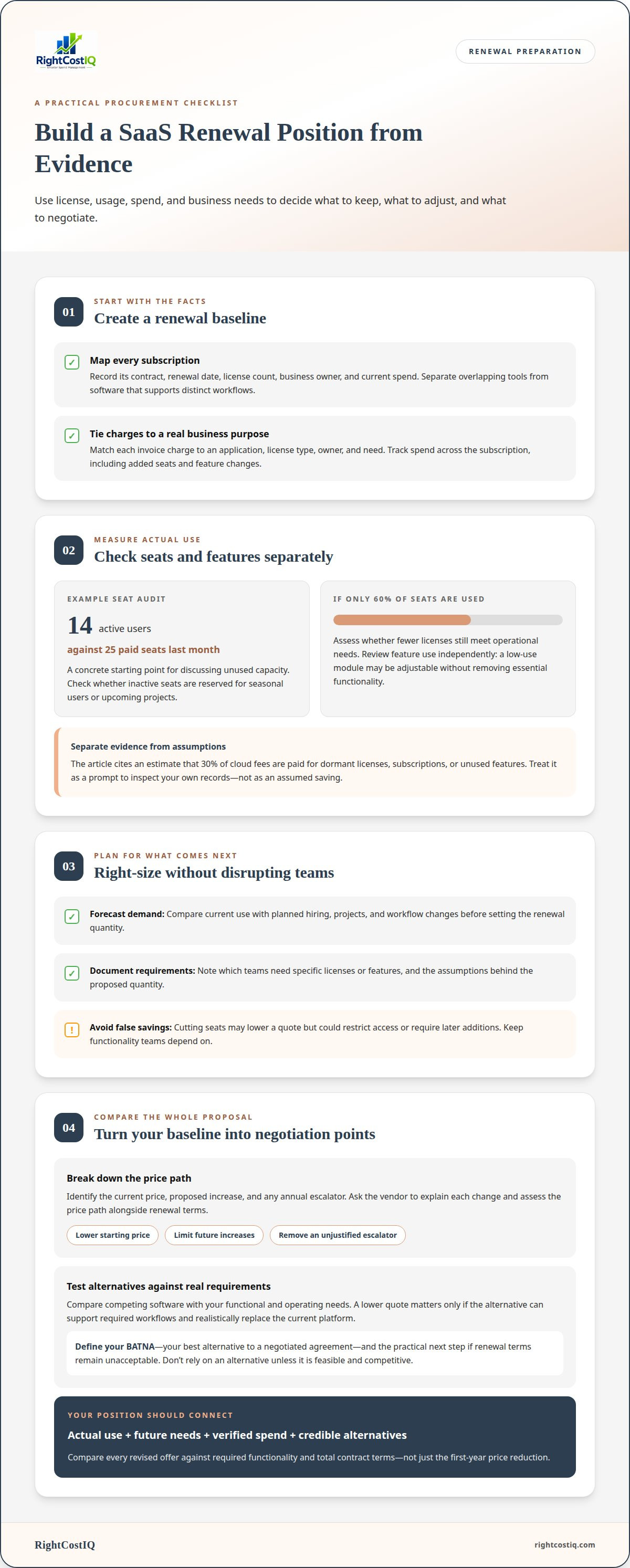
Define your BATNA, or best alternative to a negotiated agreement, before making an offer. It should identify the practical next step if the renewal terms remain unacceptable. Don’t present an alternative as leverage unless it is feasible and competitive.
-
How a Procurement Professional Negotiates Increases and Escalators
Break down the renewal proposal into the current price, proposed increase, and any annual escalator. Ask the vendor to explain each change, then negotiate the price path and renewal terms together. Seek a lower starting price, a limit on future increases, or removal of an escalator that doesn’t reflect the agreement’s value.
Set a clear target and an acceptable alternative before negotiations begin. Compare each revised offer against the required functionality and total contract terms, not just the first-year reduction. A renewal pricing analysis can help structure that comparison.
Preparation through license inventory, usage, spend, and future needs
Build a renewal baseline from license records, actual usage, spending, and upcoming requirements. This evidence can reveal right-sizing opportunities and strengthen your position before you discuss contract changes.
- Map each subscription to its contract, renewal date, license count, business owner, and current spending. Separate software with overlapping functions from tools that support distinct workflows. This inventory helps procurement distinguish a genuine reduction opportunity from a contract that appears expensive because it includes essential capabilities.
-
Evaluate Seat and Feature Use for Your SaaS Renewal
Compare assigned licenses with active users, then examine feature use across teams. For example, an audit showing 14 active users against 25 paid seats last month gives procurement a specific basis for discussing unused capacity. Check whether inactive seats belong to seasonal users or upcoming projects before proposing a reduction.
If teams use only 60% of licensed seats, assess whether fewer licenses can meet operational needs. Review features separately: low use of one module may justify a scope adjustment without removing functionality employees depend on.
- Reconcile usage findings with invoices and contract terms. An estimated 30% of cloud fees are paid for dormant licenses, subscriptions, or unused features. Treat that figure as a prompt to inspect the organization’s own records, not as an assumed saving. Match each charge to a named application, license type, owner, and business purpose.
Track actual spending over the subscription term, including added seats and feature changes. This provides a reliable comparison between the current arrangement and the vendor’s renewal proposal, rather than relying on a headline rate alone.
-
Right-Size Licenses for Your Future Needs
Forecast license demand against planned hiring, projects, and workflow changes before setting a renewal quantity. Use the usage review to distinguish active users from expected additions, then size the contract accordingly. Avoid cutting seats just to secure a lower quote if doing so would restrict access or require later additions.
Document the assumptions behind the proposed quantity, including which teams need specific features. This ties each license decision to an operational requirement and makes a requested reduction easier to explain.
- Convert the inventory into a concise negotiation position: retain essential functionality, adjust demonstrably unused capacity, and align future licenses with forecast demand. A structured SaaS usage and spend review can help connect subscription records with procurement priorities.
Assessing organizational needs and vendor research
Procurement compares the agreement’s cost and functionality with current priorities before deciding whether to renew or switch. For a confident platform choice, a buyer may trade a two- or three-year commitment for a lower annual rate; annual renewals preserve more frequent decision points.
- Define operational requirements before evaluating vendor proposals. Ask each business owner which workflows depend on the software, which functions are essential, and where service gaps affect results. For example, a team that relies on automated reporting may value that capability more than a lower-priced alternative without it. This scope prevents procurement from treating subscription cost as the only decision criterion.
Separate requirements into must-have functionality and negotiable features, then compare the current agreement against that list. If the vendor proposes new features alongside price increases, determine whether those additions address a documented need or simply expand the package.
-
Compare Renewal and New-Vendor Negotiations
Compare the renewal proposal with the full commercial terms available from a new vendor. A renewal discussion starts with existing usage, implementation, and established workflows; a new-vendor negotiation must also account for transition requirements and fit. Request comparable scope from each option, including support and relevant features, so apparent savings don’t come from missing functionality.
For a larger enterprise agreement, allow six to twelve months for due diligence, benchmarking, and negotiation. Keep the renewal and new-vendor cases distinct because their implementation needs and commercial assumptions differ.
-
Decide Whether to Switch Vendors
Decide whether switching is viable by weighing the alternative’s functionality against transition effort and business priorities. A lower quote alone doesn’t prove the replacement is suitable. If the vendor objects to a requested reduction, ask what specific cost or scope issue informs its position, then respond with documented requirements and comparable terms.
Procurement should distinguish a resolvable pricing objection from a material product gap. Record each response and its impact on the agreement, then reassess whether renewal still serves the organization’s needs.
- Research two or three competing products against the same requirements. A brief comparison should capture features, service scope, contract structure, and implementation dependencies. Spend thirty minutes on initial market research to identify potential alternatives, then deepen the review if a credible option could change the sourcing decision.
Use the findings to set a negotiation position. If the incumbent challenges the comparison, explain where the alternatives match requirements and where they differ. Avoid overstating a competitor’s capability or presenting an option as a credible replacement before procurement has assessed its fit.
Document the decision logic for stakeholders: renew under revised terms, pursue a competitive process, or plan a transition. Tie the recommendation to requirements, proposal evidence, and the organization’s tolerance for changing vendors. This gives procurement a consistent basis for addressing objections and evaluating revised offers.
Auto-renewal clauses and notice requirements
Map each SaaS renewal date against the contract’s notice window before discussing revised terms. Timing matters: an auto-renewal can limit your options if the opt-out deadline passes.
-
Review Auto-Renewal and Notice Terms for Your SaaS Contract
Read the renewal and cancellation clauses, then record the renewal date, notice deadline, required delivery method, and recipient. A market estimate indicates that 69% of software contracts include auto-renewal clauses with cancellation notice periods of 30 to 90 days. The contract’s actual wording controls your deadline, so don’t assume the same period applies across vendors.
Review business terms beyond price. Procurement can negotiate contract length, support arrangements, service commitments, implementation scope, and renewal mechanics alongside subscription pricing. Check quotes against these terms, since a lower annual rate may not help if the revised agreement changes service or integration requirements.
-
When a Procurement Professional Should Start Negotiating Your SaaS Renewal
Start preparation 90 days before renewal, then contact the account manager at least 60 days before renewal. Track both dates in a shared renewal calendar, with an owner responsible for notices and negotiation milestones. A 90-day start leaves time to assess the proposal, resolve questions, and decide whether the relationship should continue.
Set reminders 90 and 60 days before renewal, and work backward from the contract’s opt-out deadline. Leverage diminishes 30 days before renewal, while a renewal only 14 days away leaves little negotiating leverage. Treat those points as planning cues, not substitutes for the written notice clause.
- Assign responsibility for notices, quotes, approvals, and contract records. Keep the executed agreement, amendments, renewal quote, and communications together. A clear record helps prevent missed notices and makes it easier to compare revised vendor terms with the existing agreement.
- Reduce hidden-fee and disruption risks by reconciling the renewal quote with the contract’s scope and commercial terms. Ask procurement to identify changes in charges, included services, or implementation obligations, then document which terms remain unchanged. If the agreement requires formal notice, use its stated delivery method and retain evidence of submission.
Once an auto-renewal processes, negotiating changes for that renewal may be difficult. Don’t rely on a last-minute price discussion to reverse it. Instead, escalate the deadline internally and preserve continuity while evaluating future options.
Benchmarking competitor pricing and alternatives
Build a like-for-like market comparison before treating a renewal quote as competitive. Compare scope, pricing structure, contract terms, and functionality to distinguish real savings from a reduced service package. This evidence also helps you negotiate SaaS renewal pricing without relying on market assumptions.
- Standardize the comparison around the same user volume, features, support, and contract period. A lower quote for fewer licenses or less functionality isn’t an equivalent benchmark. Record each platform’s inclusions and exclusions alongside its quoted price to identify which differences explain the gap.
Compare the renewal’s current terms with the proposed terms, not just the new headline rate. Note any price increase, changed feature bundle, or revised renewal condition. This helps show the vendor which commercial changes are driving your concern.
- Assess each alternative against the operational requirements established earlier. For example, if two platforms support the core workflow but only one includes a required integration, reflect that in the comparison. A competitor’s lower quote is useful leverage only when the product meets your organization’s needs.
Separate measurable differences from assumptions. Document matching features, material gaps, and implementation dependencies. This makes it harder to dismiss the benchmark as incomplete and keeps the negotiation focused on evidence.
- Use market benchmarks to test whether a proposed increase fits the product’s scope and pricing structure. Negotiations informed by independent benchmarking have achieved 15-35% better outcomes than unassisted procurement. Treat this as a reported range, not a promised result for an individual renewal.
Turn the findings into a clear request: explain the difference, identify the adjustment needed, and state which terms could change. RightCostIQ’s Procurement Category Cost benchmarking and Analytics can help organize pricing evidence for the negotiation.
- Evaluate discounts against total commitment and flexibility. SaaS vendors may offer discounts of 10% to 25% for multi-year commitments. Compare the proposed reduction with the cost of accepting a longer term, including whether the organization can accommodate changing needs during that period.
Review the complete quote before accepting a discount. Check whether it applies throughout the agreement, which services it covers, and what happens at renewal. A first-period reduction can obscure a later increase if you compare only the initial offer. Reviewing the full commitment helps you negotiate SaaS renewal pricing based on the complete cost.
- Present the benchmark as a decision case, not a threat. Summarize comparable scope, price differences, and material trade-offs, then ask the vendor to respond against those points. To strengthen the evidence behind your position, request a SaaS pricing benchmark.
RightCostIQ
RightCostIQ helps procurement teams turn SaaS renewal evidence into a structured negotiation position. Its Request For Proposal (RFP) Management and Negotiation Assistance and Procurement Category Cost benchmarking and Analytics support pricing reviews, vendor discussions, and alternative evaluations. Procurement and Vendor Performance Tracking Service helps assess vendor performance alongside commercial terms, while Price Risk Management and Tracking Service supports visibility into pricing exposure.
Turn to RightCostIQ when renewal complexity, limited internal benchmarking, or unclear vendor pricing makes it difficult to assess a proposal and plan a response. Its procurement services connect spending, market context, and vendor performance to a practical purchasing decision.
Contact RightCostIQ to discuss support for your SaaS renewal negotiation.
Make Each Renewal Strengthen the Next
Treat the signed agreement as a new procurement baseline, not the end of the renewal process. Record the commercial decisions, accepted trade-offs, and service expectations that shaped the outcome. This gives future teams a clearer starting point and helps distinguish a genuine change in business needs from a vendor’s standard renewal position.
A disciplined approach to how to negotiate SaaS renewal pricing can improve consistency across your software portfolio. Apply the same decision framework to upcoming renewals while tailoring each negotiation to its contract, usage, and operational importance. When internal capacity or market evidence limits your options, RightCostIQ’s procurement and negotiation assistance can help structure the analysis and response.
Contact RightCostIQ to discuss renewal savings and the procurement support that fits your priorities. A well-documented renewal creates a stronger foundation for the next decision.
Frequently Asked Questions
What is SaaS Renewal Management?
SaaS renewal management coordinates subscription reviews before contracts renew. It brings renewal dates, business ownership, usage, pricing, and approval decisions into one workflow. For example, procurement can flag an upcoming renewal for finance and the application owner, then track the quote and decision together. This reduces fragmented decisions and helps organizations manage renewals as part of ongoing software spend governance.
How can a procurement professional review your SaaS usage and licenses before renewal?
Combine license assignments, login or activity records, invoices, and business-owner input in one usage review. The key is distinguishing an unused account from a temporarily inactive user who still needs access. For example, a departing employee’s license may be removable, while an employee on leave may need reinstatement. Comparing these records helps avoid both excess purchasing and disruptive access cuts.
What SaaS renewal pricing benchmarks and discount rates are typical?
There is no universal benchmark because SaaS pricing depends on product scope, license volume, features, and contract terms. Annual renewal increases of 5% to 10% are described as common, while multi-year commitments may attract discounts of 10% to 25%. Treat these ranges as negotiation context, not a target or entitlement. A useful comparison matches equivalent functionality, service levels, quantities, and commitment periods.
What leverage can customers use to negotiate SaaS pricing?
Use documented usage, account spending history, credible alternatives, and a clear willingness to change scope. Leverage is strongest when each point connects to a real business decision. For instance, propose fewer licenses while retaining required features, or present a viable alternative that meets operational needs. A specific request gives the vendor something concrete to address instead of a general demand for a lower price.
How can a procurement professional compare SaaS renewal quotes with competing vendors?
Normalize each quote against the same requirements before comparing totals. Align license quantity and type, functionality, support, implementation scope, and contract duration. Then separate recurring subscription charges from one-time or conditional items. For example, a lower quote that excludes a required integration may not be comparable. A side-by-side review makes scope differences visible and strengthens the basis for negotiation.
What are common SaaS auto-renewal notice periods and cancellation rules in the US?
Software contracts commonly contain cancellation notice periods of 30 to 90 days, and 69% include an auto-renewal clause. The specific deadline and cancellation method depend on the agreement’s wording, so there is no single notice period that applies to every US SaaS contract. Procurement should identify the renewal date, notice deadline, and required delivery method, then retain the cancellation record if the organization decides not to renew.


