

A polished RFP can still become inconsistent when requirements, approvals, and supplier evidence are handled differently across the team. A procurement RFP requirements checklist turns the process into clear, verifiable controls, from defining business needs to evaluating responses and meeting submission rules. Its value is not just completeness: it gives every reviewer a shared basis for decisions.
That structure matters when sourcing involves procurement, finance, legal, IT, and business stakeholders. A checklist helps reveal gaps in ownership, clarify what suppliers must submit, and keep evaluation criteria aligned with the need the RFP is intended to address.
This article explains what to include in an RFP checklist and how to use it to manage stakeholder requirements, approvals, compliance, supplier evidence, and consistent reviews. You’ll get a practical framework for avoiding omissions and making proposal decisions easier to trace, without treating every sourcing event as identical.
Key Takeaways
- Translate stakeholder input into specific business requirements, owners, and response tasks so suppliers receive a clear, usable scope.
- Build decision gates, review responsibilities, and internal deadlines into the process to keep approvals and submission work on track.
- Map compliance forms, addenda, and submission instructions to explicit checks to reduce avoidable omissions.
- Use consistent evidence criteria for supplier experience, references, and performance claims so evaluations are easier to compare.
- Record confidence levels and risk areas alongside scores to give decision-makers a clearer view of where proposals need scrutiny.
Procurement stakeholder interviews and business requirements
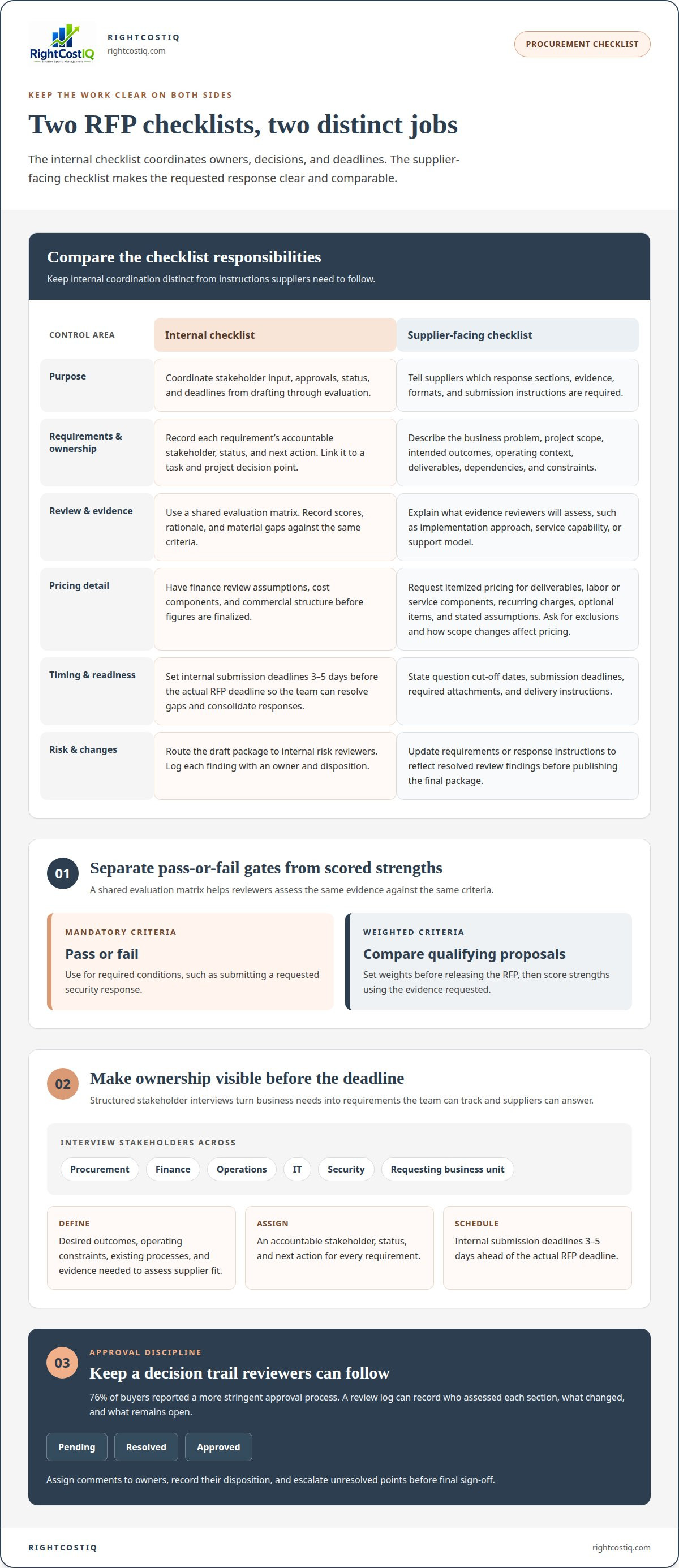
Start with structured interviews involving procurement, finance, operations, IT, security, and the business unit requesting the purchase. Ask each stakeholder to identify the desired outcome, operating constraints, existing processes, and evidence needed to assess supplier fit. Record the answers in a requirements summary, linking each requirement to an owner, task, and decision point in the project plan.
Make ownership visible. For every requirement, name the accountable stakeholder, its status, and the next action. For example, IT may own integration specifications while operations defines service-level expectations. Set internal submission deadlines 3-5 days before the actual RFP deadline, giving the team time to resolve gaps and consolidate responses.
The RFP should explain the organization’s role, the business problem, the project scope, and the intended outcomes. Include relevant operating context, affected departments, deliverables, dependencies, and constraints. Define success in practical terms, such as an agreed implementation plan or measurable service performance, rather than relying on broad goals like “improve efficiency.”
How should procurement teams compare RFP responses and score vendor proposals? Use a shared evaluation matrix that links each requirement to the relevant response and scoring rationale. Reviewers should assess the same evidence against the same criteria, then record scores and material gaps for comparison.
Separate mandatory criteria from weighted criteria. Mandatory requirements are pass-or-fail conditions, such as submitting a requested security response. Weighted criteria distinguish the strengths of proposals that qualify. Set weights before releasing the RFP, and explain what evidence reviewers will assess, such as the implementation approach, service capability, or support model.
What pricing, fees, and cost breakdowns should an RFP request from bidders? Request itemized pricing for each required deliverable, labor or service component, recurring charge, optional item, and stated assumption. Ask suppliers to identify exclusions and explain how scope changes affect pricing, so finance can compare proposals consistently.
Keep the internal checklist separate from the supplier-facing checklist. The internal version tracks owners, interview findings, approvals, status, and deadlines. The supplier-facing version lists required response sections, evidence, formats, and submission instructions. A [structured RFP management process](https://app.rightcostiq.com/rfp) can keep these controls aligned from drafting through evaluation.
Send the RFP package to the internal risk team before release. Include draft agreements and IT and security checklists so reviewers can flag contractual, data, and technology issues while changes are still practical. Log each finding with an owner and disposition, then update the requirements or response instructions before publishing the final package.
RFP review, approval, and submission
Build review and approval time into the RFP schedule, before the package reaches suppliers. A standard intake process includes a go/no-go decision, allowing the team to assess strategic fit, available capacity, and ability to meet requirements before committing bid resources. Record the decision and its rationale so approvers have a clear basis for proceeding or stopping.
Set milestone dates against the external submission deadline, then assign an owner to each task. Complete internal tasks 5-7 days before submission, leaving time to resolve review comments and assemble the final response. Put question cut-off dates and submission deadlines in team members’ diaries, so each contributor can plan their work around the same schedule.
- Intake: Document the opportunity and complete the go/no-go decision.
- Draft review: Route the response to technical, finance, legal, and business reviewers.
- Resolution: Assign each comment to an owner and record its disposition.
- Approval: Obtain required stakeholder sign-off on the final response and pricing approach.
- Submission: Confirm the approved files are complete and ready for delivery.
Assign an owner to contract review and keep a written record of exceptions. Assess indemnity clauses, intellectual property ownership, and payment terms against the organization’s position. If a draft agreement includes unacceptable terms, document the specific provision and proposed alternative. Keep the record with the approval materials so reviewers can see the exposure before authorizing submission.
Finance should review the RFP pricing spreadsheet before figures are finalized. Ask finance to assess assumptions, cost components, and the commercial structure, then obtain approval for the proposed pricing approach from appropriate senior stakeholders. This separates spreadsheet validation from approval authority and creates a clear decision trail for the submitted offer.
Approval discipline is increasingly relevant: 76% of buyers reported a more stringent approval process. A review log can show who assessed each section, what changed, and which issues remain open. Use a clear status such as pending, resolved, or approved, and escalate unresolved points before the final sign-off rather than burying them in email threads.
Reserve time for a final review of one controlled response version. Confirm that approved changes appear in the submission copy, required attachments are included, and internal sign-offs are recorded. The submission owner should mark completion against the timetable and retain the submitted version, giving procurement a traceable record for later evaluation or negotiation.
Compliance forms, certifications, addenda, and submission rules
Specify the contract terms, insurance evidence, data security controls, and compliance documents relevant to the purchase. For example, identify required policy limits, data handling practices, certifications, and contract schedules in the solicitation, then state whether each item is mandatory or evaluated.
What procurement rules and public bidding requirements apply to RFPs in the United States? Requirements depend on the issuing public entity, jurisdiction, funding, and solicitation terms. The RFP should identify the rules and submission procedures for that specific procurement, rather than assuming one set of requirements governs every public bid.
Separate forms by purpose so suppliers know what to complete and what evidence to attach. A compliance schedule can identify each document, the responsible supplier contact, the requested format, and the relevant response section. For instance, list a security questionnaire separately from a signed contract acknowledgment, since each requires a different review.
- Contract documents: Identify the draft agreement, required acknowledgments, and requested exceptions.
- Insurance evidence: State which insurance documents are requested and how suppliers should submit them.
- Security responses: Specify the systems, data practices, and control descriptions bidders must address.
- Certifications and forms: Name each requested document and explain its submission format.
Use a compliance matrix to link each requirement to a response field and an internal owner. Mark whether evidence is required with the submission, requested later, or reviewed during evaluation. This helps prevent a missing attachment from being treated like a weak technical answer, while keeping mandatory items visible to reviewers.
Control how addenda are distributed and acknowledged. Record each addendum’s identifier, release date, affected RFP section, and required supplier acknowledgment. Suppliers should explicitly acknowledge every addendum because a missing acknowledgment can disqualify a proposal. Track receipt and acknowledgment together so the procurement record shows which version each bidder addressed.
What timeline, submission instructions, and question-and-answer process should an RFP specify? State the question deadline, response channel, how answers will be published, and the final submission deadline. Specify the time zone, file formats, naming conventions, required signatures, and any portal instructions. Verify the deadline’s time zone before release.
For public bids, keep clarifications consistent across all participating suppliers. Publish material answers and addenda through the stated process, then update the controlled RFP package so every bidder has the same instructions. Before release, check the document set against a final checklist: forms included, dates aligned, response fields mapped, and acknowledgment requirements clearly stated.
Experience, references, and evidence of performance
Supplier claims need evidence that matches the RFP’s scope, delivery model, and risks. Request comparable project examples, named roles, and outcome measures, then assess them against the same criteria. This prevents impressive but unrelated credentials from outweighing relevant delivery experience.
- Request comparable engagements. Ask bidders to describe projects with similar scope, complexity, and operating conditions. Comparable examples help reviewers assess whether experience transfers to the requirement rather than relying on broad claims.
- Define the details each case study must include. Request the client context, supplier responsibilities, delivery approach, and reported outcome. A consistent template makes a short implementation example easier to compare with a longer narrative.
- Build an experience matrix. Map the required capabilities against each proposed team member’s relevant experience. The matrix shows whether the bid team has the necessary depth and breadth, instead of leaving reviewers to infer coverage from biographies.
- Request role-specific CVs when relevant. For professional services bids, prepare concise fee-earner CVs that are two pages long when the client requests that format. A consistent length helps evaluators locate qualifications, project roles, and relevant expertise quickly.
- Ask for references tied to comparable work. Request a reference contact and a brief description of the engagement, including the supplier’s role. This gives evaluators a focused basis for discussing delivery, communication, and issue resolution.
- Specify performance evidence. Identify the measures that demonstrate success for the scope, such as service availability, delivery timeliness, or quality controls. Clear measures help distinguish documented results from unsupported descriptions of strong performance.
- Request examples of reporting and issue management. Ask bidders to show how they track commitments, escalate service problems, and report corrective actions. A sample reporting approach reveals how performance information would support ongoing contract oversight.
- Store feedback centrally. Keep client feedback, testimonials, and approved quotes in a shared, organized location. A central record helps bid teams retrieve consistent evidence and avoids relying on scattered files or recollections during proposal preparation.
Review evidence for relevance, clarity, and traceability. A reference should relate to a stated project example, and a claimed outcome should identify what was measured. Record missing evidence as a specific gap, then apply the same standard to every supplier. This supports an auditable comparison and a stronger handoff from proposal review to vendor performance tracking after award.
Use the experience matrix to check required capabilities, not merely summarize biographies. For each proposed role, connect relevant experience to the project examples and outcomes provided. This helps reviewers assess whether the evidence supports the responsibilities assigned and whether the bid team has the required depth and breadth. If a capability has little supporting evidence, seek clarification before treating a general credential as proof of fit.
Apply the same evidence standard to every bidder. Record which claims are supported by comparable work, role-specific contributions, and traceable outcomes, and distinguish them from claims that remain broad or difficult to verify. Reviewers can then explain how evidence informed their assessment, identify gaps consistently, and keep the decision focused on the proposed team and delivery approach.
RFP checklist benefits for consistency and risk reduction
A checklist makes sourcing repeatable, not automatic. Its value comes from assigning each control an owner, a status, and evidence of completion. For example, a review record can show whether a security response was assessed, who assessed it, and which unresolved issue could affect the award. This creates a visible trail from requirements to decision.
Standardize the process without forcing every category into identical questions. A reusable framework can contain nearly 90 checkpoints organized into 10 categories, then activate only the controls relevant to each sourcing event. That structure helps teams keep core controls consistent while adapting technical, commercial, and compliance details to the purchase.
- Track requirement completion. Give each checklist item an owner and status, so a missing approval doesn’t disappear between departments.
- Separate pass-or-fail controls from scored factors. This prevents a strong narrative from compensating for a missed mandatory requirement.
- Map evidence to evaluation. Link each supplier document to the requirement it supports, so reviewers can trace scores to evidence.
- Record decisions and exceptions. Capture the rationale when a requirement is waived or an exception accepted, preserving the decision context.
- Use a confidence column. Label evidence High, Medium, or Low confidence to help leadership identify proposal risk areas requiring scrutiny.
- Compare equivalent evidence. Apply the same definitions and scoring guidance to each bidder, reducing reviewer variation.
- Review after each sourcing event. Record recurring clarification requests and evaluation gaps, then revise the checklist before its next use.
- Retain version history. Track updates to templates and criteria, so teams know which controls applied to each RFP.
What common RFP requirements mistakes and risks should procurement teams avoid? Common risks include vague requirements, inconsistent scoring, unclear ownership, missing evidence, and changes that don’t reach every reviewer. A checklist helps close these gaps by making each requirement traceable from its owner through evaluation and approval.
Use the checklist as a risk register, not just a completion form. Flag weak or conflicting evidence, identify the decision it could affect, and assign an owner for follow-up. For example, a low-confidence response about implementation capacity can prompt clarification before the team finalizes its recommendation. This gives leadership a clearer view of uncertainty alongside proposal scores.
Assess whether your current controls expose evidence gaps and inconsistent review. Request a procurement process diagnostic to identify opportunities to improve checklist discipline and decision traceability.
A confidence-level column can make uncertainty easier to scan. RFP teams can use High, Medium, or Low labels to help leadership assess proposal risk areas. Reviewers can describe their confidence in the supporting evidence and explain the label. This keeps uncertainty visible alongside the requirement and its status. If a response is marked Low, identify the evidence gap and consider whether clarification or further review is needed before relying on it.
Using the same labels makes assessments easier to interpret while leaving room to explain unusual evidence or unresolved concerns. A confidence column should guide scrutiny, not replace the underlying record or decision. Pairing a label with a concise reason highlights where a proposal needs attention and gives leadership a clearer basis for assessing risk.
RightCostIQ
RightCostIQ helps sourcing teams turn RFP requirements into a disciplined procurement process. Its RFP management and negotiation assistance supports teams preparing and evaluating solicitations, while category cost benchmarking and analytics provide market context for commercial decisions. Vendor performance tracking can connect supplier evidence with ongoing reviews, and price risk management and market price forecasting support decisions involving cost exposure.
Turn to these services when sourcing teams need better alignment between requirements, supplier evaluation, pricing analysis, and post-award oversight. The right support depends on the procurement challenge, whether structuring an RFP, assessing category costs, or tracking vendor performance. Contact RightCostIQ to discuss your procurement requirements.
Turn the checklist into a sourcing advantage
The lasting value of a procurement RFP requirements checklist depends on how consistently teams use it. Treat it as part of sourcing governance, not as a static template. After each event, note where decisions stalled, which supplier evidence proved useful, and what changed between the planned process and actual execution. Use those observations to improve future sourcing events.
That learning loop helps procurement improve decision quality over time. RightCostIQ supports teams with RFP management and negotiation assistance, procurement category cost benchmarking and analytics, and vendor performance tracking. These services connect sourcing decisions with commercial insight and supplier oversight, helping teams make future processes more deliberate.
Contact RightCostIQ to discuss procurement and identify a practical next step for your sourcing process. Bring the requirements or process challenge you want to address, and start building a more consistent approach to procurement decisions.
Frequently Asked Questions
What is an RFP checklist?
An RFP checklist is a working control document that helps a sourcing team manage the tasks and evidence involved in a proposal process. Tailor it to the purchase, then reuse it as a starting point for similar sourcing events. For example, a software procurement checklist may include integration questions, while a professional services checklist may emphasize team experience and delivery approach.
What is an RFP?
A request for proposal (RFP) is a procurement document that invites suppliers to propose how they would meet a defined business need. It typically asks for a solution, delivery approach, and commercial response, allowing the buyer to assess more than price alone. A request for information is more exploratory, while a request for quote focuses on the cost of a product or service.
What should a procurement RFP requirements checklist include?
A procurement RFP requirements checklist should cover the needs and controls that apply to the specific purchase, alongside response instructions and review tasks. Include a document owner, version record, and a place to log clarifications, so updates don’t get lost between drafts. For a multi-category project, separate category-specific questions from shared requirements to keep supplier responses relevant and reduce unnecessary duplication.
What vendor qualifications, references, and certifications should an RFP require?
Request qualifications that demonstrate a supplier can deliver the actual scope, rather than imposing credentials unrelated to the work. Ask for comparable engagement examples, the proposed team’s roles, and references who can discuss similar delivery. Include certifications when they directly support a stated requirement, such as a relevant security control. Explain what evidence to provide and how reviewers will assess it, so suppliers can respond consistently.


