
The largest procurement opportunity isn’t always the category with the highest spend. A procurement opportunity assessment combines spend, demand, contract, supplier, and market data to identify where action could create value, then ranks opportunities by potential impact and practical feasibility. It looks beyond past purchases to distinguish actionable opportunities from patterns that need more context.
Prioritisation matters because an opportunity must fit the organisation’s needs, not just look attractive in a spreadsheet. This article explains how spend analysis, supplier performance and market intelligence reveal potential value, and how to weigh savings against delivery effort, risk, resilience, quality and wider business priorities. You’ll see how the assessment turns evidence into a focused roadmap for decision-making.
Key Takeaways
- Combine spend, demand, contract, supplier and market evidence to distinguish actionable opportunities from patterns that need context.
- Rank initiatives by potential value, delivery feasibility, urgency and strategic fit, then sequence them into a practical roadmap.
- Use supplier performance and market intelligence to reveal dependencies, overlap and opportunities to strengthen sourcing decisions.
- Balance potential savings against cash flow, resilience, quality, speed and sustainability so decisions support wider business priorities.
- Improve analysis quality by consolidating and categorizing procurement data before benchmarking or estimating opportunity value.
What Is a Procurement Opportunity Assessment ?
A procurement opportunity assessment brings together spend, demand, contract, supplier, and market evidence. It identifies potential value and separates practical initiatives from findings that need further analysis.
A spend report shows what an organization bought, from whom, and at what recorded price. An assessment interprets those transactions in light of business requirements and market conditions. For example, similar purchases at different prices may deserve review, but delivery terms, specifications, and service levels could explain the difference. The analysis tests those factors before classifying a finding as a reduction opportunity.
Professionals first consolidate records from purchase orders, accounts payable, ERP exports, corporate cards, contracts, and prior category reports. They normalize supplier names so abbreviations and subsidiary names map to the correct supplier. They also apply consistent category definitions across business units and regions. This improves visibility, exposes conflicting records, and helps identify untracked or misclassified spend.
Next, professionals connect category spend with demand patterns, contract terms, supplier performance, and market intelligence. Demand shows whether purchasing volumes reflect operational needs. Contract data reveals renewal timing, pricing structures, and off-contract activity. Supplier information adds context on performance and dependency. Market comparisons help assess whether current terms remain competitive. A category cost benchmarking analysis can inform that comparison without implying guaranteed savings.
Professional Spend Profiling and Opportunity Identification
Spend profiling classifies purchasing by category, supplier, business unit, contract status, and purchasing pattern. This helps professionals prioritize categories with meaningful, addressable spend and a practical route to action. The analysis flags off-contract purchases and fragmented tail spend, where many small transactions may fall outside negotiated arrangements. Category leaders then assess whether consolidation or sourcing initiatives fit operational requirements.
Prioritization also considers whether spend is negotiable, recurring, or tied to a specific supplier relationship. A large category may offer limited leverage if demand is fixed or switching creates operational risk. Smaller purchases may deserve attention when repeated transactions reveal supplier overlap or inconsistent buying practices. The resulting profile separates potential initiatives from spend that should remain unchanged.
Requirements and Assessment Examples
Requirements analysis establishes the commercial, operational, and compliance context for each opportunity. In the United States, applicable procurement regulations and compliance requirements depend on the organization, jurisdiction, funding, and contract. An opportunity assessment does not replace a compliance review.
No single template fits every assessment. A useful example is a category matrix covering spend, demand, suppliers, contracts, market comparisons, risks, and proposed actions. Professionals can use it to link each finding to its evidence and business relevance. A pre-procurement review, according to the Scottish Government, considers readiness to begin procurement and whether commercial risks are understood.
How professionals prioritize opportunities
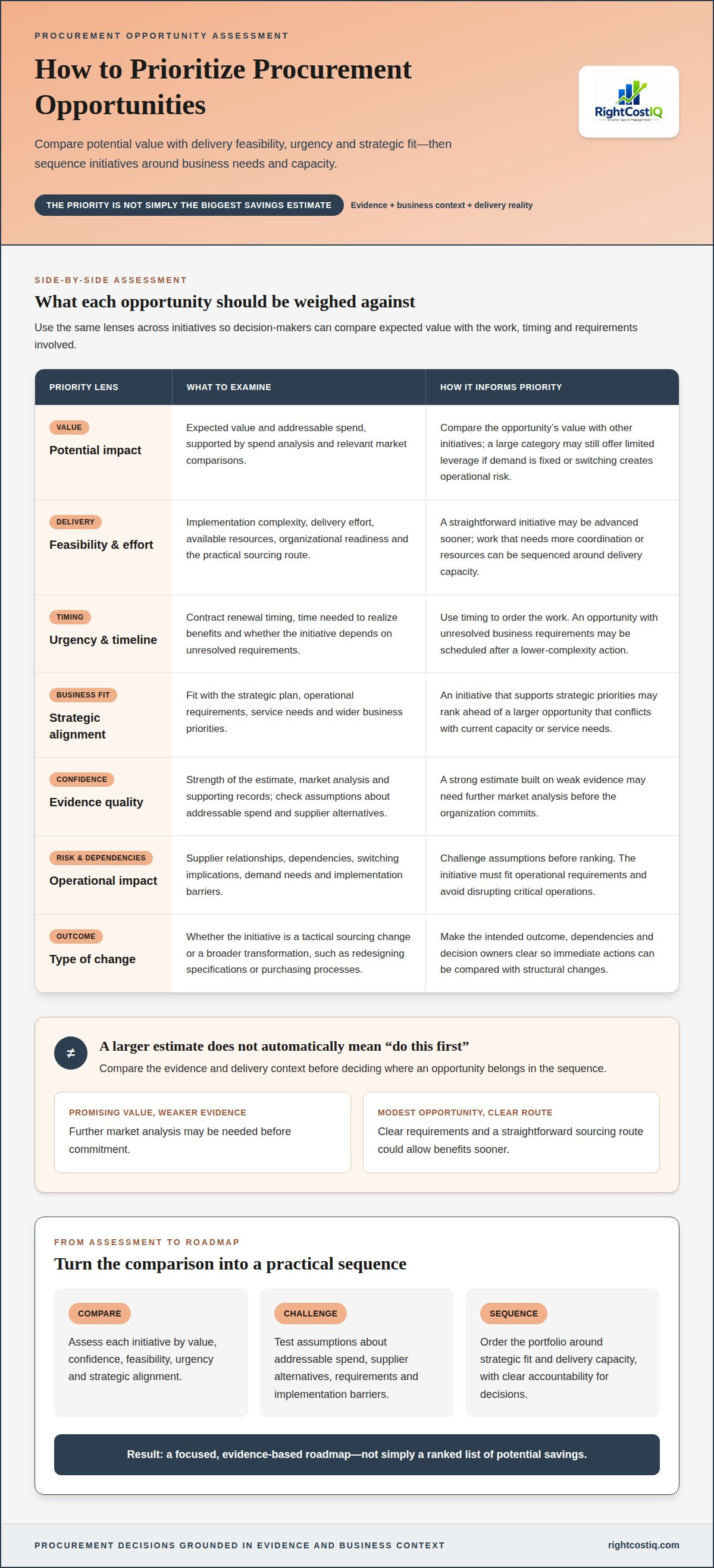
Professionals rank initiatives by value, feasibility, urgency, and alignment with business priorities. The result is a sequenced portfolio, not simply a list of potential savings.
Professional Prioritization by Value and Alignment
Professional prioritization compares each initiative’s expected value with its complexity and strategic fit. This helps decision-makers direct resources toward work that can deliver relevant outcomes without disrupting critical operations.
Spend analysis may identify a promising category, but category leaders add context before ranking it. They consider demand requirements, contract timing, operational dependencies, organizational readiness, and implementation resources. An initiative that supports a strategic plan may rank ahead of a larger opportunity that conflicts with current capacity or service needs.
Professionals also distinguish cost-reduction initiatives from broader cost transformation. A tactical sourcing change may be relatively direct, while redesigning specifications or changing purchasing processes can require coordination across teams. The assessment clarifies the intended outcome, dependencies, and decision owners for each initiative. That distinction helps executives compare immediate actions with structural changes, rather than treating every opportunity as interchangeable.
Prioritization supports informed judgment, not just a mechanical ranking. Category leaders can challenge assumptions about addressable spend, supplier alternatives, and implementation barriers. If a high-value initiative depends on unresolved business requirements, the team may schedule it after a lower-complexity action. The order should reflect strategic alignment and delivery capacity, with clear accountability for each decision.
How Professionals Compare Savings, Effort, and Timelines
Professionals compare estimated savings with delivery effort, implementation complexity, and the time needed to realize benefits. This gives leaders a practical basis for deciding which opportunities to advance first.
Each initiative is assessed for value, confidence, feasibility, and urgency. A strong estimate based on weak evidence may need further market analysis before commitment. A modest opportunity with clear requirements and a straightforward sourcing route could deliver sooner. This comparison makes uncertainty visible and prevents an untested savings estimate from outweighing operational realities.
Timing matters. Early opportunities should be implementable within 90 days and provide benefits within six to twelve months. Those timeframes help distinguish near-term actions from longer transformation work; they don’t mean every initiative will fit those windows. Professionals also account for contract renewal dates, stakeholder approvals, supplier transition needs, and internal capacity when estimating a realistic route to delivery.
A phased roadmap can group initiatives by value, feasibility, and organizational capacity. It assigns ownership, milestones, and expected outcomes, while preserving space for category leaders’ experience-driven judgment. Review the opportunity priorities through a structured diagnostic when the portfolio needs sharper sequencing.
How professionals use supplier performance and market intelligence
Supplier performance and market intelligence help professionals assess whether current sourcing arrangements still serve the business. They connect delivery, quality, service, pricing, and supply-chain exposure to identify relationship improvements, cost-reduction options, and risks that price data alone can miss.
Professionals examine supplier performance against agreed expectations, including delivery consistency, quality issues, responsiveness, and operational impact. For example, recurring delays may create costs beyond the purchase price. Supplier performance tracking helps distinguish a one-off disruption from a pattern that warrants corrective action, commercial discussion, or a sourcing review. The assessment considers category expertise and internal stakeholder experience alongside recorded performance.
Market intelligence adds context to supplier evidence. Professionals compare current commercial terms with relevant market information, then consider changing prices, available alternatives, and category conditions. Market movements can affect negotiation timing, while supplier capacity or specialized expertise can affect the viable sourcing route. This analysis helps teams challenge assumptions without treating the lowest quoted price as the only measure of value.
Supplier rationalization means evaluating whether the supply base can be simplified without weakening coverage or resilience. Professionals look for duplicate suppliers serving the same category across business units, overlapping capabilities, and fragmented purchasing. Consolidation may improve leverage or governance, but the case depends on service requirements, supplier capacity, transition effort, and dependency risk. Fewer suppliers are not automatically better.
Risk diversification requires a separate test. A single-source dependency can leave operations exposed if that supplier cannot meet demand or experiences disruption. Professionals examine the criticality of the input, the availability of alternatives, and dependencies beyond Tier 1 suppliers. Tier 2 and Tier 3 suppliers can affect the strength of Tier 1 supply, so risk review may need to examine those upstream relationships.
Relationship improvements can address issues before teams replace a supplier. Professionals may identify unclear performance expectations, recurring communication failures, or contract terms that no longer match business needs. They can assess whether clearer governance, performance measures, or a structured supplier discussion could resolve the problem. For a strategic supplier, preserving expertise and continuity may outweigh the immediate appeal of switching.
Common assessment risks include incomplete performance records, market comparisons that overlook differences in specifications, and consolidation that creates excessive dependency. Professionals reduce these risks by testing data quality, validating comparable terms, and weighing supplier capability against business continuity needs before recommending action.
The final analysis connects findings to defined initiatives: improve an existing relationship, diversify supply, rationalize overlapping suppliers, or begin a sourcing review. Each recommendation should explain its evidence, operational implications, and intended outcome. This gives decision-makers a clear basis for choosing improvements while protecting supply-chain performance.
How professionals balance savings with cash, resilience, quality, speed, and sustainability
Professionals assess savings alongside the operational and financial effects of each initiative. This separates actionable value from a price reduction that shifts costs or creates new risk.
How Professionals Identify Cost Savings and Value Creation
Professionals identify value by comparing current outcomes with a realistic alternative, not by measuring purchase price alone. They examine spend, service requirements, supplier capability, and operational impact. This helps decision-makers assess whether sourcing changes can reduce costs while protecting quality, speed, and resilience.
For example, a lower unit price may come with longer lead times or different service terms. Professionals assess those trade-offs against business needs and the cost of disruption. They also consider whether process changes, better specifications, or improved supplier performance could create value without changing suppliers. An opportunity becomes actionable when its assumptions, resource needs, and expected benefits are clear.
Value measurement continues after implementation. Professionals compare realized results with an agreed baseline, accounting for changes in volume, specifications, timing, and service levels. They can track cost, cash flow, quality, delivery, resilience, and sustainability separately. This shows whether an initiative delivered its intended outcome or merely shifted spend between categories.
Assessment Costs and ROI Benchmarks
The assessment price depends on the case and is provided after a quote request; scope, data condition, category coverage, and analytical depth shape it. Most organizations see a 10-20x return on investment from an assessment in year one.
ROI should connect assessment effort with benefits that can be evidenced and realized. Professionals distinguish identified opportunities from approved initiatives and implemented savings. They also account for the resources needed to deliver the work, including stakeholder time, sourcing activity, and operational changes. This gives leaders a more useful view than comparing projected savings with assessment effort alone.
Savings and Total Cost of Ownership
Professionals calculate savings by comparing an agreed baseline with actual costs after implementation, using consistent volumes and specifications. Total cost of ownership adds relevant lifecycle costs, such as acquisition, operation, maintenance, and transition, so buyers can compare alternatives on a like-for-like basis.
Cash-flow analysis adds timing. A sourcing change may create benefits only after a contract renewal, supplier transition, or operational adjustment. Professionals map expected costs and benefits to those milestones, then test assumptions against delivery capacity. Sustainability can also enter the evaluation: some market-leading practices weight CO2 factors at 10% of supplier-selection scoring.
The final recommendation reflects both financial and business value. A savings initiative may rank lower if it weakens supply resilience or quality. Another option may deserve priority if it improves cash flow, speed, or sustainability while meeting requirements. By reporting assumptions, timing, resource needs, and realized outcomes, professionals give leaders a clear basis for approving initiatives and tracking results.
How professionals collect and analyze procurement data
Professionals turn fragmented purchasing records into comparable evidence for decisions. Analysis links category economics, market conditions, stakeholder requirements, and delivery capability.
Collection starts by defining scope, categories, business units, and the decision the assessment must support. Professionals then reconcile records across sources, resolve conflicting supplier or transaction details, and flag gaps that could distort findings. For example, a credit or duplicate entry can change a category’s apparent trend. Data quality checks help separate genuine purchasing patterns from reporting artifacts.
Stakeholder input adds operational context to quantitative analysis. Category owners explain specification changes, demand drivers, service constraints, and upcoming business initiatives. Professionals compare those explanations with transaction patterns and contract terms. If a category’s volume changes after a product redesign, the analysis distinguishes that shift from a price movement. This keeps findings grounded in business conditions.
Professional Category Data Analysis
Category data analysis compares purchasing patterns, supplier mix, and commercial terms within a defined category. Category-level findings show where an organization can act, rather than relying on company-wide averages.
Professionals segment transactions by relevant attributes, such as business unit, product specification, supplier, or purchase timing. They test whether apparent price differences reflect comparable requirements. A category profile can then show concentration, fragmented demand, inconsistent terms, or changing volumes. These findings help category leaders assess addressable opportunities and identify where further stakeholder input is needed.
Professional Market Analysis
Market analysis evaluates external pricing and supply conditions against an organization’s requirements. Internal purchasing data alone cannot show whether current terms reflect market conditions.
Professionals compare like-for-like specifications, service levels, contract conditions, and relevant market indicators. They also consider supplier capacity, market price trends, and available alternatives. A benchmark is useful only when its assumptions match the category being assessed. Market evidence can guide negotiation timing, validate a sourcing hypothesis, or explain why a price difference reflects different requirements.
How Professionals Conduct a Procurement Opportunity Assessment
A professional assessment moves from defining scope and consolidating data to analyzing and validating opportunities, then building a prioritized roadmap. This sequence helps decision-makers connect evidence with initiatives that fit organizational needs.
An example process assigns Week 1 to gathering and consolidating data, Week 2 to categorization and pattern analysis, and Week 3 to market benchmarking and opportunity quantification. Week 4 is allocated to roadmap development and executive presentation. Professionals also assess capability gaps, including whether the organization has the expertise, resources, and stakeholder ownership needed to deliver each initiative.
For a structured review of procurement data and potential opportunities, request a procurement diagnostic.
RightCostIQ
RightCostIQ helps organizations turn assessment findings into focused procurement decisions. Its procurement category cost benchmarking and analytics can clarify market position, while vendor performance tracking adds evidence about supplier delivery and operational outcomes. Price risk management and market price trending support decisions when changing market conditions affect timing or sourcing strategy.
Turn to RightCostIQ when fragmented evidence makes opportunity value difficult to assess, or when validated findings need a practical next step. RFP management and negotiation assistance can support sourcing initiatives once priorities are defined. These services connect cost, supplier, and market analysis with the commercial decisions that follow, without treating every identified opportunity as an automatic saving.
Contact RightCostIQ to discuss your procurement priorities.
Turn the assessment into your next decision
The next step is to connect procurement priorities with the decisions leaders need to make. A procurement opportunity assessment becomes useful beyond analysis when its findings guide ownership, timing, and the organization’s capacity to act. That means aligning procurement and business stakeholders on which initiatives to advance, which need further evaluation, and how to review progress.
Start with the decision that matters most: where clearer evidence could improve sourcing, manage risk, or support operating priorities. A focused diagnostic can frame that discussion and clarify where deeper analysis would add value. RightCostIQ supports procurement decisions with relevant analytical and commercial assistance tailored to organizational needs.
Discuss your procurement priorities with RightCostIQ and take the next step toward a more focused procurement strategy.
Frequently Asked Questions
Should You Use Internal or External Help to Execute It?
A blended team combines internal context with external analytical capacity. Internal stakeholders understand operating constraints, decision rights, and supplier history. External professionals can add structured analysis or category expertise when the procurement team lacks capacity or an independent perspective. For example, internal leaders can validate service requirements while an external analyst tests pricing assumptions. Clarify decision ownership and implementation responsibilities from the outset.
When is the right time to conduct an OA, and why should I do it?
Conduct an assessment when a decision or business change makes existing procurement arrangements worth reviewing. A contract renewal, sustained price pressure, a new operating model, or a budget review can provide a clear trigger. The assessment helps leaders decide whether to renegotiate, source competitively, adjust requirements, or maintain current arrangements. Starting before a renewal or major sourcing decision gives stakeholders more room to evaluate options.
What information should a professional procurement opportunity assessment include?
An assessment should connect its scope and business objectives with evidence for each proposed action. Useful details include category boundaries, purchasing patterns, supplier and contract information, stakeholder requirements, market context, operational risks, and assumptions behind estimated value. It should also identify decision owners, dependencies, and measures for tracking results. For example, a recommendation to consolidate purchasing should explain which requirements are shared and which need separate treatment.
How do professionals identify and prioritize procurement opportunities?
Professionals identify opportunities by testing purchasing patterns against business needs, supplier conditions, and available market evidence. They then assess each candidate for value, confidence, feasibility, urgency, and strategic fit. A useful decision gate asks whether the evidence is strong enough to proceed, whether an accountable owner exists, and whether implementation conflicts with another initiative. This prevents a promising estimate from becoming a commitment before its assumptions and dependencies are understood.
What data and tools do professionals use to assess procurement opportunities?
Professionals may use purchase orders, accounts payable records, ERP data, contracts, supplier performance records, and market information. Spend analytics tools help classify transactions and reveal patterns, while benchmarking and forecasting add external context. The right tool depends on the decision: a renewal review needs contract terms and market comparisons, while a supplier-performance issue needs service records and stakeholder input. Access controls and consistent category definitions also support dependable analysis.
How do procurement opportunity assessments compare with spend analysis and sourcing strategies?
Spend analysis organizes purchasing evidence and reveals patterns; an opportunity assessment interprets those patterns in business and market context. A sourcing strategy then defines how to pursue an approved opportunity, such as through negotiation, a competitive process, or a change in requirements. For example, spend analysis may reveal fragmented purchases, the assessment tests whether consolidation fits operational needs, and the strategy sets the sourcing route and evaluation criteria.
How do professionals assess supplier, market, and contract risks?
Professionals examine whether supplier performance, market conditions, and contract terms could affect continuity, cost, or service. They review renewal provisions, pricing mechanisms, supplier dependencies, performance history, and available alternatives. A contract nearing renewal without a recent market comparison may warrant review, while a critical service with limited alternatives may require continuity planning. The assessment records how each risk could affect the proposed action and what decision or mitigation it requires.


