

Approval should depend on evidence, not paperwork volume. A vendor pre-qualification process checklist organizes the checks used to assess a supplier’s legal standing, financial stability, compliance, technical capability, safety, and readiness to deliver. Match the review to the consequences of failure: a low-risk purchase needs less scrutiny than critical work or access to sensitive systems.
Prequalification determines whether a supplier is eligible to proceed; onboarding follows approval and covers practical arrangements such as payment setup, access, ownership, and project requirements. It’s easy to treat both as an administrative form, but a complete vendor onboarding checklist connects submitted documents to clear review criteria and an approval decision. This article explains what to request, how to assess supplier and contractor readiness, and how to record approval conditions and scope. The result is a more consistent process for qualifying vendors without adding checks that don’t fit the work.
Key Takeaways
- Scale supplier checks to the potential impact of failure, including spend, business criticality, and access to systems or data.
- Review submitted evidence against consistent criteria before deciding whether to approve, approve with conditions, or decline a supplier.
- Separate contractor eligibility checks from onboarding logistics so approval and work readiness are assessed clearly.
- For work involving special processes, assess procedures, personnel qualifications, equipment calibration, and inspection records together.
- NIST recommends periodically requiring vendors to self-attest that their practices conform to applicable SP 800-218 requirements.
What is a vendor onboarding checklist?
A vendor onboarding checklist records the information, reviews, and approvals needed before a supplier starts work. It supports pre-qualification by matching checks to purchase spend, business criticality, and the supplier’s access to systems, facilities, or data. A low-risk purchase, such as standard office supplies, may require basic business details, tax and payment setup, agreement terms, and an internal owner. A critical supplier with access to sensitive data needs deeper due diligence.
Assess cybersecurity, data privacy, and information security according to risk, reviewing security practices, data handling, system access, and continuity plans. For high-risk vendors, use a security questionnaire, review data-processing terms, and confirm that access is limited to what the work requires.
The National Institute of Standards and Technology describes due diligence that considers supply-chain tiers, foreign ownership, control or influence, provenance, stability, and foundational cyber practices. These factors can reveal risks that a company profile alone may miss.
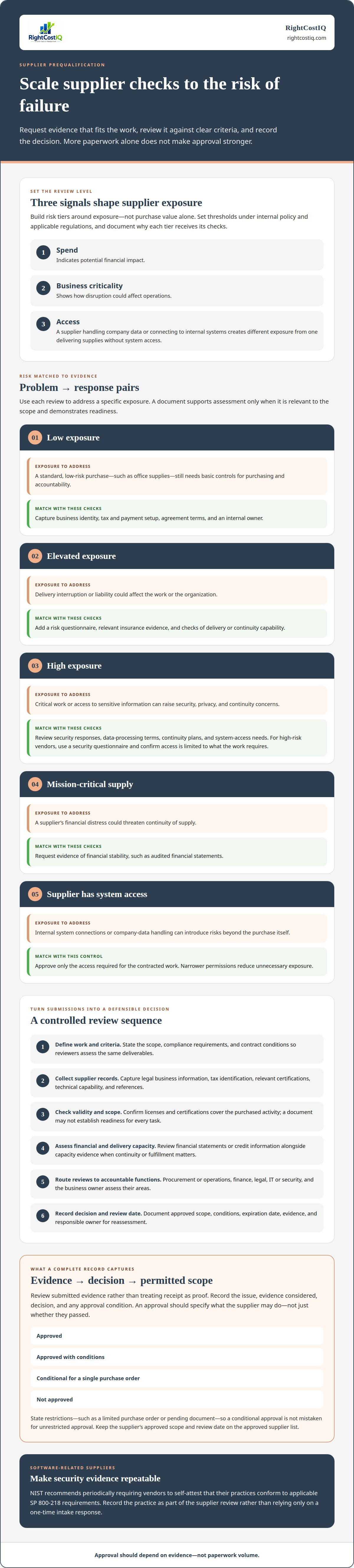
Build risk tiers around exposure, not just purchase value. Spend indicates financial impact, while business criticality shows how disruption could affect operations. Access adds another dimension: a supplier handling company data or connecting to internal systems poses different exposure from one delivering supplies without system access. Set thresholds under internal policy and applicable regulations, then document why each tier receives its assigned checks.
For each tier, define the required evidence and review owner before requesting documents:
- Low exposure: Capture business identity, tax and payment setup, agreement terms, and an internal owner; these basics support controlled purchasing.
- Elevated exposure: Add a risk questionnaire, relevant insurance evidence, and checks of delivery or continuity capability; these address operational and liability concerns.
- High exposure: Review security responses, data-processing terms, continuity plans, and system-access needs; these checks probe risks tied to critical work or sensitive information.
- Mission-critical supply: Request evidence of financial stability, such as audited financial statements; financial distress could threaten continuity.
- System access: Approve only the access required for the contracted work; narrower permissions reduce unnecessary exposure.
Screening should also account for geography, ownership, and payment risks. Businesses may use the OFAC Sanctions List Search as part of vendor due diligence when those risks apply. Follow the organization’s documented policy when making screening decisions. A tool result alone does not replace review of the supplier’s identity and ownership details.
Red flags include inconsistent business details, gaps in security responses, unexplained ownership, weak continuity evidence, or documents that fail to support the stated capability. Send each flag to the relevant procurement, finance, legal, or security reviewer. Record the issue, evidence considered, decision, and any approval condition so similar risks receive consistent treatment across suppliers.
Supplier prequalification steps and approval outcomes
A controlled approval sequence turns supplier submissions into a defensible decision. Define the scope of work first, then request evidence relevant to that scope. Review each document rather than treating receipt as proof. A company profile, vendor evaluation form, business registration, tax records, relevant licenses, financial statements, quality records, and customer references can support the assessment.
- Define the work and criteria. State the product or service scope, applicable compliance requirements, and contract conditions so reviewers assess the same deliverables.
- Collect supplier records. Capture legal business information, tax identification, relevant certifications, technical capability, and references to create a traceable file.
- Review evidence for validity and scope. Confirm that licenses and certifications cover the purchased activity, since a document may not establish readiness for every task.
- Assess financial and delivery capacity. Review financial statements or credit information alongside capacity evidence when continuity or fulfillment matters to the contract.
- Route reviews to accountable functions. Procurement or operations, finance, legal, IT or security, and the business owner assess the areas they oversee.
- Record the decision and review date. Document the approved scope, conditions, expiration date, evidence, and responsible owner for future reassessment.
For software-related suppliers, include security evidence in the record. NIST recommends periodically requiring vendors to self-attest that their practices conform to applicable SP 800-218 requirements. This creates a repeatable way to record supplier practices, rather than relying only on a one-time intake response.
Approval should specify what the supplier may do, not just whether they passed. Outcomes can include approved, approved with conditions, conditional for a single purchase order, or not approved. Apply standards consistently, and maintain an approved supplier list that records each vendor’s scope and review date. A conditional approval should state the restriction, such as a limited purchase order or pending document, so teams do not mistake it for unrestricted authorization.
Automation can route questionnaires and documents to assigned reviewers, track completion, and send reminders about expiring insurance or certifications. Keep the underlying record accessible to procurement, finance, legal, security, and the business owner. For example, keep a missing certificate visible as an open approval item rather than letting it disappear in an email chain.
After approval, connect the supplier record to performance reviews so new issues inform future decisions. A supplier performance diagnostic can help structure that review around documented supplier results.
Definition and purpose of contractor prequalification
Contractor prequalification assesses whether a contractor is eligible to bid on or perform defined work. It examines capability, safety, compliance, and operational readiness before the contract begins. Onboarding follows, covering logistics such as payment setup, project requirements, and system access. Keeping the stages distinct prevents an incomplete screening file from being mistaken for permission to start work.
Use project-specific criteria. A contractor installing equipment needs different evidence from one performing office maintenance. Connect each requirement to the work package, relevant jurisdiction, and contract terms. For example, licenses and registrations must cover the activities and location involved. A formal decision can limit approval to the evaluated scope rather than imply unrestricted eligibility.
A practical contractor checklist can collect:
- Business identity: Record the legal business name, structure, registration, and tax identification; capture jurisdiction-specific identifiers, such as an ABN where relevant.
- Project team: Request the proposed organization chart, brief CVs for project staff, employee certifications, licenses, and training records.
- Equipment and capacity: List plant and equipment assigned to the project, then compare the resources with the scheduled work.
- Relevant experience: Request completed major projects and their values to assess experience with comparable scopes.
- Safety readiness: Collect the safety manual, incident and injury information, and applicable safety certifications or records.
- Insurance and compliance: Include certificates of insurance and documents supporting requirements applicable to the work and contract.
Contracts convert screening into operating controls. Define the scope, deliverables, inspection responsibilities, documentation, and change process before work starts. Pricing should identify the agreed basis and any defined assumptions, so bids can be compared against the same scope. Payment terms belong in the signed agreement; Net 30 is one example of an agreed payment term, not a default for every engagement.
A renewal review should revisit the contractor’s active scope, insurance certificates, licenses, and performance record. Changes in ownership, location, work type, or risk can trigger reassessment. A renewal date recorded with the contractor’s details makes expired documents and scope changes visible before the relationship is extended.
For materials, define identification and traceability requirements in the project documents. Link purchase records, material certificates, inspection results, and release records to the relevant work package. This creates a documented path from receipt through use and helps reviewers resolve discrepancies without relying on memory. For controlled processes, include approved procedures, qualification records, personnel certifications, and equipment calibration status in the evidence package.
Inspection, testing, and documentation readiness
Inspection readiness means matching evidence to the work’s acceptance criteria. Before evaluating a supplier, define the required tests, inspection points, records, and release conditions. For special processes, review approved procedures, procedure qualification records, personnel certifications, continuity records, and equipment calibration status. These documents show whether the supplier’s controls support the specific work package.
Health, safety, environmental, and quality checks should cover relevant policies and plans, safety records, incident metrics, applicable certifications, and documented quality controls. Match each request to the work and its hazards, then assess the evidence against stated expectations instead of collecting documents without reviewing them.
Use a checklist that connects each evidence item to a decision:
- Confirm inspection criteria. Record product scope, required certifications, inspection hold points, source-inspection expectations, and records-retention requirements so suppliers work to defined acceptance conditions.
- Review test coverage. For SaaS vendors, check whether penetration-test scope covers the relevant product or network; scope determines whether results address the buyer’s exposure.
- Inspect vulnerability evidence. Review network-level and application-level scans; a SaaS assessment may sample scans covering three months, including the latest month.
- Track material records. Link inspection results, material certificates, and release documentation to the applicable work package so teams can trace decisions.
- Check insurance and license dates. Most organisations re-verify contractor insurance and licensing on renewal, typically annually, reducing the chance of relying on expired documents.
- Define critical surveillance. Set witness and hold points, notification periods, photo-evidence expectations, and nonconformance escalation rules before award.
Document review should test substance, not just confirm that a file exists. For example, compare a procedure’s stated controls with inspection records and calibration evidence for the equipment used. A quality certificate can support the review, but its scope and the supplier’s actual controls must fit the assigned work.
Procurement software can centralize supplier documents, renewal dates, inspection records, and review ownership. Set reminders for expiring insurance, licenses, and certifications, then route exceptions to the responsible reviewer. Access reviews should confirm that vendor permissions still match active work. Remove access during offboarding when the engagement ends.
Consistent monitoring turns a completed prequalification file into an operational record. Link each document to its supplier, scope, expiration date, and approval status. When a document expires or a project changes, reopen the relevant review rather than relying on a calendar reminder. This keeps evidence current and makes inspection expectations traceable across procurement and project teams.
Supplier quality, delivery, and ethical sourcing
Assess supplier quality and delivery against the actual work package, not a generic questionnaire. Define product specifications, capacity expectations, acceptance criteria, delivery milestones, and required records before evaluation. ISO 9001 certification can support a quality review, but certification alone doesn’t establish readiness for a specific project. Confirm that the supplier’s controls and demonstrated performance fit the purchased scope.
Requirements vary by industry and U.S. state because statutory rules, industry standards, customer requirements, and contract obligations differ. Set criteria for the work’s location and activities, including required licenses and certifications, then assess evidence against those criteria.
Use a work-specific assessment to compare suppliers consistently:
- Technical and quality capability: Review relevant processes, quality records, personnel competence, and specification compliance; a sample weighted evaluation assigns this area 30%.
- Delivery and capacity: Assess production or service capacity, delivery history, and milestone commitments; the sample assigns this category 25%.
- Financial and continuity risk: Consider evidence of stability and plans for maintaining supply; the sample assigns this area 20%.
- Commercial terms: Compare the proposed contract terms with the required scope and assumptions; the sample assigns this category 15%.
- Service responsiveness: Evaluate communication and issue resolution using relevant records; the sample assigns this category 10%.
These weights illustrate one evaluation model, not a universal standard. Set benchmarks that reflect the purchase’s risk and priorities. For a safety-critical package, capability and controlled processes may matter more than responsiveness. For routine consumables, identity, basic compliance, and delivery terms may provide a proportionate assessment.
Make ethical sourcing criteria specific to the work and contract. Document supplier expectations, relevant evidence, and how to escalate a concern. For supply-chain visibility, identify critical third parties, including subcontractors, technology providers, and parties processing buyer data. A qualified prime supplier does not automatically qualify organizations performing outsourced processes, so assess sub-tier work that could affect quality, continuity, or compliance.
After onboarding, monitor supplier results against the original benchmarks. Track delivery adherence, quality issues, corrective-action closure, capacity changes, and service responsiveness. Reassess when a material quality failure, repeated late delivery, ownership change, or substantially different project scope alters the risk picture. These checks help procurement focus reviews on documented performance and emerging exposure.
Assess supplier performance against defined benchmarks to identify where monitoring can better support quality, delivery, and sourcing decisions.
RightCostIQ: Procurement and Vendor Performance Tracking Service
RightCostIQ helps procurement teams track vendor performance after approval, connecting supplier results with operational and sourcing decisions. Its Procurement and Vendor Performance Tracking Service is relevant when delivery, quality, or compliance data needs structured monitoring against defined expectations. This service helps teams identify performance trends and focus reviews where supplier outcomes affect procurement priorities.
For sourcing decisions, Procurement Category Cost benchmarking and Analytics adds market cost context, while Request For Proposal (RFP) Management and Negotiation Assistance supports structured supplier selection and commercial discussions. These offerings complement prequalification by connecting supplier readiness with performance and procurement analysis.
Contact RightCostIQ to discuss your vendor performance tracking needs.
Make supplier readiness part of procurement strategy
Treat supplier qualification as an input to decisions, not a file that stops being useful after approval. Connect the vendor pre-qualification process checklist to sourcing priorities, commercial analysis, and performance reviews so future decisions reflect both supplier capability and business value. As requirements shift, a clear view of supplier performance helps procurement teams focus attention and refine upcoming sourcing activity.
RightCostIQ supports this work through its Procurement and Vendor Performance Tracking Service, Procurement Category Cost benchmarking and Analytics, and Request For Proposal (RFP) Management and Negotiation Assistance. These offerings connect supplier oversight with cost context and structured sourcing support.
Contact RightCostIQ to discuss vendor readiness and define a practical next step for your procurement priorities.
Frequently Asked Questions
What Is Supplier Prequalification?
Supplier prequalification is an early assessment of whether a supplier meets the requirements to be considered for a purchase or contract. It gives procurement teams a consistent basis for deciding which suppliers advance to formal evaluation. For example, a buyer sourcing a data service may assess the supplier’s relevant experience and data-handling controls before comparing proposals or negotiating terms.
Can prequalification be automated?
Yes. Workflow software can collect intake information, assign reviews, track missing documents, and send reminders as records approach expiry. Automation is most useful for repeatable routing and status tracking, not for replacing judgment. For example, a workflow can flag a missing insurance certificate while a procurement or risk specialist assesses whether the evidence meets the organization’s requirements.
How Should Procurement Teams Verify Supplier Capability, Compliance, and Risk?
Verify each area using evidence tied to the supplier’s proposed work. Assess capability through relevant project records or technical documentation, compliance through applicable licenses and certifications, and risk through financial, operational, security, and ownership reviews. For example, a supplier’s certificate should match the activity under consideration, and a reference should relate to comparable work rather than a different service.
Who should own the prequalification process?
Procurement or operations should coordinate the process, while subject-matter reviewers assess their areas. Finance can review financial information, legal can assess contract terms, IT or security can evaluate technology exposure, and the business owner can confirm operational fit. Assign one process owner to maintain the workflow and an approval authority to resolve exceptions, so submissions do not stall between departments.
What is a vendor pre-qualification process?
A vendor pre-qualification process is a structured screening that determines whether a vendor is eligible to advance for a defined purchase. A vendor pre-qualification process checklist maps requirements to evidence, reviewers, and decision status. For example, a buyer evaluating a supplier for recurring services can record which qualifications are mandatory and which findings require a condition or further review.
What documents should a vendor pre-qualification checklist include?
Include documents that demonstrate the vendor’s identity, authority, capability, and relevant controls. Depending on the work, the file may contain business registration, tax information, licenses, insurance certificates, financial statements, quality records, safety materials, technical evidence, references, and security responses. Organize each item by requirement, owner, review status, and expiry date so the record supports approval and later reassessment.
What criteria should be used to evaluate and score vendors?
Choose criteria that reflect the purchase’s objectives and risks, such as technical fit, quality controls, delivery capacity, financial continuity, compliance, service responsiveness, and commercial terms. Separate mandatory pass-or-fail requirements from scored criteria, then document how the evidence supports each rating. For instance, a required license can serve as a qualification gate, while demonstrated performance against project needs can inform comparative scoring.
How do you verify a vendor's financial stability and creditworthiness?
For a critical supplier, assess financial evidence such as audited statements and consider available credit information as part of the review. Examine liquidity, profitability, debt, and cash-flow trends rather than relying on a single indicator. Relate the findings to the vendor’s role: a supplier supporting an essential operation warrants closer attention to continuity than one providing a readily replaceable service.


