

The lowest vendor quote can become the costliest choice when fees, worker rates, service levels, or renewal terms are unclear. Professional support with vendor rate card negotiation helps clarify the full pricing structure, compare quotes on consistent terms, and negotiate changes that reflect your priorities.
A clear rate card should show what you’ll pay and what each fee covers. Yet quotes may package labor, service scope, support, and commercial terms differently, making headline rates difficult to compare. A sound negotiation looks beyond the initial figure to identify what is included, where terms differ, and which tradeoffs affect value.
This article explains how professional negotiation support can assess vendor pricing, clarify worker rates and fees, and present proposals transparently. You’ll also learn how to explain tradeoffs and compare quotes against the service, performance, and contract terms that matter to your organization.
Key Takeaways
- Assess current spend, contract terms, usage, and service outcomes to identify where rate discussions can create value.
- Clarify how worker pay, vendor fees, role categories, and experience levels shape the total cost of a service.
- Keep negotiation communication transparent by making proposals and concessions clear, specific, and documented.
- Evaluate pricing tradeoffs against scope, service levels, flexibility, and the business value each term provides.
- Compare competing quotes on consistent criteria, including fees, performance, and the full vendor package, not just the headline rate.
1. How can a professional help me negotiate better vendor rates?
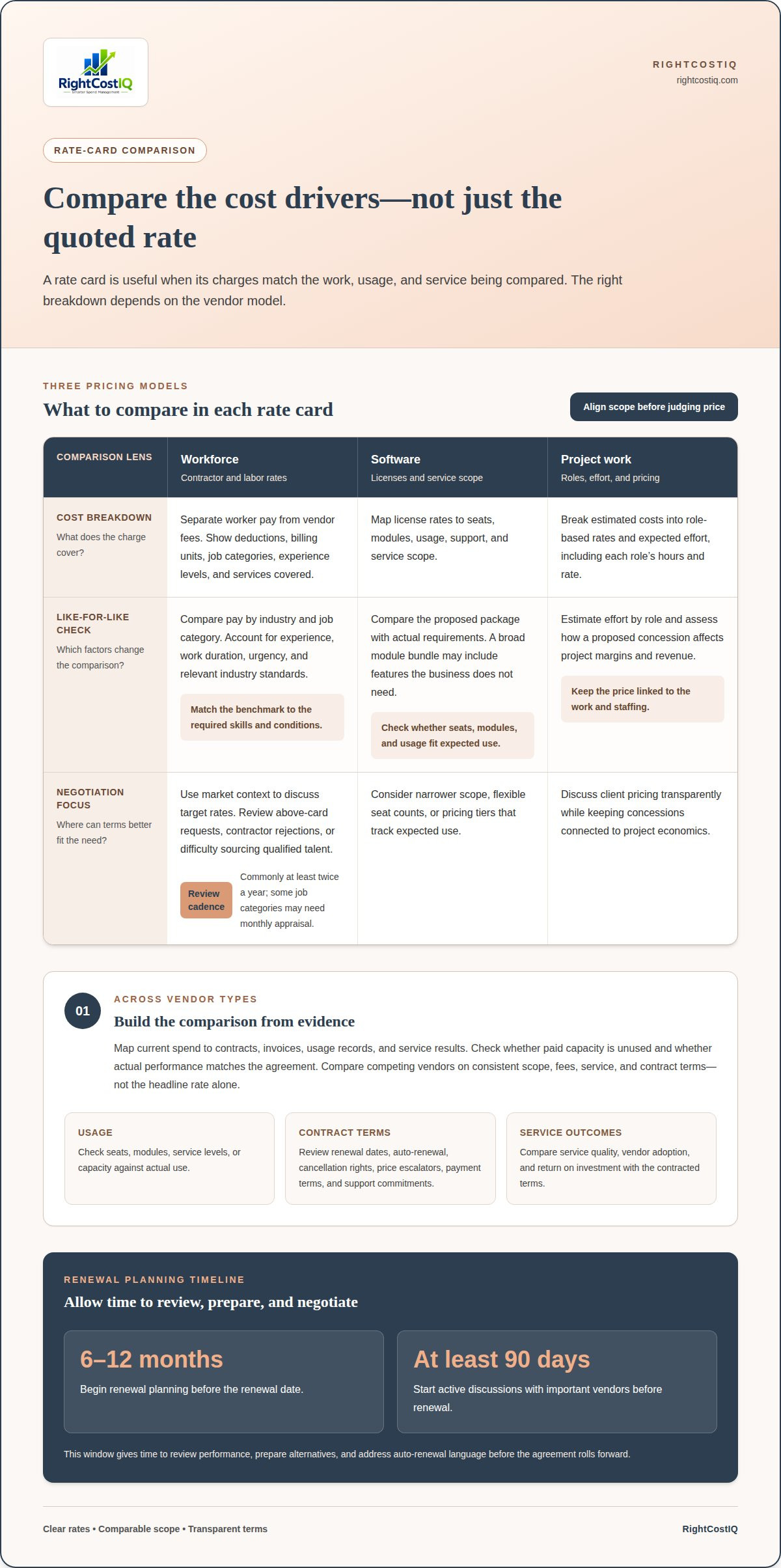
Effective vendor rate card negotiation begins with evidence, not an arbitrary request for a discount. The work starts by mapping current spend to contracts, invoices, usage records, and service results. This shows whether the organization pays for unused seats, modules, or service levels, and whether actual performance matches the agreement.
Next, review renewal dates, auto-renewal clauses, cancellation rights, price escalators, payment terms, and support commitments. Compare contracted rates with actual usage and outcomes, including vendor adoption, service quality, and return on investment. For example, a low unit rate may offer little value if invoices include unused capacity or annual increases compound over the contract term.
Vendor operations also shape the negotiation. Professionals clarify agreement length, minimum purchase quantities, order processing time, shipping methods, delivery frequency, and warranty terms. They assess which terms affect total cost and service continuity, rather than treating the quoted rate as the only negotiating point. A supplier may consider a lower price for payment within 15 days, but the value depends on the buyer’s cash-flow priorities.
Timing matters. Procurement teams are advised to begin renewal planning 6-12 months before renewal, while active discussions with important vendors should start at least 90 days before renewal. That window allows time to review performance, prepare alternatives, and address auto-renewal language before the existing agreement rolls forward.
Pre-identified contractors can create a different leverage problem. A hiring manager may meet a personally sourced worker and discuss rates only after deciding they want that person. The manager may then accept a rate above the target because losing a preferred contractor feels costly. Bringing rate-card benchmarks and role criteria into the process earlier makes budget decisions less dependent on a late-stage personal preference.
How can a professional negotiate volume discounts, tiered pricing, and bundled rates? Model expected demand against each pricing tier, then compare the discount with the commitment, usage risk, and included services. For bundles, separate useful components from surplus scope so a lower combined rate does not conceal spend on services the organization will not use.
Supplier discussions can then address rate reductions, payment terms, scope, service levels, and renewal protections. A professional can seek competing quotes, use market benchmarks, and record concessions in the agreement. If the supplier will not meet essential terms, the analysis can show whether switching vendors is commercially preferable.
2. Transparency around worker rates and vendor fees
A transparent rate card separates the worker’s pay from the vendor’s fee. It explains deductions, billing units, job categories, experience levels, and the services covered by each charge. This structure shows whether a quoted amount goes to the worker, covers vendor administration, or combines both. That clarity helps clients assess the commercial relationship without treating the contractor’s rate and the provider’s margin as interchangeable.
Market research adds context to target rates. Compare pay-rate data by industry and job category with competing vendors’ charges and prices for comparable services. Account for experience, work duration, urgency, and relevant industry standards. A target rate should reflect the required skills and conditions, not apply one flat figure across unrelated roles. Like-for-like comparisons also make a proposed rate easier to explain and negotiate.
How do vendor rate cards differ by industry and service type? They reflect different job categories, experience levels, labor conditions, and service requirements. A rate for one role or industry cannot automatically serve as a benchmark for another. Align the comparison with the work and its scope before judging whether a rate is competitive.
Workforce rate cards need periodic review because labor conditions change. Contingent workforce vendors commonly update their rate cards at least twice a year, and some job categories may need appraisal every month. Contractor rejections, above-card rate requests, and difficulty sourcing qualified talent can signal that target rates no longer fit the market.
Software licensing calls for a different cost breakdown. Map license rates to seats, modules, usage, support, and service scope, then compare the actual requirement with the proposed package. For example, a business paying for a broad module bundle may need only a subset of its features. Negotiation can focus on narrower scope, flexible seat counts, or pricing tiers that track expected use.
For project work, estimate costs using role-based rates and expected effort. Distinguish each role’s hours and rate, then assess how a proposed concession affects project margins and revenue. This lets a provider discuss client pricing transparently while maintaining a clear link between the work, staffing, and commercial terms.
A vendor performance review can connect rate transparency with delivery evidence, so the buyer sees what fees support and whether service outcomes justify the structure. For a focused view of rate assumptions and cost drivers, use a procurement cost diagnostic to inform the next discussion.
3. Transparent communication during negotiations
Set a clear agenda before the first vendor discussion. Identify the requested rate, service scope, contract terms, and evidence behind each proposal. For example, connect a request for lower fees to reduced usage or a changed service requirement. This gives the supplier a specific issue to address rather than a vague demand to cut prices.
Counteroffers work best when they are limited and supported by reasons. In supplier discussions, one or two counteroffers can keep the negotiation focused while preserving a constructive relationship. Each should state the proposed term, the business rationale, and any corresponding concession. If the supplier cannot reduce the rate, discuss scope, payment terms, or service commitments instead.
Respectful communication also protects the credibility of market evidence. Explain that competing quotes informed the target without disclosing another vendor’s quoted price. Keep comparisons focused on equivalent scope and requirements. This gives the supplier a fair basis for responding and avoids a negotiation built on confidential details or unsupported claims.
During each discussion, record decisions, open questions, and who is responsible for follow-up. A written meeting summary can distinguish agreed changes from proposals still under review. For example, a reduced rate may be agreed in principle while support levels remain unresolved. Separating these points prevents either party from treating an incomplete discussion as a final agreement.
Proactive rate-card communication gives affected teams time to plan. Agencies should discuss changes with clients weeks or months beforehand when possible, giving clients time to adjust expectations internally. The same principle helps procurement teams explain planned changes to hiring managers before new rates affect requisitions. Clear timing supports informed decisions about budgets, staffing, and vendor relationships.
Before payment or renewal, confirm every accepted concession in the contract or agreement. The written record should capture discounts, scope, renewal language, support commitments, usage rights, termination terms, and price protections. A verbal promise about future increases is no substitute for precise language. Clear documentation gives finance and operations teams a shared reference after negotiations conclude.
Negotiation success also depends on separating the commercial issue from the working relationship. Acknowledge a supplier’s constraints, state the organization’s priorities, and explain which tradeoffs are acceptable. This keeps discussions direct without personal judgments. A structured vendor rate card negotiation turns each proposal into a decision about value, risk, and terms, not simply the amount being paid.
4. Explaining pricing tradeoffs with confidence
Frame each concession against the value and risk it creates. In vendor rate card negotiation, a lower rate may require a longer term, faster payment, consolidated spend, or narrower service scope. Show what procurement gains and what the organization commits in return. This makes it easier to accept a concession only when its value justifies the tradeoff.
Vendor pricing research gives the discussion a factual baseline. Compare market pricing, competing vendors, bundled options, internal capabilities, and consolidation opportunities. Assess whether the proposed rate reflects the same service scope and performance expectations. For example, a cheaper package may exclude support or training included in another proposal, changing its overall value. This comparison also strengthens vendor rate card negotiation by grounding requests in comparable commercial terms.
Tradeoffs can also involve speed and operating costs. A business requiring delivery within 8 hours may pay more for materials or inventory while reducing storage costs. A professional explains both sides of this choice, then relates the premium to the operational need. The same logic applies to contractor rates: a worker may accept a lower rate in exchange for security through extended work.
What risks and red flags should you watch for in vendor pricing? Examine unclear fee components, automatic increases, unnecessary bundled services, and commitments that exceed expected usage. A low starting rate can become costly if renewal increases or restrictive exit terms erase its initial advantage.
Billing oversight turns negotiated terms into measurable checks. Align invoices with the agreed scope, rates, service levels, and usage rights. Compare billed quantities with actual consumption and flag charges that do not match the contract. Procurement and vendor performance tracking can connect these cost checks with adoption and service quality, rather than assessing invoices in isolation.
How do professionals document negotiated rates and manage future rate increases? They record rates, scope, discounts, renewal language, price protections, and termination terms in the agreement, then track renewal dates and invoices against those terms. For example, an 8% annual auto-renewal increase can make an initially favorable rate more costly over time, so the increase and renewal mechanism need explicit review.
Measured concessions protect both economics and delivery. Model the impact of flexible seat counts, improved service levels, training, credits, or performance-based pricing before recommending acceptance. Connect each option to a defined business requirement. Also consider stable usage, proven performance, clear service commitments, and acceptable exit terms before trading a longer commitment for a lower rate.
Clear explanations of tradeoffs give decision-makers a basis for approval. Show the proposed term, the value received, the exposure accepted, and the contractual protection required. This keeps vendor rate card negotiation focused on sustainable economics, not a headline discount detached from service delivery.
5. Comparing competing vendor quotes
Competing quotes create useful leverage only when they cover equivalent requirements. Normalize each proposal against the same scope, service levels, usage assumptions, delivery needs, and contract terms. For example, a lower quote may exclude implementation or support included by another supplier. A comparison matrix makes these differences visible before price becomes the deciding factor.
How do professionals compare vendor rate cards and evaluate total cost of ownership? Align rates by role or service, then assess the full package, including fees, usage, quality, delivery performance, support, and contract commitments. Consider internal capabilities and consolidation opportunities too, so the preferred quote reflects the organization’s broader procurement needs.
Examine operational evidence, not just proposal language. Assess product or service quality, on-time delivery, responsiveness, and performance against agreed requirements. A supplier offering a lower rate may create additional work if delivery delays require internal teams to intervene. Performance records help show whether a price difference corresponds to a meaningful difference in service.
Next, identify cost elements treated differently across quotes. One proposal may bundle support and training, while another prices them separately. Map these components to actual needs, then distinguish required services from optional scope. This prevents a bundled discount from seeming more valuable simply because its total includes services the organization will not use.
Terms matter as much as rates. Compare contract duration, minimum quantities, payment terms, renewal provisions, price protections, and exit conditions. For example, a favorable introductory rate may be less competitive if future increases apply automatically or cancellation requires lengthy notice. A total-cost view accounts for these commitments across the agreement, not just the initial quote.
Use the comparison to explain requirements, not to disclose another supplier’s quoted price. State which scope or service level needs adjustment and invite each vendor to respond on equivalent terms. This supports fair engagement and preserves competitive pressure without turning one supplier’s proposal into another’s negotiation tool. Assess any discounts against service quality and contract risk.
After selection, track vendor adoption, service quality, and agreed performance measures against the original comparison. A reporting process tied to total cost of ownership helps reveal whether expected value continues after signing. This evidence can also improve the next sourcing engagement by showing which proposal assumptions matched actual delivery.
For a structured review of competing proposals and cost drivers, request a procurement cost diagnostic.
RightCostIQ: Request For Proposal (RFP) Management and Negotiation Assistance
RightCostIQ provides Request For Proposal (RFP) Management and Negotiation Assistance for organizations preparing a sourcing process or negotiating vendor terms. This support can help structure vendor proposals, assess pricing, and carry negotiation priorities into the agreement. Turn to this service when competing quotes are difficult to compare, worker rates and vendor fees need clearer analysis, or renewal terms require focused review.
Procurement Category Cost benchmarking and Analytics can add market context to cost comparisons. Procurement and Vendor Performance Tracking Service connects agreed terms with delivery results, while Price Risk Management and Tracking Service addresses price exposure. These services support different parts of procurement analysis, depending on the issue at hand.
For support with vendor pricing and negotiations, contact RightCostIQ.
Make pricing clarity part of your next procurement decision
Clear pricing is most useful when it informs decisions beyond a single negotiation. Build a shared view of vendor costs into procurement planning so finance, operations, and procurement can assess commercial terms against business priorities. That alignment gives future vendor rate card negotiation a stronger basis: decisions reflect the organization’s requirements, not just a supplier’s latest proposal.
When you need structured sourcing support, RightCostIQ provides Request For Proposal (RFP) Management and Negotiation Assistance. Its Procurement Category Cost benchmarking and Analytics informs cost comparisons, while its Procurement and Vendor Performance Tracking Service connects vendor performance with ongoing oversight. Together, these capabilities support informed procurement decisions that consider pricing and delivery.
Choose the next step that fits your current need, whether that means preparing a sourcing process or reviewing vendor costs. Contact RightCostIQ to discuss vendor rates and identify a practical starting point. A clearer view of pricing can help your team move forward with greater confidence.
Frequently Asked Questions
How can a professional help me negotiate better vendor rates?
A professional can turn procurement priorities into a structured negotiation position and coordinate the supplier discussion. For example, they can distinguish essential requirements from flexible terms, then assess whether a vendor’s counterproposal meets the business need. RightCostIQ’s Request For Proposal (RFP) Management and Negotiation Assistance supports this work. The goal is a clear commercial decision, with agreed terms recorded for the teams responsible for implementation and oversight.
How can a professional ask for a better vendor rate on my behalf?
Present the request with a defined rationale, relevant market context, and clear boundaries for acceptable terms. If a supplier resists a lower base rate, explore a different scope or pricing structure instead of making an unsupported demand. You provide business priorities and approval limits; the professional handles the negotiation conversation and evaluates whether the supplier’s response meets those requirements.
Should I sign a longer contract for a lower rate?
Only if the lower rate justifies the commitment and the contract remains workable as needs change. Weigh expected usage, service performance, price protections, and exit provisions against the proposed savings. For example, a stable, regularly used service may support a longer term, while uncertain demand can make flexibility more valuable. The decision should reflect total commercial exposure, not the reduced rate alone.
What vendor costs are easiest to renegotiate?
Costs tied to adjustable scope are often practical starting points: unused seats, optional modules, bundled services, support levels, or order quantities. Identify charges that do not match actual requirements, then ask the supplier to revise that element. For example, reducing a software package to the modules the organization uses may address excess spend without changing the features employees rely on.
When is Negotiation Appropriate?
Negotiation is appropriate when a renewal is approaching, usage or scope has changed, performance no longer meets expectations, or a new sourcing decision is underway. It can also make sense when market conditions or business priorities shift enough to affect an agreement’s value. A clear trigger keeps the discussion tied to a business decision rather than reopening terms without a defined reason.
How can a professional prepare for a vendor rate card negotiation?
Prepare by organizing the documents and decisions needed for a focused discussion. Gather the current agreement, relevant invoices, usage information, service requirements, and the organization’s approval limits. Establish which terms are priorities and which can be exchanged. This preparation helps prevent internal teams from giving conflicting instructions or accepting a proposal before understanding its operational impact.
What benchmarks and market rates can a professional use to negotiate vendor pricing?
Useful benchmarks depend on the category and the work being purchased. Compare competing vendor charges, market pricing, bundled options, internal capabilities, and consolidation opportunities. For contingent roles, comparisons should reflect job category, experience, and work conditions. The objective is to compare equivalent services or roles, not treat a rate from a different scope or category as a reliable target.
Which vendor rate card fees and terms are negotiable?
Negotiable items can include base rates, volume discounts, tier thresholds, bundle contents, seat flexibility, payment terms, support, training, and performance commitments. Contract terms may also cover renewal language, price protections, usage rights, and termination conditions. Prioritize items with the clearest business impact, then assess any requested tradeoff. The final agreement should state accepted rates, scope, and terms precisely.


