

A procurement org chart alone won’t create clear workflows. Knowing how to structure a procurement team for success starts with aligning roles, approvals, and supplier processes with business objectives, then choosing a centralized, hybrid, or decentralized model that fits the organization.
Clear ownership and consistent processes can improve procurement execution. The structure works best when people know who leads sourcing, manages contracts, evaluates suppliers, and approves purchases, and how those responsibilities connect with finance, legal, operations, and other teams.
This guide explains how to define procurement objectives, assign responsibilities, choose an operating model, and document sourcing, approval, and supplier onboarding workflows. It also covers how performance measures and supplier data can keep the function aligned as business needs change.
Key Takeaways
- Define procurement roles around the work the business needs, from sourcing and analysis to contract and supplier management.
- Document sourcing, supplier evaluation, and contract steps so responsibilities and handoffs are clear.
- Choose centralized, hybrid, or decentralized procurement based on business structure, category needs, and local operating conditions.
- Standardize approval thresholds and supplier onboarding to create consistent purchasing controls and smoother workflows.
- Connect procurement objectives and performance measures to wider business priorities, then adjust the operating model as those priorities change.
1. Documenting sourcing, supplier evaluation, and contract workflows
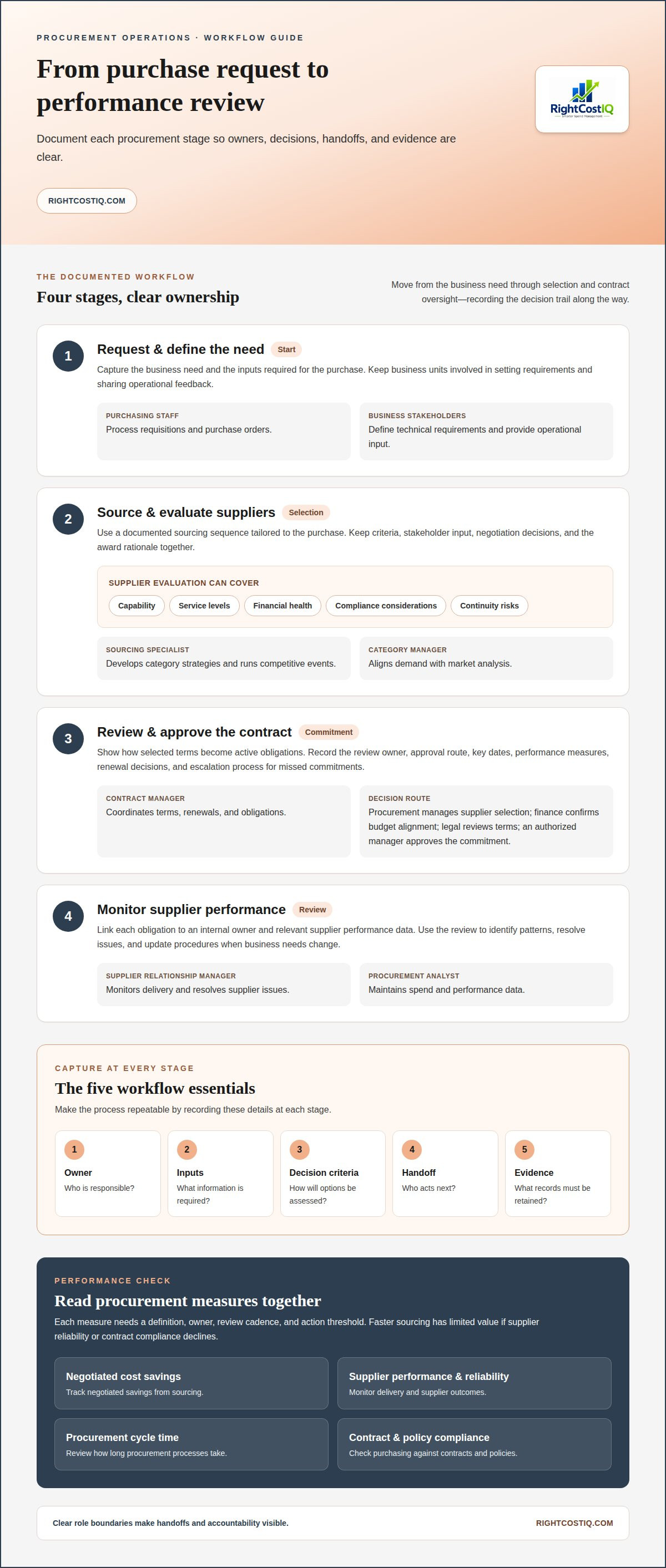
Document each procurement workflow from request through supplier selection, contract approval, and performance review. At every stage, record the owner, required inputs, decision criteria, handoff, and evidence to retain. For example, a sourcing specialist might own bid analysis, while a contract manager tracks review dates and obligations. This makes the process repeatable and clarifies who acts when a purchase changes scope.
Separate responsibilities by function, then define the handoffs. Purchasing staff process requisitions and purchase orders; sourcing specialists develop category strategies and run competitive events; contract managers coordinate terms, renewals, and obligations; supplier relationship managers monitor delivery and resolve issues; procurement analysts maintain spend and performance data. In a smaller team, one person may cover several functions, but documented role boundaries prevent approvals, negotiation, and supplier oversight from becoming unassigned work.
Centralizing some activities can strengthen strategic sourcing by consolidating category knowledge, coordinating demand, and engaging suppliers earlier. Keep business units involved in setting requirements and sharing operational feedback, while central procurement manages sourcing methods, evaluation records, and contract standards. For example, a central category lead can coordinate a shared specification, while local stakeholders assess whether a supplier can meet site-specific needs. This approach builds leverage without losing necessary operational input.
Use a documented sourcing sequence for each category, tailoring criteria to the purchase rather than relying on informal preferences. Record the business need, market options, evaluation criteria, stakeholder input, negotiation decisions, and award rationale. A supplier evaluation record might cover capability, service levels, financial health, compliance considerations, and continuity risks. Keeping criteria and evidence together supports consistent decisions and creates a useful history when requirements or market conditions change.
Contract procedures should show how selected terms become active obligations. Record the review owner, approval route, key dates, performance measures, renewal decisions, and process for escalating missed commitments. Link each obligation to an internal owner and relevant supplier performance data. Procurement analytics can then help identify patterns such as cost fluctuations, purchasing trends, or repeated delivery issues, rather than leaving contract management dependent on individual memory.
Which procurement KPIs measure team performance and savings? Track negotiated cost savings, supplier performance and reliability, procurement cycle time, and compliance with contracts and policies. Read these measures together: faster sourcing has limited value if supplier reliability or contract compliance declines.
Use procurement cost benchmarking and analytics to inform category comparisons, and connect the findings to sourcing records. Procurement and supplier performance data become more useful when each measure has a definition, owner, review cadence, and action threshold. Automation can support purchasing, invoicing, contract management, and supplier evaluations; documented process rules help ensure the technology follows the intended workflow. Review exceptions and stakeholder feedback regularly, then update procedures when the process no longer reflects business needs.
2. What Is a Procurement Organization Structure?
A procurement organization structure assigns decision rights, responsibilities, and reporting relationships to purchasing work. It connects business objectives with the people who handle sourcing, manage suppliers, and control purchasing activity. The United States Environmental Protection Agency emphasizes that teams need a shared understanding of processes, procedures, roles, and responsibilities to work toward common goals. Clear job descriptions make that shared understanding part of accountable daily work.
Define roles by decisions and outputs, not titles alone. A purchasing coordinator processes requisitions and purchase orders; a sourcing specialist develops bid strategies and evaluates offers; a category manager aligns demand and market analysis; a contract manager coordinates terms and obligations; an analyst maintains spend and performance reporting. In a smaller organization, one employee may hold several roles, but every responsibility still needs an owner and an approval path.
Governance defines who recommends, reviews, approves, and monitors procurement decisions. For example, a department lead can define technical requirements, procurement can manage supplier selection, and finance can confirm budget alignment. Legal can review contract terms, while an authorized manager approves the commitment. Written decision limits and escalation routes help teams handle exceptions without duplicating reviews or bypassing controls.
In the United States, procurement controls should support transparent transactions, fair supplier selection, compliance with applicable trade laws, and prevention of conflicts of interest. Document the organization’s relevant obligations, retain evaluation records, and train staff on its code of conduct. Risk controls can also assign responsibility for reviewing supplier financial health, compliance information, and disruption exposure before a critical award.
How should procurement teams be structured by company size and industry? Base the model on annual spend, purchasing complexity, supply-chain risk, and the number of operating locations. A complex global supply chain or highly regulated industry may need specialist capacity even when spend is relatively modest; a simpler organization can combine roles while preserving clear decision rights.
What steps can you take to build or reorganize a procurement team? Map current purchasing activity and business objectives, identify capability gaps, assign decision owners, document reporting lines, then define measures and review points. Match recruitment, training, and technology investment to those gaps instead of starting with an org chart.
Common mistakes include unclear ownership, excessive approval layers, and designing procurement around reporting lines instead of business needs. Prevent them by documenting role boundaries, aligning finance, legal, and operations, and testing proposed changes against real purchasing workflows. A procurement operating-model diagnostic can help identify where responsibilities and processes need alignment.
3. Choosing centralized, hybrid, or decentralized procurement structures
Centralized procurement concentrates purchasing authority, category strategy, and spend control in a central team. Decentralized procurement gives departments or locations greater autonomy over operational buying. A hybrid model combines central strategic oversight with local purchasing execution, while a center-led model sets shared direction and standards across business units. The practical distinction is where decision rights sit and who controls each purchase.
Smaller organizations often centralize procurement to encourage consistent processes and cost control. Growing businesses may adopt a hybrid model, with central teams leading strategic sourcing and local teams responding to operational needs. Large enterprises with distributed operations may decentralize some decisions, while maintaining oversight for visibility and consistent standards. These are starting points, not fixed rules: organizational structure and stakeholder requirements should guide the operating model.
How many procurement staff are needed relative to company spend or headcount? Common benchmarks range from one procurement professional for every $10-$15 million in annual company spend to one procurement full-time equivalent per $15–23M of spend. A mid-market company may consider its first procurement hire at about $20–30M+ in addressable non-payroll spend or ~300–500+ employees. Treat these as reference points; complexity, industry, and supply-chain risk also affect staffing needs.
To choose a model, map purchasing decisions across business units, locations, and categories. Identify which categories share specifications or suppliers, where local regulations or stakeholder needs differ, and which decisions require consistent oversight. For example, a global category with common specifications may benefit from consolidated sourcing, while regional teams manage requirements that vary by location. Establish decision rights for strategy, supplier selection, and operational purchases before changing reporting lines.
Centralization can improve spend visibility and strategic coordination, but a central team still needs business-unit input to develop workable requirements. Decentralized teams can respond directly to local operating needs, but fragmented purchasing can make spend harder to control. A center-led approach can establish common policies and category priorities while leaving defined execution decisions closer to operations. Effective collaboration matters more than physical location or reporting lines, so include cross-functional training and shared performance measures in the design.
Review the model against actual purchasing patterns, not the organization chart alone. Compare category opportunities, stakeholder feedback, supplier performance, and workflow exceptions, then adjust decision rights where the model causes delays or weak oversight. A structure should evolve as technology, customer requirements, and political conditions change. Regular review keeps procurement responsive to operations while protecting strategic priorities and spend control.
4. Standardizing approval and supplier onboarding workflows
Set a consistent route from purchase request to approval, supplier setup, contract execution, and order release. Define the information each request needs, who reviews it, and how exceptions move forward. For example, return a requisition with an incomplete business justification to its requester before approval. A documented route gives employees a clear next step and helps procurement distinguish routine purchases from decisions that need specialist review.
Use approval thresholds to match oversight with purchasing risk and authority. A sample procurement objective requires manager approval for off-policy purchases above $500. Translate that principle into a workflow that identifies policy exceptions, assigns an approver, records the decision, and routes unresolved cases to a designated leader. Clear controls prevent employees from treating urgent requests as automatic exceptions or seeking approval after a commitment has already been made.
Supplier onboarding should follow a defined sequence. First, collect the information needed to assess the supplier and proposed purchase. Next, route the record for relevant risk, finance, legal, and operational reviews. Then document the approved terms, account setup, internal owner, and any conditions for starting work. A supplier with a critical supply-chain role may need closer risk review than one providing a low-impact, easily replaced item.
Standardization does not require removing local supplier contact. Decentralized supplier relationship management lets procurement staff and operational stakeholders engage suppliers regularly, including on performance matters beyond the negotiated contract. Keep a central record of commitments and issues, while assigning a local relationship owner who understands delivery requirements. This preserves visibility and gives suppliers a clear route for resolving day-to-day operational problems.
Build negotiation and supplier relationship capabilities into hiring criteria and training. Look for evidence of analytical preparation, clear communication, problem-solving, and professional conflict resolution. A sourcing professional might lead commercial discussions, while an operational stakeholder explains service requirements. Define each person’s role before negotiations begin, then record decisions and commitments so relationship-building supports contract performance rather than conflicting with agreed terms.
Collaboration improves when expectations are clear. Set performance measures with suppliers, communicate changes through agreed channels, and review recurring issues with the relevant internal teams. Fair contracts, regular discussions, and professional dispute resolution support constructive working relationships. For a supplier with repeated delivery problems, for example, a joint review can identify causes, assign corrective actions, and track follow-through against the contract.
Include sustainability and supplier diversity objectives in onboarding and evaluation criteria. Procurement can define the information needed to assess these priorities, apply consistent criteria, and retain the rationale for supplier decisions. Digital workflows can reduce paper handling while improving process visibility. Review approval exceptions, onboarding delays, supplier performance, and policy compliance together to identify where process changes or further staff training can strengthen procurement controls.
5. Aligning procurement structure with the business
Procurement structure should follow business priorities, not procurement’s preferred reporting chart. Start by translating business plans into decisions the function must support: cost control, continuity, customer requirements, risk management, or growth. A business expanding into new markets, for example, may need procurement involved in assessing supplier capacity and regional requirements before launch. Those objectives should shape category ownership, stakeholder participation, and the measures leaders review.
Give procurement leaders a clear route into executive decisions. Board-level representation, or a competent sponsor who understands the supply chain, helps connect sourcing choices with business plans. The sponsor can raise supplier risks, capacity constraints, and investment trade-offs before they disrupt delivery. Managers should align procurement with finance, legal, operations, and logistics so that budgets, contracts, and operational requirements inform decisions together.
Build regular collaboration into operating routines. Procurement leaders can join sales and operations planning meetings, where forecasts and supply availability affect customer commitments. Finance can contribute budget and cash-flow context; operations can explain production needs; sales can share demand changes. When forecasts conflict, identify the decision owner and resolve assumptions before purchase plans reach suppliers.
Measure procurement against outcomes the wider business values. Pair negotiated savings with supplier reliability, contract compliance, cycle time, and stakeholder feedback. A cost reduction that increases delivery failures may undermine customer service, while a faster process that bypasses policy weakens control. Define each measure with an owner, reporting cadence, and corrective action, then review results with the business managers whose performance depends on procurement.
A practical way to decide how to structure a procurement team for success is to align each initiative with executive priorities before assigning capacity. If leaders support an initiative but departments resist it, seek executive sponsorship and align performance measures. If the business values work that procurement does not consider strategic, support it through automation rather than taking ownership unnecessarily. Deprioritize proposals without business support, and use pilot projects to demonstrate value when priorities remain unclear.
Leaders deciding how to structure a procurement team for success should reassess the design when technology, customer requirements, or political conditions change. Review whether team members can influence the order-to-cash cycle, whether supplier decisions reflect current forecasts, and whether collaboration produces workable processes. Avoid prolonged organizational redesign that distracts from execution. Different structures can work; the test is whether managers and team members coordinate decisions and deliver business objectives.
Use a focused review to identify gaps between procurement processes and business priorities. Assess procurement alignment against the outcomes leaders need, then direct improvement work toward the highest-impact gaps.
RightCostIQ
RightCostIQ helps procurement teams connect sourcing decisions with cost, supplier, and market data. When refining workflows or aligning category responsibilities with business objectives, procurement category cost benchmarking and analytics can inform sourcing decisions, while vendor performance tracking helps assess supplier outcomes. Request for Proposal (RFP) management and negotiation assistance support structured sourcing events, and price risk management and tracking help teams monitor market exposure. These services complement a defined operating model by giving decision-makers evidence for supplier and category reviews. They support procurement analysis and execution, but do not replace internal roles, approval authority, or governance. Contact RightCostIQ to discuss your procurement priorities.
Turn the operating model into a working plan
The next step in deciding how to structure a procurement team for success is to treat the operating model as a working plan, not a finished chart. Assign an owner to each priority, agree how progress will be reviewed, and identify the signals that should trigger a change. These might include shifting business needs, recurring workflow delays, or supplier performance that no longer supports operational goals.
Build the review into existing leadership routines so procurement decisions stay connected to finance, operations, and customer requirements. Use the findings to refine responsibilities, strengthen collaboration, and focus effort on what matters most to the business. A disciplined review keeps the structure useful as the organization changes.
For a focused assessment of procurement priorities and opportunities, start a procurement diagnostic with RightCostIQ. A clear next step can turn organizational intent into practical action and help your team move forward with purpose.
Frequently Asked Questions
How do you identify procurement objectives?
Identify procurement objectives by translating business plans into specific outcomes the function can influence. If leadership prioritizes reliable product availability, for example, define an objective around continuity and assign an owner to monitor supplier disruption risks. Record the objective’s scope, accountable leader, review cadence, and trade-offs with other goals. This keeps procurement priorities connected to business decisions instead of treating cost reduction as the only measure of value.
What internal stakeholders should you talk to?
Talk to the people who request, fund, approve, use, and rely on purchased goods or services. A department requester can explain functional requirements, while a budget owner clarifies funding constraints and an end user identifies practical acceptance criteria. Include risk or information security specialists when a purchase affects sensitive systems or data. Mapping these perspectives before sourcing helps procurement distinguish mandatory requirements from preferences and resolve competing needs early.
What is a procurement organization structure?
A procurement organization structure describes how purchasing work is assigned, governed, and connected to business decision-making. It defines reporting relationships, role boundaries, approval authority, and how procurement interacts with other functions. Assess the structure by tracing a typical purchase: who raises the need, selects the sourcing approach, approves the commitment, and monitors the result? That decision path reveals how the model operates beyond its chart.
Who’s on the procurement team?
The team includes employees who own procurement decisions and execution, with its composition shaped by the organization’s workload and capabilities. A developing function might assign procurement responsibilities to existing employees before creating dedicated positions. As workload or category complexity grows, it can separate transactional purchasing from sourcing, analysis, contract oversight, or supplier relationship work. The key is ensuring every critical activity has a clear owner, even when roles are combined.
What are the key roles and responsibilities in a procurement team?
Assign responsibilities through a decision matrix that distinguishes who performs work, who is accountable, who advises, and who receives updates. For a service purchase, the business owner could define requirements, procurement could manage the selection process, legal could advise on terms, and an authorized leader could approve the commitment. A matrix exposes conflicting authority and missing handoffs before they cause delays or leave a decision without accountability.
What skills and qualifications should procurement team members have?
Procurement team members benefit from negotiation, attention to detail, communication, problem-solving, and supplier relationship management skills. Match those capabilities to the role: an analyst needs careful data interpretation, while a sourcing lead needs commercial judgment and stakeholder communication. Develop skills through practical projects, coaching, workshops, or relevant professional development. Treat credentials as one way to build expertise, not as a substitute for demonstrated capability in the organization’s procurement work.
How should procurement collaborate with finance, legal, operations, and business units?
Establish collaboration around decisions and handoffs, not just scheduled meetings. Finance can connect a purchase plan to budget assumptions; legal can review contract risks; operations can define delivery and acceptance needs; business units can explain demand changes. When forecasts shift, procurement can coordinate an updated supplier requirement with operations and finance before commitments change. Shared decision records help each function understand what changed, who approved it, and what action follows.
What procurement technology and tools should a team use?
Choose technology based on the processes the team needs to control, such as purchasing, invoicing, contract administration, supplier evaluation, and spend analysis. Prioritize consistent records, useful reporting, and workflow visibility so team members can trace a decision from request to outcome. Before adopting a tool, map the process it will support and identify who maintains its data. Technology can accelerate a clear process, but it cannot resolve unclear ownership or approval authority.


