
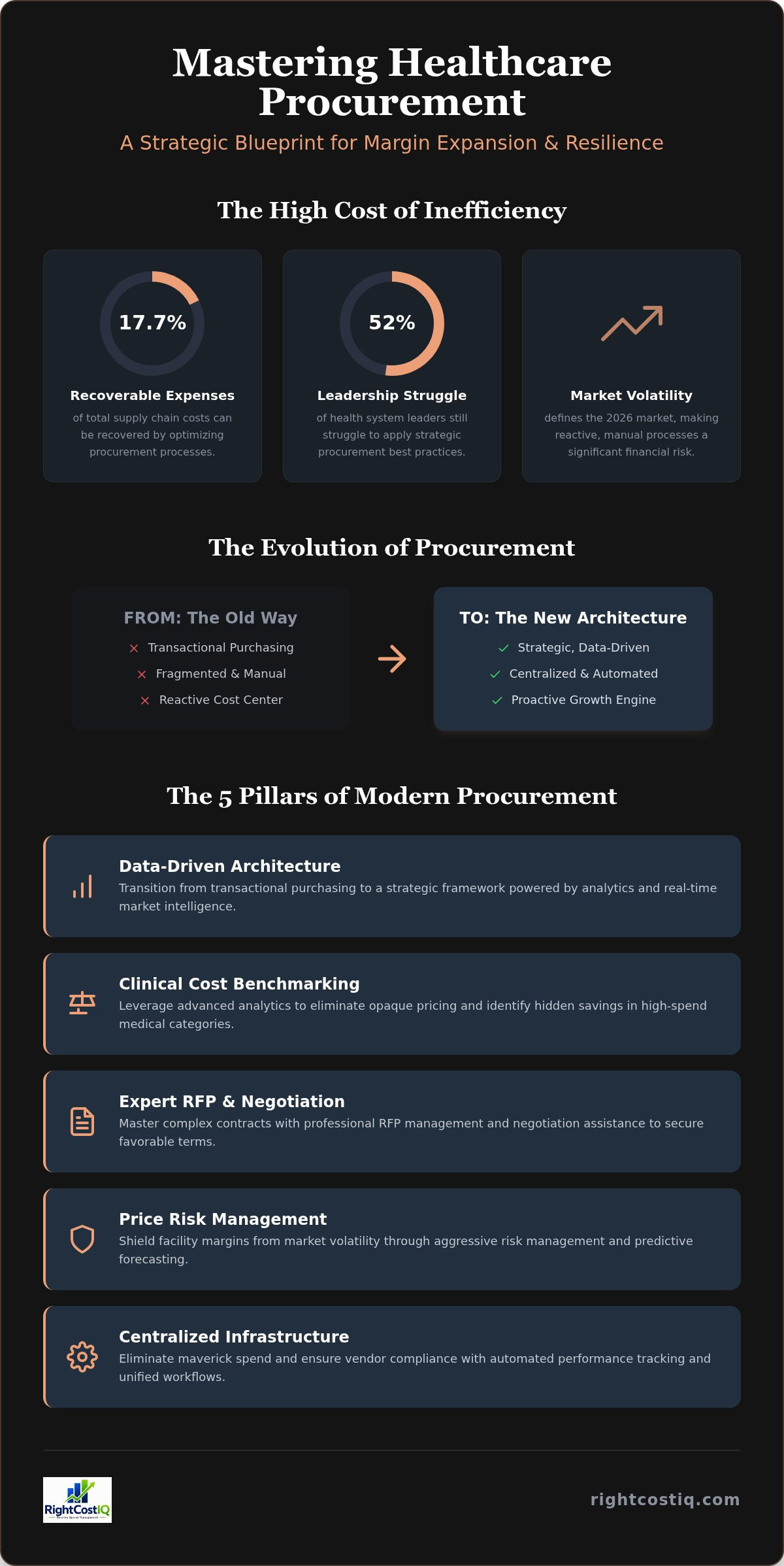
Optimizing procurement processes in healthcare can recover up to 17.7% of total supply chain expenses, yet 52% of health system leaders still struggle to apply strategic procurement best practices to balance cost control with operational reliability. You've likely seen your margins eroded by opaque pricing across medical categories and the inherent friction of manual RFP processes. It's a systemic vulnerability that leaves organizations exposed to the high price volatility defining the 2026 market. We recognize that traditional sourcing methods are no longer sufficient to maintain financial health in an era of adjusted federal procurement thresholds and increased regulatory scrutiny.
This article provides a clinical framework for mastering these efficiencies, enabling you to shift from transactional purchasing to a sophisticated, data-driven architecture. You'll learn how to leverage cost benchmarking and market intelligence to achieve measurable margin expansion and secure supply chain resilience. We'll preview the essential steps for establishing a compliant vendor network and utilizing predictive analytics to justify every financial decision. By the end of this guide, you'll possess the blueprint to transform your procurement department into a primary driver of institutional growth.
Key Takeaways
- Transition from transactional purchasing to a strategic, data-driven architecture that positions procurement as a primary driver of healthcare financial optimization.
- Leverage clinical category cost benchmarking to identify hidden savings and eliminate the opaque pricing structures common in high-spend medical categories.
- Master strategic procurement best practices by integrating professional RFP management and negotiation assistance into your sourcing lifecycle for complex contracts.
- Shield facility margins from 2026 market volatility through aggressive price risk management and precise market trending forecasting.
- Centralize procurement infrastructure to eliminate maverick spend while utilizing automated performance tracking to ensure total vendor compliance.
The Evolution of Healthcare Procurement: From Logistics to Strategic Architecture
In the 2026 fiscal year, healthcare procurement has transcended its origins as a backend logistics function. It now operates as a high-precision clinical financial architecture. Modern health systems no longer view purchasing as a cost center; instead, they treat it as a primary engine for margin expansion. This transition requires a fundamental shift from fragmented, manual ordering to a centralized, data-driven strategic sourcing process. While traditional Group Purchasing Organizations (GPOs) provided a safety net for decades, they often lack the granular visibility required to mitigate the 2026 market's extreme price volatility. Achieving true financial optimization demands strategic procurement best practices that move beyond generic contracts toward aggressive category cost benchmarking. This evolution replaces reactive purchasing with a proactive architecture that prioritizes supply chain resilience alongside cost reduction.
The High Cost of Manual Procurement Inefficiency
Manual procurement cycles create a visibility gap that facilitates maverick spend, where unauthorized purchases bypass negotiated contracts and erode potential savings. When data remains siloed across different facilities, significant price variances emerge; one hospital within a system may pay 15% more for the same medical device than its sister facility. These inefficiencies do more than drain capital. Fragmented manual processes increase the risk of regulatory non-compliance, particularly regarding the full enforcement of the Drug Supply Chain Security Act (DSCSA). Errors in documentation or vendor verification don't just result in fines; they jeopardize patient safety by allowing unverified products into the clinical environment. Standardizing these workflows across the enterprise is a prerequisite for any system aiming for total financial transparency.
Strategic Drivers for Procurement Optimization
Procurement serves as the first line of defense in protecting organizational financial health during periods of economic instability. By aligning supply chain goals with clinical outcome metrics, administrators ensure that cost-cutting measures never compromise care quality. This alignment requires sophisticated RFP management and negotiation assistance to secure terms that reflect the actual value of medical technologies. Establishing a baseline for clinical precision in procurement decision-making ensures that every dollar spent is a deliberate investment in patient safety and facility longevity. For the 2026 fiscal year, procurement optimization is defined as the systematic integration of real-time market intelligence and automated analytical frameworks to maximize institutional liquidity and operational resilience.
Procurement Analytics and Category Cost Benchmarking Standards
Healthcare financial optimization depends on a granular understanding of every dollar exiting the facility. Traditional purchasing models often fail because they lack the transparency required to identify hidden savings in high-spend categories. By adopting strategic procurement best practices centered on advanced analytics, organizations can uncover immediate margin expansion opportunities. This methodology moves beyond simple price comparisons; it establishes a baseline for procurement planning and management that reflects true market transparency. Effective spend analysis enables leaders to categorize tail spend and high-value contracts for targeted optimization, ensuring every vendor agreement aligns with institutional financial goals. For a deeper look at this architectural shift, review our guide on Category Management in Procurement: A Clinical Framework for Margin Expansion (2026).
Implementing Advanced Benchmarking Frameworks
Market pricing data serves as a powerful lever to challenge legacy vendor contracts. Without standardized spend data, facilities within the same system often pay vastly different rates for identical products. We eliminate these outliers by utilizing should-cost analytics to identify price discrepancies in medical-surgical and pharmaceutical categories. This clinical precision allows procurement teams to secure better terms based on objective market intelligence rather than anecdotal evidence. Standardizing this data ensures cross-facility comparisons are accurate, providing a clear roadmap for enterprise-wide cost reduction.
Data-Driven Sourcing and Margin Expansion
Procurement analytics must translate directly to the bottom line to satisfy C-suite requirements for financial growth metrics. Strategic sourcing is no longer a localized function; it's a core component of enterprise financial reporting. Utilizing procurement category cost benchmarking during high-stakes contract renewals provides the data-driven justification needed for aggressive negotiation. By quantifying the ROI of analytics-led initiatives, supply chain leaders can secure the necessary infrastructure investment to maintain a competitive advantage. This results in a resilient vendor network that supports long-term liquidity. If you're ready to identify hidden savings, consider a comprehensive diagnostic of your current spend architecture to uncover immediate opportunities.
Clinical Execution of RFP Management and Negotiation
High-stakes healthcare RFPs require more than administrative oversight; they demand clinical precision. Strategic procurement best practices dictate that the RFP lifecycle must be a rigorous architectural process. It starts with stakeholder alignment and ends with a contract that secures long-term margin resilience. By drafting specifications that eliminate vendor ambiguity, facilities ensure service level compliance from day one. Ambiguous language is a primary driver of cost overruns. Precision drafting requires technical descriptors that leave no room for vendor interpretation. This clinical approach ensures that the awarded vendor is legally bound to the specific quality standards your facility requires. For an advanced look at technical integration, read our analysis on RFP Management: Strategic Frameworks for AI-Led Procurement Optimization.
The 5-Step Precision RFP Framework
Successful procurement outcomes are built on structured execution. We've moved beyond simple bidding toward a methodology that prioritizes data and clinical relevance. This framework ensures that every award is defensible and optimized for value.
- Step 1: Clinical Requirement Alignment: Secure stakeholder buy-in early to ensure operational continuity. You can't optimize what the clinical team won't use.
- Step 2: Market Intelligence: Leverage data-driven vendor shortlisting through a dedicated procurement platform to identify high-performance partners. This eliminates the guesswork in vendor selection.
- Step 3: Objective Evaluation: Implement weighted scoring models that prioritize clinical efficacy alongside total cost of ownership. This removes bias from the final award decision.
Negotiation as a Strategic Asset
Negotiation is a strategic maneuver. It isn't just about the lowest price. Complex, multi-year medical service and device contracts often fail because of post-award performance gaps. Negotiation assistance is critical here to move discussions beyond unit price. We focus on securing robust service levels, extended warranties, and tiered performance penalties. Utilizing a negotiation coach helps balance the power dynamics when dealing with dominant market vendors. It's about leveling the playing field. By integrating performance tracking metrics directly into the initial contract architecture, facilities create a self-correcting vendor ecosystem. This ensures that the final agreement delivers tangible value throughout the entire contract lifecycle, rather than just an initial discount.
Mitigating Volatility with Price Risk Management and Forecasting
Facility margins are under constant assault from global economic fluctuations and high price volatility. Protecting these margins requires a transition from reactive purchasing to proactive price risk management. Strategic procurement best practices in 2026 demand the integration of market price trending data to anticipate cost escalations before they manifest in vendor invoices. By building structural flexibility into contracts, organizations can account for inflationary pressures and sudden supply chain disruptions without compromising liquidity. We focus on establishing price caps and index-based adjustments that protect the facility from sudden market spikes. Forecasting models empower procurement teams to enter renewal cycles with quantifiable market intelligence, transforming a standard negotiation into a data-driven strategic engagement that secures institutional stability.
Market Intelligence and Price Trending Models
Integrating market intelligence into the annual procurement budget cycle ensures that financial projections remain grounded in reality. We track commodity price trends, such as raw material costs for medical supply manufacturing and global shipping indices, to identify early warning signs of price hikes. This granular visibility allows for the adjustment of sourcing strategies in real-time. Effective forecasting requires monitoring the impact of regulatory shifts, such as the government-negotiated drug prices under the Inflation Reduction Act (IRA), which reshape global pricing structures. Market forecasting serves as a critical negotiation lever for 2026 by providing the objective data needed to challenge unjustified vendor price increases during contract renewals. Utilizing these models ensures that your facility isn't just reacting to the market but actively navigating it with clinical precision.
Managing Supply Chain Compliance and Risk
Supply chain resilience is built on the intersection of price risk management and continuous vendor performance tracking. Procurement teams must deploy proactive strategies to address potential shortages before they impact clinical operations or patient outcomes. The Healthcare Supply Chain Association notes that optimizing these processes can lead to savings of up to 17.7% of total expenses. Maintaining a resilient vendor ecosystem requires constant vigilance and the elimination of non-compliant partners who cannot meet established service levels or documentation requirements under the Drug Supply Chain Security Act (DSCSA). This proactive stance minimizes operational friction and financial exposure. For organizations seeking to identify vulnerabilities in their current sourcing architecture, we recommend a comprehensive spend diagnostic to establish a baseline for risk mitigation and financial optimization.
Standardizing Procurement Infrastructure for Enterprise Efficiency
Centralization serves as the final phase of a clinical financial architecture. It effectively eliminates the maverick spend that typically erodes the margins secured during the benchmarking and negotiation stages. By synchronizing procurement technology with enterprise financial reporting, we provide high-level decision-makers with absolute visibility into sourcing outcomes. This integrated approach closes the loop between initial price analysis and ongoing vendor management. Implementing strategic procurement best practices at the enterprise level ensures that every facility adheres to a single, compliant sourcing standard. This structural alignment is essential for managing the complexities of tail spend management and ensuring total contract adherence across the healthcare system.
Automating Vendor Performance and Compliance
Real-time vendor tracking architectures replace manual oversight with automated performance reporting. These systems monitor contract adherence and clinical service levels, flagging deviations before they impact care delivery or institutional liquidity. Automated frameworks also simplify the management of supplier diversity programs. They allow organizations to meet corporate responsibility goals without increasing administrative overhead. Digital integration streamlines procurement workflows and reduces the friction between requisition and fulfillment. This operational efficiency is a prerequisite for maintaining a resilient, high-performance vendor network in the 2026 market. We prioritize automated compliance to ensure that every partner meets the rigorous documentation standards required by current federal procurement thresholds.
Finalizing the Strategic Procurement Roadmap
A multi-year procurement optimization plan must align with broader organizational growth goals. This roadmap moves beyond simple cost savings to focus on enterprise-wide liquidity and supply chain resilience. Success is measured through specific, data-driven KPIs. These include contract compliance rates, price variance reduction across facilities, and vendor risk scores. Establishing these metrics ensures that strategic procurement best practices are not just temporary fixes but permanent fixtures of the institutional financial strategy. A sophisticated roadmap anticipates market shifts and provides the agility needed to pivot sourcing strategies as economic conditions evolve. It transforms the procurement department into a strategic architect of institutional health. To begin this transformation, execute a free diagnostic to optimize your healthcare procurement outcomes and identify immediate infrastructure improvements.
Architecting the Future of Healthcare Financial Resilience
Mastering strategic procurement best practices requires a fundamental shift from transactional purchasing to a sophisticated, data-driven architecture. We've analyzed how clinical-grade cost benchmarking and analytics provide the market transparency necessary to eliminate price opacity. By integrating professional RFP management and assertive negotiation assistance, health systems secure margins that traditional sourcing methods often overlook. Advanced market price trending and price risk forecasting models further insulate organizations from the volatility of the 2026 market. These tools transform procurement from a backend function into a primary engine for enterprise growth and operational stability.
The path to total financial optimization begins with a rigorous assessment of your current sourcing infrastructure. Establishing a resilient vendor network and ensuring regulatory compliance are no longer optional objectives; they're institutional imperatives. You now possess the framework to drive measurable margin expansion and secure long-term supply chain integrity. Optimize your healthcare procurement outcomes with RightCostIQ today. Your commitment to strategic precision will define your facility's financial health for years to come.
Frequently Asked Questions
What are the key components of healthcare procurement best practices?
Key components include a data-driven architecture that prioritizes category cost benchmarking and professional RFP management. Strategic procurement best practices focus on shifting from transactional purchasing to clinical-grade financial analysis. This involves integrating market intelligence with automated vendor tracking to ensure total contract adherence. By centralizing these functions, organizations eliminate maverick spend and secure long-term supply chain resilience. This holistic approach ensures every dollar spent contributes directly to institutional liquidity.
How does cost benchmarking improve healthcare procurement outcomes?
Cost benchmarking identifies hidden savings by surfacing price outliers across high-spend medical categories. It moves beyond simple price comparisons to provide market transparency. By using clinical-grade analytics, facilities challenge legacy vendor contracts and secure terms that reflect the actual value of medical technologies. This process ensures cross-facility price parity within a health system, preventing margin erosion caused by fragmented data. It provides the objective evidence needed to justify every sourcing decision.
Why is RFP management critical for hospital supply chains?
Professional RFP management is essential for eliminating vendor ambiguity and ensuring service level compliance. High-stakes healthcare RFPs require technical descriptors that leave no room for interpretation by suppliers. This precision drafting secures multi-year contract stability and protects the facility from post-award cost overruns. It also facilitates objective evaluation through weighted scoring models, ensuring that clinical efficacy and total cost of ownership are prioritized equally in the final award decision.
How can healthcare facilities manage price risk in 2026?
Managing price risk in 2026 requires the use of advanced market price trending and forecasting models. Facilities must build structural flexibility into contracts through index-based adjustments and price caps. These mechanisms insulate margins from global economic fluctuations and inflationary pressures. By tracking commodity price trends that impact manufacturing and shipping, procurement teams can anticipate escalations. This proactive stance allows for the adjustment of sourcing strategies before volatility impacts institutional liquidity.
What is the difference between a GPO and a procurement optimization platform?
Traditional GPOs provide broad contract access but often lack the granular analytics required for specific category optimization. A procurement optimization platform integrates clinical-grade cost benchmarking and negotiation assistance to identify deeper savings. While GPOs offer a baseline, optimization platforms leverage real-time market intelligence to challenge industry averages. They provide the technical architecture needed for precise price risk management and automated vendor tracking, which are necessary for maximizing modern healthcare margins.
How do you measure vendor performance in a clinical setting?
Measuring vendor performance requires automated architectures that track contract adherence and clinical service levels in real-time. We focus on specific metrics such as documentation accuracy under the Drug Supply Chain Security Act and adherence to established delivery timelines. By integrating performance tracking directly into the contract architecture, facilities create a self-correcting vendor ecosystem. This ensures that partners meet rigorous service standards, reducing operational friction and protecting the quality of patient care.
What role does market forecasting play in procurement negotiations?
Market forecasting serves as a critical negotiation lever by providing objective data to challenge unjustified price increases. It allows procurement teams to enter renewal cycles from a position of strength, armed with predictive analytics on commodity and manufacturing trends. This foresight empowers leaders to negotiate tiered performance penalties and favorable service levels. By anticipating market shifts, facilities can secure long-term price stability and ensure that vendor agreements reflect future economic realities.
How can we reduce tail spend in healthcare procurement?
Reducing tail spend involves centralizing procurement operations to eliminate maverick spend across fragmented facilities. Strategic procurement best practices utilize automated management tools to bring low-volume, high-frequency purchases under negotiated contract terms. This process uncovers significant savings in unmanaged categories that typically escape standard sourcing oversight. By standardizing these workflows, organizations reduce administrative overhead and ensure enterprise-wide compliance, ultimately reclaiming lost margins and strengthening the institutional bottom line.


