
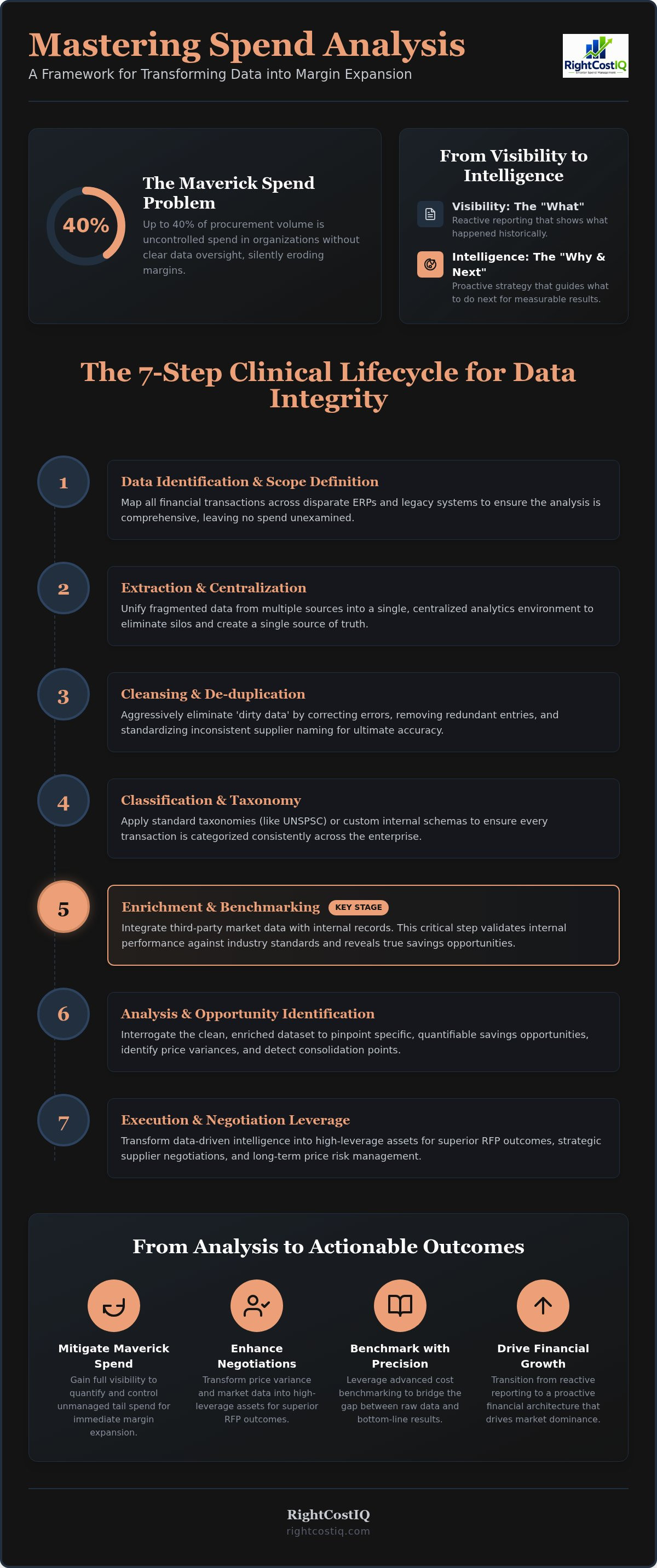
Maverick spend accounts for up to 40% of total procurement volume in organizations lacking clinical data oversight. It's a silent margin killer that thrives in the gaps between fragmented ERP systems, making spend analysis in procurement a necessity rather than an elective. Most procurement executives understand that visibility is the primary barrier to efficiency, yet they struggle to synthesize disparate data points into an actionable strategy.
You'll learn to master a rigorous framework designed to transform raw data into high-leverage negotiation assets. We'll demonstrate how to achieve clinical data integrity and capture measurable margin expansion. Our analysis covers the identification of tail spend savings and the development of strategic leverage for upcoming RFP cycles. By moving beyond basic reporting, your team can secure the price risk management and cost benchmarking capabilities necessary for dominant market positioning. This guide details the transition from reactive data collection to proactive financial architecture.
Key Takeaways
- Transition from reactive reporting to proactive sourcing intelligence by treating data as a clinical asset for financial growth.
- Execute a rigorous 7-step framework for spend analysis in procurement to centralize fragmented data and ensure enterprise-wide integrity.
- Quantify and mitigate the impact of maverick spend and unmanaged tail spend to secure immediate margin expansion.
- Transform historical price variance and market trending data into high-leverage assets for superior RFP outcomes and supplier negotiations.
- Leverage advanced cost benchmarking to bridge the execution gap between raw data sets and measurable bottom-line results.
The Strategic Architecture of Spend Analysis in Procurement
Spend analysis in procurement isn't a mere accounting exercise or a backward-looking audit. It's a clinical architecture designed to extract financial value from operational noise. While traditional bookkeeping focuses on historical accuracy, strategic procurement requires forward-looking intelligence to drive margin expansion. In 2026, external spend typically accounts for 60% to 80% of a company's total revenue, making every percentage point of inefficiency a direct threat to the bottom line. A clinical approach to spend analysis transforms raw transaction records into a roadmap for enterprise financial resilience. Organizations that treat this process as a one-time report fail to capture the 5% to 15% savings opportunities that structured analysis uncovers. High-level decision-makers must view data integrity as the primary driver of procurement ROI.
The Core Questions Every Spend Analysis Must Answer
To move from data collection to cost optimization, procurement teams must interrogate their datasets with clinical precision. Every analysis should resolve three critical uncertainties. First, what exactly are we buying, and who is the end user? This identifies internal consumption patterns and potential consolidation points. Second, which suppliers represent the highest concentration of price risk? Identifying these vulnerabilities is essential for mitigating financial volatility. Third, where does the variance between the contracted price and the actual invoiced price exist? This reveals immediate leakage that you can reclaim through audits. Top-quartile Chief Procurement Officers are expected to allocate 24% of their budgets to technology in 2026 to answer these questions with automated accuracy.
Spend Visibility vs. Spend Intelligence
Visibility tells you what happened; intelligence tells you what to do next. Modern spend analysis in procurement leverages real-time data to transition from reactive reporting to proactive sourcing. Visibility might show a high volume of maverick spend, but intelligence identifies the specific behavioral triggers causing it. This level of insight serves as the foundation for effective RFP Management. By using cost benchmarking and price risk management, teams enter negotiations with defensible data rather than anecdotal requests. Intelligence allows you to forecast market trends and use them as a negotiation lever for long-term contracts. It's the difference between asking for a price reduction and proving that a reduction is mathematically justified by market intelligence.
The Clinical Lifecycle: A 7-Step Framework for Spend Data Integrity
The clinical execution of spend analysis in procurement demands a rigorous seven-step lifecycle to guarantee data integrity. Step 1 focuses on data identification and scope definition across disparate ERPs and legacy systems. This initial mapping ensures that the analysis encompasses every financial transaction without exception. Step 2 involves the extraction and centralization of this data into a unified analytics environment. This process eliminates the silos that typically obscure total spend volume. Step 3 targets the elimination of 'dirty data' through aggressive cleansing and de-duplication. This phase is vital for removing the noise created by inconsistent supplier naming and redundant entries. Step 4 applies standard taxonomies, such as UNSPSC or customized internal schemas, to ensure consistent categorization. Adopting this strategic approach to procurement allows organizations to move from anecdotal observations to defensible financial facts.
Advanced Data Enrichment and Benchmarking
Step 5 introduces external context to the internal spend profile. Data enrichment is the process of adding third-party market context to internal spend records. By integrating external data, procurement teams can validate their internal performance against broader industry standards. This stage is where procurement category cost benchmarking becomes a decisive asset. It identifies specific savings opportunities by revealing where internal pricing deviates from market-clearing rates. This enrichment process transforms a static list of transactions into a dynamic map of competitive advantage. Without this external benchmarking layer, procurement teams remain blind to the true cost of their supply chain inefficiencies.
Analysis and Execution: The Final Stages
The framework concludes with a focus on actionable outcomes. Step 6 utilizes statistical analysis to identify price variances and emerging market trends. This analytical rigor exposes hidden costs and facilitates more accurate financial forecasting. Step 7 is clinical execution, where these findings are translated into a high-leverage sourcing strategy. This comprehensive framework ensures category management excellence by providing a clear pathway from raw data to measurable margin expansion. It removes the guesswork from vendor selection and contract renewal cycles. If your current systems fail to provide this level of clarity, exploring a centralized analytics platform is the first step toward reclaiming lost margin.
Quantifying Inefficiencies: Maverick Spend and Tail Spend Optimization
Maverick spend is the primary catalyst for margin erosion in decentralized procurement environments. It represents purchases made outside of negotiated contracts, effectively nullifying the leverage gained during previous RFP cycles. In organizations lacking a clinical spend analysis in procurement, maverick buying often accounts for 20% to 40% of total expenditure. This financial leakage is frequently buried within tail spend, the unmanaged 20% of spend volume that typically involves 80% of the supplier base. Addressing these inefficiencies requires sophisticated parent-child relationship mapping. This technical process links subsidiary vendors to their corporate parents, revealing consolidation opportunities that standard accounting views as separate entities. Automated tracking then ensures future transactions align with these established contracts, preventing the recurrence of price variance.
The Economic Impact of Unmanaged Tail Spend
Fragmented, low-value purchases create a disproportionate administrative burden on the organization. Managing hundreds of one-off vendors generates massive overhead that frequently exceeds the value of the goods or services purchased. Bringing tail spend under management is essential for reclaiming operational efficiency. Adhering to GAO Best Practices for Strategic Procurement demonstrates that consolidating these indirect categories yields a significant return on investment. By centralizing these transactions, procurement teams reduce the number of active suppliers and simplify the accounts payable process. This consolidation doesn't just save on unit price. It optimizes the entire procure-to-pay lifecycle by reducing the cost of transaction management.
Root Cause Analysis of Maverick Buying
Eliminating non-compliant spend requires identifying the underlying drivers of user behavior with clinical precision. Spend analytics serve as a diagnostic tool to pinpoint specific departments or individuals bypassing established protocols. Data-driven insights reveal whether the issue is a lack of technical training or a failure in the procurement platform's accessibility. Analytics show if users choose alternative vendors due to perceived convenience or a lack of awareness regarding preferred suppliers. Corrective actions must move beyond simple policy enforcement. They should focus on improving RFP accessibility and integrating preferred vendor catalogs directly into the workflow. This approach ensures that compliance becomes the path of least resistance for the end user, securing long-term financial discipline.
Turning Intelligence into Leverage: Spend Analytics as a Negotiation Asset
Spend analysis in procurement serves as the primary defensive mechanism against arbitrary supplier price increases. By weaponizing historical price variance data, procurement teams can dismantle a supplier's justification for cost hikes with mathematical certainty. If a vendor cites inflation to justify a 10% increase while your analytics reveal a 5% decrease in underlying commodity costs, the power dynamic shifts. This clinical precision forces suppliers to defend their margins against objective benchmarks rather than anecdotal market sentiment. It transforms the negotiation room from a theater of persuasion into a forum for data-driven financial optimization.
Benchmarking as a Negotiation Tool
Effective negotiation requires an external frame of reference to identify "over-market" spend. Comparing internal acquisition costs against category-specific benchmarks allows procurement professionals to set aggressive but realistic targets for upcoming RFP cycles. Should-Cost modeling is a data-driven prediction of what a product or service ought to cost based on market inputs. Utilizing these models enables teams to isolate specific cost drivers within a supplier's quote and challenge inefficient pricing structures. This ensures that every contract renewal is grounded in real-time market-clearing rates rather than legacy agreements. To identify your immediate negotiation leverage, access our clinical spend diagnostic tool.
Forecasting and Risk Mitigation
Strategic leverage extends beyond historical data into future demand aggregation. Predicting future spend patterns allows organizations to secure volume-based discounts by centralizing fragmented requirements across the enterprise. Market trend tracking mitigates financial volatility by identifying the optimal windows for contract execution. Aligning these insights with RFP execution cycles ensures that sourcing events occur when market conditions are most favorable. This proactive posture transforms procurement from a transactional support function into a driver of enterprise financial resilience. It facilitates the transition from basic reporting to professional negotiation assistance that guarantees measurable margin expansion.
Implementing RightCostIQ: Precision Analytics for Procurement Outcomes
RightCostIQ functions as the strategic architect for organizations seeking to operationalize spend analysis in procurement. While legacy software often provides static visibility, RightCostIQ delivers the clinical precision required for measurable margin expansion. It bridges the gap between raw datasets and actionable outcomes by integrating RFP management with advanced cost benchmarking. This unified approach ensures that every sourcing event is informed by real-time market-clearing data. It eliminates the structural failure where identified savings opportunities are lost during the execution phase. By moving beyond basic automation, you gain access to the managed expertise necessary to secure high-leverage negotiation assets.
The RightCostIQ Advantage in Complex Sourcing
Success in high-stakes financial analytics requires a specialized focus on categories where procedure price variance and market volatility are highest. Generic procurement solutions fail to account for the granular nuances of specialized supply chains. RightCostIQ quantifies the specific impact of market trends on your unique spend profile, providing a defensive barrier against supplier price volatility. A clinical approach is necessary for enterprise-level optimization because it replaces anecdotal decision-making with mathematical certainty. This level of rigor is essential for maintaining a competitive advantage in an environment where external spend represents the vast majority of corporate revenue. We ensure that your most complex categories are managed with the same precision as your primary direct materials.
Achieving Strategic Procurement Maturity
Transitioning to a data-driven procurement infrastructure requires a roadmap for continuous spend improvement rather than a series of one-off audits. RightCostIQ facilitates this journey by embedding vendor performance tracking into the core of your sourcing strategy. This ensures that the savings captured during a negotiation are realized throughout the entire contract lifecycle. Strategic maturity is reached when spend analysis in procurement becomes a continuous feedback loop that informs every financial decision. Building this infrastructure secures long-term financial resilience and establishes procurement as a primary driver of corporate growth. It's time to move beyond fragmented data and embrace a clinical framework for cost optimization. Optimize your procurement outcomes with RightCostIQ today.
Operationalizing Data for Sustainable Margin Expansion
Transitioning from fragmented data silos to a unified intelligence layer is the only defensible path to reclaiming eroded margins. We've established that a clinical framework for spend analysis in procurement identifies immediate recovery opportunities within maverick and tail spend categories. By weaponizing historical price variance and market trends, procurement teams shift the power dynamic during supplier interactions. RightCostIQ provides the specialized RFP Management and Negotiation Assistance required to convert these insights into tangible financial results. Our expertise in Procurement Category Cost Benchmarking and Advanced Price Risk Management protocols ensures your organization maintains a competitive advantage in volatile markets. The transition toward a mature, data-driven infrastructure isn't just an operational upgrade; it's a strategic necessity for enterprise financial resilience. You have the tools to transform fragmented data into a high-leverage asset. Master your procurement spend with RightCostIQ’s clinical analytics today.
Frequently Asked Questions
What is the primary difference between spend analysis and spend analytics?
Spend analysis is the foundational process of identifying, gathering, and cleansing expenditure data. Spend analytics refers to the strategic application of that data to drive decision-making. While analysis focuses on the structural integrity of the dataset, analytics leverages technology to uncover patterns and forecast future trends. Both are essential components of spend analysis in procurement, ensuring that raw figures transform into actionable intelligence for high-stakes negotiations and margin expansion.
How often should a procurement department conduct a comprehensive spend analysis?
Procurement departments should maintain continuous data visibility, but a comprehensive spend analysis refresh must occur at least quarterly. This frequency allows teams to align their sourcing strategies with shifting market trends and upcoming RFP cycles. In volatile economic environments, waiting for an annual review results in significant margin leakage. Regular analysis ensures that cost benchmarking remains accurate and that price risk management protocols reflect current market-clearing rates.
Can spend analysis be performed if our data is currently fragmented across multiple systems?
Spend analysis is actually most critical when data is fragmented across multiple ERPs or legacy systems. Clinical frameworks are specifically designed to extract, centralize, and normalize disparate datasets into a unified analytics environment. This process eliminates the silos that obscure total spend volume and prevent effective cost optimization. You can't manage what you can't see, so centralizing fragmented data is the first step toward achieving enterprise-level procurement maturity.
What are the most critical KPIs to track in a modern spend analysis framework?
Modern frameworks focus on four critical KPIs: maverick spend percentage, price variance across categories, supplier concentration, and total addressable spend under management. Maverick spend reveals compliance failures, while price variance identifies specific leakage points in contract execution. Tracking these metrics provides a clear diagnostic of procurement efficiency. It allows decision-makers to prioritize categories that offer the highest potential for immediate margin expansion and long-term financial resilience.
How does spend analysis directly impact the RFP process?
A rigorous spend analysis in procurement provides the defensible data necessary for superior RFP outcomes. It allows teams to develop should-cost models based on historical price variance and enriched market intelligence. Instead of relying on supplier-provided figures, procurement professionals enter negotiations with a data-backed understanding of what a product should cost. This leverage is essential for countering unjustified price hikes and securing more favorable terms during competitive bidding events.
What is the role of AI and automation in cleansing spend data?
AI and automation are indispensable for cleansing 'dirty data' at scale without the risk of manual error. These technologies automate supplier de-duplication and categorize transactions using standard taxonomies like UNSPSC. This clinical precision ensures that inconsistent naming conventions don't obscure total spend with a single vendor. Automation transforms a labor-intensive administrative task into a streamlined, repeatable process that maintains the integrity of your procurement data infrastructure.
How can spend analysis help identify and mitigate supplier risk?
Analysis identifies supplier risk by uncovering hidden dependencies through parent-child relationship mapping. This process reveals if multiple subsidiary vendors are actually owned by a single corporate entity, which could lead to dangerous concentration risk. Additionally, market price trending identifies categories most vulnerable to financial volatility. By quantifying these risks, procurement teams can diversify their supply base or implement price risk management protocols to protect the organization's bottom line.
What is maverick spend, and how does it affect the bottom line?
Maverick spend refers to any purchase made outside of established corporate contracts or preferred supplier agreements. It's a primary driver of margin erosion, often representing 20% to 40% of an organization's total expenditure. When users bypass negotiated terms, the organization loses the volume-based leverage secured during the RFP process. Spend analytics pinpoint these non-compliant behaviors, allowing for corrective actions that secure immediate financial growth and operational discipline.


