
Market price trending is not a passive observation of historical data; it is a strategic architectural lever that dictates the success of the entire RFP lifecycle. In a 2026 landscape where the copper supply faces a 1 million metric ton deficit and Brent Crude fluctuates near $60 per barrel, mastering commodity price forecasting is the only way to avoid significant financial liability. You recognize that unpredictable volatility in raw materials erodes margins and weakens your position during high-stakes vendor negotiations. Inefficient category cost benchmarking often leaves money on the table, yet the path to recovery requires more than just better data.
This article delivers a comprehensive framework for market analysis to replace speculative guesswork with clinical execution. You'll learn to utilize data-driven leverage to optimize RFP outcomes and mitigate financial risk through sophisticated price risk management protocols. We'll examine the technical integration of category cost benchmarking and vendor performance analytics to ensure your procurement strategy drives tangible margin expansion. This guide prioritizes operational efficiency and financial growth metrics to transform your department into a primary driver of corporate profitability through disciplined market intelligence and technical upskilling.
Key Takeaways
- Master the clinical application of commodity price forecasting to transform procurement from a reactive cost center into a proactive driver of financial growth.
- Utilize data-driven sourcing models that prioritize objective market intelligence over intuition to ensure precision in cost forecasting and risk mitigation.
- Distinguish between static cost benchmarking and dynamic market price trending to identify and capture category savings through shifting market conditions.
- Embed market price trajectory insights into the RFP lifecycle to maximize leverage during vendor negotiations and optimize final contract outcomes.
- Deploy advanced technology to synchronize high-level financial strategy with granular technical execution for sustained margin expansion and operational efficiency.
The Strategic Importance of Market Price Trending in 2026
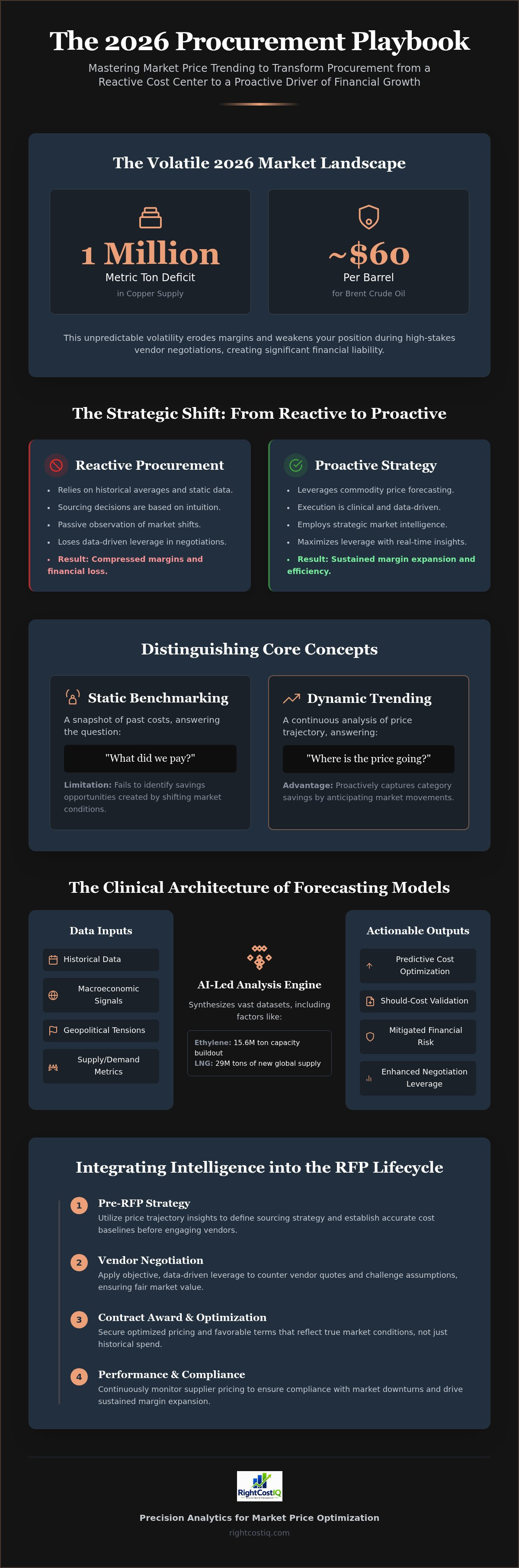
Market price trending in 2026 is no longer an optional analytical exercise; it is a fundamental procurement discipline required to maintain enterprise resilience. Traditional sourcing often relies on historical averages, yet 2026 demands a shift toward proactive market intelligence. With Brent Crude oil forecasted to remain near $60 per barrel while copper faces a 1 million metric ton deficit, procurement leaders must move beyond simple price tracking. Reactive purchasing in high-volatility markets results in immediate margin erosion and inflated landed costs. By establishing price risk management as a core function, organizations build a defensive perimeter against the Diverging Commodity Performance seen across energy and metals sectors.
Beyond Commodity Ticks: A Holistic View
Strategic sourcing requires a synthesis of disparate data points to build accurate forecasting methods. Geopolitical tensions and trade barriers act as primary catalysts for price volatility, often outweighing basic supply and demand metrics. US economic indicators, specifically inflation data and labor statistics, dictate Federal Reserve expectations, which directly influence borrowing costs and industrial demand. Effective commodity price forecasting integrates these macroeconomic signals to predict shifts before they manifest in vendor quotes. Market price trending is a clinical tool for financial growth that translates market volatility into actionable procurement leverage.
The Economic Impact of Inefficient Trend Analysis
The financial cost of delayed market response is quantifiable through compressed gross margins. When procurement teams lack real-time trend awareness, they lose the data-driven leverage necessary for aggressive vendor negotiations. This lag creates a disconnect between market realities and contract pricing, leading to inefficient category cost benchmarking. Trend awareness also ensures supply chain compliance by identifying when suppliers fail to pass through downward price corrections in energy or petrochemicals. Integrating these insights into a broader framework for Category Management in Procurement allows for the clinical execution of sourcing strategies that prioritize results over intuition. Reliable commodity price forecasting ensures that procurement departments act as strategic architects of the bottom line rather than passive observers of financial loss.
The Clinical Architecture of Market Price Forecasting Models
Precision in 2026 procurement requires a transition from intuition based sourcing to a clinical architecture that prioritizes hard data. Successful models don't just track price; they synthesize historical data, real-time news, and macroeconomic indicators to reveal the underlying mechanics of market shifts. For instance, understanding the nuances of Modeling Commodity Prices allows teams to identify how global economic activity and currency fluctuations influence local contract pricing. By identifying hidden price drivers, such as the 15.6 million metric ton buildout in ethylene production capacity that is currently deepening oversupply, organizations can shift from retrospective spend analysis to predictive cost optimization.
Data-Driven Sourcing and Predictive Analytics
Effective commodity price forecasting relies on the integration of technology into traditional sourcing workflows. Procurement teams must leverage advanced procurement analytics to validate vendor quotes against objective market realities. This process involves constructing a Should-Cost modeling framework that accounts for trend trajectories in raw materials and energy inputs. AI-led optimization now plays a critical role in reducing forecasting error margins by processing vast datasets, such as the 29 million metric tons of new global LNG supply capacity expected this year. This level of technical analysis allows for the clinical execution of RFP strategies that secure margin expansion even in volatile markets.
Quantifying Financial Volatility and Risk
Standardizing risk metrics across diverse procurement categories is the hallmark of a sophisticated strategic architect. You must move beyond fragmented spreadsheet tracking to automated platforms that provide a single source of truth for market intelligence. Clinical execution in data gathering ensures that your risk mitigation strategies are grounded in reality rather than speculation. This systematic approach allows for the identification of specific vulnerabilities, such as the projected 48.3 gigawatt power demand from U.S. data centers, which impacts broader energy procurement costs. Transitioning to these automated frameworks ensures your team maintains a competitive advantage through unwavering focus on the bottom line. Evaluate your current exposure and identify optimization opportunities with a market readiness diagnostic.
By treating commodity price forecasting as a rigorous financial discipline, procurement departments redefine their strategic importance within the enterprise. The shift from reactive responses to predictive modeling ensures that every sourcing decision is backed by data-driven leverage. This technical upskilling is the primary driver for sustained financial growth and operational efficiency in a complex global economy.
Benchmarking vs. Trending: Identifying Category Savings
Static benchmarking provides a historical snapshot of what was paid, but dynamic price trending reveals the trajectory of what should be paid. In the 2026 economy, where industrial material growth sits at a marginal 0.7%, relying on outdated benchmarks is a recipe for margin erosion. Category management must evolve from a periodic review cycle to a continuous loop of market calibration. By integrating commodity price forecasting into your benchmarking process, you transform cost analysis from a retrospective audit into a forward-looking strategic tool that secures your competitive advantage.
Advanced Benchmarking Standards
Establishing a rigorous baseline for procurement category cost benchmarking requires more than internal spend data. You must calibrate your internal costs against World Bank Commodity Markets data to identify vendor pricing outliers in real-time. This clinical approach exposes price gouging during supply disruptions and identifies opportunities for immediate renegotiation. Strategic architects also utilize Tail Spend Management to address the hidden 20% of spend that often escapes professional scrutiny. These unmanaged categories frequently hide significant variance that, when aggregated, represents a substantial drag on enterprise profitability.
Identifying and Quantifying Category Variance
Quantifying the delta between market trends and actual vendor performance is essential for maintaining a competitive cost structure. When vendors fail to align their quotes with downward trends, such as the 5% drop in the Materials Price Index seen in late 2025, variance analysis provides the necessary leverage for correction. This data acts as the primary driver for strategic RFP Management, ensuring that contract terms reflect market realities. Static benchmarking is insufficient in a 2026 economy because it fails to account for the rapid divergence between commodity sectors, such as the rising costs in transition metals versus the persistent supply gluts in energy. Effective commodity price forecasting allows procurement leaders to pinpoint exactly where category costs have decoupled from market fundamentals, enabling surgical interventions in vendor pricing.
Implementing Price Risk Management in Complex RFP Cycles
Price risk management is a tactical discipline that begins long before a single bid is received. In the 2026 procurement environment, integrating commodity price forecasting into the RFP lifecycle is the only way to secure maximum leverage. You don't just ask for a price; you dictate the terms based on technical market trajectories. This clinical approach ensures that financial volatility is managed through data-driven contract structures rather than reactive negotiation. By aligning your sourcing calendar with forecasted supply gluts or deficits, you transform the RFP from a clerical task into a strategic architectural lever.
The RFP Lifecycle and Market Intelligence
Pre-RFP research allows you to time the market for optimal entry. For example, knowing that global LNG supply capacity is increasing by 29 million metric tons allows for more aggressive energy procurement strategies. You evaluate vendor responses against market-driven cost models to identify discrepancies that suggest hidden margin padding. Utilizing professional RFP Management Services ensures your sourcing process is grounded in technical precision. This level of data-driven leverage is essential when navigating markets like copper, where the 1 million metric ton deficit requires surgical timing to avoid peak pricing.
Negotiation Strategies for High-Value Procurement
Negotiation strategies for high-value procurement must use trend data as a psychological and financial anchor. When a vendor cites general inflationary pressures, you counter with the specific fact that the Materials Price Index growth for Q2 2026 is limited to 0.7%. This level of detail removes the vendor's ability to inflate quotes under the guise of market instability. You can utilize a Negotiation Coach to refine these tactics and ensure your team remains focused on the bottom line. Mitigating volatility also requires indexed contract clauses, perhaps linked to EU carbon prices at €87 per ton, to protect your margins against sudden regulatory or environmental shifts.
Execution at this level requires a sophisticated partner who understands the intersection of market intelligence and contract law. Don't leave your margins to chance during your next high-stakes negotiation. Assess your current RFP strategy and identify critical risk gaps by requesting a free procurement diagnostic today.
RightCostIQ: Precision Analytics for Market Price Optimization
RightCostIQ functions as a sophisticated partner for high-level decision makers who require more than just raw data. While generic market reports focus on historical price ticks, our approach prioritizes the clinical execution of market intelligence to drive financial growth. We integrate advanced technology into traditional sourcing functions to ensure that your commodity price forecasting translates directly into tangible margin expansion. By utilizing our Market Price Trending and Forecasting Service, organizations replace speculative purchasing with a disciplined, data-driven framework that accounts for the specific macroeconomic shifts of 2026. This technical integration ensures that your procurement department operates as a primary driver of corporate profitability.
The Strategic Architect of Your Supply Chain
We don't offer generic consulting; we act as a strategic architect for your enterprise supply chain. Our Price Risk Management and Tracking Service allows for the clinical execution of procurement analytics to secure long term financial stability. By identifying specific market trajectories, such as the diverging performance between energy gluts and metal deficits, we help you refine corporate strategy and maintain operational efficiency. This partnership enables you to move from a defensive posture to an offensive one, leveraging market intelligence to dictate contract terms during vendor negotiations. Our Procurement Category Cost benchmarking and Analytics service ensures that every dollar spent is optimized against real-time market realities rather than outdated internal averages.
Operational efficiency is further secured through our Procurement and Vendor Performance Tracking Service. Unlike academic models that achieve high theoretical accuracy but lack practical application, our tracking service correlates market trends with actual vendor delivery. This ensures that suppliers remain compliant with market-indexed pricing and that your supply chain remains resilient against external shocks. We provide the technical upskilling necessary for your team to master complex RFP outcomes and secure competitive advantages in high-stakes environments.
Next Steps for Enterprise Optimization
The first step toward enterprise optimization is assessing your current spend under management and identifying critical gaps in your procurement infrastructure. Integrating market intelligence into your daily operations requires a methodical transition from fragmented tracking to automated, clinical analysis. RightCostIQ provides the professional RFP management and negotiation assistance necessary to bridge these gaps and eliminate inefficient category cost benchmarking. By aligning your procurement strategy with our specialized forecasting models, you ensure that your organization is prepared for the volatility of the 2026 economy. Take the next step in your digital transformation and optimize your procurement outcomes with a free diagnostic.
Architecting a Resilient Procurement Future
Mastering the intersection of market intelligence and clinical execution is the only way to navigate the 2026 commodity landscape. By transitioning from reactive purchasing to a model grounded in commodity price forecasting, you secure the data-driven leverage necessary for sustained margin expansion. We've explored how identifying category variance and implementing indexed contract clauses transform procurement from a cost center into a primary driver of financial growth. Tactical precision in cost analysis ensures that your organization remains insulated from the supply gluts and deficits defining the current market.
Founded in 2023 with a specialization in healthcare financial analytics, RightCostIQ provides the proprietary RFP management and negotiation frameworks required for high-stakes sourcing. Our comprehensive category cost benchmarking and analytics services bridge the gap between traditional processes and modern technological innovation. It's time to replace speculative guesswork with technical precision and operational efficiency. Execute a precision procurement strategy with RightCostIQ to safeguard your enterprise against volatility. You have the tools to redefine your strategic importance; now is the time to deploy them.
Frequently Asked Questions
What is the primary difference between market price trending and cost benchmarking?
Market price trending is a dynamic, forward-looking discipline that tracks the trajectory and future direction of costs, whereas cost benchmarking is a static evaluation of historical pay rates against peer averages. Trending allows procurement teams to anticipate shifts before they occur to secure a competitive advantage. Benchmarking merely validates past performance. In a 2026 economy characterized by diverging commodity performance, relying solely on static benchmarks often leads to missed savings opportunities during rapid market corrections.
How can procurement teams use market forecasting to improve RFP outcomes?
Procurement teams improve RFP outcomes by using commodity price forecasting to time market entry during periods of oversupply or price stabilization. This data serves as a clinical anchor during vendor evaluations, allowing you to challenge quotes that deviate from technical market trajectories. Instead of accepting vendor-driven pricing, you dictate terms based on objective cost models. This strategic alignment ensures that final contract awards reflect real-time market realities rather than inflated supplier projections.
What are the most critical macroeconomic indicators for procurement in 2026?
The most critical indicators for 2026 include energy supply gluts, such as the 29 million metric tons of new LNG capacity, and the 1 million metric ton copper deficit. You must also track the Materials Price Index (MPI), which shows a marginal 0.7% growth for Q2 2026. US data center power demand, projected at 48.3 gigawatts, also functions as a primary driver for energy category costs. Monitoring these specific metrics allows for the clinical execution of risk mitigation strategies.
How does price risk management mitigate financial volatility in contracts?
Price risk management mitigates volatility by embedding market-indexed clauses into long-term agreements to ensure pricing remains aligned with actual commodity shifts. This discipline protects margins by allowing for downward price adjustments when indices like Brent Crude fall toward $60 per barrel. It eliminates the financial liability associated with fixed-price contracts in volatile markets. By standardizing risk metrics, organizations build a defensive perimeter that ensures operational efficiency regardless of external geopolitical tensions or trade barriers.
Can market price trending help in managing tail spend?
Market price trending is highly effective for managing tail spend by identifying pricing outliers in the high-volume, low-value categories that often escape professional scrutiny. Applying trend analysis to this unmanaged 20% of spend reveals where vendors are maintaining static pricing despite downward market movements. This visibility allows procurement teams to consolidate fragmented categories and negotiate better terms. It's a primary driver for capturing hidden savings and ensuring enterprise-wide cost optimization through disciplined market intelligence.
Why is clinical execution important in procurement category analytics?
Clinical execution is vital because it replaces speculative guesswork with rigorous, data-driven analysis that prioritizes financial growth. In procurement category analytics, a methodical approach ensures that every sourcing decision is backed by verifiable market intelligence rather than intuition. This level of precision is necessary to validate Should-Cost models and ensure vendor compliance. It transforms traditional procurement functions into a sophisticated architectural lever that directly impacts the bottom line through an unwavering focus on efficiency.
How does vendor performance tracking relate to market price trends?
Vendor performance tracking correlates market price trends with actual supplier behavior to ensure that cost reductions are passed through to the organization. If commodity price forecasting indicates a deepening oversupply in petrochemicals, tracking services monitor whether vendors adjust their quotes accordingly. This process identifies suppliers who fail to align with market realities, providing the necessary leverage for renegotiation. It ensures that vendor performance is measured not just by delivery speed, but by financial transparency and market alignment.
What tools are essential for tracking market price trending in real-time?
Essential tools include automated procurement analytics platforms that integrate real-time intelligence feeds with internal spend data. Organizations require sophisticated RFP management software to synthesize these trends into active sourcing cycles. Specialized negotiation assistance tools and vendor performance dashboards are also critical for maintaining a competitive advantage. These technological solutions replace fragmented spreadsheets with a single source of truth, enabling the fast-paced, methodical execution required to manage complex global supply chains in 2026.


