
Traditional supplier diversification is no longer a sufficient hedge against the hyper-volatility projected for the 2026 fiscal landscape. Procurement leaders consistently face the reality of unpredictable price fluctuations eroding margins and opaque vendor pricing structures that defy standard analysis. Successfully mitigating supply chain financial risk now requires a transition from reactive sourcing to a clinical, data-driven framework centered on price transparency and rigorous RFP execution. You likely recognize that inefficient RFP processes and sub-optimal contracts are the primary drivers of fiscal leakage in your organization.
By reading this guide, you'll master the sophisticated strategies and clinical frameworks required to quantify volatility and insulate your procurement outcomes from financial risk. We'll provide a high-level blueprint for achieving predictable procurement costs through automated vendor performance tracking and data-backed negotiation leverage. This analysis moves beyond broad strategic promises to deliver granular insights into market price trending and category cost benchmarking. You'll gain the technical upskilling necessary to transform your procurement department into a primary driver of institutional financial growth.
Key Takeaways
- Adopt a clinical framework for 2026 that moves beyond traditional supplier diversification to address vendor instability and market volatility.
- Transition to proactive price risk management by utilizing market price trending to forecast cost trajectories and neutralize cost volatility.
- Utilize procurement category cost benchmarking to identify high-impact savings opportunities and secure data-backed negotiation leverage.
- Execute the strategy of mitigating supply chain financial risk by transforming the RFP from a clerical task into a strategic event that mandates vendor financial transparency.
- Deploy automated vendor performance tracking to ensure contract compliance and achieve predictable procurement outcomes across the enterprise.
The Architecture of Supply Chain Financial Risk in 2026
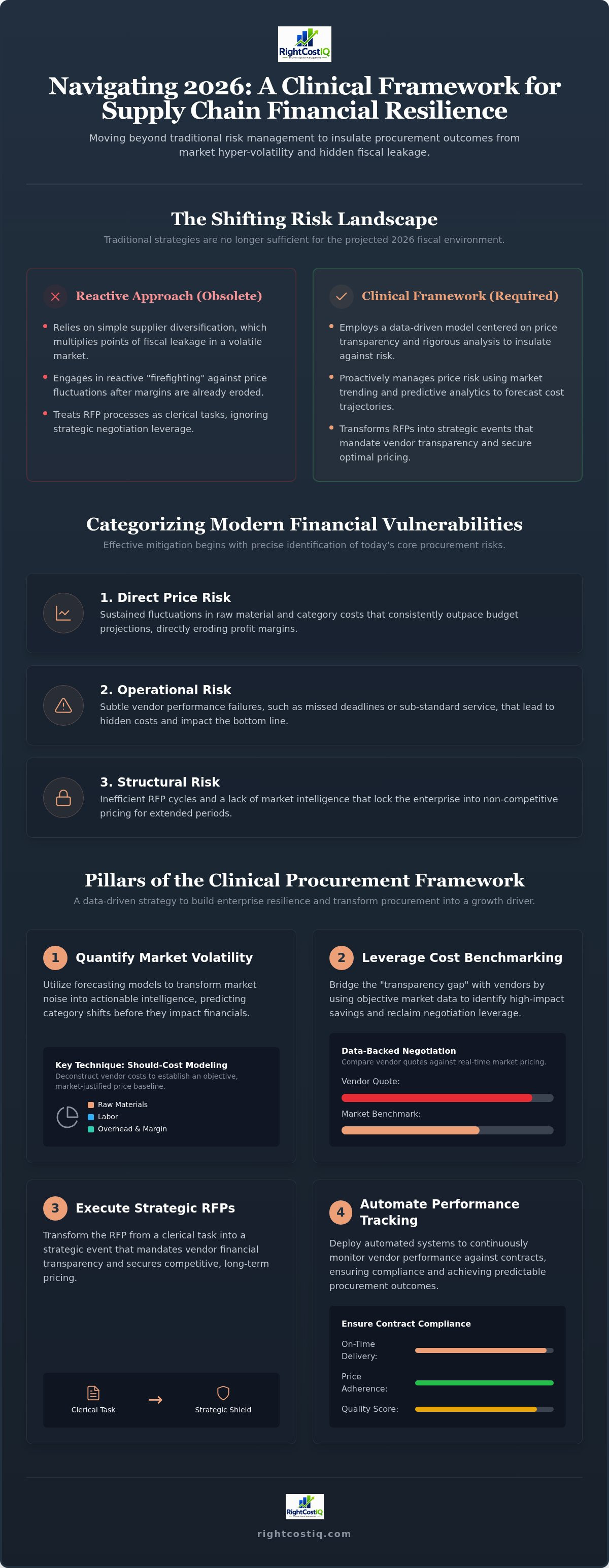
In 2026, the architecture of supply chain financial risk has evolved beyond simple insolvency monitoring. It's now the convergence of vendor instability, extreme market volatility, and internal procurement inefficiency. Traditional Supply chain risk management strategies often rely on supplier diversification to spread exposure. However, in a high-volatility economy, diversification without data-driven oversight merely multiplies the number of points for fiscal leakage. You can't diversify away from systemic market shifts. While some industry analysts focus solely on supplier bankruptcy as the primary threat, this narrow view ignores the systemic risk of price volatility and cost-transparency gaps.
Hidden financial risks often reside in unmanaged tail spend and contract non-compliance. These "invisible" erosions can compromise margins more severely than a single supplier failure. Mitigating supply chain financial risk requires a clinical approach that identifies these leakages before they compound. Procurement teams must move beyond clerical oversight to active financial forensics. Establishing clinical precision in modern enterprise procurement is no longer optional; it's a fundamental requirement for maintaining competitive advantage.
Categorizing Modern Financial Vulnerabilities
Effective mitigation starts with precise categorization. Modern vulnerabilities fall into three distinct silos that require specific analytical responses:
- Direct price risk: Sustained fluctuations in raw material and specific category costs that outpace budget projections.
- Operational risk: Subtle vendor performance failures that result in missed deadlines or sub-standard service, directly impacting the bottom line.
- Structural risk: Inefficient RFP cycles that lock the enterprise into non-competitive pricing for extended periods due to lack of market intelligence.
The Role of Cost Transparency in Risk Mitigation
Information asymmetry remains a primary weapon for vendors during negotiation cycles. In complex procurement categories, the "transparency gap" prevents procurement teams from understanding a vendor's true cost structure. This gap allows suppliers to maintain high margins even when market indicators suggest prices should drop. Clinical procurement leaders use benchmarking to bridge this gap and reclaim leverage. Cost transparency is the primary barrier against margin erosion.
Achieving enterprise resilience demands a transition to clinical precision. This means moving away from reactive "firefighting" and toward a framework where every sourcing decision is backed by real-time market intelligence. This clinical framework is the only reliable method for mitigating supply chain financial risk in the current economic climate.
Quantifying Market Volatility: Price Risk Management Frameworks
Quantifying market volatility is the core requirement for mitigating supply chain financial risk in an era of rapid economic shifts. Many organizations focus exclusively on supplier stability, yet they remain vulnerable to the silent erosion caused by unhedged price fluctuations. Proactive price risk management requires a systemic shift from simple cost-cutting to a model of financial insulation. This transition is powered by clinical analytics that transform market noise into actionable procurement intelligence. A sophisticated strategy for mitigating supply chain financial risk involves move away from reactive sourcing and toward a framework that anticipates market pivots.
Forecasting Models for Procurement Stability
Developing a reliable forecast requires the integration of market price trending into the foundational layers of procurement planning. This process utilizes historical data and real-time market intelligence to predict category shifts before they impact the bottom line. A critical step in this methodology is to Explore Should-Cost Modeling for baseline accuracy. Should-cost modeling provides an objective price point by deconstructing a vendor’s cost drivers, including raw materials, labor, and overhead. It's the only way to verify if a price increase is justified by market conditions or if it's merely a margin-expansion attempt by the supplier. Establishing these objective baselines ensures that negotiation cycles start from a position of data-backed authority rather than defensive reaction.
Price Risk Management as a Competitive Asset
Cost certainty is a more valuable asset than a one-time discount. By maintaining cost predictability, procurement teams enable more accurate enterprise budgeting and capital allocation. The clinical execution of price risk tracking across high-spend categories allows for the identification of price-peak periods, enabling teams to adjust purchasing volumes or contract timing accordingly. Market forecasting serves as a critical negotiation lever by providing the data necessary to challenge vendor price increases during contract renewals. When procurement leaders possess a clear view of future cost trajectories, they don't have to rely on vendor-provided data to justify budget requests.
Strategic hedging is achieved through sophisticated contract structures that include price-adjustment clauses tied to specific market indices. These clauses ensure that pricing remains fair and competitive, regardless of external volatility. This data-driven approach removes the guesswork from vendor management and replaces it with clinical precision. If you're ready to evaluate your current contract exposure, a strategic procurement assessment can highlight where your existing agreements lack sufficient price protection.
Benchmarking and Analytics: Transitioning to Proactive Sourcing
Transitioning from volatility quantification to operational execution requires a robust benchmarking framework. Procurement category cost benchmarking serves as the analytical foundation for identifying fiscal leakage across the enterprise. By utilizing cross-industry price analytics, organizations can uncover savings opportunities that remain hidden within standard vendor proposals. This process is essential for mitigating supply chain financial risk, as it establishes an objective standard of value that transcends individual supplier relationships. It allows procurement teams to move beyond internal historical data and see how their contracts perform against the broader market.
A critical metric in this transition is "Spend Under Management" (SUM). Quantifying SUM allows procurement leaders to assess organizational risk exposure accurately. Every dollar not actively managed represents a potential point of failure or margin erosion. Clinical management demands that a high percentage of spend be brought under active analytical oversight to ensure contract compliance and pricing integrity. Without a high SUM percentage, the organization remains vulnerable to unmonitored price creep and unauthorized vendor substitutions.
Data-Driven Cost Benchmarking Standards
Establishing market-relative pricing targets is the first step toward clinical procurement excellence. This involves setting benchmarks for both clinical and non-clinical categories based on real-time market data. Analytics play a decisive role in identifying vendor pricing outliers, which are suppliers whose costs deviate significantly from established market norms. These outliers often indicate where contracts have become disconnected from market realities. For a deeper dive into these structures, consult Category Management in Procurement: A Clinical Framework. This approach ensures that negotiations are grounded in market reality rather than supplier-led narratives, providing the data-backed leverage needed to secure optimal pricing.
Tail Spend Optimization for Enterprise Resilience
The "hidden 20%" of procurement, specifically unmanaged tail spend, often represents a disproportionate financial risk. While individual transactions may be small, their aggregate volume creates a massive surface area for inefficiency and non-compliance. Consolidating this fragmented spend is vital for improving auditability and reclaiming lost margins. Organizations that ignore this segment face an increased risk of tail spend leakage, where small overcharges accumulate into significant annual losses. You can Mitigate Tail Spend Risk through automated tracking systems that bring these rogue purchases into a controlled environment. This level of optimization is a prerequisite for enterprise resilience in a 2026 economic environment, ensuring every transaction aligns with the broader financial strategy.
Clinical RFP Execution: Mitigating Risk via Strategic Negotiation
Transforming the Request for Proposal (RFP) from a clerical formality into a strategic risk-mitigation event is essential for securing long-term fiscal integrity. Traditional sourcing often treats the RFP as a document collection exercise, but clinical execution demands it functions as a primary tool for mitigating supply chain financial risk. By structuring the RFP to mandate vendor financial transparency, procurement leaders can identify potential points of failure before contracts are signed. This proactive approach ensures that every agreement is insulated against the market volatility discussed in previous sections. It's about moving from hope-based sourcing to a framework of verified compliance.
The RFP Lifecycle as a Risk Shield
A clinical RFP process acts as a defensive barrier against sub-optimal pricing and vendor performance failures. This lifecycle must be methodical and data-driven to ensure predictable results. The process involves three critical stages:
- Step 1: Pre-qualify vendors based on rigorous financial stability metrics and historical performance data to eliminate high-risk partners early in the cycle.
- Step 2: Structure the RFP document to extract a granular cost-breakdown, forcing vendors to disclose margins and specific material cost drivers.
- Step 3: Utilize the benchmarking data established in section three to set hard negotiation ceilings that prevent price creep during the final award stage.
Implementing Professional RFP Management Services provides the technical framework necessary to move beyond generic templates and into high-stakes strategic sourcing. This level of precision ensures that vendor compliance isn't just a promise but a contractual requirement backed by auditability. It creates a record of transparency that protects the organization from future price disputes.
Negotiation Strategies for Financial Resilience
Strategic negotiation is the final safeguard against unfavorable contract terms that erode enterprise margins. Procurement teams must leverage market price trending data to counter unjustified vendor price hikes during the final stages of the award process. When vendors realize your team possesses superior market intelligence, the information asymmetry that previously favored the supplier evaporates. Utilizing Advanced Negotiation Assistance allows your organization to maintain a position of authority, ensuring that the final contract reflects market reality rather than vendor-led narratives. Professional coaching ensures your team doesn't leave money on the table during complex category negotiations.
Post-contract financial adherence is just as critical as the initial negotiation. Implementing automated vendor performance tracking ensures that the pricing and service levels agreed upon during the RFP are maintained throughout the contract's duration. This prevents the "contract leakage" that often occurs when oversight fades after the signing ceremony. If you're concerned about your current contract terms, you can perform a free procurement diagnostic to identify immediate risk-mitigation opportunities.
Building Enterprise Resilience with RightCostIQ Analytics
The integration of advanced technology into traditional business functions is the definitive step toward building enterprise resilience. RightCostIQ provides the clinical precision required for mitigating supply chain financial risk in the 2026 economic landscape. By replacing manual oversight with automated analytics, organizations can achieve a holistic view of supply chain health that was previously unattainable through legacy processes. This transition positions procurement as a primary driver of financial growth and stability. It moves the department from a reactive support role to a strategic architect of the bottom line.
The shift toward clinical precision represents a fundamental redefinition of procurement's role in the modern corporation. It's no longer about simply finding the lowest price but about architecting a supply chain that can withstand systemic shocks while maintaining predictable margins. By deploying a comprehensive suite of analytics, leaders can transform volatility from a threat into a strategic opportunity. This level of operational efficiency is the hallmark of an organization prepared for the complexities of 2026 and beyond. Total cost certainty is the ultimate goal of this technological evolution.
The RightCostIQ Strategic Architecture
The framework combines real-time market intelligence with clinical negotiation execution to neutralize vendor-side information asymmetry. This data-driven sourcing model eliminates the guesswork in financial risk management by providing objective, verifiable benchmarks for every procurement category. For a deeper look at the technological evolution of these processes, consult RFP Management: Strategic Frameworks for Optimization. The ROI of professional RFP management and price risk tracking is realized through sustained margin protection and the systematic elimination of contract leakage. When every sourcing decision is backed by proprietary analytics, the enterprise gains an unassailable competitive advantage.
Next Steps for Procurement Leaders
Securing your organization's financial future starts with a rigorous audit of current risk exposure. Utilizing cost benchmarking tools allows you to identify exactly where pricing has decoupled from market reality. Transitioning to an automated vendor performance tracking service ensures that the value secured during the negotiation phase is actually delivered throughout the contract lifecycle. This clinical approach to mitigating supply chain financial risk is the only reliable method for insulating procurement outcomes from external volatility. It's time to move beyond surface-level cost reduction and toward total price risk management. Optimize Your Procurement Outcomes with RightCostIQ today to begin your transition to data-driven sourcing.
Transitioning to Clinical Procurement Excellence for 2026
The 2026 economic landscape demands a shift from legacy procurement habits to a clinical architecture of financial oversight. Successfully mitigating supply chain financial risk is no longer achieved through simple vendor diversification; it requires a data-driven integration of market price trending and rigorous category benchmarking. By establishing cost transparency as a non-negotiable standard, procurement leaders can effectively insulate their margins from the volatility of unmanaged tail spend and opaque pricing structures. This transformation ensures that every contract is an asset for institutional growth rather than a point of fiscal leakage.
RightCostIQ provides the specialized tools necessary to execute this transition with surgical precision. Our proprietary Price Risk Management Frameworks and specialized healthcare financial benchmarking allow you to reclaim leverage in even the most complex negotiation cycles. Leveraging our clinical RFP execution expertise ensures that your sourcing events are shielded by data-backed ceilings and automated performance tracking. You can begin optimizing your enterprise resilience today by auditing your current exposure. Secure Your Margins with RightCostIQ Strategic Analytics and transform your procurement department into a high-performance driver of bottom-line stability.
Frequently Asked Questions
What is financial risk in a supply chain context?
Financial risk is the convergence of market volatility, vendor instability, and internal procurement inefficiency that erodes institutional margins. It encompasses direct price fluctuations, operational failures, and structural risks like non-competitive contracting. Organizations must view this risk as a systemic threat to capital allocation rather than just a series of isolated disruptions. Clinical precision in identifying these vulnerabilities is the only way to protect the bottom line against unpredictable economic shifts.
How can market price trending help mitigate procurement risk?
Market price trending provides the predictive intelligence required to forecast cost trajectories and neutralize price volatility before it impacts the budget. By tracking price indices and material cost drivers, procurement leaders can adjust purchasing timing and contract structures to align with market lows. This proactive approach eliminates the information asymmetry that typically favors suppliers during negotiation cycles. It transforms market noise into actionable data for mitigating supply chain financial risk across high-spend categories.
Why is cost benchmarking essential for financial resilience?
Cost benchmarking establishes an objective standard of value by comparing internal pricing against real-time, cross-industry market data. It allows organizations to identify vendor pricing outliers and recapture lost margins that remain hidden within opaque contract structures. Without benchmarking, procurement teams operate in an analytical vacuum, unable to verify if their current rates are competitive. This practice serves as the foundation for proactive mitigation, ensuring that enterprise resilience is built on verified financial standards rather than historical assumptions.
How does professional RFP management reduce vendor-related risk?
Professional RFP management transforms the sourcing cycle from a clerical task into a high-stakes strategic event designed to extract granular financial transparency. It implements rigorous pre-qualification based on vendor stability and mandates detailed cost-breakdown disclosures. This methodology ensures that contracts include enforceable compliance clauses and price-adjustment mechanisms tied to market indices. By using clinical RFP execution, organizations eliminate high-risk partners early and secure agreements that are structurally insulated against future performance or pricing failures.
Can tail spend management significantly impact financial stability?
Managing the "hidden 20%" of unmanaged tail spend is critical because its aggregate volume often creates massive surface areas for fiscal leakage. Fragmented purchases outside of primary contracts frequently suffer from unmonitored price creep and unauthorized substitutions. Consolidating this spend through automated tracking improves auditability and ensures that small transactions don't accumulate into significant annual losses. Effective tail spend optimization is a prerequisite for total enterprise stability, bringing rogue spending under clinical analytical oversight.
What is the difference between price risk management and standard sourcing?
Standard sourcing focuses on one-time cost reduction, while price risk management prioritizes long-term cost certainty and predictability through clinical analytics. Standard processes are often reactive, responding to price hikes only after they occur. In contrast, price risk management utilizes market forecasting and "should-cost" modeling to anticipate shifts and implement strategic hedging. This sophisticated approach focuses on insulating the enterprise from external volatility rather than just securing a temporary discount from a specific vendor.
How does vendor performance tracking ensure financial compliance?
Vendor performance tracking provides real-time verification that suppliers are adhering to the financial and service level agreements established during the RFP. It prevents "contract leakage" by identifying deviations in pricing or delivery before they compound into institutional losses. This automated oversight ensures that the value secured during negotiation is actually realized throughout the contract lifecycle. By maintaining a clinical record of compliance, procurement teams gain the data-backed leverage necessary to enforce contract terms or justify vendor transitions.
What tools are best for supply chain cost transparency in 2026?
The most effective tools for 2026 integrate market intelligence platforms with automated benchmarking and vendor tracking software. These systems provide the clinical precision required for mitigating supply chain financial risk by surfacing information asymmetry in real-time. Organizations should prioritize platforms that offer proprietary cost-modeling and predictive analytics to move beyond legacy spreadsheets. RightCostIQ provides this level of strategic architecture, combining financial forensics with clinical negotiation execution to ensure total procurement transparency across all enterprise categories.


