
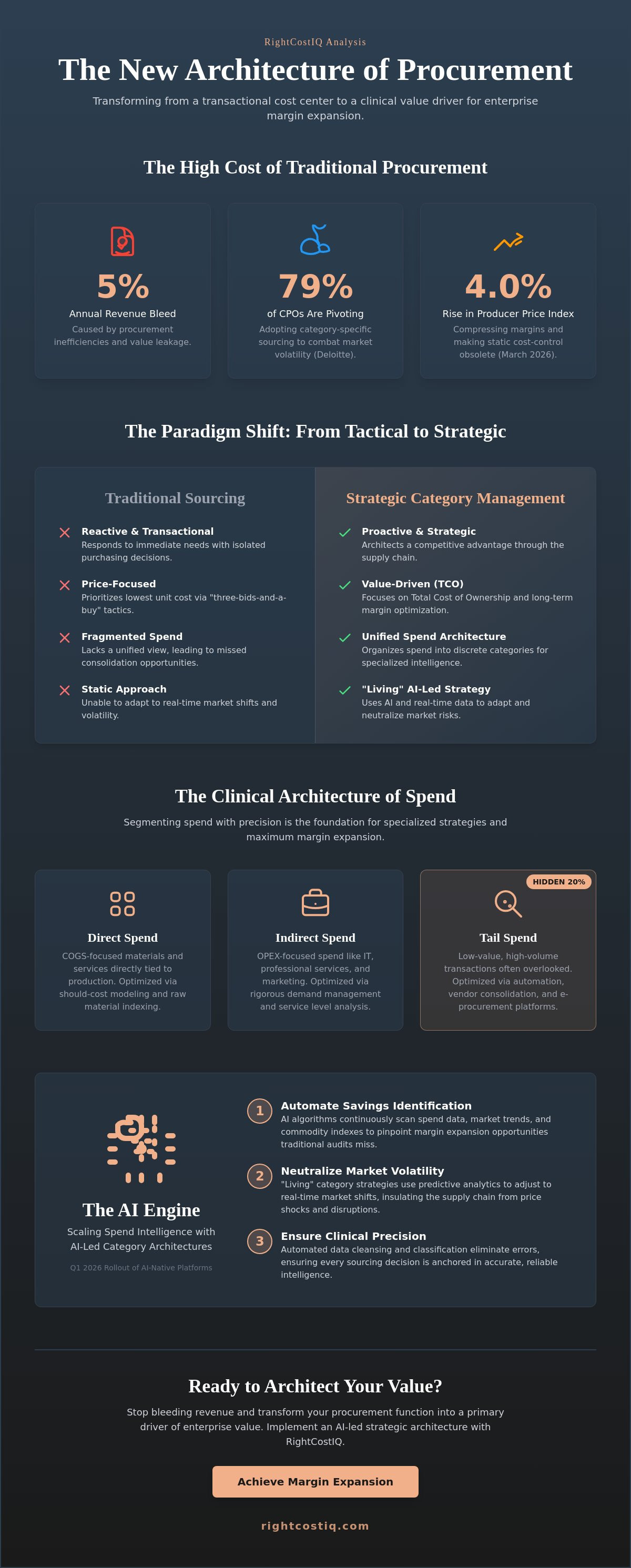
A recent Deloitte study reveals that 79% of Chief Procurement Officers are pivoting toward category-specific sourcing to combat a market where procurement inefficiencies bleed up to 5% of annual revenue. You've likely seen your margins compressed by the 4.0% rise in the Producer Price Index recorded in March 2026. Managing fragmented spend across disconnected vendors isn't just an operational hurdle; it's a direct threat to your bottom line. Traditional, static approaches to category management procurement can't keep pace with the current volatility or the clinical precision required for modern enterprise success.
We'll show you how to transform your procurement function into a primary value driver through a sophisticated strategic architecture. You'll learn to implement AI-led spend intelligence and adopt "living" category strategies that adapt to real-time market shifts. We'll also examine how the April 30, 2026, federal mandate for fixed-price contracts and the Q1 2026 rollout of AI-native procurement platforms provide the tools necessary to achieve aggressive margin expansion and eliminate value leakage across your entire supply chain.
Key Takeaways
- Transition from transactional purchasing to a strategic architecture where procurement functions as a clinical value driver for enterprise margin expansion.
- Identify and capture the "Hidden 20%" of organizational spend by applying rigorous management protocols to direct, indirect, and often-overlooked tail spend categories.
- Shift from short-term price reductions to a Total Cost of Ownership (TCO) model that prioritizes long-term margin optimization over tactical sourcing.
- Modernize your category management procurement framework by integrating AI-led spend intelligence to automate savings identification and neutralize market volatility.
- Execute a multi-phase optimization cycle utilizing commodity indexing and data cleansing to ensure every sourcing decision is anchored in clinical precision.
Defining Category Management: Why Procurement is the New Value Driver
In the 2026 fiscal environment, enterprise resilience isn't a byproduct of passive cost control. It's the result of aggressive, clinical margin expansion. Traditional purchasing functions often fail because they treat spend as a series of isolated transactions rather than a unified strategic asset. Category management procurement replaces this fragmented approach with a strategic architecture designed for end-to-end spend optimization. This shift is fundamental to the RightCostIQ philosophy: Procurement is the new value driver.
Effective Category management (purchasing) requires a move away from legacy "three-bids-and-a-buy" tactics. Instead, it organizes enterprise spend into discrete segments based on market dynamics and supplier ecosystems. This structural alignment allows procurement teams to apply specialized intelligence to every dollar. It's the difference between merely buying supplies and architecting a competitive advantage through your supply chain. By treating spend as a portfolio, organizations can neutralize market volatility and secure superior commercial terms.
The Strategic Architect Mindset
Category managers in high-performing organizations don't just manage contracts; they act as the CEOs of their specific spend domains. This mindset demands total accountability for the financial outcomes of a category. Managers must align their sourcing goals with the broader corporate financial strategy to ensure every negotiation contributes to the bottom line. Category management is a clinical framework for margin expansion. By adopting this architect persona, procurement professionals transform from administrative support into essential strategic partners who drive enterprise-wide efficiency and long-term stability.
Beyond Cost Savings: The Value Driver Model
The transition to a value driver model means moving past simple price chasing. While unit price reductions matter, they're only one lever in a sophisticated margin expansion strategy. True value creation involves identifying non-price levers such as supplier-led innovation, proactive risk mitigation, and performance optimization. Spend intelligence serves as the technical engine for this process. It converts raw data into actionable insights, allowing teams to identify margin-draining inefficiencies that traditional audits miss. By focusing on the total value delivered rather than just the initial quote, organizations secure profitability even when the Producer Price Index fluctuates.
The Architecture of Spend: Direct, Indirect, and Tail Spend Management
Clinical spend categorization is the foundation of a high-performance procurement function. Misalignment in supplier data or improper category boundaries leads to an average revenue loss of 5% annually across the enterprise. To stop this leakage, organizations must move beyond broad buckets and adopt a granular architecture. This structure divides spend into direct materials, indirect services, and the often ignored tail spend. As highlighted by Forbes on Category Management, this segmentation allows for specialized strategies that address the unique market pressures of each domain. In a year where the March 2026 Producer Price Index rose by 4.0%, failing to define these boundaries with precision is a direct threat to profitability.
Modern category management procurement utilizes commodity indexing and market price trending to draw these boundaries dynamically. Static categories don't work in 2026. Instead, spend analytics must continuously identify consolidation opportunities where fragmented vendor pools can be unified under a single strategic framework. This architectural rigor ensures that every dollar spent is visible, categorized, and optimized for maximum margin expansion.
Direct vs. Indirect Category Dynamics
Direct spend management requires a rigorous focus on COGS-focused materials. We utilize should-cost modeling to strip away supplier margins and identify the true cost of production. This clinical approach ensures you aren't overpaying for raw materials during periods of market volatility. Conversely, indirect spend, covering OPEX domains like IT and Professional Services, requires a demand management strategy. Instead of just chasing price, we optimize the volume and necessity of the services themselves. Applying this level of precision to vendor performance tracking ensures that both domains contribute to the enterprise's strategic financial goals.
Addressing Tail Spend Volatility
The "Hidden 20%" of spend, or tail spend, represents the thousands of low-frequency transactions that typically escape executive oversight. While individually small, these unmanaged purchases erode margins and introduce significant operational risk through non-compliant vendors. Strategic architects consolidate this tail into managed category frameworks using AI-led analytics. These tools surface hidden savings by identifying patterns in fragmented data that manual audits miss. To close these value gaps, you can evaluate your current spend intelligence maturity. By applying clinical precision to the tail, you transform a legacy source of leakage into a predictable value driver.
Strategic Category Management vs. Tactical Sourcing
Tactical sourcing is a legacy reflex that prioritizes immediate price reductions over sustainable financial health. This "Three-Bids-and-a-Buy" approach focuses on the transaction, treating procurement as a back-office function rather than a strategic lever. In contrast, category management procurement operates on a Total Cost of Ownership (TCO) model. This clinical framework looks beyond the initial quote to analyze logistics, inventory carrying costs, and supplier risk. While tactical buyers celebrate a 2% price cut on a single invoice, strategic architects secure long-term margin optimization by re-engineering the entire category value chain.
The difference between vendor management and strategic partnership development is equally stark. Tactical sourcing views suppliers as interchangeable entities to be squeezed for concessions. Strategic category management treats them as extensions of the enterprise tech stack and production line. This shift changes the nature of RFP management. Instead of simple price discovery, RFPs become tools for identifying partners capable of co-creating value. Negotiation assistance in this context isn't just about aggressive posturing; it's about using should-cost modeling to ensure both parties operate from a foundation of data-driven transparency.
The Performance Gap in Traditional Sourcing
Traditional sourcing models are inherently reactive. They fail to address the price risk inherent in market volatility, such as the 4.0% Producer Price Index increase reported in March 2026. Organizations without a defined category architecture often suffer from "maverick spend," where decentralized purchasing bypasses negotiated contracts. This lack of control is expensive. Industry data suggests that traditional RFP cycles often leave 10% to 15% of potential value on the table because they fail to capture non-price levers like supplier innovation or volume consolidation. This value leakage directly impacts the bottom line, turning procurement into a cost center rather than a driver of margin expansion.
Clinical Execution: The Category Management Advantage
Clinical execution requires integrating market price trending into every negotiation cycle. By leveraging cost benchmarking, category managers set aggressive should-cost targets that reflect real-world commodity indexing. This move from reactive buying to proactive category forecasting allows the enterprise to anticipate disruptions before they hit the P&L. For example, with the April 30, 2026, federal mandate shifting toward fixed-price contracts, organizations using category management are better positioned to lock in favorable terms. They don't wait for market shifts; they architect their spend to withstand them. This proactive stance ensures that procurement remains the primary engine for organizational resilience and financial optimization.
Executing the Optimization Cycle: A Data-Driven Implementation Guide
Execution of a clinical category management procurement framework requires a methodical, five-phase optimization cycle. This isn't a one-time event; it's a rhythmic process designed to neutralize volatility and capture incremental value. Organizations that fail to follow a structured implementation often see their strategic initiatives degrade into tactical fire-fighting within six months. To maintain margin expansion, you must treat each phase as a high-stakes engineering task.
- Phase 1: Spend Intelligence & Data Cleansing. Establish the foundation of clinical precision by aggregating fragmented spend data into a single, verified truth.
- Phase 2: Market Analysis & Commodity Indexing. Benchmark your internal costs against the 4.0% Producer Price Index increase from March 2026 to understand your relative market position.
- Phase 3: Strategic Sourcing & RFQ Sprints. Execute rapid sourcing cycles that leverage competitive tension to reset category pricing.
- Phase 4: Contract Optimization & Price Risk Management. Lock in value by aligning with the April 30, 2026, federal preference for fixed-price contracts to mitigate future inflationary spikes.
- Phase 5: Continuous Vendor Performance Tracking. Monitor operational compliance to ensure the negotiated savings actually materialize on the balance sheet.
Leveraging Cost Benchmarking and Analytics
Clinical precision in supplier negotiations starts with identifying outlier pricing through category-specific benchmarking. By comparing your current rates against industry standards and commodity indexing data, you can pinpoint specific vendors where margins are bloated. Should-cost models serve as your primary analytical tool here. These models strip away supplier overhead and profit padding to reveal the "clean sheet" cost of a product or service. This data-driven transparency allows you to time your RFQ sprints for maximum leverage, ensuring you hit the market when prices are most favorable for the buyer.
Negotiation Strategies for High-Value Categories
Strategic Architects don't negotiate on sentiment; they negotiate on architecture. Complex RFP management requires a shift from transactional haggling to value-based partnership agreements. This involves using price risk management to protect the enterprise from financial volatility in long-term contracts. By integrating clean sheet cost models into your negotiation scripts, you force suppliers to justify every cent of their quote. This level of rigor is essential for high-value categories where even a 1% variance can represent millions in lost margin. To achieve this level of control, you can access our clinical sourcing framework to audit your current negotiation protocols. Transitioning to this model ensures that your supply chain remains a predictable engine for margin expansion rather than a source of financial risk.
Scaling Spend Intelligence with AI-Led Category Architectures
Scaling spend intelligence requires a definitive shift from human-dependent analysis to AI-led category architectures. By Q2 2026, the transition from AI pilots to AI-native procurement platforms has become the industry standard, exemplified by the Q1 2026 rollout of rebuilt, AI-native architectures on the SAP Business Technology Platform. These systems don't just store data; they actively identify savings opportunities that escape manual oversight. Integrating AI directly into your category management procurement workflow allows for the automation of bid analysis and sourcing support, turning raw spend intelligence into immediate enterprise value.
Prompt engineering has emerged as a critical technical skill for the modern procurement professional. It allows category managers to refine spend analytics and forecasting models with clinical precision. Through the RightCost Academy, we provide the technical upskilling necessary to transform your team into Strategic Architects. This isn't about general support; it's about competitive advantage. We equip your personnel to use AI-led tools to build "living" category strategies that adapt to the 4.0% PPI fluctuations recorded in March 2026. This ensures your procurement function remains a relentless engine for margin expansion.
The Future of AI-Driven Margin Expansion
Predictive forecasting is the essential infrastructure for 2026 sourcing. AI-led platforms anticipate market price shifts before they impact your P&L, allowing you to lock in favorable terms through rapid RFQ sprints. Automating vendor compliance through your tech stack eliminates the administrative burden of performance tracking. This ensures that the margin expansion identified during the negotiation phase is actually realized during the contract lifecycle. Organizations that fail to adopt these AI-led architectures will find themselves unable to neutralize the volatility that has become a permanent fixture of the global supply chain.
Implementing the RightCostIQ Edge
RightCostIQ functions as your sophisticated partner for AI-driven margin expansion. Our RFP management and negotiation assistance protocols deliver clinical results by integrating procurement analytics into your existing corporate infrastructure. We don't just provide software; we provide a clinical framework for financial optimization. Discover how RightCostIQ optimizes your category strategy for margin expansion. By aligning high-level strategy with technical execution, we ensure that procurement remains your organization's primary value driver. This approach secures your margins against inflation while positioning your enterprise as a leader in procurement innovation.
Architecting Your 2026 Competitive Advantage
The transition from a cost center to a value driver is no longer optional in an era defined by the 4.0% Producer Price Index increase recorded in March 2026. You've seen how a clinical approach to category management procurement eliminates the 5% revenue loss typical of unmanaged spend. By mastering the architecture of direct and indirect domains while neutralizing tail spend volatility, your organization secures the resilience required for sustained margin expansion.
Integrating AI-led spend intelligence and "living" category strategies ensures your procurement function remains proactive. RightCostIQ provides the technical engine and strategic mentorship to execute this transformation with absolute precision. Our AI-Driven Margin Expansion Framework and Specialized Price Risk Management Services shield your P&L from market shocks. We combine clinical RFP management and negotiation expertise to ensure every sourcing cycle delivers measurable financial outcomes.
It's time to stop chasing prices and start architecting value. Optimize Your Procurement Strategy with RightCostIQ and lead your enterprise into a new era of financial optimization. Your path to clinical procurement excellence starts today.
Frequently Asked Questions
What is the primary difference between category management and strategic sourcing?
Category management is a continuous strategic architecture whereas strategic sourcing is a discrete, project-based event. Strategic sourcing focuses on the specific execution of a contract or negotiation. Category management procurement oversees the entire lifecycle of a spend domain, prioritizing long-term Total Cost of Ownership and alignment with enterprise financial goals over one-time price reductions.
How does category management contribute to margin expansion?
It directly addresses the 5% revenue loss caused by procurement inefficiencies through clinical spend optimization. By utilizing should-cost modeling and commodity indexing, category managers identify and recapture bloated supplier margins. This systematic approach ensures that every dollar spent is architected to deliver maximum value, neutralizing the impact of the 4.0% Producer Price Index increase recorded in March 2026.
Why is tail spend management critical for an effective category strategy?
Tail spend represents the "Hidden 20%" of enterprise spend that often escapes executive oversight and drives maverick purchasing. While individual transactions are small, their cumulative volume introduces significant operational risk and margin leakage. Managing this spend through AI-led frameworks closes the value gaps that traditional, manual procurement processes miss.
What role does AI play in modern procurement category management?
AI-led platforms automate spend intelligence by identifying savings opportunities and anomalies in real-time. These systems utilize prompt engineering to refine predictive forecasting and automate vendor compliance tracking within the enterprise tech stack. In 2026, AI is the essential infrastructure for turning raw data into actionable margin levers without increasing administrative headcount.
How often should procurement categories be re-benchmarked?
High-volatility categories require quarterly re-benchmarking to maintain clinical precision. Static annual reviews are insufficient in a market where indices fluctuate rapidly. Regular benchmarking against current commodity trends ensures your category management procurement framework remains aligned with market realities and protects the organization from unexpected price spikes.
What are the key KPIs for measuring category management success?
Success is measured through realized margin expansion, Total Cost of Ownership (TCO) reduction, and the percentage of spend under management. Secondary metrics include vendor compliance rates and the speed of RFQ sprints. These KPIs provide a data-driven view of how effectively procurement is functioning as a primary value driver for the enterprise.
How does price risk management integrate into category planning?
It integrates through the use of should-cost models and a preference for fixed-price contracts, as emphasized by the April 30, 2026, federal mandate. Category plans now include specific triggers for renegotiation based on commodity index movements. This proactive stance allows firms to lock in favorable terms before market volatility impacts the bottom line.
Can category management be outsourced to professional service firms?
Specialized margin expansion firms can manage specific categories to provide immediate access to sophisticated spend intelligence and negotiation expertise. This model is particularly effective for complex categories or tail spend consolidation. Outsourcing allows internal teams to focus on core strategic initiatives while leveraging external clinical frameworks to drive rapid financial optimization.


