
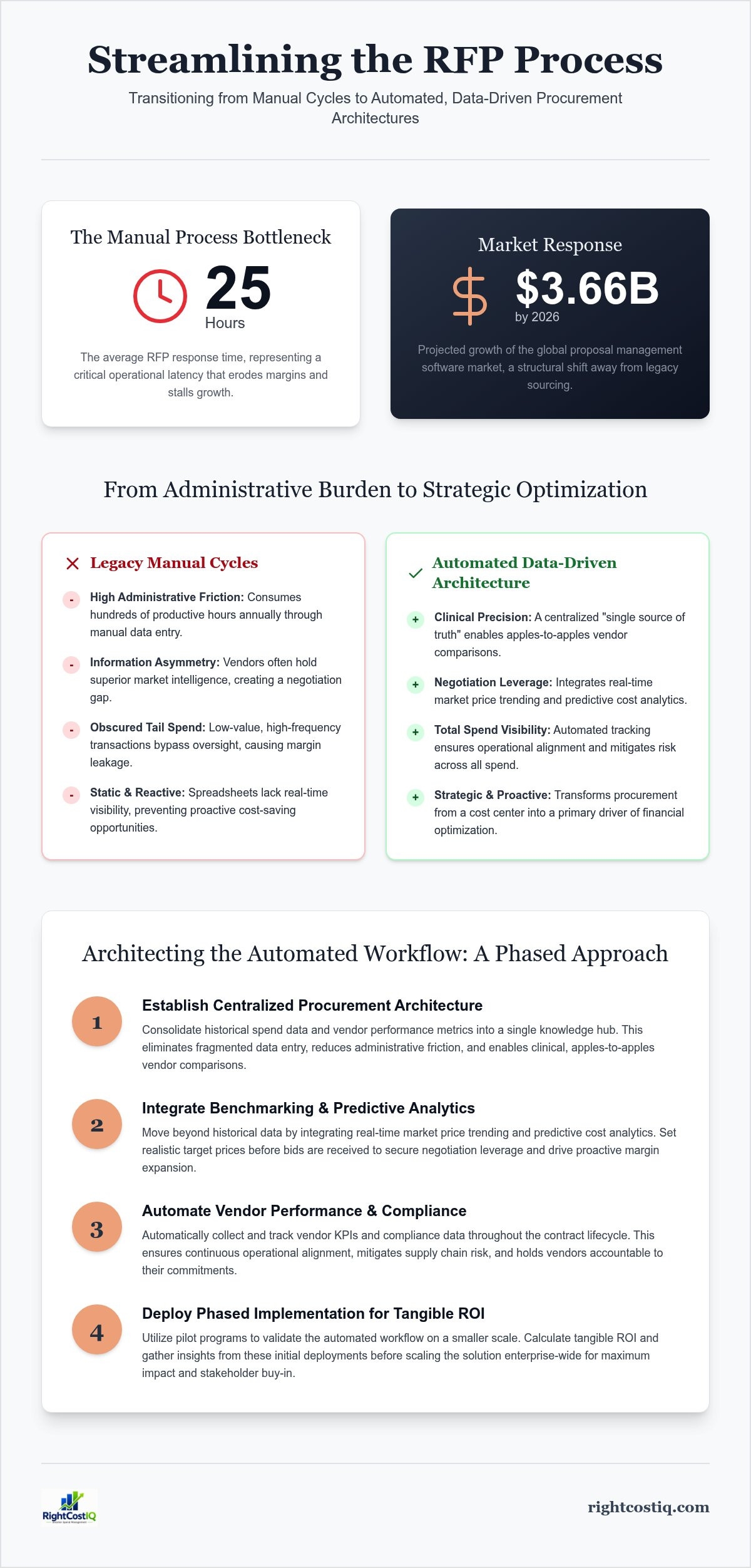
The average RFP response time has reached a critical 25-hour threshold. This operational latency represents a systemic failure in traditional procurement workflows that directly erodes corporate margins and stalls strategic growth. You recognize that manual bid cycles are no longer sustainable in a high-velocity market demanding real-time cost transparency and clinical precision. This guide provides a comprehensive strategic framework for streamlining the RFP process by transitioning from legacy manual cycles to automated, data-driven procurement architectures.
You'll master the integration of proprietary cost benchmarking and automated compliance tracking to maximize margin expansion and vendor accountability. We will examine the specific technical mechanics of reducing RFP cycle times, securing negotiation leverage through market price forecasting, and implementing rigorous vendor performance tracking protocols. By the end of this analysis, you'll have the blueprint to replace 20-hour manual bottlenecks with an automated intelligence layer that transforms procurement from a cost center into a primary driver of financial optimization.
Key Takeaways
- Establish a centralized procurement architecture to eliminate fragmented data entry and enable clinical, apples-to-apples vendor comparisons.
- Implement the strategic frameworks necessary for streamlining the RFP process to resolve the 25-hour response latency bottleneck.
- Integrate real-time market price trending and predictive cost analytics to move beyond historical data toward proactive margin expansion.
- Automate the collection of vendor KPIs and compliance data to ensure operational alignment throughout the contract lifecycle.
- Deploy a phased implementation model that uses pilot programs to calculate tangible ROI before scaling to enterprise-wide automation.
The Economic Drain of Manual RFP Cycles in Modern Procurement
The global proposal management software market is projected to reach $3.66 billion by 2026. This growth isn't merely a technological shift; it's a structural response to the systemic inefficiencies of legacy sourcing. For high-level decision-makers, streamlining the RFP process has evolved from an operational preference to a financial necessity. Manual data entry and fragmented vendor communication create significant margin erosion through administrative friction. Traditional spreadsheets fail to capture the nuances of market price trending and volatility, leaving organizations vulnerable to unmanaged price risk. Organizations that cling to manual data normalization struggle to maintain clinical cost transparency in an increasingly complex supply chain.
The Hidden Economic Drain of Legacy Sourcing
Manual procurement cycles consume an average of 25 hours per response according to 2026 industry benchmarks. This labor intensity scales poorly across enterprise operations, leading to hundreds of lost productive hours annually. When procurement teams rely on non-automated data normalization, they invite information asymmetry. Vendors often hold superior market intelligence, creating a negotiation gap that favors the supplier during the bidding phase. Spreadsheet-based workflows also obscure tail spend leakage. Without automated tracking, these low-value, high-frequency transactions bypass strategic oversight, directly impacting the bottom line. The foundational Request for Proposal (RFP) document becomes a static artifact rather than a dynamic intelligence tool when managed through legacy systems. This lack of real-time visibility prevents procurement from identifying cost-saving opportunities within fragmented spend categories.
From Administrative Burden to Strategic Optimization
Modern procurement must function as a primary driver of financial growth. Transitioning from reactive sourcing to proactive category management procurement requires a clinical shift in methodology. Strategic optimization involves replacing administrative friction with automated, data-driven sourcing models. This architecture provides the clinical precision needed for rigorous vendor selection and risk mitigation. By streamlining the RFP process, organizations generate high-fidelity data sets that empower executive reporting. Procurement leaders move away from chasing document signatures and toward architecting complex negotiation strategies. This evolution ensures that high-level strategy and technical execution remain perfectly aligned, securing a sustainable competitive advantage in a volatile market.
Architecting the Automated RFP Management Workflow
Automation isn't merely a layer added to existing workflows; it's a fundamental redesign of the procurement lifecycle. Effective streamlining the RFP process requires a centralized architecture that acts as a clinical single source of truth. This centralized hub eliminates the fragmented communication and siloed data that typically plague manual sourcing. By implementing semantic understanding, procurement teams can automate the mapping of vendor responses to specific technical requirements. This ensures that every proposal is evaluated on its technical merits rather than the quality of its marketing prose. The result is a high-fidelity data environment where strategic decisions are based on objective metrics rather than administrative assumptions.
Phase 1: Knowledge Hub and Template Standardization
The foundation of a strategic workflow begins with the consolidation of historical spend data and previous vendor performance metrics. This knowledge hub provides a data-driven baseline for every new bid cycle. Dynamic templates then adapt to specific category requirements automatically, ensuring consistency across the enterprise while reducing the time spent on document creation. Integrating cost benchmarking into the initial request phase allows procurement to set realistic target prices before the first bid is even received. The success seen in automating federal acquisition processes highlights how these structured hubs reduce administrative friction and significantly improve departmental performance by replacing manual oversight with intelligent validation.
Phase 2: Automated Scoring and Evaluation Frameworks
The evaluation phase often represents the most significant time sink in the procurement cycle. Automated scoring frameworks utilize specialized agents to normalize disparate pricing models into a uniform structure. This normalization allows for an objective, apples-to-apples comparison of vendor value that's impossible to achieve in a manual spreadsheet. Clinical performance data, rather than subjective impressions or relationship-based preferences, becomes the primary driver for shortlisting candidates. This approach eliminates cognitive bias and ensures that vendor selection aligns perfectly with organizational financial goals. Automated compliance checks and security questionnaire verification further accelerate the cycle by identifying non-compliant bids instantly. By streamlining the RFP process through these automated evaluation layers, teams can focus their expertise on high-level negotiation rather than data entry. You can begin identifying specific friction points in your current workflow by initiating a diagnostic analysis of your procurement architecture to see where automation will yield the highest return.
Benchmarking and Analytics: The Core of Automated RFP Success
Strategic success in procurement hinges on the quality of the intelligence layer integrated into the sourcing cycle. While earlier sections focused on workflow architecture, the true value of streamlining the RFP process lies in the application of granular category cost benchmarking. By 2026, relying on historical data alone is an invitation for margin erosion. Modern systems must integrate real-time market price trending to identify hidden savings opportunities through automated spend analysis. This clinical approach ensures that procurement leaders operate with a high degree of professional authority, backed by objective market intelligence. Automated benchmarking enables the aggregation of data across the entire enterprise, revealing volume-based negotiation leverage that remains invisible in siloed, manual workflows.
Leveraging Market Intelligence for Negotiation Power
Manual negotiation often relies on anecdotal evidence or vendor-provided benchmarks. Automated data normalization allows procurement to challenge these models directly during the bid evaluation phase. Professional negotiation assistance utilizes should-cost analytics to establish absolute transparency and drive margin expansion. This methodology aligns with the strategic goals of the Federal Automation Community of Practice, which emphasizes using technology to enhance complex acquisition outcomes. By architecting a should-cost model within the RFP, you force vendors to justify pricing against objective manufacturing and logistics variables. This high-stakes approach ensures that high-level strategy and technical execution are perfectly aligned, preventing vendors from leveraging information asymmetry to their advantage.
Price Risk Management and Volatility Mitigation
Predictive cost analytics move procurement from a reactive stance to a proactive risk management function. Organizations must forecast future cost fluctuations during the initial RFP evaluation phase to mitigate volatility before a contract is signed. Automation identifies financial risks in complex vendor contracts that manual reviews often overlook, such as unfavorable price adjustment clauses or opaque indexing. By linking RFP outcomes to long-term price risk management, organizations secure financial stability in an increasingly unpredictable global market. This strategic foresight ensures that streamlining the RFP process contributes directly to the bottom line by securing favorable terms that withstand market shifts. Transitioning to this predictive model allows procurement to function as a strategic architect of corporate profitability rather than an administrative gatekeeper.
Operationalizing Vendor Performance and Compliance Automation
Procurement excellence requires more than just selecting a vendor; it demands the operationalization of those selections through automated feedback loops. Streamlining the RFP process only achieves its full financial potential when the commitments made during bidding are rigorously tracked against live performance data. This closed-loop architecture ensures that the "should-cost" projections and service level agreements (SLAs) secured during the sourcing phase aren't lost in the transition to active contract management. By 2026, the integration of RFP data into continuous monitoring systems has become a baseline requirement for organizations seeking to maintain clinical cost transparency and supply chain resilience.
Automated Vendor Performance Tracking Architectures
Legacy systems treat the RFP as a static event. Modern frameworks utilize automated triggers to initiate performance reviews and contract renewals based on real-time data ingestion. This clinical oversight allows stakeholders to view live performance dashboards that directly compare current vendor output against their original RFP commitments. High-level decision-makers can identify service degradation instantly, preventing margin erosion before it becomes systemic. This level of visibility is particularly critical for managing tail spend, where unmanaged, low-value transactions often aggregate into significant financial leakage. By automating the oversight of these secondary categories, procurement teams maintain enterprise-wide control without increasing administrative headcount.
Compliance and Risk Mitigation in Automated Sourcing
Sourcing automation must extend into continuous regulatory and financial monitoring to protect the organization from supply chain shocks. Automated audits verify vendor health and compliance status in real-time, replacing the error-prone manual audit cycles of the past. This proactive stance is essential for long-term price risk management. For instance, post-award price tracking ensures that vendors adhere to the index-linked pricing models established during the negotiation phase. Streamlining the RFP process through this continuous monitoring lens allows organizations to build resilient procurement ecosystems that prioritize vendor diversity and financial stability. This strategic integration of automation ensures that high-level strategy and technical execution remain perfectly aligned throughout the entire vendor lifecycle. To evaluate the efficiency of your current vendor tracking protocols, access our diagnostic framework for procurement optimization.
Strategic Implementation: Deploying RFP Automation for ROI
The transition from manual sourcing to an automated architecture is a high-stakes financial pivot. Calculating the return on investment for streamlining the RFP process requires a clinical analysis of both labor-hour recovery and direct cost savings. Data from 2026 industry reports indicates that 61% of organizations achieve a full return on their investment within one year of implementing automated RFP management frameworks. This ROI isn't merely a byproduct of speed; it's driven by the capture of negotiation leverage that remains invisible in legacy systems. Future-proofing procurement requires an AI-led infrastructure that prioritizes clinical data over administrative assumptions, ensuring every sourcing decision contributes directly to the bottom line.
The Roadmap to Procurement Modernization
Successfully deploying an automated framework begins with a clinical assessment of current maturity levels and data readiness. Organizations must identify where fragmented communication and manual data entry are most prevalent within their existing workflows. Selecting a procurement platform that scales with enterprise needs is critical for long-term operational stability. A phased implementation strategy allows for the validation of automation success through pilot programs before committing to enterprise-wide adoption. Key performance indicators should focus on margin expansion targets and the measurable reduction of cycle times. This structured approach ensures that the integration of advanced technology remains perfectly aligned with high-level financial growth metrics.
Partnering for Clinical Execution
Software alone is insufficient for capturing the full value of a modernized procurement department. While generic tools offer basic automation, professional RFP management services provide the strategic architecture needed for complex, high-value sourcing. The synergy between clinical analytics and automated workflows creates a powerful tool for high-level decision-makers who prioritize results over conversational warmth. Professional negotiation assistance acts as a force multiplier, utilizing automated should-cost models to challenge vendor pricing with absolute precision. This partnership moves procurement beyond simple document management and toward sophisticated financial strategy. As a final step in your optimization journey, you can secure your margin expansion with a free diagnostic to identify exactly where automation will deliver the highest strategic return.
Architecting the Future of Procurement Intelligence
Manual procurement cycles represent a systemic inefficiency that erodes corporate margins. Transitioning to an automated, data-driven architecture is the only viable path for high-level decision-makers aiming to secure a competitive advantage in 2026. By streamlining the RFP process, organizations replace administrative friction with clinical precision, ensuring every vendor selection is backed by proprietary cost benchmarking and real-time market analytics. This strategic framework moves beyond simple document management, establishing a continuous intelligence layer that links initial sourcing to live performance tracking and long-term price risk mitigation.
Capturing the full ROI of automation requires a partner capable of delivering expert negotiation assistance for high-value contracts and comprehensive vendor performance tracking protocols. You have the strategic blueprint to transform your procurement department from a reactive cost center into a primary driver of financial growth. The final step in this optimization journey is validating your current maturity levels and identifying specific margin expansion opportunities. Optimize your procurement outcomes with a Free Diagnostic today. Secure your organization's financial stability through clinical execution and advanced procurement architecture.
Frequently Asked Questions
What is RFP process automation and how does it benefit procurement?
RFP process automation is the deployment of a strategic architecture to handle the procurement lifecycle through software rather than manual document cycles. It benefits procurement by eliminating administrative bottlenecks, such as the 25-hour average response latency observed in legacy systems. By streamlining the RFP process, organizations centralize their sourcing intelligence, allowing for clinical cost transparency and more consistent vendor compliance. This architecture transforms fragmented data into a single source of truth for high-level decision-makers.
How does AI improve the accuracy of RFP evaluations for buyers?
AI enhances evaluation accuracy by utilizing semantic understanding to normalize disparate vendor pricing models and technical responses. This automation removes the cognitive bias inherent in manual scoring by applying objective, data-driven rubrics to every proposal. It allows buyers to conduct high-fidelity, apples-to-apples comparisons of vendor capabilities. Strategic decision-makers can then shortlist candidates based on clinical performance metrics rather than the persuasive quality of a vendor's marketing materials or relationship-based preferences.
Can RFP automation help in reducing vendor pricing during negotiations?
Automation provides the market intelligence necessary to drive direct price reductions during the negotiation phase. By integrating real-time market price trending and should-cost analytics, procurement teams can challenge vendor pricing models with absolute precision. This data-driven approach identifies hidden margin expansion opportunities that are often obscured in manual workflows. Automation secures negotiation leverage by ensuring that high-level strategy and technical execution remain perfectly aligned during high-stakes vendor discussions and contract finalization.
What is the difference between RFP response automation and RFP management automation?
RFP response automation is a seller-side function designed to accelerate the drafting of proposals through content libraries. Conversely, RFP management automation is a buyer-side architecture focused on streamlining the RFP process for procurement departments. It prioritizes the structured collection of data, objective evaluation of vendor bids, and ongoing performance tracking. This distinction is critical for procurement leaders who require a clinical single source of truth for enterprise sourcing and margin expansion.
How long does it take to implement an automated RFP workflow?
Implementation timelines vary based on organizational maturity, but a phased deployment model typically yields results within months. Most enterprises start with a pilot program for a single category to validate the automated scoring and benchmarking frameworks. Full enterprise-wide adoption follows once KPIs for efficiency and margin expansion are met. Industry data indicates that 61% of organizations achieve a full return on investment within one year of deploying these automated procurement architectures for their sourcing needs.
Does RFP automation replace the need for procurement professionals?
Automation doesn't replace procurement professionals; it elevates their role from administrative coordination to strategic architecture. By removing the 20-hour manual response bottlenecks, professionals can focus on high-level negotiation and complex risk management. The technology serves as a sophisticated tool for technical upskilling, allowing teams to manage larger spend volumes with clinical precision. It transforms the department into a primary driver of financial growth rather than a transactional cost center that manages documents.
How does automated cost benchmarking impact procurement ROI in 2026?
Automated cost benchmarking provides the clinical data needed to capture projected ROI through proactive margin expansion. In 2026, organizations use real-time analytics to move beyond historical data, identifying volume-based leverage and price risk before contracts are signed. This granular visibility into category costs ensures that RFP outcomes are linked to long-term financial stability. It acts as a rhythmic heartbeat for procurement, ensuring that every sourcing event contributes to measurable bottom-line growth and vendor accountability.


