
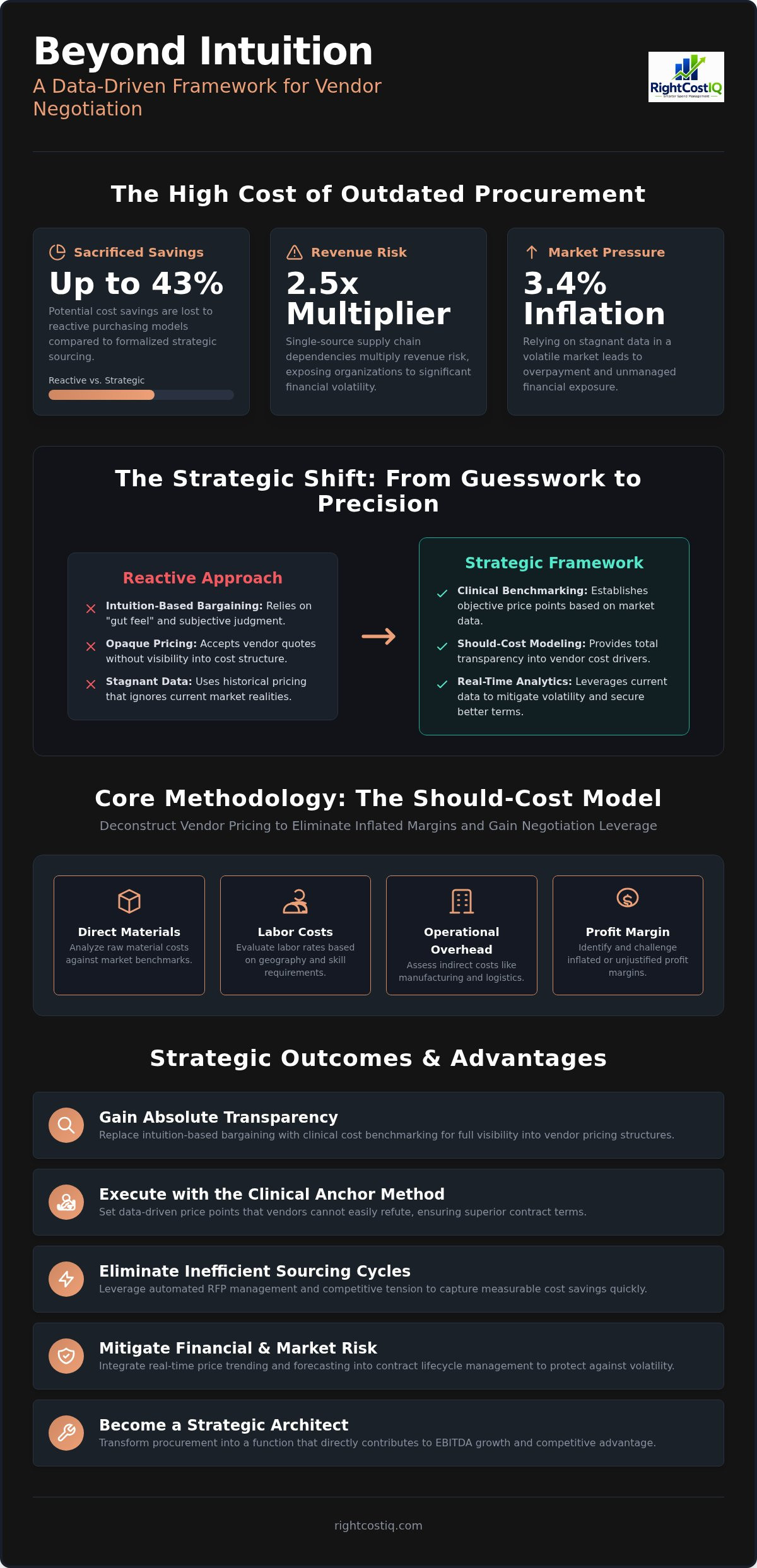
Dependency on reactive purchasing models currently sacrifices up to 43% in potential cost savings compared to formalized strategic sourcing. Procurement leaders frequently encounter the frustration of opaque vendor pricing models and inefficient RFP cycles that force rushed, sub-optimal decisions. Entering a high-stakes meeting without real-time market benchmarking data makes it impossible to challenge a supplier's opening bid with clinical precision. Relying on stagnant data in a 2026 market defined by 3.4% inflation and shifting regulatory standards often results in significant overpayment and unmanaged financial volatility.
This framework provides the technical depth needed to master vendor negotiation strategies through advanced benchmarking, market analytics, and strategic risk management. It moves beyond tactical haggling to execute a data-driven methodology that secures superior contract terms while mitigating price risk. The following analysis examines the integration of should-cost analytics and SOFR-aligned financial benchmarks to establish high-performance vendor compliance standards. This methodical roadmap enables your department to capture measurable savings and protect the organization from the 2.5x revenue risk associated with single-source supply chain dependencies.
Key Takeaways
- Replace intuition-based bargaining with clinical cost benchmarking and should-cost modeling to gain absolute transparency into vendor pricing structures.
- Execute high-impact vendor negotiation strategies using the Clinical Anchor method to set data-driven price points that vendors cannot easily refute.
- Leverage automated RFP management and competitive tension to eliminate inefficient sourcing cycles and capture measurable cost savings.
- Mitigate financial risk from market volatility by integrating real-time price trending and forecasting into your contract lifecycle management.
- Transform procurement into a strategic architecture function by utilizing advanced negotiation assistance and performance tracking ecosystems.
The Strategic Imperative: Beyond Intuition-Based Vendor Negotiation
Intuition is a liability in high-stakes procurement. Many organizations mistakenly treat supplier interactions as social exercises rather than precise financial maneuvers. This reliance on subjective gut feeling leads to significant margin leakage and missed opportunities for enterprise value creation. Clinical execution of vendor negotiation strategies requires a fundamental shift from subjective bargaining to objective, data-driven analysis. Standard win-win models often prioritize relationship preservation over financial performance, failing to address the underlying cost drivers that erode corporate capital. Strategic urgency dictates that every contract must contribute to the bottom line through measurable efficiency gains and operational excellence.
The Erosion of Procurement Margins
Opaque pricing models function as a silent drain on corporate liquidity. Without granular visibility into a vendor's cost structure, procurement teams can't distinguish between legitimate overhead and inflated margins. Strategic sourcing delivers a documented 43% cost reduction compared to reactive purchasing, yet many firms remain trapped in cycles of tactical haggling. Market volatility in 2026, characterized by a 3.4% inflation rate, necessitates a move beyond static pricing. Understanding fundamental Bargaining and negotiation principles remains essential, but these must be applied through a lens of margin expansion and risk mitigation. Tactical haggling focuses on the immediate unit price; strategic optimization addresses the total cost of ownership and long-term contract viability. Dependency on a single-source supply chain multiplies revenue risk by 2.5 times, making diversification a non-negotiable strategic priority.
Shifting to a Data-First Negotiation Culture
Transforming procurement into a growth engine requires a cultural pivot toward advanced vendor negotiation strategies. Reactive negotiation occurs when a contract is nearing expiration and time becomes the vendor's primary source of leverage. Proactive market positioning utilizes market analytics and cost benchmarking to dictate terms well before the RFP cycle begins. This transition requires a clinical framework for vendor evaluation that prioritizes performance metrics and technical compliance over historical tenure. Internal alignment is critical. The procurement department must present data-backed outcomes that resonate with the C-suite. When sourcing teams demonstrate a direct link between technical analysis and EBITDA growth, they move from being a cost center to a strategic architect of the organization's financial future. Establishing this data-first culture ensures that every procurement action is a deliberate step toward operational efficiency and competitive advantage.
Clinical Preparation: Leveraging Cost Benchmarking and Analytics
Preparation is the differentiator between a tactical buyer and a strategic architect. Clinical cost benchmarking serves as the foundation for this transformation, moving procurement away from historical price comparisons toward objective market realities. By dismantling vendor pricing structures, organizations close the information gap that suppliers traditionally exploit. This data-driven approach ensures that vendor negotiation strategies are built on a bedrock of fact-based market intelligence rather than anecdotal evidence or incumbent loyalty. Organizations must treat the pre-negotiation phase as a rigorous analytical exercise designed to eliminate information asymmetry.
The Architecture of a Should-Cost Model
Effective negotiation requires a granular understanding of how a vendor arrives at their final quote. A robust should-cost model deconstructs these quotes into four primary technical components: direct materials, labor costs, operational overhead, and profit margin. Utilizing should-cost analytics allows procurement teams to simulate these variables and identify exactly where a vendor's pricing deviates from market efficiency. Should-cost modeling is the clinical standard for price justification, providing the technical leverage needed to challenge unverified "cost-plus" claims. This transparency forces vendors to justify every cent of their quote against verified benchmarks.
Advanced Category Benchmarking Standards
Category management requires more than just high-level spend analysis; it demands real-time market alignment. Advanced benchmarking involves comparing individual RFP responses against proprietary market price trending data to identify statistical outliers. When a vendor's bid exceeds the 75th percentile of market norms without a corresponding service level increase, it signals a lack of competitiveness. Integrating these advanced negotiation strategies into your sourcing workflow enables a more aggressive pursuit of margin expansion. By automating the identification of pricing anomalies, procurement departments focus their energy on high-impact deals that offer the greatest potential for cost recovery.
Establishing these standards ensures that every RFP cycle is a clinical execution of spend optimization. Organizations that fail to implement these analytics often suffer from "bracket creep," where vendor prices rise incrementally without a logical basis in market fluctuations. To maintain a competitive edge, procurement leaders must adopt a relentless focus on data integrity. You can begin optimizing your sourcing outcomes today by exploring our procurement analytics platform to identify hidden savings in your current categories.
High-Stakes Execution: 7 Advanced Negotiation Strategies for 2026
Execution transforms analytical data into realized EBITDA growth. Clinical execution of vendor negotiation strategies requires a departure from traditional bargaining toward a structured, relentless focus on enterprise value. By setting a "Clinical Anchor"—an opening position derived from should-cost analytics—negotiators dictate the financial parameters of the deal before the vendor can establish an inflated baseline. This method ensures the conversation remains grounded in operational reality rather than supplier-led narratives. It's about moving from a defensive posture to an offensive, data-backed strategy that commands the negotiation table.
Leveraging Competitive Tension
Maintaining leverage requires a controlled, competitive environment. Digital Applied recommends securing 3-5 competing bids for every major procurement category to maximize market pressure. Utilizing automated RFP management creates this structured bidding environment, forcing vendors to compete on merit and efficiency. When dealing with incumbents, transparency is paramount. Require current suppliers to re-justify their pricing structures against current market benchmarks. This aggressive approach prevents "incumbency creep" and ensures that long-term partners remain as lean as new market entrants. A well-executed strategic vendor negotiation framework treats every contract renewal as a fresh opportunity for margin recovery.
Negotiating Beyond the Unit Price
High-performance procurement looks past the immediate price tag to optimize the total contract lifecycle. Negotiators must secure favorable Service Level Agreements (SLAs) that link vendor payments directly to operational performance metrics. Payment flexibility is another critical lever; extending terms can significantly improve corporate cash flow without impacting the unit price. Smaller, fragmented purchases often escape this level of scrutiny, leading to significant leakage. Implementing tail spend management allows organizations to consolidate these disparate spends, creating the volume-based leverage necessary to dictate terms to smaller vendors.
Bundling and Strategic Walking
Consolidating cross-category spend increases your enterprise value to a supplier, providing a powerful lever for volume-based discounts. If a negotiation fails to align with your clinical should-cost model, you must be prepared to walk. Data-backed confidence removes the fear from this decision. When your benchmarks show a vendor is significantly above market norms, exiting the deal is a logical risk mitigation step. This level of strategic walking preserves your department's credibility and ensures that only high-performance vendor negotiation strategies are utilized to populate your supply chain with cost-efficient partners.
Mitigating Volatility: Price Risk Management and Market Trending
Market volatility isn't a temporary hurdle; it's a permanent feature of the 2026 procurement environment. Effective vendor negotiation strategies must integrate price risk management directly into the contract lifecycle to prevent margin erosion. Relying on fixed-price agreements during periods of 3.4% inflation creates significant financial exposure for the enterprise. Strategic architects use market price trending and forecasting to identify potential cost fluctuations before they manifest in a supplier's invoice. This proactive stance allows procurement teams to build index-based pricing models that provide long-term supply chain resilience. Predictive procurement analytics serve as the primary tool for identifying these vulnerabilities before they impact the bottom line.
Forecasting as a Negotiation Lever
Market data provides the clinical evidence needed to justify price caps and collars within a contract. By utilizing predictive procurement analytics, negotiators can secure re-opener clauses that trigger when specific market benchmarks deviate beyond an agreed-upon range. This ensures that the organization isn't trapped in an uncompetitive agreement if market conditions shift favorably. Forecasting models transform procurement from a reactive administrative function into a predictive strategic architecture. These models allow for the simulation of various economic scenarios, providing the technical leverage required to challenge vendor-imposed price hikes with objective data.
Risk-Adjusted Contract Frameworks
Geopolitical shifts and regulatory changes necessitate a more robust approach to supply chain compliance. Contracts must address force majeure with clinical precision, especially in high-risk categories where dependencies are concentrated. Research indicates that dependency on a single source for a critical category multiplies revenue risk by 2.5 times. Mitigating this risk requires the implementation of vendor performance tracking services to monitor operational continuity in real-time. Negotiators should prioritize alternative reference rates like SOFR, following the total cessation of USD LIBOR in late 2024, to ensure financial transparency in complex deals. Predictive analytics enable procurement to anticipate these shifts, allowing for the execution of risk-adjusted frameworks that protect corporate liquidity.
Operationalizing these risk management protocols ensures that your supply chain remains resilient against external shocks. You can begin identifying hidden exposures in your current contract portfolio today. Access our market price forecasting tools to secure your 2026 margins.
Operationalizing Excellence: The RightCostIQ Negotiation Ecosystem
Strategic excellence isn't a static achievement but a continuous operational requirement. Transforming procurement departments into strategic architects requires a departure from fragmented sourcing processes toward a centralized, data-driven ecosystem. RightCostIQ provides the technical infrastructure necessary to integrate benchmarking, RFP management, and risk tracking into a single, high-performance workflow. This alignment ensures that every procurement action is a deliberate execution of enterprise strategy, moving the department from a cost center to a primary driver of financial growth. Precision in execution is what separates market leaders from organizations burdened by inefficient spend.
The Integrated Procurement Infrastructure
Efficiency in 2026 depends on the seamless integration of advanced technology into traditional business functions. Automated platforms significantly streamline the RFP lifecycle, eliminating the manual inefficiencies that frequently lead to rushed, sub-optimal contract terms. Real-time performance tracking ensures that vendor compliance remains a constant operational standard rather than a periodic review. This technical framework bridges the gap between high-level strategy and granular execution, allowing sourcing teams to maintain aggressive leverage throughout the entire sourcing event.
A central pillar of this infrastructure is the Negotiation Coach, which provides real-time deal optimization and clinical guidance. By utilizing this ecosystem, negotiators can refine their vendor negotiation strategies based on live market analytics and proprietary should-cost models. It removes the guesswork from the bargaining table, replacing intuition with actionable data points that force vendor transparency. This level of technical support empowers sourcing professionals to secure terms that were previously inaccessible through traditional negotiation methods.
Achieving Sustainable Financial Growth
The ultimate metric of procurement success is the delivery of measurable, sustainable financial growth. Professional negotiation assistance and precision sourcing provide a quantifiable ROI that procurement leaders must communicate effectively to the C-suite. Reporting on spend under management and realized cost savings validates the strategic importance of the department. Building a resilient supply chain through data-driven sourcing mitigates the 2.5x revenue risk associated with single-source dependencies, ensuring operational continuity in a volatile market.
Implementing these advanced vendor negotiation strategies allows organizations to capture superior contract terms while establishing high-performance compliance standards across the vendor base. This methodical approach to sourcing ensures that cost savings are captured and defended throughout the contract duration. Optimize your procurement outcomes today by deploying the RightCostIQ ecosystem to secure your organization's financial future and establish a new standard for procurement excellence.
Mastering the Clinical Standard of Procurement
Clinical execution of vendor negotiation strategies requires a definitive shift from subjective bargaining to the objective application of market analytics. Organizations must leverage specialized procurement category cost benchmarking to dismantle opaque pricing and secure superior enterprise value across the entire contract lifecycle. Integrating expert RFP management and negotiation assistance with real-time market price trending and forecasting allows procurement leaders to neutralize volatility and establish high-performance compliance standards that endure beyond the initial signing.
Establishing this data-driven framework effectively transforms sourcing from a reactive cost center into a strategic architecture for sustained financial growth. RightCostIQ provides the technical precision needed to forecast cost fluctuations and capture measurable savings in a complex 2026 economic landscape. Request a demo of the RightCostIQ Negotiation Coach to begin your transition toward procurement excellence. You've built the technical framework; now it's time to execute with clinical precision and secure your organization's competitive advantage.
Frequently Asked Questions
What are the most effective vendor negotiation strategies for 2026?
The most effective vendor negotiation strategies for 2026 prioritize clinical spend analysis over traditional bargaining. Negotiators utilize AI-powered should-cost modeling to dismantle supplier pricing structures and establish a data-backed Clinical Anchor. This approach focuses on total cost of ownership and collaborative risk-sharing. By integrating real-time market intelligence, procurement teams move from reactive haggling to proactive strategic execution that secures superior contract terms and long-term financial growth.
How does cost benchmarking improve negotiation outcomes?
Cost benchmarking improves negotiation outcomes by eliminating information asymmetry between the buyer and the vendor. It provides an objective baseline by comparing supplier bids against verified market price trending data. When a quote exceeds the 75th percentile of market norms, benchmarking identifies the deviation for immediate correction. This clinical transparency forces vendors to justify inflated margins and allows procurement to set realistic, data-driven price points that protect corporate margins.
What is the difference between price negotiation and strategic sourcing?
Price negotiation is a tactical event focused solely on reducing the immediate unit cost of a product or service. Strategic sourcing is a holistic framework that addresses the entire value chain to drive enterprise performance. Strategic sourcing can lead to a 43% cost savings compared to reactive purchasing by optimizing vendor performance, payment terms, and supply chain resilience. It transforms procurement from a transactional function into a strategic architecture for financial optimization.
How can I negotiate with a single-source vendor?
Negotiating with a single-source vendor requires a clinical focus on total cost of ownership and performance-linked SLAs. Since competitive tension is absent, leverage must be derived from spend consolidation and long-term partnership value. Negotiators should implement rigorous vendor performance tracking to ensure contract compliance. Because single-source dependencies multiply revenue risk by 2.5 times, these negotiations must also prioritize robust risk mitigation clauses and transparent cost-plus pricing models.
What role does market price trending play in contract renewals?
Market price trending acts as a clinical justification for price caps, collars, and re-opener clauses during contract renewals. In a 2026 market with 3.4% inflation, these trends identify when supplier price hikes exceed macroeconomic realities. By utilizing predictive forecasting, procurement teams can negotiate index-based pricing that adjusts automatically to market shifts. This ensures long-term supply chain resilience and prevents the organization from being locked into uncompetitive rates during favorable market corrections.
How do I use an RFP to gain negotiation leverage?
An RFP generates negotiation leverage by creating a structured, transparent bidding environment that fosters competitive tension. Industry standards recommend securing 3-5 competing bids for every major category to maximize market pressure. Automated RFP management ensures that vendors are evaluated on identical technical criteria, making it impossible for incumbents to rely on historical tenure. This clinical framework forces suppliers to offer their most efficient pricing to remain viable in the selection process.
What are the common mistakes to avoid in vendor contract negotiations?
Common mistakes include relying on intuition-based bargaining and failing to update outdated financial benchmarks. Many negotiators ignore total cost of ownership, focusing exclusively on unit price while sacrificing payment flexibility or service levels. Another critical error is failing to reference SOFR instead of the discontinued LIBOR in new financial contracts. Rushed negotiation cycles often lead to opaque pricing models that result in significant margin leakage over the contract duration.
How can procurement analytics mitigate supply chain risk?
Procurement analytics mitigate supply chain risk by providing real-time visibility into vendor performance and market volatility. Analytics identify dangerous single-source dependencies and simulate the financial impact of geopolitical shifts or regulatory changes. By integrating price risk management into the sourcing workflow, organizations can anticipate cost fluctuations before they manifest. This predictive capability allows strategic architects to build resilient contract frameworks that protect corporate liquidity and ensure operational continuity.


