
A poorly structured RFP timeline is more than a scheduling inconvenience; it's a strategic failure that erodes negotiation leverage and invites budget volatility. While many procurement teams treat scheduling as a secondary administrative task, the clinical execution of a sourcing calendar is the primary driver of contract value. Mastering how to create an RFP timeline that balances aggressive milestones with vendor capacity is essential for any organization looking to transition from reactive purchasing to strategic cost optimization.
You've likely faced the mounting pressure of impatient internal stakeholders or the diminishing quality of bids caused by vendor fatigue. It's a common frustration that leads to rushed decisions and compromised compliance. This guide provides a sophisticated framework to master your procurement scheduling. We'll analyze the specific phases of a high-performance RFP, from initial market intelligence to final contract execution. This approach ensures your team delivers predictable results that align with C-suite expectations while reducing the total time to contract.
Key Takeaways
- Transition from administrative scheduling to clinical execution by distinguishing between standard lead times and strategic evaluation intervals for superior supply chain resilience.
- Discover how to create an RFP timeline that utilizes data-driven cost benchmarking to define precise "should-cost" parameters and inform objective scoring criteria.
- Optimize vendor response windows through solicitation management techniques that balance operational urgency with the depth required for rigorous technical and commercial bids.
- Accelerate contract finalization by structuring focused negotiation sprints that utilize market price trending and analytics as primary leverage points.
- Bridge the gap between procurement operations and executive expectations by delivering a predictable, analytical sequence for RFP execution that minimizes financial risk.
Defining the RFP Timeline: A Framework for Clinical Execution
A strategic RFP timeline is the blueprint for supply chain resilience. It isn't merely a series of deadlines; it's a calibrated sequence that determines your organization's ability to extract value from the market. Understanding how to create an RFP timeline requires a shift from administrative box-ticking to a focus on clinical execution. When scheduling is treated as an afterthought, procurement becomes a bottleneck that delays critical operations and erodes negotiation leverage. A well-constructed Request for Proposal (RFP) process ensures that every stakeholder is aligned with the financial objectives of the project.
Administrative lead times often disguise the actual work of strategic evaluation. While a team might allocate two weeks for vendor response, the real value lies in the strategic evaluation intervals where data is analyzed and compared against internal benchmarks. Clinical precision in these windows prevents the "rush to contract" that frequently plagues enterprise sourcing. The economic impact of timeline slippage is severe. Every week a contract remains unfinalized is a week of lost savings, increased price risk, and potential budget volatility that affects the bottom line.
The Anatomy of a High-Performance RFP Schedule
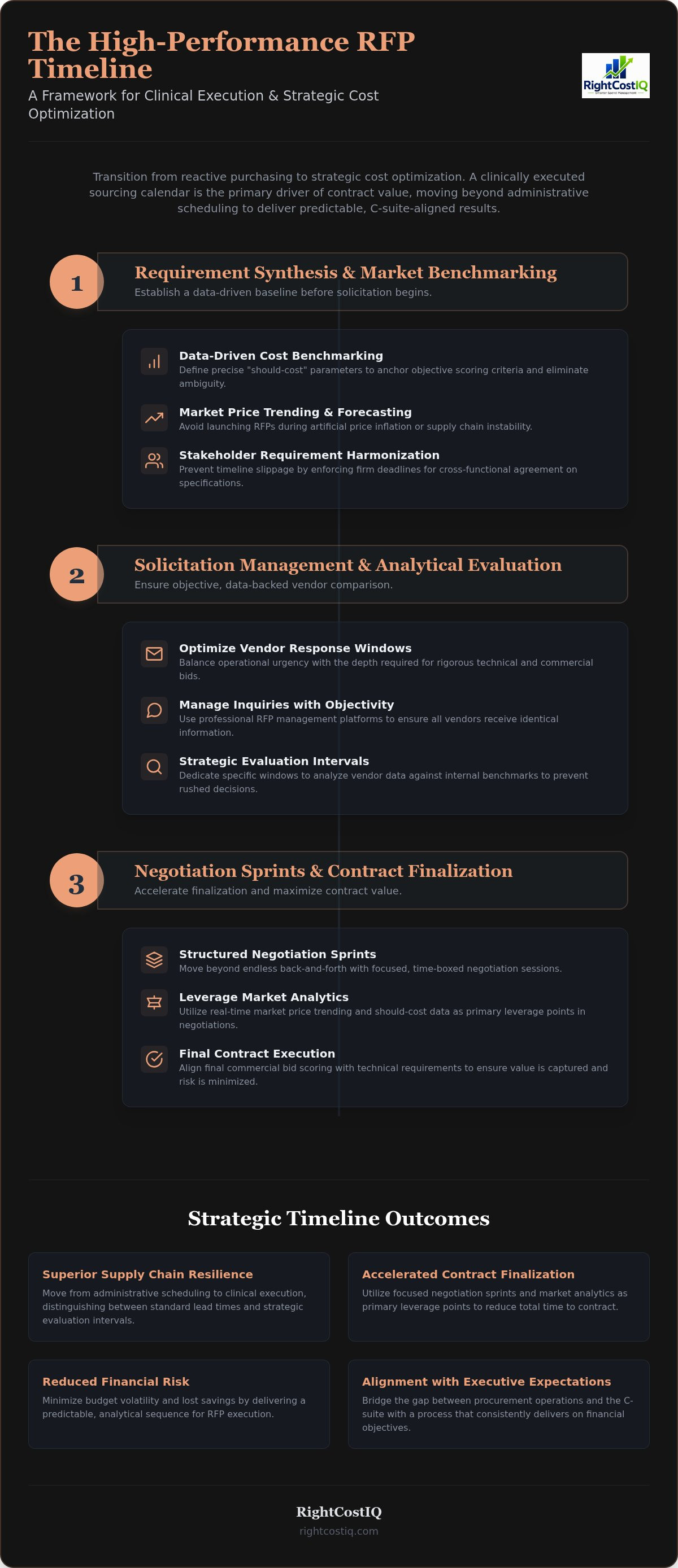
A high-velocity schedule is divided into three distinct, non-negotiable phases. Phase I focuses on pre-solicitation and requirement synthesis. This is where procurement aligns with internal stakeholders to define technical specifications. Phase II involves active solicitation and vendor engagement. During this window, the solicitation is issued, and vendor inquiries are managed with strict objectivity through professional RFP management platforms. Finally, Phase III covers evaluation, negotiation, and contract finalization. This phase requires the most analytical rigor to ensure the commercial bid scoring aligns with the technical requirements.
Variables Influencing Procurement Velocity
Velocity isn't uniform across all categories. Commodity sourcing often moves faster due to standardized specifications; conversely, specialized professional services require longer evaluation cycles to assess qualitative nuances. Stakeholder alignment is another critical variable. Without cross-functional agreement on requirements, the timeline will inevitably stall. Market volatility also plays a role. Effective price risk management dictates that certain RFPs must be launched during specific market windows to maximize savings. Mastering how to create an RFP timeline involves accounting for these variables before the first document is ever sent to a vendor.
Phase I: Requirement Synthesis and Market Benchmarking
Phase I represents the strategic bedrock of any high-performance sourcing event. Understanding how to create an RFP timeline requires moving beyond simple list-making to establish a data-driven baseline through rigorous procurement category cost benchmarking. This process identifies precise "should-cost" parameters that serve as the anchor for all subsequent RFP scoring criteria. By dedicating a specific window to market price trending and forecasting, organizations avoid launching RFPs during periods of artificial price inflation or supply chain instability. The development of a technical descriptor framework is equally critical. This framework ensures every vendor responds to the same granular specifications, facilitating a clinical comparison that eliminates the need for manual bid normalization later in the cycle.
Benchmarking as a Timeline Accelerator
Strategic analytics serve as the ultimate timeline accelerator by removing ambiguity before the solicitation begins. When you integrate real-time market intelligence into your initial requirement documents, you drastically reduce the volume of vendor inquiries and the need for multiple clarification rounds. This front-loaded analytical rigor ensures the solicitation is technically robust and commercially viable from the moment of issuance. Cost benchmarking is the prerequisite for RFP precision and acts as the primary catalyst for procurement velocity. This clinical approach allows teams to bypass the traditional discovery phase during the active bid window, moving directly into high-stakes evaluation.
Stakeholder Requirement Harmonization
Internal misalignment is the most frequent cause of timeline slippage. To maintain momentum, procurement must enforce a firm deadline for internal requirement sign-off, effectively locking the scope before the RFP launch. Avoiding the scope creep trap is essential; any mid-cycle changes to the technical descriptors will result in vendor fatigue and inaccurate bid scoring. Utilizing Advanced RFP management strategies allows for the synthesis of cross-functional requirements into a single, immutable source of truth. This discipline ensures the project remains focused on the core financial objectives and operational requirements defined at the outset. Defining how to create an RFP timeline that sticks requires this level of cross-functional commitment before the first vendor is notified.
Before finalizing your solicitation documents, it's prudent to conduct a procurement category analysis to ensure your cost baselines are aligned with current market volatility.
Phase II: Solicitation Management and Analytical Evaluation
The solicitation phase is where strategic planning meets market reality. Once the "should-cost" baseline is established, procurement architects must execute a solicitation window that balances operational urgency with the need for high-quality vendor responses. Determining how to create an RFP timeline for this stage requires a clinical approach to time allocation. A response window that is too brief results in boilerplate submissions and overlooked requirements; one that is too long invites vendor fatigue and stalls momentum. Managing the Q&A interval is a critical sub-process; questions should be consolidated and answered in scheduled batches to prevent constant timeline extensions that signal a lack of internal preparation.
Filtering participants is equally vital. Utilizing data from a Procurement and Vendor Performance Tracking Service allows teams to evaluate incumbents against historic performance metrics before the scoring even begins. This ensures that only vendors with a proven track record of compliance and delivery progress to the final evaluation. By integrating these performance benchmarks early, the evaluation team can focus their analytical energy on new market entrants and disruptive solutions rather than re-evaluating known entities.
Optimizing the Vendor Response Window
Response intervals must be tailored to category complexity. Simple commodity RFPs typically require a 15 to 20-day window, while complex professional services or engineered components often necessitate 30 to 45 days. The solicitation sequence should always begin with a mandatory NDA execution phase. This acts as a gatekeeper, ensuring that sensitive technical descriptors are only shared with committed participants. Implementing automated tracking for bid submission compliance further streamlines the process. It allows procurement to monitor vendor progress in real-time and issue automated reminders, ensuring that the primary timeline remains intact without manual intervention.
Data-Driven Evaluation Frameworks
Evaluation scoring must be a clinical, two-stage process. Technical bids are scored first to ensure functional compliance, followed by a separate commercial evaluation. This separation prevents "price bias" from clouding the assessment of a vendor's technical capability. To ensure maximum objectivity, sophisticated teams utilize blinded scoring protocols where evaluators review technical responses without knowing the vendor's identity. This framework translates qualitative claims into quantitative performance metrics, allowing for a direct comparison of value. A rigorous financial risk assessment must also be conducted during this window to identify vendors with potential budget volatility or supply chain instability. Mastering how to create an RFP timeline involves protecting these evaluation windows from executive pressure, ensuring the final selection is based on data rather than administrative convenience.
Phase III: Negotiation Sprints and Contract Finalization
The final phase of the procurement cycle is where theoretical savings are converted into contractual reality. Negotiation isn't a courtesy or a casual discussion; it's a high-stakes financial event that requires a structured, clinical approach. Mastering how to create an RFP timeline involves allocating specific windows for negotiation sprints that maintain procurement momentum. By structuring these as time-bound events, you prevent the final selection window from expanding into a period of administrative stagnation that erodes the value captured during the bid process. Every day a contract remains unsigned is a day of missed cost-optimization opportunities.
Leveraging benchmarking data gathered in Phase I is your primary negotiation lever. When a vendor's commercial bid deviates from the established "should-cost" parameters, procurement has the data-driven authority to demand alignment. This clinical finalization ensures that the contract terms mirror the bid promises exactly, preventing "value leakage" that often occurs when technical specifications are diluted during the legal review. The transition from RFP management to vendor performance tracking begins here, as the final bid metrics become the baseline for future compliance audits.
The Strategic Negotiation Interval
A high-velocity timeline must include dedicated intervals for Best and Final Offer (BAFO) rounds. Rather than open-ended discussions, structure these as 3-to-5-day negotiation sprints focused on specific commercial or technical gaps. Utilizing Professional negotiation assistance for high-value contracts can significantly shorten this window by providing real-time market intelligence that resolves stalemates quickly. These services ensure that your team remains the strategic architect of the deal, keeping the vendor focused on meeting the pre-defined financial growth metrics.
Contract Execution and Onboarding Lead Times
Contract execution is the most common point of timeline failure. You must factor in realistic lead times for legal review and C-suite approval cycles, which typically require 10 to 15 business days depending on organization size. This "Post-Award" transition is critical for setting the baseline for performance tracking. It's the moment where procurement handshakes with operations to ensure the vendor is onboarded without disrupting service. Mitigating price risk during the contract lifecycle requires that these final documents include clear clauses for market-indexed adjustments, ensuring long-term budget stability. When you understand how to create an RFP timeline that accounts for these final hurdles, you deliver a predictable, clinical sequence that satisfies both the bottom line and executive expectations.
Ready to eliminate negotiation guesswork and secure superior contract terms? Access the RightCostIQ negotiation framework today.
Accelerating the RFP Cycle with RightCostIQ Frameworks
Generic procurement automation often fails because it accelerates flawed processes without addressing data integrity. RightCostIQ frameworks redefine how to create an RFP timeline by prioritizing clinical precision over simple administrative speed. By integrating Procurement Category Cost benchmarking and Analytics into the pre-solicitation phase, organizations eliminate the guesswork that typically leads to mid-cycle delays. This data-driven foundation ensures that your "should-cost" parameters are established before the first vendor is engaged, preventing the need for reactive adjustments that stall momentum.
Strategic timing is the second pillar of an optimized cycle. Our Market Price Trending and Forecasting Service allows decision-makers to identify the ideal window for RFP launch, ensuring you aren't issuing solicitations during periods of artificial market volatility. This foresight doesn't just save money; it streamlines the evaluation phase by aligning vendor bids with realistic market expectations. When you use how to create an RFP timeline as a strategic tool rather than a static calendar, you transform procurement into a primary driver of enterprise financial growth.
Closing the deal requires more than just a selection; it requires a clinical conclusion. Our specialized negotiation assistance helps teams target a 30% reduction in final closure windows by providing real-time leverage points based on proprietary benchmarking data. Once the contract is finalized, the RightCostIQ framework facilitates a seamless transition to our Procurement and Vendor Performance Tracking Service. This ensures that the technical and commercial promises made during the RFP are maintained throughout the entire contract lifecycle, securing long-term compliance and value retention.
The ROI of Clinical RFP Management
Quantifying the impact of professional sourcing execution reveals significant time savings and increased C-suite confidence. A structured timeline reduces the administrative burden on internal stakeholders and eliminates the vendor fatigue that compromises bid quality. For a deeper analysis of how technology integrates with these processes, review our guide on RFP Management: Strategic Frameworks for AI-Led Procurement Optimization. This clinical approach ensures that procurement departments function as high-level consultants rather than back-office support.
Next Steps: Diagnostic and Implementation
The first step toward optimization is assessing your current procurement velocity. Every category has unique requirements, and a one-size-fits-all schedule is rarely effective. By customizing the RightCostIQ framework for your specific category needs, you can identify bottlenecks and implement the analytical levers required for rapid execution. Don't let administrative friction dictate your financial outcomes. Get your free procurement diagnostic to optimize your RFP timeline and begin your transition to a data-led sourcing strategy.
Optimizing Your Sourcing Velocity for Financial Growth
Mastering how to create an RFP timeline is the cornerstone of modern procurement strategy. This framework transforms sourcing from a reactive administrative task into a proactive driver of financial growth. By integrating cost benchmarking analytics and clinical RFP execution frameworks, organizations eliminate budget volatility and drastically reduce time-to-contract. These strategic pillars ensure that every evaluation and negotiation phase is rooted in objective market data rather than subjective guesswork. Maintaining momentum through structured negotiation sprints prevents value leakage and secures superior commercial terms that align with C-suite expectations.
A high-performance sourcing calendar is not a suggestion; it's a requirement for supply chain resilience. Transitioning to an analytical model allows your team to focus on high-impact decision-making rather than administrative firefighting. Take the first step toward clinical procurement optimization and operational excellence. Analyze your procurement efficiency with a Free Diagnostic and leverage our strategic negotiation assistance to finalize your next high-value contract with precision. Your transition to a high-velocity, data-led sourcing model starts today.
Frequently Asked Questions
How long does the average RFP process take from start to finish?
Standard enterprise RFP cycles typically span six to ten weeks. This duration accounts for the three primary phases: requirement synthesis, solicitation, and final negotiation. While commodity sourcing may conclude in as little as 4 weeks, complex professional services often require the full 10-week window. This ensures technical compliance and commercial alignment without compromising the organization's long-term financial objectives or operational stability.
What is the most time-consuming phase of an RFP timeline?
Evaluation and negotiation represent the most labor-intensive segments of the sourcing cycle. While solicitation is largely passive, the clinical scoring of technical and commercial bids requires deep analytical focus. This phase often consumes 40% of the total schedule. It involves multi-stage scoring protocols and Best and Final Offer (BAFO) rounds designed to secure maximum financial leverage and minimize potential contract risk.
Can I shorten an RFP timeline without sacrificing vendor quality?
Yes, by front-loading the process with rigorous pre-solicitation analytics and cost benchmarking. Establishing clear "should-cost" parameters before issuance eliminates the need for multiple clarification rounds later in the cycle. This clinical approach allows for a more aggressive solicitation window while maintaining the technical integrity of vendor responses. It ensures that speed does not lead to "garbage in, garbage out" scenarios.
How much time should I allow for vendor questions and clarifications?
Allocate a dedicated 3-to-5-day window for Q&A consolidation immediately following the RFP launch. This structured interval prevents constant administrative interruptions and ensures all participants receive synchronized information. Managing these inquiries in scheduled batches preserves the primary timeline and demonstrates professional authority to the vendor pool. It also forces vendors to conduct a thorough initial review of the technical descriptors before submitting queries.
What happens if we miss a deadline in the RFP schedule?
Timeline slippage erodes negotiation leverage and invites significant budget volatility. Missing a key milestone signals a lack of internal alignment, which vendors may exploit during commercial discussions. To mitigate this risk, procurement architects must utilize automated tracking to monitor progress and enforce strict adherence to the pre-defined clinical sequence. Reliable execution is essential for maintaining stakeholder confidence and achieving the projected financial growth metrics.
How does cost benchmarking impact the length of an RFP?
Benchmarking acts as a primary timeline accelerator by providing a data-driven baseline for bid evaluation. When you understand how to create an RFP timeline rooted in market intelligence, you bypass the discovery phase during active solicitation. This precision allows for faster bid normalization and more efficient negotiation sprints. It removes the administrative guesswork that frequently causes delays during the final vendor selection phase.
Is a 4-week RFP timeline realistic for complex services?
A 4-week window is generally insufficient for specialized professional services or engineered components. These categories require extended evaluation intervals to assess qualitative nuances and conduct rigorous financial risk assessments. Attempting to compress this process often results in vendor fatigue and low-quality submissions. These failures compromise the organization's technical requirements and often lead to costly contract amendments later in the vendor lifecycle.
How do I align internal stakeholders with the RFP schedule?
Enforce a firm deadline for internal requirement sign-off before the solicitation begins. Effective stakeholder alignment requires a clinical focus on the financial growth metrics and operational outcomes defined by the C-suite. Clear communication regarding how to create an RFP timeline that adheres to strategic goals ensures cross-functional commitment. This discipline prevents scope creep and protects the integrity of the procurement sequence from start to finish.


