

In the 2026 trade environment, traditional logistics management is no longer the primary differentiator for market leaders; it's a baseline requirement. The real battleground for the modern enterprise is financial data integrity. You've likely seen how unpredictable price volatility in foreign markets and cross-border regulatory bottlenecks can erode even the most robust margins. Managing the challenges in global sourcing and procurement has shifted from a physical coordination task to a high-stakes financial data exercise where transparency isn't just a goal, it's a survival mechanism.
We understand that a lack of transparency in vendor performance often leads to missed opportunities and inflated overhead. This article promises to help you master these international complexities with clinical precision and data-driven procurement strategies. You'll learn how to transform vendor compliance into an automated asset and use category cost benchmarking to gain an upper hand in negotiations. We'll preview a strategic framework for 2026 that replaces reactive firefighting with predictable cost structures and market price forecasting. By the end of this analysis, you'll have the technical levers needed to optimize your global footprint with absolute financial confidence.
Key Takeaways
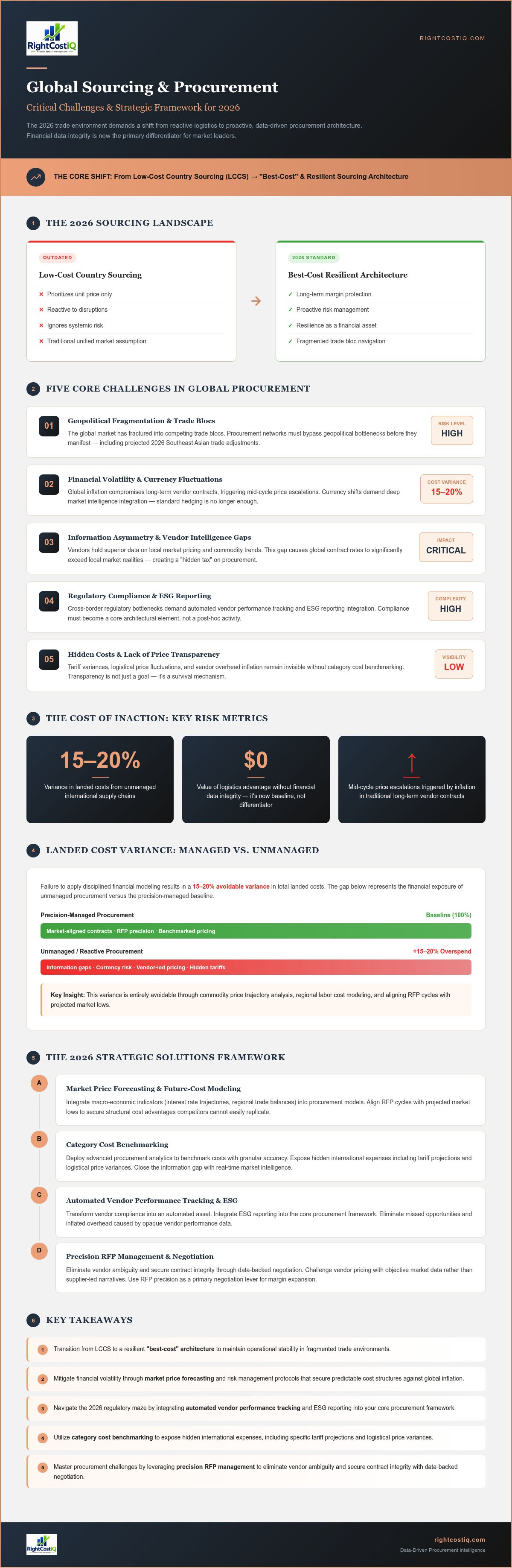
- Transition from low-cost country sourcing to a resilient "best-cost" architecture to maintain operational stability in fragmented trade environments.
- Mitigate financial volatility through market price forecasting and risk management protocols that secure predictable cost structures against global inflation.
- Navigate the 2026 regulatory maze by integrating automated vendor performance tracking and ESG reporting into your core procurement framework.
- Utilize category cost benchmarking to expose hidden international expenses, including specific tariff projections and logistical price variances.
- Master the strategic challenges in global sourcing and procurement by leveraging precision RFP management to eliminate vendor ambiguity and secure contract integrity.
The Architecture of Global Sourcing Challenges in 2026
The 2026 trade environment operates as a series of fragmented trade blocs rather than a unified global market. This shift forces a total re-evaluation of how enterprises approach the challenges in global sourcing and procurement. The previous reliance on Low-Cost Country Sourcing (LCCS) has proven insufficient; it prioritized unit price over systemic risk. Modern procurement requires a transition to "best-cost" and "resilient" sourcing architectures. These models prioritize long-term margin protection over short-term savings. Traditional procurement models fail in high-volatility markets because they lack the agility to react to rapid tariff shifts, such as the projected 2026 Southeast Asian trade adjustments, or currency collapses. Clinical precision in identifying supply chain weaknesses is now the only way to maintain a competitive advantage.
De-risking the Global Supply Chain
Strategic sourcing must move from reactive logistics to proactive risk management. The emergence of competing trade blocs necessitates a localized yet globally integrated procurement strategy. Procurement teams can't just react to shipping delays; they must architect networks that bypass geopolitical bottlenecks before they manifest. Resilient Sourcing is a business function where data transparency dictates every supplier selection and contract term to guarantee operational continuity. This approach treats supply chain resilience as a financial asset rather than a logistical cost, ensuring that disruptions don't compromise the bottom line.
The Cost of Information Asymmetry
Information asymmetry remains a primary driver of over-procurement costs. Vendors often hold superior data regarding local market pricing and commodity trends, creating a gap that buyers struggle to bridge. This intelligence gap leads to global contract rates that significantly exceed local market realities. Closing this gap requires the deployment of advanced procurement analytics to benchmark costs with granular accuracy. By aligning global contracts with real-time market intelligence, organizations eliminate the "hidden tax" of information gaps. This data-driven approach ensures that negotiation levers are backed by clinical evidence rather than vendor-supplied narratives, allowing for precise margin expansion even in volatile conditions.
Financial Volatility and Advanced Price Risk Management
Financial volatility represents a systemic threat to corporate margin integrity. Managing currency fluctuations in 2026 requires more than standard financial hedging; it demands a deep integration of market intelligence into the procurement lifecycle. Global inflation directly compromises long-term vendor contracts, often leading to mid-cycle price escalations that traditional agreements fail to prevent. Organizations must deploy clinical price risk management frameworks to insulate their cost structures from these shocks. Addressing the challenges in global sourcing and procurement in 2026 necessitates a shift from reactive accounting to predictive financial architecture. It's no longer enough to track what was paid; the focus must be on what will be paid.
Strategic procurement departments use market price trending to predict and mitigate financial shocks before they manifest in the ledger. By analyzing commodity price trajectories and regional labor cost shifts, firms can adjust their sourcing volumes ahead of market peaks. This proactive stance protects the bottom line from the erosion typical of unmanaged international supply chains. Failure to account for these variables often results in a 15% to 20% variance in landed costs, which can be avoided through disciplined financial modeling.
Forecasting Market Price Trends
Effective forecasting integrates macro-economic indicators, such as interest rate trajectories and regional trade balances, into procurement models. Relying on historical price data is a strategic failure in volatile markets. Future-cost modeling provides the necessary visibility to anticipate price shifts before they impact the supply chain. This intelligence serves as a primary negotiation lever, allowing procurement teams to challenge vendor pricing based on objective market data rather than supplier-led narratives. When you align your RFP cycles with projected market lows, you secure a structural cost advantage that competitors can't easily replicate.
Clinical Execution of Price Risk Management
Precision execution involves developing trigger-based procurement strategies for high-volatility categories. These strategies automate buying decisions based on specific market price thresholds, effectively mitigating the bullwhip effect in global sourcing cycles. During market downturns, these frameworks identify opportunities for margin expansion by locking in favorable rates before a rebound occurs. This methodical approach transforms price risk from a liability into a strategic advantage. It's about moving with the market, not against it. To optimize your current cost structures, you might consider reviewing our market price trending services to establish a data-backed baseline for your next negotiation cycle.
Regulatory Compliance and Vendor Performance Architectures
Modern supply chains face a regulatory environment that has surpassed the capacity of manual oversight. Navigating the multifaceted challenges in global sourcing and procurement requires a shift from periodic audits to continuous, automated compliance architectures. Trade laws in 2026 demand granular transparency into every tier of the supply chain. Environmental, Social, and Governance (ESG) mandates are now enforceable legal requirements that can result in significant financial penalties if ignored. Bridging the gap between contract signing and operational compliance is the only way to protect the enterprise from systemic risk.
Manual tracking is no longer a viable strategy for high-level decision-makers. The complexity of cross-border trade necessitates a system that identifies compliance bottlenecks before they disrupt the flow of goods. By the time a regulatory breach is discovered through traditional methods, the damage to the brand and the balance sheet is often irreversible. Proactive compliance is a financial necessity, not a bureaucratic hurdle.
Automated Compliance and Risk Mitigation
Establishing a clinical vendor audit framework is the first step in de-risking international operations. This involves real-time tracking of supplier adherence to international standards, which eliminates the latency inherent in traditional reporting. High-performance teams reduce legal liability by integrating compliance benchmarks directly into their RFP management processes. This ensures that only pre-verified vendors enter the negotiation phase, effectively neutralizing risk at the point of entry. Automated verification acts as a persistent shield against regulatory volatility.
Vendor Performance as a Strategic Asset
Moving beyond basic KPIs to clinical performance analytics allows procurement leaders to quantify the total financial impact of vendor non-compliance. Every quality variance or shipment delay has a measurable effect on the bottom line that must be accounted for in future negotiations. Creating a closed-loop system for vendor accountability ensures that performance data directly informs the next sourcing cycle. This transformation turns vendor management into a strategic asset that consistently drives operational efficiency and margin expansion. When performance data is used as a clinical tool, it becomes the ultimate lever for securing superior contract outcomes.
Mitigating Hidden Costs through Data-Driven Benchmarking
Invisible costs often destroy the ROI of international sourcing initiatives. While unit prices look attractive on a spreadsheet, the accumulation of tariffs, duties, and complex logistics fees creates a significant financial burden. Many organizations lack the data infrastructure to see these "invisible" costs until they hit the quarterly results. Addressing the challenges in global sourcing and procurement requires a shift toward granular cost transparency. Data dictates the winner. Without clinical benchmarking, you're essentially guessing your actual landed cost.
In the 2026 trade environment, specific tariff projections for Southeast Asian markets suggest a measurable increase in landed costs for electronics and textile categories. Data-driven benchmarking identifies these shifts early, allowing procurement architects to re-route sourcing before margins disappear. Organizations that treat these hidden variables as manageable data points rather than unavoidable costs of doing business maintain a structural advantage over their less-informed competitors.
Clinical Category Cost Benchmarking
Standardizing procurement requires comparing vendor pricing across disparate regions with absolute accuracy. You can't compare a supplier in Vietnam to one in Mexico without a standardized "should-cost" model that accounts for regional labor, energy, and raw material variances. These should-cost analysis tools provide the technical baseline for precision benchmarking. This data-driven approach removes emotional variables from the negotiation process. It allows for objective margin expansion in even the most mature categories by exposing vendor price variances that are otherwise hidden by regional market noise.
Eliminating Global Tail Spend Inefficiency
The 80/20 rule dictates that the bottom 20% of your spend often generates 80% of your operational friction. Unmanaged "Tail Spend" in global operations acts as a persistent drag on efficiency. This category is typically characterized by high-volume, low-value transactions with unvetted vendors that bypass standard procurement controls. Consolidating this fragmented spend is a primary driver for solving the challenges in global sourcing and procurement related to overhead. By implementing tail spend management solutions, enterprises regain control over rogue spending and eliminate the hidden costs of vendor proliferation. Precision analytics reveal exactly where these leaks occur, turning a chaotic expense category into a source of untapped value.
If you're ready to identify where your international margins are leaking, start with our procurement cost diagnostic to baseline your current performance against 2026 market projections.
Precision RFP Management and Negotiation as the Solution
Professional RFP management serves as the definitive antidote to the inherent volatility of international supply chains. Solving the systemic challenges in global sourcing and procurement requires a departure from subjective vendor relationships. High-level decision-makers must instead adopt objective, data-backed selection processes that force transparency from the outset. A clinical RFP doesn't just ask for a price; it dissects the vendor cost structure and operational resilience to ensure the procurement department functions as a strategic architect rather than a transactional buyer. This methodology secures the enterprise against the margin erosion common in unmanaged sourcing cycles.
Contract outcomes are directly proportional to the quality of market intelligence integrated into the negotiation phase. When you enter a negotiation armed with real-time category benchmarking and price forecasting, the power dynamic shifts. You aren't just requesting a discount; you're demanding market-aligned pricing based on verifiable data. This transformation from reactive purchasing to strategic partner architecture is what separates market leaders from those struggling with unpredictable overhead. It's about securing long-term financial growth through relentless operational precision and technical leverage.
The Clinical RFP Framework
A structured global RFP must be designed to eliminate vendor ambiguity across multiple jurisdictions. Ambiguous terms are the primary drivers of mid-cycle price escalations and service failures. To secure superior contract terms, a clinical RFP must dissect several critical variables:
- Unit cost breakdowns to expose regional price variances.
- Regulatory compliance and ESG adherence levels to mitigate legal risk.
- Logistics transparency and landed cost projections to prevent hidden fees.
By utilizing specialized negotiation coaching, procurement teams can secure terms that protect the organization from unforeseen market shifts. The ROI of a professionally managed sourcing cycle is realized in the total elimination of hidden operational risks. Precision in the RFP stage dictates the success of the entire procurement lifecycle.
Execution: From Strategy to Diagnostic
The path to global sourcing excellence begins with a transition from identifying obstacles to executing technical solutions. We've analyzed the architecture of 2026 trade, the necessity of price risk management, and the role of automated compliance. The transition from identifying challenges in global sourcing and procurement to executing data-driven solutions marks the final phase of strategic optimization. Excellence isn't an accident; it's a result of clinical execution and data-driven strategy. Secure your competitive advantage by initiating a Free Procurement Diagnostic to identify immediate opportunities for margin expansion and risk mitigation.
Architecting Procurement Resilience for 2026
Mastering the challenges in global sourcing and procurement requires a shift from reactive logistics to a proactive financial architecture. Success in the 2026 trade environment depends on your ability to integrate market intelligence directly into your operational DNA. You've seen how precision cost benchmarking analytics and automated compliance tracking act as essential shields against margin erosion. By deploying professional RFP management frameworks, you eliminate vendor ambiguity and secure a structural advantage that competitors can't replicate. Clinical negotiation assistance ensures that every contract aligns with real-time market data rather than supplier-led narratives.
The transition from identifying risks to executing technical solutions is the hallmark of a mature procurement department. You now have the strategic blueprint to transform volatility into a driver for financial growth. It's time to move beyond transactional buying and establish a sophisticated partner architecture that delivers predictable results. Optimize your procurement outcomes with a Free Diagnostic and begin your journey toward operational excellence. Your path to a resilient, data-driven supply chain starts today.
Frequently Asked Questions
What are the most common challenges in global sourcing and procurement for 2026?
The primary challenges in global sourcing and procurement for 2026 center on trade fragmentation and financial data failures. Organizations must manage systemic price volatility and cross-border regulatory bottlenecks that erode margins. Reactive logistics aren't enough; success requires a data-driven framework that anticipates geopolitical shifts and protects the bottom line through clinical precision and technical oversight.
How can businesses mitigate currency risk in international procurement?
Mitigating currency risk requires integrating market price trending into your procurement lifecycle rather than relying solely on financial hedging. Predictive modeling allows firms to adjust sourcing volumes ahead of regional currency collapses. This forward-looking approach secures predictable cost structures against the instability of foreign markets, ensuring that margin erosion doesn't compromise your financial growth metrics.
Is global sourcing still viable given the current geopolitical instability?
Global sourcing remains viable if enterprises shift from low-cost country sourcing to a resilient "best-cost" architecture. Geopolitical instability makes geographic diversification a requirement for operational continuity. The focus has moved from finding the cheapest supplier to architecting a supply chain that survives fragmented trade environments, ensuring that your organization maintains a competitive advantage despite regional shifts.
What is the difference between sourcing and procurement in a global context?
Sourcing is the strategic architecting of supplier networks, while procurement is the clinical execution of those contracts. In a global context, sourcing involves identifying resilient partners through market intelligence and category benchmarking. Procurement focuses on the methodical management of transactions, vendor performance, and regulatory compliance to protect the margin integrity established during the sourcing phase.
How does professional RFP management improve global sourcing outcomes?
Professional RFP management acts as the antidote to sourcing chaos by eliminating vendor ambiguity during the selection phase. It integrates clinical negotiation assistance and market forecasting into the contract cycle. This ensures that every agreement is backed by data-driven levers rather than subjective supplier narratives, allowing you to master the challenges in global sourcing and procurement.
What role does procurement analytics play in managing vendor risk?
Analytics transform vendor risk from a subjective concern into a quantifiable financial metric. By tracking performance data in real-time, procurement leaders can measure the exact cost of quality variances or shipment delays. This data-driven oversight allows for a closed-loop system of accountability that consistently drives operational efficiency and eliminates the hidden costs of vendor non-compliance.
How can I identify hidden costs in my international supply chain?
Identifying hidden costs requires category cost benchmarking and standardized "should-cost" models. These tools expose the invisible expenses of tariffs, duties, and regional logistics variances that unit prices often hide. Without this technical baseline, enterprises often face a 20% variance in landed costs that manual accounting fails to capture during the initial sourcing cycle.
What is the best way to track vendor performance across borders?
The most effective way to track vendor performance across borders is through automated tracking architectures that provide real-time adherence data. These systems remove the latency of manual audits and ensure compliance with international trade laws. Digital integration bridges the gap between contract signing and operational reality, providing a clinical framework for maintaining high vendor standards globally.


