
The 2026 procurement environment demands a shift from reactive sourcing to clinical financial optimization. With the U.S. Prime Interest Rate holding at 6.75% and a recent Executive Order mandating fixed-price contracts as the default for federal agencies, the margin for error in budget projections has vanished. You likely recognize that financial volatility and a lack of transparency in supplier pricing structures are currently impacting your bottom-line margins. Relying on historical data alone leads to operational friction and leaves your enterprise exposed to unpredictable market price spikes.
Effective forecasting future procurement costs requires more than a simple trendline; it necessitates sophisticated market intelligence and data-driven benchmarking. This article provides the analytical frameworks and market trending models required to stabilize enterprise margins and command a superior negotiation position. You'll gain insight into technical price risk management strategies and modern cost analysis tools that turn market volatility into a strategic lever. We examine how to integrate these predictive models into your existing workflows to ensure predictable spend and long-term fiscal resilience.
Key Takeaways
- Transition from reactive spend analysis to a proactive intelligence model to secure bottom-line margins against market volatility.
- Integrate quantitative time-series data with qualitative expert insights to build a comprehensive analytical framework for cost prediction.
- Implement deconstructed should-cost modeling and market price trending to maintain absolute transparency when forecasting future procurement costs.
- Operationalize market intelligence by establishing data-driven baselines that inform high-stakes contract negotiations and vendor performance tracking.
- Execute precision-led price risk management through clinical analytics and specialized RFP management to neutralize the impact of sudden inflationary spikes.
The Strategic Imperative of Forecasting Future Procurement Costs
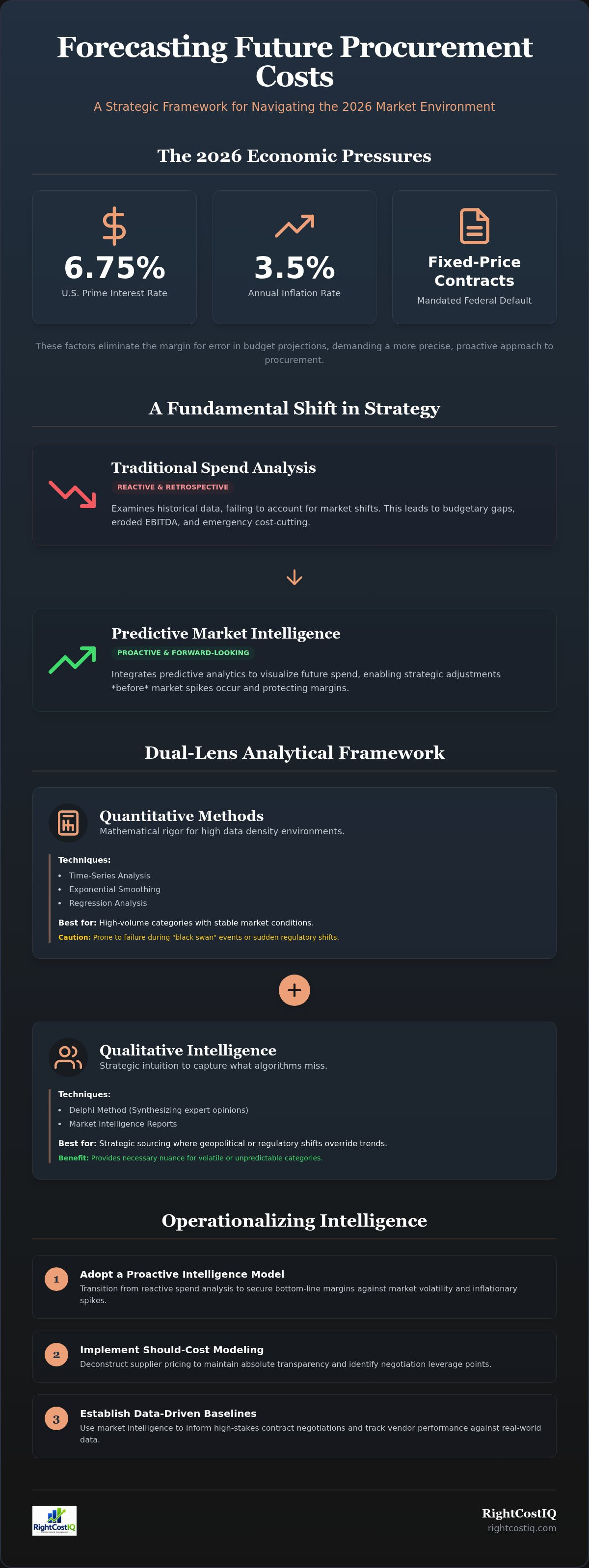
Strategic procurement has evolved beyond simple transactional management. It now functions as a proactive financial safeguard designed to protect corporate margins from external shocks. Effective forecasting future procurement costs isn't an optional exercise for the finance department; it's a clinical necessity for enterprise survival. As of August 2026, the U.S. Prime Interest Rate remains at 6.75%, and annual inflation sits at 3.5%. These metrics create a high-pressure environment where even minor budget inaccuracies lead to significant operational friction. When procurement teams fail to predict price movements, the resulting budgetary gaps directly erode EBITDA, often forcing emergency cost-cutting measures that compromise long-term growth.
Forecasting vs. Traditional Spend Analysis
Traditional spend analysis is inherently retrospective. It examines historical data to identify patterns, yet it fails to account for the rapid shifts in the 2026 global marketplace. Modern supply chain resilience requires a transition to predictive market intelligence. This shift involves moving from rear-view reporting to forward-looking cost modeling. Accurate Cost Estimation provides the technical foundation for these projections, allowing procurement leaders to bridge the gap between raw data and C-suite financial reporting. By integrating predictive analytics into the procurement infrastructure, decision-makers can visualize future spend trajectories and adjust sourcing strategies before market spikes occur. This proactive stance ensures that procurement data serves as a strategic asset rather than a historical record.
The Core Drivers of Procurement Cost Volatility
Several variables drive the current volatility in procurement categories. Geopolitical shifts continue to disrupt global commodity pricing, while currency fluctuations and logistics variability introduce hidden costs into every contract. The Revolutionary FAR Overhaul and the shift toward fixed-price contracts in federal procurement further complicate the landscape, requiring contractors to maintain absolute precision in their pricing models. Price risk management is the clinical mitigation of these variables through data-driven tracking and strategic hedging. Without these controls, organizations remain vulnerable to the 3.5% year-on-year rise in the national Producer Price Index for manufactured goods recorded in July 2026. Managing these drivers requires a sophisticated partner that can provide specialized market price trending and clinical analytics to stabilize future margins.
Analytical Frameworks: Quantitative and Qualitative Forecasting Models
Precision in forecasting future procurement costs requires a binary choice between mathematical rigor and strategic intuition. Decision-makers must determine whether a category's historical behavior effectively predicts its future or if external volatility renders past data obsolete. Quantitative frameworks excel in environments with high data density and stable market conditions. Conversely, qualitative models provide the necessary nuance for strategic sourcing where geopolitical or regulatory shifts override historical trends. Mastering both allows for a comprehensive risk profile that protects enterprise margins.
Quantitative Methods for High-Volume Categories
High-volume spend categories benefit from time-series analysis and exponential smoothing. These methods prioritize recent data points to generate short-term projections. Regression analysis allows procurement leaders to identify correlations between specific cost drivers, such as the 3.5% national PPI increase for manufactured goods recorded in July 2026. However, purely data-driven models often fail during "black swan" events. They lack the capacity to process sudden regulatory overhauls or abrupt shifts in trade policy. Relying solely on moving averages during periods of high volatility leads to budget underestimations and margin compression. Organizations must use these models as a baseline, not a final verdict.
Qualitative Intelligence for Strategic Sourcing
Strategic categories require the integration of expert market intelligence to capture what algorithms miss. The Delphi method, which synthesizes opinions from industry specialists, helps identify emerging risks before they manifest in price indices. This qualitative layer is critical when adapting to the shift toward fixed-price contracts mandated by recent federal executive orders. Procurement professionals use cost model forecasts to validate these expert assumptions against external benchmarks. Gathering supplier-side intelligence provides a competitive edge without compromising your position. Leveraging this intelligence through a negotiation-coach ensures that qualitative insights translate into tangible contract concessions. Balancing algorithmic speed with human strategic insight creates a hybrid approach that minimizes exposure to market price spikes.
Choosing the right model depends on category complexity and data availability. Simple commodities may only require quantitative tracking, while complex assemblies demand deep qualitative analysis. To optimize your category strategy, consider a preliminary cost analysis to identify which framework best serves your current spend profile. Accurately forecasting future procurement costs allows your organization to move from a defensive posture to a position of market dominance.
Market Price Trending vs. Should-Cost Modeling: A Comparative Analysis
Clinical precision in forecasting future procurement costs demands a synthesis of macro-market indicators and micro-component deconstruction. While many procurement teams rely on basic benchmarking, sophisticated organizations utilize a dual-lens approach to neutralize supplier information asymmetry. Market Price Trending provides the external context, while Should-Cost Modeling delivers the granular evidence required for high-stakes negotiation. Combining these methodologies allows procurement leaders to move from passive observation to active margin control.
Deconstructing Costs via Should-Cost Analysis
Should-cost analysis functions as a financial autopsy of a product or service. By isolating labor, raw materials, overhead, and margin components, procurement leaders identify exactly where a supplier’s pricing deviates from market reality. This process reveals hidden inefficiencies that standard bids often mask. Utilizing should-cost modeling allows you to predict future price shifts at the component level. If a specific raw material cost drops while the overall market index remains high, you possess the data-backed leverage to demand a price reduction that a macro-index would never reveal. This granular visibility ensures your budget projections remain grounded in the physical realities of production rather than supplier-dictated premiums.
Leveraging Market Price Trending for Macro Accuracy
Market price trending acts as the macro-economic baseline for your forecasting efforts. It involves tracking lead indicators in global commodity markets and national indices to identify upcoming volatility windows. In July 2026, the Producer Price Index (PPI) for manufactured goods rose by 3.5% year-on-year. This statistic serves as a vital benchmark for validating supplier claims regarding inflationary pressure. Without this external validation, your forecasts lack the necessary context to withstand C-suite scrutiny. Integrating these trends with a clinical category management framework ensures your sourcing strategy remains aligned with broader economic shifts. It allows you to anticipate when to lock in fixed rates and when to remain exposed to spot market fluctuations.
The "Gold Standard" of forecasting future procurement costs emerges when these two datasets intersect. This integrated model prevents suppliers from hiding behind general "market conditions" when their specific input costs are declining. It transforms the procurement department into a strategic architect of enterprise margin stability. You don't just predict costs; you actively manage the variables that define them, ensuring that every negotiation is backed by unassailable data and clinical market intelligence.
Operationalizing Forecasts: Bridging Market Intelligence and Contract Negotiation
Operationalizing forecasts transforms predictive modeling into a primary driver of financial performance. It bridges the gap between abstract market intelligence and the practicalities of the negotiation table. Without this integration, data remains siloed and ineffective. A clinical approach to forecasting future procurement costs involves a five-step execution framework:
- Step 1: Establish a data-driven baseline through rigorous spend analytics to identify current leakage.
- Step 2: Apply market price trending to identify upcoming volatility windows and inflationary spikes.
- Step 3: Integrate forecasted data into the RFP management cycle to set aggressive target prices.
- Step 4: Use predictive models as a primary lever during vendor negotiations to neutralize information asymmetry.
- Step 5: Implement continuous performance tracking to refine models based on actual contract outcomes.
Forecasting as a Negotiation Lever
Superior market intelligence creates a position of strength. When suppliers request price increases, procurement leaders must counter with indexed market data rather than subjective negotiations. Structuring Price Adjustment Formulas (PAFs) based on objective forecasting metrics ensures that contract pricing remains aligned with actual market movements. If the national PPI for manufactured goods rose by 3.5% in July 2026, but a supplier demands a 7% increase, your forecasted data acts as an unassailable rebuttal. This level of precision prevents margin erosion and forces suppliers to justify their pricing structures against clinical benchmarks. It turns the conversation from "what we want to pay" to "what the market dictates."
Integrating Forecasts into RFP Management
Strategic RFP management requires setting realistic target prices before the first bid is received. By evaluating supplier proposals against forecasted market trajectories, you identify outliers and inefficiencies immediately. This process ensures that competitive bidding is grounded in future market realities rather than historical averages. Integrating these insights into RFP Management: Strategic Frameworks allows for AI-led optimization that scales across the entire category portfolio. It moves the RFP from a simple price-discovery tool to a mechanism for long-term price risk management. This alignment is critical as federal agencies shift toward fixed-price contracts to promote cost control and performance-based outcomes.
To determine how your current processes align with these clinical standards, you can initiate a free diagnostic of your procurement infrastructure. Mastering forecasting future procurement costs ensures that your enterprise remains resilient in the face of the 6.75% prime interest rate and shifting regulatory mandates. Success in 2026 depends on your ability to convert data into a tactical advantage at the point of contract execution.
Executing a Precision-Led Price Risk Management Strategy
Manual data entry is a point of failure in modern supply chain management. In an economic environment where the U.S. Prime Interest Rate remains at 6.75%, relying on static spreadsheets for forecasting future procurement costs is a liability that enterprises can no longer afford. Precision-led price risk management requires a transition to automated cost transparency tools that provide real-time visibility into category fluctuations. Professional RFP management and negotiation assistance provide the tactical layer necessary to convert these insights into contractually binding savings. Clinical execution ensures that your procurement department functions as a strategic architect of financial stability rather than a reactive cost center.
The RightCostIQ Approach to Cost Transparency
RightCostIQ facilitates advanced price risk management by deploying clinical analytics that deconstruct supplier pricing structures. We utilize proprietary benchmarking to identify category-specific savings that generic software often overlooks. This methodology ensures that high-level financial strategy and technical execution are perfectly aligned through the integration of advanced technology. By maintaining a relentless focus on operational efficiency, our platform enables continuous vendor performance tracking. This ensures that suppliers adhere to agreed-upon price adjustment formulas and objective market indices. This level of oversight neutralizes the information asymmetry that suppliers typically exploit during inflationary cycles, securing your bottom-line margins against unpredictable market spikes.
Next Steps for Enterprise Procurement Leaders
Transitioning from traditional sourcing to technology-led financial optimization requires a methodical audit of your current infrastructure. Procurement leaders must identify data gaps that lead to inaccurate budget projections and operational friction. To secure your competitive advantage in 2026, follow these clinical steps:
- Audit your current forecasting accuracy to identify historical points of failure.
- Eliminate manual lag by transitioning to a specialized Market Price Trending and Forecasting Service.
- Integrate should-cost modeling into every high-stakes RFP cycle to establish unassailable target prices.
- Deploy data-backed negotiation positions to counter unjustified supplier price increase requests.
The complexity of the 2026 procurement landscape demands sophisticated solutions. You can initiate an immediate assessment of your current capabilities to identify hidden risks in your spend profile. Optimize your procurement outcome with a free diagnostic and move toward a model of predictable spend and clinical price risk management. Accurately forecasting future procurement costs is the primary driver for long-term fiscal resilience and enterprise growth.
Secure Your Enterprise Margins Through Predictive Intelligence
Precise forecasting future procurement costs is the differentiator between operational friction and strategic dominance. By integrating quantitative time-series models with deep qualitative market intelligence, your organization can neutralize the impact of 2026 economic volatility. Transitioning from manual spreadsheets to automated cost transparency tools ensures that your negotiation positions are always backed by unassailable data. Clinical execution requires a holistic approach where high-level financial strategy and technical execution are perfectly aligned.
RightCostIQ offers the specialized Price Risk Management and Tracking Service needed to stabilize spend. Our Procurement Category Cost Benchmarking and Analytics identify hidden efficiencies, while our Request For Proposal (RFP) Management and Negotiation Assistance transform data into tangible contract concessions. You've seen how deconstructing costs and tracking macro-trends provides a clinical advantage. Now it's time to operationalize these frameworks within your own infrastructure.
Access your Free Procurement Diagnostic and optimize your cost forecasting strategy today.
We look forward to helping you architect a more resilient financial future.
Frequently Asked Questions
What are the most effective methods for forecasting future procurement costs?
The most effective methods for forecasting future procurement costs involve a hybrid of quantitative time-series analysis and qualitative expert intelligence. Quantitative models leverage historical data to identify cyclical patterns, while qualitative methods like the Delphi technique integrate market intelligence to capture non-linear risks. This dual-lens approach ensures that budget projections remain resilient against sudden geopolitical shifts or regulatory changes, such as the 2026 Federal Acquisition Regulation overhaul.
How does market price trending differ from standard spend analysis?
Market price trending differs from standard spend analysis by focusing on external forward-looking indicators rather than internal historical records. Standard spend analysis identifies where capital was allocated in the past. Market price trending utilizes commodity indices and macro-economic benchmarks to predict future volatility. This transition from reactive reporting to predictive intelligence is essential for maintaining enterprise margins in high-inflation environments where historical data lacks predictive power.
Can forecasting help in mitigating price risk during vendor negotiations?
Forecasting is a critical lever for mitigating price risk during vendor negotiations. By presenting suppliers with indexed market data, procurement leaders can counter unjustified price increase requests with clinical precision. Establishing Price Adjustment Formulas tied to objective forecasts ensures that contract rates fluctuate based on actual market movements rather than supplier-dictated premiums. This strategy secures predictable spend and reduces exposure to sudden market price spikes.
What data is required to build an accurate should-cost model?
Building an accurate should-cost model requires granular data on raw material costs, labor rates, manufacturing overhead, and logistics variability. Procurement professionals must deconstruct a product into its base components to identify exactly where supplier pricing deviates from market reality. This technical cost estimation reveals hidden inefficiencies and provides the data-backed leverage necessary to command superior negotiation positions during high-stakes Request For Proposal cycles.
How often should procurement forecasts be updated for maximum accuracy?
Update frequency depends on category volatility, but monthly reviews are the clinical standard for high-risk spend. Stable categories may only require quarterly adjustments. However, with the U.S. Prime Interest Rate at 6.75% as of August 2026, real-time monitoring of financial indicators is necessary to refine models. Continuous performance tracking ensures that your projections remain aligned with the 3.5% national Producer Price Index fluctuations for manufactured goods.
What role does AI play in forecasting procurement costs in 2026?
AI in 2026 automates the synthesis of multi-source data to identify complex correlations that manual analysis misses. Research indicates that 94% of procurement decision-makers now utilize generative AI tools at least weekly for market analysis. These technologies enable the rapid scaling of forecasting future procurement costs across thousands of SKUs, transforming procurement from a manual reporting function into a technology-led driver of financial optimization and margin protection.
How can I integrate forecasting into my RFP management process?
Integrate forecasting into your RFP management process by utilizing predictive data to establish aggressive yet realistic target prices. Instead of evaluating bids against historical averages, compare supplier proposals to forecasted market trajectories. This ensures that the selected vendor can sustain their pricing throughout the contract lifecycle. It also allows procurement teams to identify outliers who haven't accounted for upcoming commodity volatility or shifting logistics costs.
Is it possible to forecast costs for indirect spend and tail spend categories?
Forecasting is both possible and necessary for indirect and tail spend categories to eliminate unmanaged margin leakage. While direct spend focuses on raw materials, indirect spend forecasting utilizes labor indices and service-specific benchmarks. Automated cost transparency tools facilitate the aggregation of tail spend data, allowing procurement leaders to apply predictive models to previously invisible spend areas. This comprehensive oversight ensures total margin protection across the entire enterprise portfolio.


