
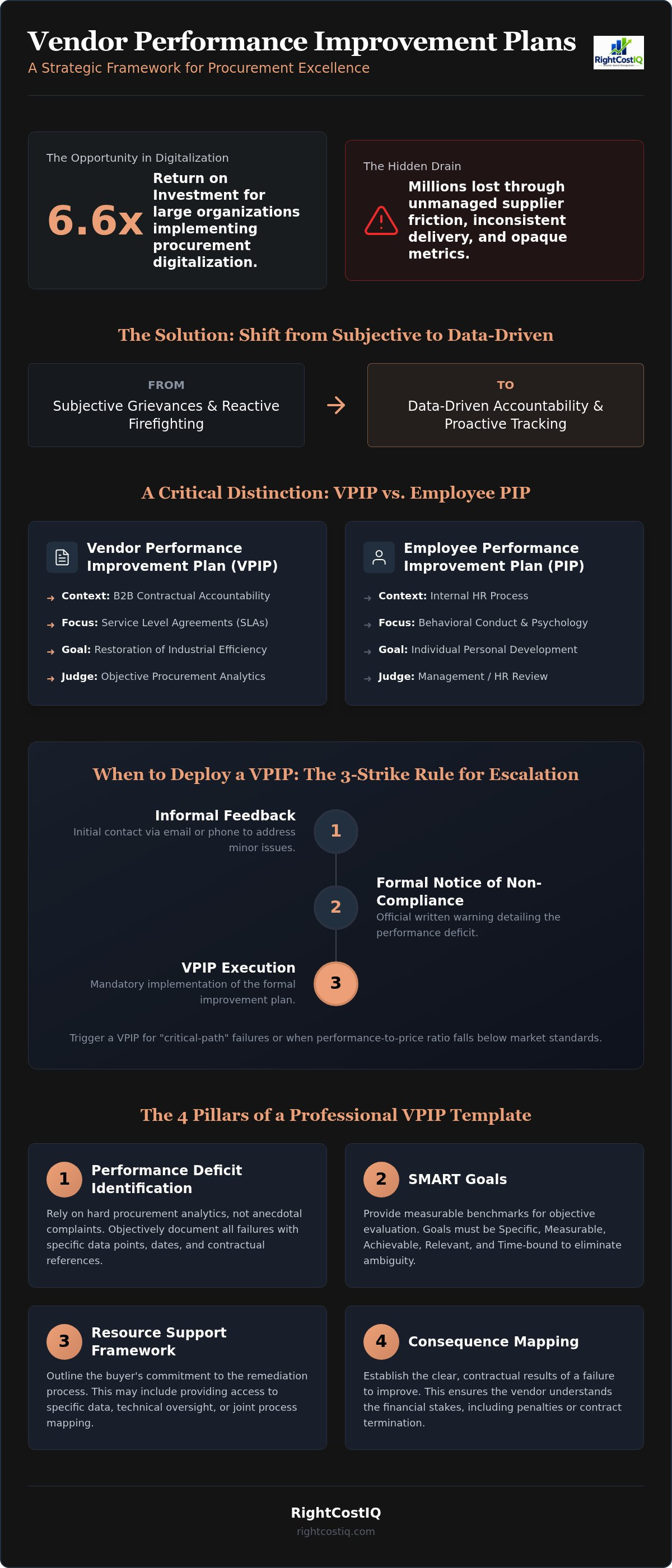
Large organizations implementing procurement digitalization are currently seeing a 6.6x return on investment, yet many still lose millions through unmanaged supplier friction. You likely recognize that inconsistent delivery and opaque performance metrics are currently draining your operational efficiency. Relying on subjective data to justify contract penalties is a liability that your bottom line cannot sustain. This guide provides a professional-grade vendor performance improvement plan template designed to stabilize your supply chain and mitigate terminal financial risk.
You'll learn to master the clinical execution of vendor remediation by shifting from subjective grievances to data-driven accountability. We'll examine the integration of ISO 9001:2026 standards into your framework, the role of AI-powered risk scoring in modern platforms, and the specific milestones required to ensure procurement excellence. This framework transforms the VPIP from a disciplinary tool into a strategic lever for margin expansion and long-term asset optimization. By the end of this analysis, you'll have the tools to force vendor accountability while protecting your organization's financial interests.
Key Takeaways
- Redefine vendor remediation as a strategic lever for margin expansion and enterprise resilience rather than a mere disciplinary measure.
- Utilize a professional-grade vendor performance improvement plan template to align corrective actions with objective procurement analytics and SMART performance goals.
- Integrate procurement category cost benchmarking to expose hidden savings and validate vendor pricing during the remediation phase.
- Implement a methodical diagnostic process that extracts performance data to drive customized, category-specific improvement strategies.
- Scale organizational accountability by transitioning from static documentation to automated vendor performance tracking and integrated RFP management frameworks.
The Strategic Architecture of a Vendor Performance Improvement Plan (VPIP)
A Vendor Performance Improvement Plan (VPIP) is a formal, legally grounded instrument that specifies performance deficits and mandates corrective actions. It functions as the primary mechanism for maintaining the integrity of Supplier Relationship Management within a high-stakes procurement environment. Unlike informal feedback, a VPIP provides a structured framework that links specific operational failures to contractual obligations. It creates a clear roadmap for remediation or, if necessary, contract termination based on objective data rather than subjective frustration.
Unmanaged vendor underperformance represents a direct threat to enterprise resilience. While procurement digitalization can yield up to a 6.6x ROI for large organizations, these financial gains are quickly liquidated when vendors fail to meet delivery timelines or quality standards. A standardized vendor performance improvement plan template ensures that compliance is a rigid requirement rather than a variable suggestion. It moves the organization from reactive firefighting, where teams scramble to fix errors after they occur, to a state of proactive vendor performance tracking that identifies risks before they impact the bottom line.
The VPIP vs. the Employee PIP
It's critical to differentiate B2B contractual accountability from internal HR processes. While an employee PIP often focuses on behavioral conduct and individual psychology, a VPIP is strictly focused on Service Level Agreements (SLAs). The goal isn't personal development but the restoration of industrial efficiency. Procurement analytics serve as the objective judge in this process. By utilizing hard data from your procurement platform, you remove the emotional friction often associated with performance disputes. This clinical approach ensures that the vendor understands that their continued partnership depends entirely on meeting quantifiable metrics rather than maintaining a positive relationship.
When to Deploy a Formal Improvement Plan
Strategic architects deploy a formal plan when "critical-path" failures jeopardize operational efficiency. These are disruptions that halt production, delay product launches, or compromise customer commitments. You should also trigger a VPIP when procurement category cost benchmarking reveals that a vendor's performance-to-price ratio has fallen significantly below market standards. Most high-performing procurement teams utilize a "Three Strike" rule to maintain discipline. This begins with informal feedback via email or phone, followed by a formal notice of non-compliance. If the deficit persists, the clinical execution of the vendor performance improvement plan template becomes mandatory to protect the organization's financial growth metrics.
Anatomy of a Professional Vendor Performance Improvement Plan Template
A high-caliber vendor performance improvement plan template functions as a technical specification for operational recovery. It's not a suggestion; it's a structural realignment of the supplier's delivery model. To Build a PIP That Actually Works, procurement architects must integrate four critical pillars into the document structure. First, Performance Deficit Identification must rely on hard procurement analytics rather than anecdotal complaints. Second, SMART Goals provide the measurable benchmarks required for objective evaluation. Third, the Resource Support Framework outlines the buyer's commitment to the remediation process, such as providing access to specific data sets or technical oversight. Finally, Consequence Mapping establishes the contractual results of a failure to improve, ensuring the vendor understands the financial stakes involved.
Setting Precision KPIs and Metrics
Moving beyond "on-time delivery" requires a transition to granular quality and cost metrics. You must define Acceptable Quality Levels (AQL) with clinical precision to avoid ambiguity during disputes. Integrating market price trending into your template ensures that you maintain value-for-money even as the vendor attempts to stabilize their operations. For organizations seeking to identify these variances before they escalate, a diagnostic review of current performance data can reveal hidden cost leakages that require immediate remediation. This data-driven approach prevents vendors from masking inefficiency with general promises of improvement.
Timelines and Review Milestones
High-value procurement strategies typically utilize a 30-60-90 day review cycle to maintain momentum. Each review phase serves as a filter to determine if the vendor is capable of meeting the new standards. Automated reporting from platforms like SAP Ariba 2608 or Oracle Fusion Cloud Procurement 26C ensures that data remains objective throughout the PIP duration. A milestone is a non-negotiable data point for contract continuation. If a vendor fails to hit a 30-day milestone, the template should dictate an immediate escalation to executive leadership or the initiation of a secondary sourcing plan. This rigorous cadence forces the vendor to prioritize your requirements or face the contractual consequences mapped out in the initial diagnostic phase.
Integrating Cost Benchmarking into Performance Remediation
Performance failure is rarely an isolated operational glitch. It's often a symptom of underlying financial misalignment. Using procurement category cost benchmarking allows you to validate whether you're paying a premium for substandard service. If a vendor is currently under a remediation plan, their pricing structure must reflect the actual value delivered, not the theoretical value promised in the original contract. This validation process prevents vendors from maintaining high-margin pricing while delivering low-quality outcomes that jeopardize your operational stability.
Performance deficits often mask hidden cost variances and price volatility. Frequent delivery delays might force your organization to carry higher safety stock, which increases inventory holding costs and ties up critical capital. A comprehensive vendor performance improvement plan template must account for these indirect financial impacts to provide a true picture of vendor ROI. By performing a "Should-Cost" analysis, you determine the fair market value of the improved performance you're demanding. This creates a data-driven baseline for the remediation period, ensuring your organization doesn't subsidize the vendor's internal inefficiencies.
Data-Driven Negotiation Assistance
Utilizing performance data strengthens your position during complex RFP cycles. Documented evidence of performance failure provides the leverage needed to demand more aggressive pricing or superior terms in future contracts. Engaging a negotiation coach helps your team present VPIP findings to incumbent vendors with clinical precision. This shifts the conversation from subjective complaints to a binary choice: meet market benchmarks or face immediate contract termination. These failures actually present opportunities for margin expansion if handled with strategic authority and objective data.
Mitigating Financial Volatility during Remediation
Mitigating financial volatility during remediation is essential for enterprise stability. You must implement price risk management strategies to ensure the vendor doesn't attempt to pass on the costs of their own remediation to your organization. Supply chain compliance should lead to cost stability, not unexpected spikes. By forecasting future costs based on corrected performance trajectories, you can align your 2026 budget with the reality of your vendor's recovery. This proactive approach ensures that your vendor performance improvement plan template serves as a tool for financial optimization rather than just a record of failure.
Executing the VPIP: A Methodical Step-by-Step Implementation Guide
Execution of the VPIP represents the transition from theoretical risk management to active operational recovery. This methodical process demands clinical precision to ensure that vendor remediation results in tangible margin expansion rather than prolonged inefficiency. Unlike generic HR-focused approaches that prioritize "growth," procurement execution focuses on the restoration of supply chain compliance and financial predictability.
- Step 1: The Diagnostic Phase. Extract objective performance data from your procurement platform, utilizing the latest updates from systems like SAP Ariba 2608 or Oracle Fusion Cloud 26C. This ensures your baseline is rooted in technical reality rather than anecdotal evidence.
- Step 2: The Drafting Phase. Customize your vendor performance improvement plan template to address specific category requirements. A generic document lacks the strategic weight needed to force compliance in complex industrial environments.
- Step 3: The Confrontation. Deliver the VPIP with professional authority. This meeting is a formal notice of contractual deficit, not a collaborative brainstorming session.
- Step 4: The Monitoring Phase. Implement daily or weekly tracking of spend under management and performance KPIs. Use automated reporting to maintain relentless pressure on the vendor's internal teams.
- Step 5: The Resolution. Conduct a final evaluation at the 90-day mark. Based on the data trajectory, you must make a binary decision: retain the vendor, renegotiate terms for margin expansion, or terminate the contract.
The Clinical Delivery of the VPIP
Scripting the delivery meeting is essential for maintaining the "Strategic Architect" persona. Focus entirely on data-driven sourcing results and the financial implications of current failures. Avoid emotional grievances that weaken your negotiation position. You must secure a formal vendor sign-off on the document to ensure legal and supply chain compliance. This signature functions as an admission of the performance gap and a binding commitment to the remediation timeline. For a clinical evaluation of your current vendor risk profile, initiate a free performance diagnostic to identify high-priority remediation candidates.
Managing Tail Spend Vendors
Apply the VPIP framework to tail spend management without over-investing human capital. High-volume, low-value suppliers often escape scrutiny, yet they represent a significant portion of unmanaged risk. Automate the vendor performance improvement plan template distribution for these tiers using AI-driven insights from your procurement suite. Tail spend performance is the primary driver of hidden operational risk due to the sheer volume of unmonitored transactions that can disrupt production cycles. By scaling accountability through automation, you protect the organization's bottom line without increasing administrative overhead.
Scaling Accountability through Automated Vendor Performance Tracking
Static documentation is a legacy constraint in a high-velocity supply chain. While a manual vendor performance improvement plan template provides a baseline, enterprise resilience now depends on dynamic vendor performance tracking services. The global Vendor Management Software (VMS) market is projected to reach USD 11.9 billion by 2030, reflecting a 12.5% CAGR as organizations move toward automated accountability. This transition replaces periodic audits with continuous, AI-led diagnostics that identify performance degradation before it necessitates a formal VPIP. The upcoming ISO 9001:2026 revision further emphasizes this shift toward digitalization and risk management as core quality requirements.
Integrating these insights into your broader RFP management framework transforms procurement from a back-office function into a driver of financial growth. AI-embedded platforms now provide predictive analytics and contract risk scoring, allowing strategic architects to anticipate disruptions. The ROI of this digitalization is documented; large organizations often see a 6.6x return on investment. By automating the data extraction process, you ensure that every negotiation is backed by a clinical record of supplier delivery and cost compliance. This eliminates the reliance on vendor-provided reports, which often mask systemic inefficiencies.
Building a Culture of Performance Transparency
Establishing transparency requires moving toward a clinical framework for margin expansion. Real-time dashboards have rendered the traditional quarterly manual review obsolete. These tools ensure that all vendors are held to the same data-driven sourcing standards, removing the risk of preferential treatment or overlooked inefficiencies. Transparency forces a shift in supplier behavior. When vendors know their performance is tracked by automated systems, compliance becomes the default operational state. This cultural shift reduces the administrative burden on procurement teams and allows for a focus on strategic category optimization.
Next Steps: Securing Your Supply Chain
Securing your supply chain in 2026 requires more than a vendor performance improvement plan template; it demands a professional diagnostic to identify current vulnerabilities. RightCostIQ streamlines the VPIP process by integrating market price trending with real-time performance analytics. This holistic approach ensures that high-level strategy and technical execution are perfectly aligned. You can't manage what you don't measure with precision. Optimize your vendor performance with a free diagnostic assessment. This assessment provides the objective data required to justify contract penalties or initiate high-stakes remediation with confidence.
Commanding Procurement Excellence through Strategic Remediation
Mastering the clinical execution of supplier remediation is now a prerequisite for organizations targeting aggressive financial growth. You have learned how a professional-grade vendor performance improvement plan template functions as a technical specification for operational recovery. It links Service Level Agreements directly to tangible bottom-line results. By integrating proprietary cost benchmarking and automated tracking, you replace subjective friction with objective accountability. This strategic shift ensures your supply chain remains resilient against market volatility while identifying hidden savings across global enterprise networks.
RightCostIQ provides clinical precision in vendor performance tracking and proprietary cost benchmarking analytics. Our framework delivers the global coverage necessary to manage complex supply chains with unwavering authority. Transitioning from static templates to dynamic, data-driven oversight is the primary driver for sustained procurement excellence in 2026. This evolution allows strategic architects to protect margins and enforce compliance with surgical accuracy.
Execute your procurement strategy with precision-Get your free diagnostic now.
Take command of your vendor relationships today to secure your organization's long-term competitive advantage.
Frequently Asked Questions
What is the difference between a Vendor PIP and a formal notice of default?
A Vendor Performance Improvement Plan (VPIP) is a remediation framework designed to restore operational standards through structured recovery. In contrast, a formal notice of default is a unilateral legal declaration that a contract has been breached. While a VPIP aims to preserve the partnership through clinical intervention, a notice of default often serves as the final precursor to litigation. Strategic architects use the VPIP to build the evidentiary record required for legal actions if recovery fails.
Can a Vendor Performance Improvement Plan be used as a legal document in contract termination?
Yes, a VPIP serves as a critical evidentiary document during contract termination proceedings. It provides a clinical record of the vendor's failure to meet specific Service Level Agreements (SLAs) despite being given a formal opportunity to remediate. By utilizing a standardized vendor performance improvement plan template, you ensure that all performance deficits and missed milestones are documented with the precision required to defend termination decisions in a legal or procurement audit.
How long should a typical vendor improvement period last for enterprise services?
Enterprise-level improvement periods typically follow a 30, 60, or 90-day cycle. The duration depends on the complexity of the corrective actions required and the impact on the supply chain. For critical-path services, a 30-day sprint may be necessary to address immediate delivery failures. Longer 90-day windows are appropriate for systemic process changes. Each phase must include non-negotiable data points that determine whether the contract will continue or move toward termination.
What happens if a vendor refuses to sign or acknowledge the VPIP?
Refusal to sign or acknowledge a VPIP is a significant red flag that necessitates immediate escalation. This lack of cooperation indicates that the vendor is unable or unwilling to meet their contractual obligations. In these scenarios, procurement leadership should pivot from remediation to exit strategy execution. Secure your supply chain by initiating a secondary sourcing event or preparing a formal notice of default, as the vendor has effectively forfeited the opportunity for a structured recovery.
How can I automate the tracking of VPIP milestones using procurement software?
Automation is achieved by integrating your vendor performance improvement plan template metrics directly into your procurement software's dashboard. Modern platforms, such as SAP Ariba 2608 or Oracle Fusion Cloud 26C, allow you to set automated alerts for KPI thresholds and milestone deadlines. This eliminates the need for manual tracking and ensures that performance data remains objective. Real-time visibility allows strategic architects to intervene instantly if the vendor's recovery trajectory deviates from the agreed-upon plan.
Is it possible to use a VPIP to renegotiate better pricing with an underperforming vendor?
Performance failures provide significant leverage for high-stakes negotiation and margin expansion. If a vendor is unable to meet the original service standards, their current pricing is no longer justified by the value delivered. You can use the VPIP findings to demand price concessions or improved terms as a condition for continuing the partnership. This clinical approach transforms an operational deficit into a financial opportunity, ensuring the organization is compensated for the risk of vendor underperformance.
What KPIs are most effective for tracking professional services vendor performance?
Effective KPIs for professional services focus on output quality and milestone velocity rather than simple hours billed. You should track the Acceptable Quality Level (AQL) of deliverables, adherence to project timelines, and cost variance against the initial budget. Measuring the "Should-Cost" of the service against actual performance reveals hidden inefficiencies. These metrics provide the data-driven sourcing evidence needed to hold consultants and service providers accountable to the same standards as physical goods suppliers.
How does a VPIP impact the overall category management strategy?
A VPIP is a core component of a robust category management strategy. It informs supplier tiering by identifying which vendors are strategic partners and which are high-risk candidates for replacement. Frequent use of remediation plans within a specific category may signal the need for a total market re-evaluation or a new RFP cycle. Integrating performance data into category planning ensures that your sourcing decisions are always aligned with the broader goals of enterprise resilience and financial growth.


