

Subjective scoring in vendor selection isn't just a workflow inefficiency; it's a direct threat to your organization's bottom line. With 2026 federal acquisition thresholds now reaching $350,000 for simplified acquisitions, the financial stakes of every contract have escalated. When procurement teams rely on qualitative gut feelings rather than rigorous, data-driven rfp evaluation criteria, they invite hidden costs and price volatility. You've likely experienced the frustration of watching a seemingly ideal vendor fail to meet market benchmarks or operational KPIs within months of an engagement. This lack of precision creates a strategic vacuum where financial growth is sacrificed for simple administrative completion.
It's a common challenge for decision-makers who must justify spend against volatile market conditions and evolving regulatory standards. We'll show you how to master the architecture of high-stakes vendor selection with a data-driven framework for weighted evaluation criteria. This guide delivers a repeatable, objective scoring methodology that aligns procurement activity with long-term financial growth while minimizing price risk. We'll preview the integration of cost benchmarking, market price trending, and performance tracking to ensure your next selection process is a clinical exercise in value optimization rather than a gamble.
Key Takeaways
- Transform rfp evaluation criteria from a simple checklist into a clinical financial instrument that prevents scope creep and price volatility.
- Structure vendor assessments around three core pillars: technical architecture, financial benchmarking, and operational scalability, to ensure total organizational alignment.
- Deploy a weighted scoring model to convert subjective vendor responses into objective, quantifiable data points that prioritize strategic business goals.
- Neutralize selection bias through blind technical evaluations and market-benchmarked cost analysis to secure the highest possible ROI.
- Integrate advanced procurement analytics and negotiation assistance to move beyond manual selection and drive sustained financial growth.
The Strategic Architecture of RFP Evaluation Criteria
RFP evaluation criteria function as the essential quantitative and qualitative filters used to measure vendor alignment against enterprise goals. In high-stakes procurement, these criteria act as a clinical instrument designed to strip away ambiguity. Without precise definitions, organizations succumb to financial volatility and scope creep. By 2026, the standard for a Request for Proposal (RFP) requires total alignment with organizational KPIs, ensuring every vendor selection drives measurable financial growth. This strategic architecture transforms an administrative task into a sophisticated risk management exercise.
Strategic procurement necessitates a shift from chasing the lowest unit price to securing the optimal Total Cost of Ownership (TCO). Focusing strictly on upfront costs ignores the long-term price risk and operational friction that erode margins over time. High-performance criteria integrate cost benchmarking and analytics to reveal the true fiscal impact of a vendor partnership. This approach ensures that procurement activity doesn't just manage spend but actively contributes to the balance sheet through reduced price volatility and improved selection precision.
Why Subjective Evaluation Fails the Modern Enterprise
Relying on gut-feeling selection creates significant hidden costs that emerge post-contract. Subjective scoring lacks the data-driven rigor needed to withstand audit scrutiny or ensure supply chain compliance in an increasingly regulated environment. When criteria are inconsistent, vendor performance tracking becomes impossible because there's no baseline for objective measurement. This failure leads to poor vendor fit, often resulting in expensive contract renegotiations or service interruptions that disrupt the bottom line. Efficiency requires removing human bias from the initial filtering phase to protect profit margins.
The Role of Market Intelligence in Criteria Setting
Establishing rfp evaluation criteria requires deep integration of market intelligence before the solicitation is released. Utilizing market price trending allows procurement teams to set realistic financial expectations and identify outliers early in the process. Benchmarking data provides the necessary context to validate vendor claims against current industry standards and competitor offerings. Market-aligned criteria represent the intersection of vendor capability and real-world pricing data. This alignment ensures that the final selection is grounded in economic reality rather than vendor marketing promises.
Categorizing Core Evaluation Pillars: Technical, Financial, and Operational
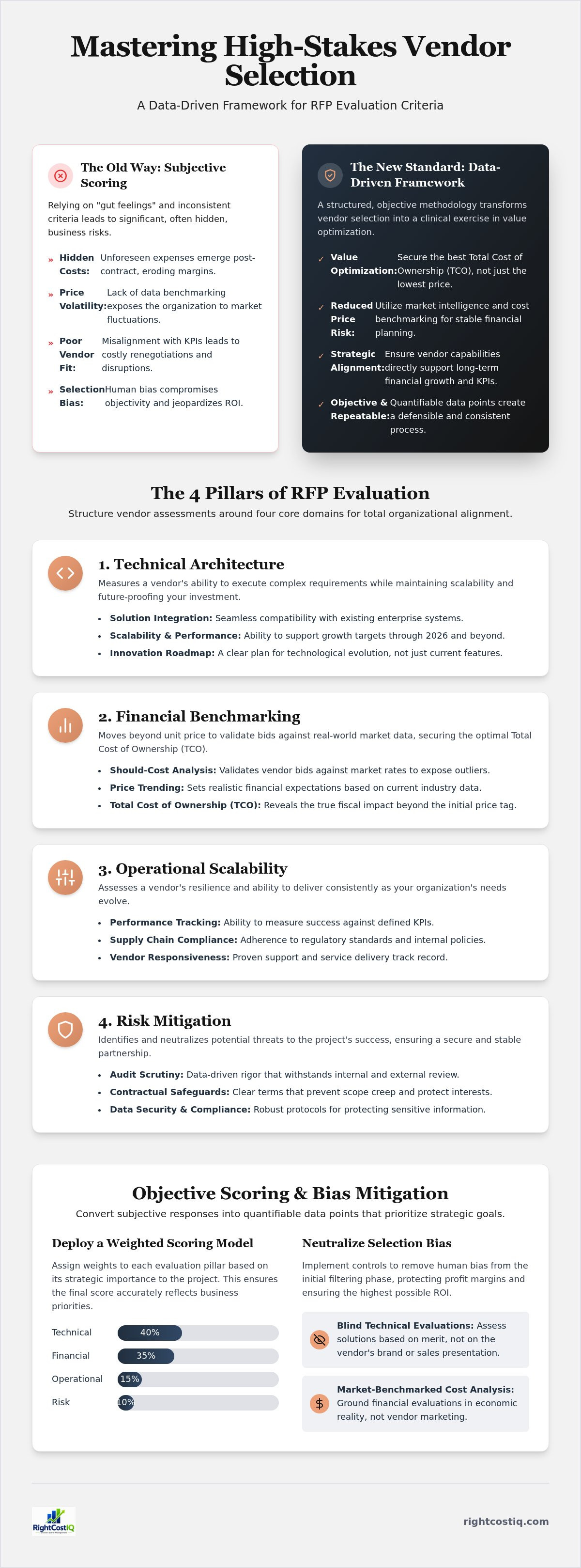
High-stakes procurement demands a structured hierarchy of rfp evaluation criteria to ensure vendor selection aligns with long-term financial objectives. Organizations must look past superficial marketing claims to evaluate four distinct pillars: technical architecture, financial transparency, operational resilience, and risk mitigation. This categorical approach prevents the "Halo Effect" where a strong sales presentation masks fundamental operational weaknesses. By segmenting requirements into these specific domains, decision-makers can apply precise weights that reflect the project's strategic priority.
The Technical Assessment: Capability vs. Innovation
The technical pillar measures a vendor's ability to execute complex project requirements while maintaining scalability. Procurement teams must evaluate solution architecture to ensure it integrates seamlessly with existing enterprise systems. It's not enough to assess current capabilities. You must determine if the vendor offers future-proofed innovation or a stagnant, off-the-shelf product. A strategic partner provides a roadmap for technological evolution that supports your enterprise growth targets through 2026 and beyond. This distinction ensures your infrastructure remains competitive in a rapidly shifting digital landscape.
The Financial Deep-Dive: Benchmarking and Analytics
Moving beyond unit price is critical for clinical procurement optimization. Sophisticated financial evaluation utilizes should-cost analysis to validate vendor bids against real-world market data. This process exposes hidden margins and ensures the organization doesn't overpay for commodity services. Additionally, analyzing a vendor's financial health and their proposed price risk management strategies provides a necessary buffer against market volatility. Validating these metrics against market benchmarks ensures the selected vendor remains a viable partner throughout the entire contract lifecycle, protecting your budget from unforeseen price spikes.
Operational evaluation focuses on supply chain resilience and compliance. With new regulations like the New Jersey Public Procurement Law (P.L. 2025, c. 180) and updated federal acquisition thresholds taking effect in 2026, vendors must demonstrate strict adherence to payroll records and debarment checks. The risk pillar specifically addresses potential financial volatility. Evaluating how a vendor manages their own cost drivers allows your procurement team to anticipate and mitigate future price increases. For organizations seeking to refine these filters, utilizing advanced procurement analytics provides the necessary data to build more robust selection frameworks.
Quantitative Scoring Models and Weighting Methodologies
Objective vendor selection requires a transition from qualitative narratives to a rigorous weighted scoring model. This framework serves as the industry standard for clinical procurement, allowing organizations to quantify vendor alignment with strategic priorities. By applying a mathematical structure to rfp evaluation criteria, decision-makers ensure that the final selection is based on verifiable data rather than internal bias. This methodology is essential for maintaining transparency and justifying high-stakes financial commitments to stakeholders.
Designing the Weighted Scoring Matrix
A high-performance scoring matrix assigns specific percentage weights to different requirement categories based on their strategic impact. A recommended 2026 framework for complex procurement includes Technical Architecture (40%), Financial Benchmarking (35%), Risk Mitigation (15%), and Vendor Experience (10%). To calculate the final value, teams multiply the raw score of each category by its assigned weight. This produces a weighted score that reflects the organization's unique priorities. Weighting must be finalized before vendor responses are opened to maintain clinical integrity and prevent retrofitting criteria to a preferred bidder.
Effective models also distinguish between "Must-Have" knockout criteria and "Nice-to-Have" scored criteria. Knockout criteria act as binary filters. If a vendor fails to meet a mandatory compliance or technical requirement, they're immediately disqualified from further evaluation. This streamlining ensures that the evaluation committee only spends time on viable candidates. Scored criteria then provide the nuance needed to differentiate between top-tier performers. This two-tiered approach protects the organization from selecting a vendor that lacks fundamental capabilities despite high scores in secondary areas.
Standardizing Qualitative Responses into Quantitative Data
Normalizing subjective answers, such as "cultural fit" or "innovation approach," requires a standardized 1 to 5 or 1 to 10 scale. Without a predefined rubric for each score, reviewer bias inevitably skews the results. Each numerical value must correlate with specific, documented evidence within the vendor's proposal. Utilizing advanced procurement analytics allows teams to normalize disparate data points and identify outliers in the scoring process. This data-driven normalization ensures consistency across diverse evaluation committees, transforming individual observations into a cohesive enterprise decision.
Mitigating Bias and Ensuring Vendor Performance Alignment
Systemic bias remains the primary cause of poor vendor fit in high-stakes procurement. The "Halo Effect" occurs when a vendor's strong brand reputation or polished sales presentation unfairly inflates their scores across unrelated rfp evaluation criteria. Organizations must neutralize this risk through structural objectivity. Implementing blind evaluations for technical specifications ensures that subject matter experts judge solutions based on merit rather than brand recognition. This clinical approach protects the selection process from psychological interference and focuses strictly on operational requirements.
Effective selection frameworks look beyond the initial award to establish long-term accountability. Every criterion used during the scoring phase must map directly to future vendor performance tracking metrics. If a vendor's selected based on promised innovation cycles or specific service levels, those attributes must be codified as measurable KPIs within the contract. It doesn't make sense to evaluate a vendor on metrics you don't intend to manage. This alignment ensures that the procurement activity delivers sustained financial value rather than short-term administrative success.
Post-Evaluation Verification: The Due Diligence Phase
The shortlist phase requires a transition from reviewing proposals to validating claims. High-value engagements necessitate technical proof of concepts or site visits to verify a vendor's operational capacity. Independent benchmarking serves as a critical filter during this stage. By cross-referencing bid data with market price trending, procurement teams can identify unsustainable low-ball offers. These offers often signal future price risk or a lack of understanding regarding project complexity. Verifying data against market reality is the only way to ensure financial stability throughout the contract lifecycle.
From Evaluation to Negotiation
Scoring data provides the necessary leverage for the final selection phase. Identifying specific gaps between a vendor's proposal and the ideal rfp evaluation criteria allows procurement teams to demand better terms or additional concessions. Utilizing a negotiation coach helps transform these scoring discrepancies into tangible contract improvements. The objective is to ensure the final agreement explicitly reflects the capabilities and pricing structures that secured the vendor's position. This rigorous approach prevents "bait and switch" tactics and secures the organization's financial growth through precise contract management.
To identify and eliminate hidden risks in your current vendor selection process, access our procurement risk diagnostic today.
Optimizing Procurement Outcomes with RightCostIQ Analytics
Manual selection processes often rely on fragmented data and static spreadsheets. This traditional approach lacks the clinical precision required to manage high-stakes contracts in an era of increasing price volatility and regulatory complexity. RightCostIQ provides a sophisticated procurement infrastructure that transforms how organizations apply rfp evaluation criteria. By moving beyond manual entry, decision-makers can leverage real-time analytics to identify hidden savings and mitigate financial risk before a contract is even signed. This data-driven sourcing strategy ensures that every vendor selection is backed by market-benchmarked evidence rather than internal assumptions, establishing a foundation for sustained operational efficiency.
The ROI of Professional RFP Management
Selection precision increases when organizations deploy professional RFP management. RightCostIQ's framework integrates cost benchmarking directly into the scoring phase, allowing for immediate validation of vendor bids against current market standards. This level of precision prevents the selection of vendors with unsustainable pricing models that lead to post-award friction and budget overruns. When combined with expert negotiation assistance, this methodology drives substantial bottom-line growth. Professional intervention ensures that the final contract terms reflect the best possible market position, securing margins that are often lost in less rigorous processes. Utilizing these services allows procurement departments to function as a tool for financial optimization rather than just an administrative cost center.
Next Steps: Modernizing Your Sourcing Strategy
Transitioning to a high-performance sourcing model requires an immediate audit of your existing selection filters. Organizations must identify and eliminate subjective bias that compromises the integrity of their rfp evaluation criteria. Integrating market price trending into your next cycle provides the necessary context to negotiate from a position of strength. This proactive approach allows procurement teams to anticipate price risk and secure fixed-cost protections that safeguard the enterprise against market fluctuations through 2026. Leveraging a repeatable, objective framework ensures that procurement activity remains perfectly aligned with long-term financial growth objectives.
Schedule a consultation for clinical procurement optimization to align your sourcing activity with enterprise financial goals. Our platform delivers the benchmarking data and performance tracking services needed to turn procurement into a primary driver of financial growth. Don't leave your vendor selection to chance when data-driven precision is available to protect your organization's future and maximize every dollar of spend.
Securing Sustained Financial Growth Through Procurement Precision
Transitioning from subjective vendor selection to a data-driven framework is a requirement for modern enterprise stability. By implementing weighted rfp evaluation criteria, procurement teams transform administrative tasks into clinical financial instruments. This methodology effectively neutralizes selection bias and aligns vendor performance with long-term organizational KPIs. You've learned how to categorize requirements into technical, financial, and operational pillars to ensure total cost of ownership optimization while mitigating price risk.
Founded in 2023 with a specialized focus on healthcare financial analytics, RightCostIQ delivers global coverage for procurement category cost benchmarking. Our expertise in price risk management and market price trending ensures your selection process remains grounded in real-world economic data. It's time to move beyond manual spreadsheets and embrace a sophisticated infrastructure that prioritizes margin expansion. You can build a more resilient supply chain today by applying these objective scoring principles to your next sourcing cycle. Optimize your next RFP with RightCostIQ's clinical management frameworks.
Frequently Asked Questions
What are the most important RFP evaluation criteria?
The most critical rfp evaluation criteria include technical solution architecture, financial health, and operational scalability. High-performance frameworks prioritize Total Cost of Ownership (TCO) over simple unit price. This ensures the vendor provides long-term value and avoids hidden post-contract costs. By categorizing these into core pillars, decision-makers measure vendor alignment against specific enterprise KPIs and market benchmarks to drive sustained financial growth.
How do you calculate weighted scores in an RFP?
You calculate weighted scores by multiplying the raw score of a specific category by its assigned percentage weight. If Technical Capability is weighted at 40% and a vendor scores an 8 out of 10, their weighted score is 3.2. Aggregating these values across all categories provides a single, quantifiable data point for objective comparison. This mathematical approach eliminates subjective bias during the final selection phase.
What is the difference between an RFP and an RFQ evaluation?
RFP evaluation focuses on qualitative strategy and complex solution architecture, while RFQ evaluation is strictly transactional and price-driven. An RFP seeks a strategic partner capable of solving specific business challenges. Conversely, an RFQ assumes the requirements are commoditized and prioritizes the lowest cost for a defined product. Strategic procurement requires an RFP when vendor innovation and scalability are critical for long-term success.
How can I avoid bias when evaluating vendor proposals?
Neutralizing bias requires the implementation of blind technical reviews and standardized scoring rubrics. Evaluators should score technical specifications without knowing the vendor's identity to prevent the "Halo Effect." Additionally, pre-defining a 1 to 10 scale for qualitative responses ensures that every reviewer uses the same objective standard. This clinical structure protects the selection process from individual preferences and psychological interference.
Should price be the most important criterion in an RFP?
Price shouldn't be the primary criterion. Instead, focus on the Total Cost of Ownership and risk mitigation. While financial transparency is vital, the lowest bid often masks operational inefficiencies or future price volatility. A clinical evaluation weighs financial metrics against technical capability and supply chain resilience. This balanced approach ensures that the chosen vendor doesn't just offer the lowest price but delivers the highest ROI.
How many vendors should I include in the final evaluation phase?
Limit the final evaluation phase to a shortlist of three to five high-performing vendors. Including more than five candidates creates administrative bloat and dilutes the depth of your due diligence. A smaller pool allows the evaluation committee to conduct thorough site visits, proof-of-concepts, and detailed cost benchmarking. This focused approach ensures a high-stakes decision is based on granular data rather than surface-level proposal reviews.
What role does cost benchmarking play in RFP evaluation?
Cost benchmarking serves as the primary tool for validating vendor pricing against real-world market data. It identifies whether a bid is an unsustainable low-ball offer or an inflated proposal. By integrating market price trending into your rfp evaluation criteria, you secure a baseline for negotiation. This data-driven validation protects your organization from overpaying and ensures the vendor's financial model is viable for the contract duration.
Can I change evaluation criteria after receiving vendor bids?
You must never change evaluation criteria after vendor bids are opened. Modifying weights or requirements post-submission compromises the clinical integrity of the procurement process and risks accusations of favoritism. Strategic architecture requires all criteria and scoring methodologies to be finalized and documented before the RFP is released. This discipline maintains transparency and ensures the final selection is based on the original strategic objectives.


