
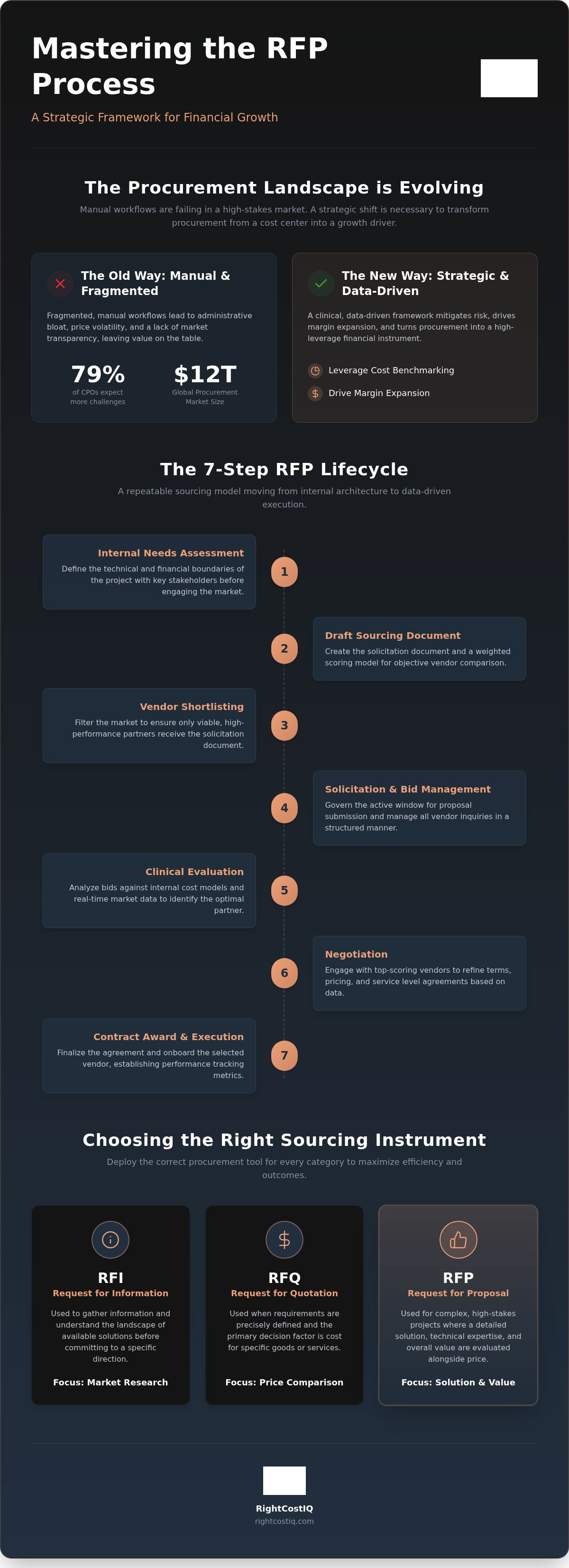
79% of Chief Procurement Officers expect 2026 to be more challenging, yet many organizations continue to execute sourcing through fragmented, manual workflows. When technical leaders ask what is an RFP process, they often mistake it for a mere administrative requirement rather than a high-leverage financial instrument. This narrow view creates administrative bloat and leaves firms vulnerable to a lack of market price transparency during negotiations. You've likely experienced the friction of inconsistent vendor evaluation criteria and the resulting price volatility in a global procurement market that now exceeds $12 trillion annually.
This article provides the strategic architecture necessary to master the Request for Proposal (RFP) lifecycle. By adopting a clinical, data-driven framework, your team can mitigate price risk and drive aggressive margin expansion through structured vendor selection. We'll outline a repeatable sourcing model that utilizes cost benchmarking and market intelligence to secure identifiable savings. This guide previews the transition from manual response cycles to an automated, analytical approach that reduces price volatility in long-term contracts and transforms procurement into a primary driver of financial growth.
Key Takeaways
- Transition from manual administrative workflows to a strategic architecture that eliminates operational bloat and prioritizes financial growth.
- Define exactly what is an RFP process by treating it as a clinical solicitation mechanism for complex, high-stakes vendor selection.
- Master the 7-step sourcing lifecycle, moving from internal requirement architecture to the execution of data-driven evaluation criteria.
- Identify the critical distinctions between RFIs, RFQs, and RFPs to ensure the correct procurement instrument is deployed for every category.
- Leverage cost benchmarking and market price forecasting to mitigate price risk and drive sustainable margin expansion.
Defining the RFP Process: A Strategic Procurement Framework
The Request for proposal (RFP) is a formal, clinical solicitation process designed for complex sourcing requirements. It functions as a strategic architecture rather than a simple administrative task. By deploying a structured framework, procurement teams move beyond the limitations of casual vendor inquiries. They establish a rigorous mechanism for comparing vendor capabilities, technical specifications, and pricing structures on an objective, data-driven basis. This process acts as the foundation for clinical negotiation; it ensures that every vendor response is evaluated against a fixed set of enterprise standards.
Understanding what is an RFP process requires a shift in perspective. It's the primary tool for mitigating price risk while ensuring total supply chain compliance. This transformation is critical. It replaces subjective, "gut-feeling" vendor selection with a relentless focus on objective financial analysis. In a global economy where public procurement accounts for 12% to 15% of GDP in developed nations, the ability to execute this process with precision is a core competitive advantage. It forces vendors to compete on value, not just proximity or historical relationships.
RFP as a Driver for Margin Expansion
Structured sourcing identifies hidden cost variances that often remain buried in informal vendor bids. When organizations standardize their bid formats, they expose price discrepancies that would otherwise go unnoticed. This clinical precision allows procurement leads to align their category strategy with high-level financial growth metrics. By defining project requirements with absolute clarity early in the lifecycle, firms prevent scope creep and eliminate the "price-only" trap. This approach ensures that every dollar spent is an investment in margin expansion rather than a sunk operational cost. Data-driven sourcing frameworks allow for benchmarking against current market price trends, providing the leverage needed to secure favorable terms.
Why Enterprise Efficiency Requires Formal Sourcing
Manual, fragmented procurement cycles generate significant administrative friction. High-performance organizations utilize standardized RFP management cycles to reduce this bloat. This structure provides the operational transparency required for C-suite and stakeholder reporting. It moves the conversation beyond simple cost-cutting. Instead, it focuses on holistic vendor performance tracking and long-term value creation. When you master what is an RFP process, you create a repeatable framework that ensures every contract is anchored in market reality and enterprise-wide efficiency. This methodology provides a clear audit trail and a robust lever for future negotiations, allowing for a seamless transition between high-level strategy and technical execution.
The 7-Step RFP Lifecycle: From Architecture to Execution
Mastering what is an RFP process requires a methodical progression from internal assessment to final award. It's not a linear document creation task; it's a multi-stage architecture designed to extract maximum value from the market. A high-performance lifecycle ensures that every vendor interaction is governed by data rather than administrative habit. By following a structured framework, procurement teams eliminate the bloat that typically characterizes manual sourcing cycles.
- Step 1: Internal Needs Assessment and Requirement Architecture. Stakeholders must define the technical and financial boundaries of the project before engaging the market.
- Step 2: Drafting the Sourcing Document and Evaluation Criteria. This involves creating the solicitation and a corresponding weighted scoring model for objective comparison.
- Step 3: Vendor Shortlisting and Pre-qualification. Filtering the market ensures only viable, high-performance partners receive the solicitation.
- Step 4: Solicitation and Bid Management. This phase governs the active window where vendors submit proposals and procurement manages inquiries.
- Step 5: Clinical Evaluation and Benchmarking. Bids are analyzed against internal cost models and real-time market data to identify the most efficient partner.
The final stages of the lifecycle involve intense negotiation and contract award. With 68% of proposal teams now utilizing AI as of 2026, the speed of these cycles has accelerated. However, the need for human-led, clinical oversight remains paramount to ensure long-term supply chain resilience.
Phase 1: Defining the Scope of Work (SOW)
The Scope of Work serves as the technical anchor of an RFP, ensuring all bidders operate on identical assumptions. Effective SOWs integrate specific key performance indicators (KPIs) to enforce vendor accountability from the start. By incorporating market price trending during this phase, procurement teams set realistic budget expectations and avoid the "sticker shock" associated with outdated internal estimates. This precision prevents scope creep and ensures that the eventual contract is anchored in operational reality.
Phase 2: Evaluation and Vendor Comparison
Data-driven evaluation is where strategic sourcing wins or loses. Organizations should utilize cost benchmarking to identify outliers in vendor pricing that suggest either overcharging or a fundamental misunderstanding of the requirements. Implementing weighted scoring models ensures that decisions remain objective and aligned with enterprise priorities. To maintain this level of clinical precision across large vendor pools, many firms adopt automated RFP Management frameworks to streamline complex calculations. If your current evaluation process feels fragmented, exploring a structured sourcing diagnostic can help identify hidden margin leaks.
Critical Components of a High-Performance RFP
A high-performance solicitation document is more than a list of requirements; it's a strategic instrument designed to extract granular data from the vendor market. Defining what is an RFP process in a modern procurement context requires a focus on the structural DNA of the document itself. Every component must serve as a clinical mechanism for comparing vendor capabilities against enterprise financial goals. Without these core elements, the sourcing cycle reverts to a subjective exercise that invites price risk and administrative bloat.
- Technical Specifications: These provide the blueprint for vendor execution. They must be dense and precise to ensure all bidders respond to the exact same operational needs.
- Pricing Tables: Standardizing bid formats is essential for clinical comparison. Standardized tables prevent vendors from hiding costs in opaque fee structures or bundled services.
- Contractual Terms: These manage price risk and supply chain compliance from the outset. Including "red-lined" terms in the RFP phase accelerates the final negotiation cycle.
- Evaluation Rubric: A pre-defined scoring model ensures transparency. It communicates to stakeholders that the selection is based on objective financial analysis rather than historical bias.
Integrating Cost Benchmarking and Analytics
Data-driven sourcing relies on the integration of advanced analytics within the RFP document. By utilizing procurement cost benchmarking, teams can validate vendor cost structures against real-world market intelligence. This prevents "bracket creep," a phenomenon where service costs drift upward due to a lack of defined pricing boundaries in complex contracts. Identifying market price trends allows procurement leaders to negotiate rates that reflect current economic realities rather than outdated internal budgets. This analytical layer transforms the RFP from a passive inquiry into a powerful lever for margin expansion.
Vendor Performance and Compliance Tracking
Strategic sourcing doesn't end at the award; it begins with the inclusion of robust service level agreements (SLAs) within the RFP. These clauses set the stage for post-award vendor performance tracking, ensuring that the value promised during the bid phase is actually delivered. To mitigate financial volatility, high-performance RFPs include specific price-adjustment clauses. These mechanisms allow for objective rate corrections based on market fluctuations, protecting the organization from sudden price spikes. Integrating these tracking requirements into the initial solicitation ensures that vendors remain accountable throughout the entire contract lifecycle, securing long-term operational efficiency.
RFP vs. RFI vs. RFQ: Navigating Sourcing Terminology
Strategic procurement relies on the precise application of solicitation instruments. While many professionals use these terms interchangeably, understanding what is an RFP process requires a clear distinction between the "RFx" family of documents. Deploying the wrong document type leads to administrative friction and vendor misalignment. Each instrument serves a specific clinical purpose within the sourcing architecture, and selecting the wrong one can jeopardize your financial objectives.
- Request for Information (RFI): This is exploratory research. Use it to identify market capabilities and gather intelligence without a formal commitment to purchase.
- Request for Quotation (RFQ): This is a purely cost-focused solicitation. It's used for commodities or standardized goods where technical specifications are already fixed.
- Request for Proposal (RFP): This is the most complex instrument. It's used for strategic solutions where the vendor's methodology and technical approach are as critical as the final price.
The RFP remains the primary driver for complex decision-making. It forces vendors to provide a comprehensive solution architecture rather than just a price point. By contrast, an RFQ is a tactical tool used when the market is already well-understood and the primary goal is cost-minimization for high-volume categories.
The Strategic Selection Matrix
Selecting the correct solicitation type depends entirely on the spend category and the technical complexity of the requirement. For low-complexity items or managing high-volume tail spend, a simplified RFQ is the most efficient choice to reduce administrative bloat. When the solution is unknown, procurement teams should initiate an RFI to map the vendor landscape before transitioning into a full RFP cycle. This phased approach ensures that the eventual RFP is built on a foundation of real-world market capabilities, preventing unrealistic requirements that drive up bid prices.
Avoiding Common Sourcing Missteps
A frequent error in procurement is the application of an RFQ to complex professional services. This "price-only" focus ignores critical performance metrics and often results in long-term contract failure or hidden costs. One-size-fits-all sourcing documents are a primary driver of operational inefficiency. They confuse vendors and dilute the quality of the data received. Maintaining clinical precision in terminology ensures that vendors understand exactly what is required for a compliant response. If your organization struggles to differentiate these instruments effectively, you can perform a sourcing diagnostic to audit your current solicitation frameworks. This ensures your team uses the right tool for every category, protecting your margins and ensuring total supply chain resilience.
Optimizing the RFP Process with Advanced Analytics
Legacy procurement cycles often fail because of a reliance on fragmented, spreadsheet-based management. This manual approach obscures real-time market volatility and prevents C-suite visibility into potential margin leaks. Understanding what is an RFP process in a modern enterprise requires moving beyond the document-centric view toward a data-centric architecture. By leveraging real-time market forecasting, procurement teams gain a clinical negotiation lever that legacy systems cannot provide. This level of insight is critical for maintaining supply chain resilience in a global market where 75% of Chief Procurement Officers still prioritize cost savings as their primary objective.
Professional RFP management and negotiation assistance deliver a tangible ROI by bridging the gap between bid receipt and final contract execution. This ensures that the aggressive pricing captured during the solicitation phase isn't lost to "negotiation drift" before the award. A high-performance sourcing framework treats the RFP not as a static event, but as a dynamic data set that informs every subsequent interaction with the vendor. This transition from administrative sourcing to strategic financial growth requires the integration of advanced analytics into the core of the procurement workflow.
Clinical Negotiation Assistance
RFP data shouldn't sit idle; it must fuel professional negotiation strategies. Using cost benchmarking, teams can identify precise "walk-away" points where vendor pricing ceases to align with market reality. Accessing a Negotiation Coach provides the expert assistance needed to convert raw bid data into favorable contract terms. This clinical approach eliminates the subjectivity that often characterizes the final stages of vendor selection. It allows procurement leads to enter negotiations with a data-driven mandate, securing identifiable cost savings through rigorous benchmarking rather than anecdotal pressure.
RightCostIQ: Precision RFP Management
RightCostIQ integrates procurement category cost benchmarking directly into every RFP cycle. This automation allows for sustained margin expansion by identifying cost variances in real-time. Organizations can automate vendor performance tracking to ensure compliance persists long after the initial award, mitigating the risk of post-contract price spikes. This platform bridges the gap between traditional business functions and cutting-edge digital innovation. To identify specific margin leaks in your current workflow, start with a free procurement diagnostic. This provides the baseline data needed to transition from administrative sourcing to a high-performance financial growth engine.
Architecting Financial Growth through Strategic Sourcing
Transitioning from administrative procurement to a high-performance sourcing model requires more than a template. It demands a clinical framework that integrates data-driven market price forecasting and rigorous cost benchmarking into every stage of the lifecycle. By mastering the 7-step architecture detailed in this guide, you move beyond the limitations of manual workflows to secure identifiable cost savings and long-term price stability. Understanding what is an RFP process in this context allows technical leaders to treat every solicitation as a high-leverage financial instrument rather than a mere compliance requirement.
The path to sustained margin expansion lies in bridging the gap between raw bid data and expert negotiation assistance for complex contracts. You can identify hidden savings and eliminate operational friction by adopting a repeatable, analytical approach to vendor selection. Take the first step toward a more efficient procurement ecosystem today. Optimize your procurement outcomes with a free diagnostic and transform your sourcing department into a primary driver of enterprise value. Your team's potential for strategic impact is immense when supported by the right analytical tools.
Frequently Asked Questions
What is the primary purpose of an RFP process in procurement?
The primary purpose is to provide a formal solicitation framework for complex sourcing requirements where the solution is not strictly commoditized. It enables organizations to evaluate vendor methodology, technical capability, and pricing structures through a clinical, objective lens. This structured approach mitigates price risk and ensures that the final selection aligns with enterprise-level financial growth metrics rather than subjective preferences.
How long does a typical RFP process take to complete?
A standard lifecycle usually spans six to twelve weeks, depending on the complexity of the requirement architecture. While automation has reduced the average time to respond to 25 hours per vendor, the internal phases of needs assessment and clinical evaluation remain time-intensive. High-performance teams utilize automated management cycles to accelerate these timelines without sacrificing data integrity or negotiation leverage.
What is the difference between an RFP and a tender?
An RFP focuses on soliciting a comprehensive solution and methodology for complex projects, whereas a tender is often a more rigid, compliance-heavy solicitation common in public sector procurement. While tenders often prioritize the lowest compliant bid, the RFP process emphasizes strategic value and long-term margin expansion. It allows for a more nuanced comparison of vendor innovation and performance tracking capabilities.
Can you run an RFP process for small-scale procurement projects?
You can execute an RFP for smaller projects, but it's often more efficient to use a Request for Quotation (RFQ) for spends below the $15,000 micro-purchase threshold. Small-scale projects only require a full RFP when the technical solution is highly complex or carries significant operational risk. For most low-value commodities, a simplified price-focused solicitation reduces administrative friction and bloat.
What are the most common mistakes in drafting an RFP?
The most frequent errors include vague technical specifications and the absence of standardized pricing tables. When technical leaders ask what is an RFP process, they often overlook the importance of a pre-defined evaluation rubric. Failing to establish objective scoring criteria leads to inconsistent vendor comparisons and administrative bloat. This lack of precision ultimately dilutes the organization's negotiation power during the final award phase.
How does cost benchmarking improve the RFP evaluation phase?
Cost benchmarking provides a clinical market baseline that exposes outliers in vendor pricing structures. By comparing incoming bids against real-time market data, procurement teams identify which vendors are inflating margins or underestimating project scope. This analytical layer transforms the evaluation from a simple bid comparison into a data-driven exercise that secures identifiable savings and reduces long-term price volatility.
What happens after the RFP process is finished?
The conclusion of the solicitation triggers the clinical negotiation phase and final contract execution. Procurement leaders use the data captured during the bid cycle to anchor negotiations in market reality. Once the contract is awarded, the focus shifts to post-award vendor performance tracking. This ensures that the financial benefits and service levels promised during the sourcing cycle are sustained throughout the contract term.
Is an RFP process legally binding for the organization?
The solicitation itself is generally not a legally binding contract, but it creates a "process contract" in many jurisdictions that governs how the selection must be conducted. Organizations should include explicit disclaimers stating that they aren't obligated to award a contract to any bidder. This maintains strategic flexibility while protecting the firm from litigation related to inconsistent evaluation or unfair vendor treatment.


