
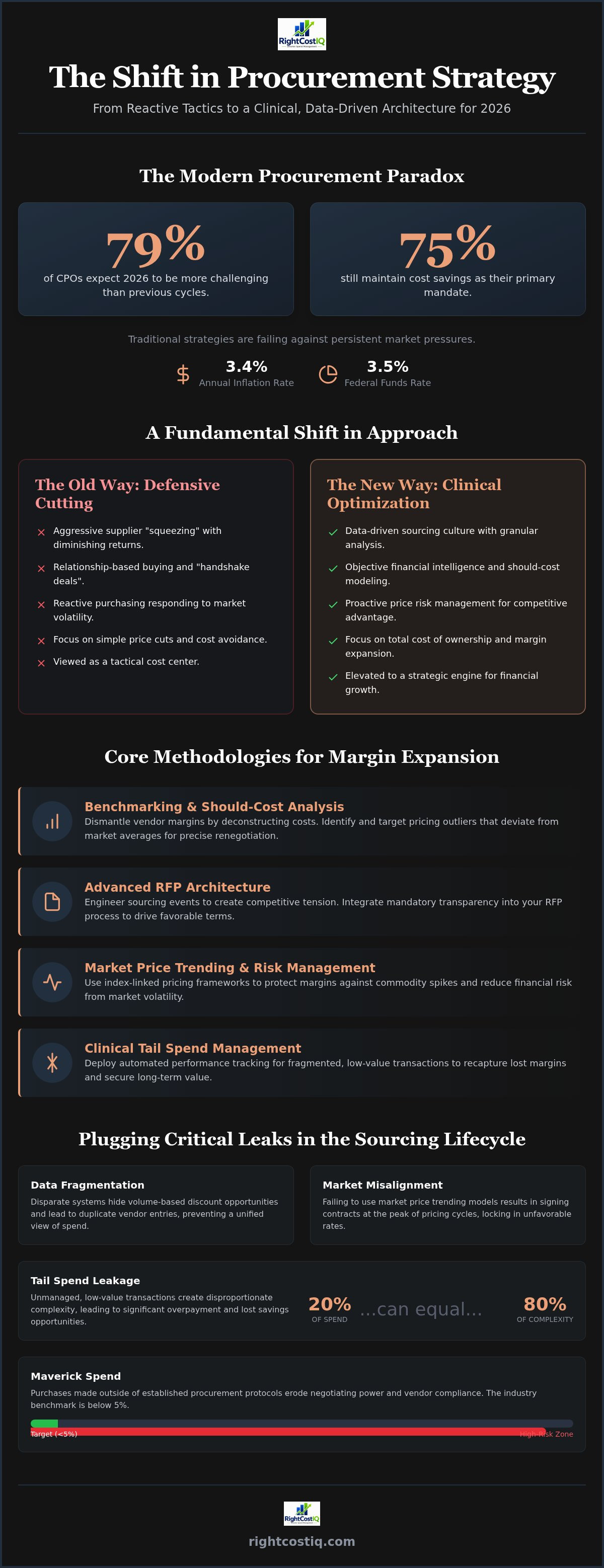
79% of Chief Procurement Officers expect 2026 to be more challenging than previous cycles, yet 75% maintain cost savings as their primary mandate. This statistical paradox exposes the exhaustion of traditional procurement cost reduction strategies that rely on aggressive supplier negotiation. You likely recognize that manual price suppression cannot offset the 3.4% annual inflation rate or the persistent pressure of a 3.5% federal funds rate. Diminishing returns from legacy tactics leave procurement teams without the granular data required for precise clinical benchmarking.
This article provides the clinical framework necessary to master advanced data-driven methodologies and negotiation frameworks that drive sustainable margin expansion. We will analyze the integration of market price trending, should-cost modeling, and RFP architecture to deliver defensible metrics to the C-suite. You'll learn to reduce financial risk through technical price tracking and improved vendor compliance protocols. Our focus remains on structural efficiency and the clinical alignment of market intelligence with operational execution. This approach transforms procurement from a tactical function into a primary driver of financial growth and long term stability.
Key Takeaways
- Transition from reactive supplier negotiation to a clinical cost architecture capable of neutralizing 2026 market volatility.
- Utilize Should-Cost modeling and category benchmarking to dismantle vendor margins and identify actionable pricing outliers.
- Master advanced procurement cost reduction strategies by integrating competitive tension and mandatory transparency into your RFP architecture.
- Reduce financial risk through market price trending and index-linked pricing frameworks that protect margins against commodity spikes.
- Secure long-term value by deploying automated performance tracking and clinical management protocols for fragmented tail spend.
Beyond Defensive Cutting: The Strategic Shift to Clinical Cost Optimization
Traditional procurement models are failing in the face of 2026 market realities. Aggressive supplier "squeezing" yields diminishing returns when US inflation sits at 3.4% and the Federal funds rate remains between 3.50% and 3.75%. You can't negotiate your way out of structural market volatility using 20th-century tactics. Modern procurement cost reduction strategies require a shift from reactive purchasing to a sophisticated cost architecture. This framework prioritizes enterprise-wide EBITDA expansion over simple department-level price cuts. It's about building a data-driven sourcing culture that replaces relationship-based buying with objective financial intelligence. Handshake deals are a liability; clinical precision is the only path to sustainable margin protection.
The ROI of Strategic Procurement Optimization
Realized savings hit the bottom line. Cost avoidance only preserves the status quo. While 75% of CPOs in 2026 identify cost savings as their primary mandate, few successfully bridge the gap between procurement activities and C-suite financial growth metrics. Strategic optimization moves beyond "price-down" requests to focus on total cost of ownership and margin expansion. Transitioning from reactive purchasing to proactive Price Risk Management ensures that market volatility becomes a lever for competitive advantage rather than a threat to operational solvency. By aligning procurement goals with corporate finance, you transform the department from a cost center into a strategic engine for capital efficiency.
Identifying Inefficiencies in the Current Sourcing Lifecycle
Fragmented data is the primary driver of "shadow" procurement costs. When data is siloed, organizations lose visibility into the true sourcing lifecycle, leading to significant overpayment. Maverick spend—purchases made outside of established procurement procedures—is a critical leak. The industry benchmark for maverick spend is below 5% of total spend, yet many organizations exceed this due to poor vendor compliance. Identifying these inefficiencies requires a clinical approach to data analysis.
- Data Fragmentation: Disparate systems hide volume-based discount opportunities and lead to duplicate vendor entries.
- Market Misalignment: Failing to use market price trending models results in signing contracts at the peak of pricing cycles.
- Tail Spend Leakage: Unmanaged, low-value transactions often account for 20% of spend but 80% of procurement complexity.
Addressing these leaks through clinical tail spend management and automated vendor performance tracking recaptures lost margins. It eliminates the guesswork of relationship-based sourcing and provides the hard data required for defensible cost reduction metrics. Efficiency isn't just about paying less; it's about ensuring every dollar spent is clinically aligned with current market benchmarks.
Leveraging Benchmarking and Should-Cost Analysis for Precision Pricing
Precision pricing begins with the rejection of vendor-led price discovery. To execute advanced procurement cost reduction strategies, you must deconstruct the components of every line item. Category cost benchmarking provides the necessary market intelligence to identify outliers that deviate from peer averages. This methodology transitions the sourcing event from a defensive posture to an offensive, data-backed negotiation. Clinical benchmarking identifies exactly where your current contracts sit on the market bell curve, allowing for targeted renegotiation of the most egregious overpayments first. It transforms price from a fixed vendor output into a manageable variable.
The transition from accepting "what they charge" to demanding "what it should cost" requires a rigorous methodology. Integrating procurement analytics into your sourcing lifecycle ensures that every decision aligns with enterprise-wide margin goals. It's no longer sufficient to ask for a generic discount. You must dictate the terms of the transaction based on a granular understanding of material costs, labor indexes, and overhead allocations. This data-driven approach removes the ambiguity from complex supply chains and establishes a position of professional authority during supplier interactions.
Data-Driven Category Benchmarking
Market intelligence validates or invalidates vendor claims of "market-driven" price increases. By analyzing price variance across similar procurement categories, you expose inconsistencies in vendor pricing models. Deploying Should-Cost analysis as a pre-negotiation requirement forces transparency. This process involves a bottom-up rebuild of the product or service cost structure. It shifts the burden of proof to the vendor, requiring them to justify margins that exceed the clinical baseline established by your internal data and external benchmarks. This level of scrutiny ensures that price adjustments are rooted in economic reality rather than opportunistic margin expansion.
Visualizing Spend Under Management
Achieving a single source of truth for enterprise spend is the only way to eliminate savings leakage. Real-time analytics identify where negotiated savings fail to translate into realized bottom-line results. Should-Cost modeling serves as the clinical baseline for all 2026 negotiation frameworks. Organizations that fail to visualize their spend often lose 10% to 15% of their negotiated value to non-compliant purchasing behavior or "shadow" invoices. Visibility allows for the immediate identification of maverick spend before it impacts quarterly EBITDA. You can optimize your sourcing precision to reclaim these lost margins and ensure every sourcing event is anchored in financial reality.
RFP Architectural Excellence: Driving Competitive Tension in Sourcing
RFP design is a precision instrument, not a clerical formality. Most organizations settle for a "Three Bids and a Buy" approach that fails to extract maximum value. To execute effective procurement cost reduction strategies, the RFP must be engineered to force vendor transparency and mandatory margin disclosure. This architectural shift creates artificial but necessary competitive tension. By mandating granular cost-plus reporting, you strip away the obfuscation common in complex supply chain bids. The goal is to move from a simple selection process to a clinical extraction of market value.
The Anatomy of a High-Performance RFP
High-performance RFPs require bidders to provide exhaustive cost-breakdown requirements. You shouldn't accept bundled pricing that hides structural inefficiencies. Every line item must be scrutinized against the Should-Cost baseline established in previous analytical phases. Utilizing structured RFP management frameworks ensures that all participants adhere to strict compliance standards. This level of rigor aligns service level agreements (SLAs) directly with your cost reduction targets. When vendors know their margins are being clinically analyzed, they're forced to present their most efficient pricing models immediately.
Managing Vendor Performance from the Start
Effective RFP management reduces sourcing cycle times by automating the evaluation of complex sourcing events. It's about integrating performance tracking into the initial contract architecture rather than treating it as a post-implementation task. Setting clear KPIs for vendor-led cost improvement ensures that the initial contract savings aren't lost to margin creep over time. By automating the evaluation process, you eliminate subjective bias and focus solely on the financial and operational metrics that drive enterprise-wide EBITDA. Engineering competitive tension through structured bidding cycles prevents vendor complacency and ensures your procurement function operates as a strategic architect of financial growth through advanced procurement cost reduction strategies.
Advanced Negotiation and Price Risk Management as Cost Levers
Negotiation in a high-volatility environment requires a departure from intuition toward a data-centric methodology. Relying on "soft skills" or historical relationships is a liability when US inflation remains at 3.4% and market volatility impacts forecasting accuracy. To implement effective procurement cost reduction strategies, organizations must deploy clinical negotiation frameworks that leverage real-time market intelligence. This shift involves implementing index-linked pricing models that protect against commodity spikes while ensuring that downward market movements are automatically reflected in contract pricing. Proactive price risk management serves as the structural foundation for maintaining sustainable margins despite macroeconomic instability.
Forecasting Market Price Trends
Timing is as critical as the price point itself. By utilizing historical data and market intelligence, procurement teams can predict future cost trajectories with high degrees of accuracy. Forecasting allows you to identify the "Optimal Negotiation Window" where market cycles favor the buyer. For instance, with forecasters projecting inflation to slow to 2.7% by the end of 2026, securing longer-term fixed pricing during temporary market dips becomes a primary lever for cost suppression. This strategic foresight prevents reactive buying and ensures that contract renewals align with favorable economic conditions rather than arbitrary expiration dates.
Clinical Negotiation Assistance
High-value enterprise contracts demand a level of technical precision that exceeds the capabilities of traditional sourcing teams. Employing negotiation assistance allows your team to counter vendor price increases with hard market data rather than emotional appeals. This "Negotiation Coach" approach uses Should-Cost modeling and category benchmarking to dismantle vendor justifications for margin expansion. Price risk management stands as the primary defense against 2026 inflation and remains the only way to ensure contractual compliance with enterprise-wide financial targets. By neutralizing vendor information asymmetry, you regain control over the sourcing lifecycle and drive specific, defensible business outcomes. You can assess your negotiation readiness to identify immediate opportunities for margin recovery and risk mitigation.
Ensuring Long-Term Value Capture: Performance Tracking and Tail Spend
The execution of a sourcing event represents only the initial phase of a clinical cost architecture. True enterprise value is captured through the relentless tracking of vendor performance and the aggressive management of fragmented spend categories. Without automated oversight, negotiated savings frequently erode within the first two quarters of a contract lifecycle due to price creep and non-compliant ordering. Sophisticated procurement cost reduction strategies depend on a closed-loop system where contract terms are audited against real-time invoice data. This ensures that the margin expansion promised to the C-suite is actually realized on the balance sheet rather than lost to operational friction.
Transitioning procurement into a profit center requires a shift from tactical buying to continuous improvement cycles. This involves analyzing the delta between expected and actual spend to identify structural inefficiencies. When you treat every transaction as a data point, you build a defensible framework for long-term value capture. It's about maintaining a position of professional authority over the entire supply chain, ensuring that vendors remain compliant with both pricing and performance SLAs throughout the duration of the agreement. This ensures that procurement cost reduction strategies are not just one-time events but permanent fixtures of your financial operation.
Optimizing Tail Spend for Resilience
Addressing the "Hidden 20%" is essential for structural margin expansion. This unmanaged tail spend typically consists of high-volume, low-value transactions that bypass traditional sourcing rigor, often accounting for 80% of total vendor count. By implementing clinical tail spend management, you consolidate these fragmented categories into managed buckets. This process recaptures lost margins that are otherwise invisible to standard accounting. Automation allows you to apply sourcing precision to non-strategic purchases, reducing the manual workload on your core procurement team and ensuring that even small-dollar transactions contribute to enterprise-wide EBITDA targets.
Vendor Compliance and Performance Audits
Establishing automated vendor performance tracking systems is the only way to neutralize the risk of "shadow" cost increases. You must track realized savings against contractually agreed pricing using granular analytics. This performance data serves as the primary intelligence for future RFP cycles, allowing you to identify and disqualify non-compliant vendors before they can impact your supply chain again. Compliance isn't a periodic clerical task; it's a strategic mandate that prevents the erosion of negotiated value. Discover how RightCostIQ can optimize your procurement architecture and provide the clinical oversight necessary to secure long-term financial growth.
Architecting Financial Resilience Through Clinical Procurement
Transitioning to a clinical framework requires the integration of Should-Cost modeling and market price trending into every sourcing event. By shifting from relationship-based buying to data-driven architectural excellence, organizations can neutralize 2026 market volatility and secure structural margin expansion. Effective management of tail spend and automated vendor performance tracking ensures that negotiated value is realized on the balance sheet rather than lost to operational friction. Implementing these advanced procurement cost reduction strategies transforms the department from a reactive cost center into a strategic engine for enterprise-wide EBITDA growth.
RightCostIQ provides the technical precision required for this evolution through Expert RFP Management and Negotiation Assistance, Advanced Price Risk Management and Forecasting, and Data-Driven Category Cost Benchmarking. These methodologies allow you to reclaim lost margins and establish professional authority over complex supply chains. It's time to replace intuition with objective financial intelligence to protect your bottom line. Optimize your procurement outcomes with RightCostIQ and lead your organization toward a more efficient and profitable future.
Frequently Asked Questions
What is the difference between cost reduction and cost avoidance in 2026?
Cost reduction represents a year over year decrease in the actual price paid for a specific SKU or service, directly impacting enterprise EBITDA. Cost avoidance refers to the mitigation of potential price increases, such as neutralizing a vendor's 3.4% inflationary surcharge request. In 2026, C-suite executives prioritize realized cost reduction metrics because they provide defensible financial growth, whereas avoidance is viewed as a defensive baseline rather than a proactive margin lever.
How does Should-Cost modeling differ from traditional market benchmarking?
Should-Cost modeling is a bottom up deconstruction of a product's cost drivers, including raw materials, labor indexes, and overhead, to determine a clinical baseline for negotiation. Traditional market benchmarking only compares your current price against what peers are paying. While benchmarking identifies outliers, Should-Cost modeling provides the technical evidence required to challenge vendor margins. It shifts the negotiation focus from market rates to the objective economic reality of production and delivery.
Why is RFP management considered a primary cost reduction strategy?
RFP management acts as a precision tool for engineering competitive tension and forcing vendor transparency. By utilizing structured architectural frameworks, procurement teams can mandate granular cost disclosures that reveal hidden margins. This process is one of the most effective procurement cost reduction strategies because it systematically dismantles information asymmetry. It ensures that vendor selection is based on objective performance data and clinical price alignment rather than subjective relationships or legacy contract terms.
Can tail spend management significantly impact the bottom line?
Tail spend management recaptures the lost margins found in the unmanaged 20% of enterprise spend that often accounts for 80% of vendor complexity. Because these low value transactions bypass standard sourcing rigor, they are frequently subject to significant price creep. Consolidating this fragmented spend into managed categories through automated sourcing protocols can drive immediate EBITDA expansion. It eliminates maverick spend and ensures that even non-strategic purchases adhere to clinical cost benchmarks.
How does market price trending help in vendor negotiations?
Market price trending provides the historical data and predictive intelligence needed to identify optimal negotiation windows. By tracking commodity cycles and inflationary shifts, procurement teams can counter opportunistic price increase requests with hard data. This methodology allows for the implementation of index-linked pricing, ensuring that downward market movements are reflected in contract terms. It replaces intuition with clinical precision, allowing you to secure longer-term fixed pricing when market cycles favor the buyer.
What are the most effective procurement cost reduction strategies for indirect spend?
The most effective procurement cost reduction strategies for indirect spend involve category consolidation and the enforcement of strict vendor compliance audits. Indirect categories like professional services and facilities management often suffer from decentralized purchasing and fragmented data. Implementing a single source of truth for spend analytics allows for the identification of volume-based discount opportunities. Using automated tracking systems ensures that negotiated rates are actually applied to every invoice, preventing realized savings from eroding.
How do we measure the success of a procurement optimization program?
Success is measured through defensible financial metrics, specifically the delta between negotiated savings and realized bottom-line impact. Key performance indicators include the percentage of spend under management, the reduction in maverick spend below the 5% benchmark, and the ROI of digitalization efforts. A clinical optimization program must also track vendor compliance rates and the accuracy of price risk management models. These metrics provide the C-suite with a transparent view of procurement's contribution to enterprise growth.
What role does technology play in capturing realized procurement savings?
Technology serves as the operational heartbeat for capturing realized savings by automating the audit of invoice data against contractually agreed pricing. It eliminates the manual friction that leads to shadow procurement costs and savings leakage. Advanced platforms provide real-time visibility into vendor performance and market price trends, allowing for proactive adjustments to sourcing strategy. By integrating AI-native tools for RFP management and spend analytics, organizations ensure that high-level strategy and technical execution remain perfectly aligned.


