
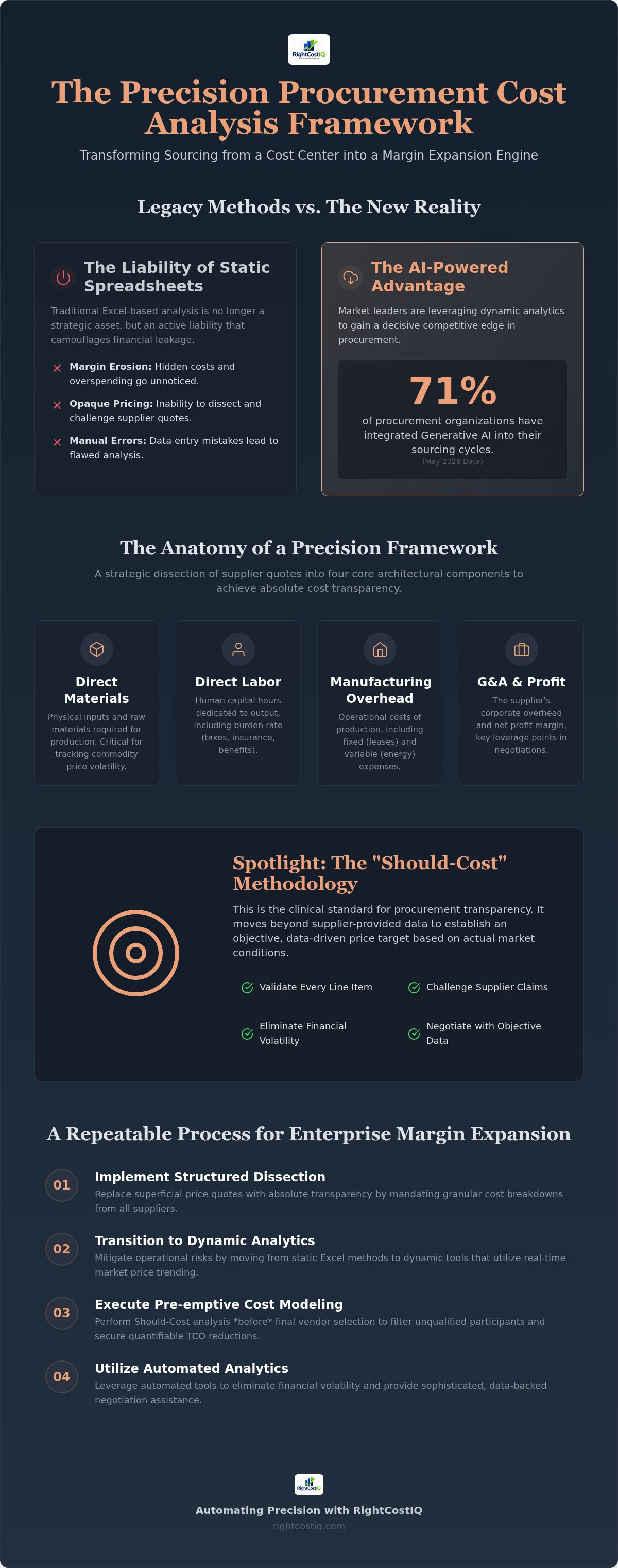
Legacy Excel templates are no longer strategic assets; they are operational liabilities that actively camouflage margin erosion. While 71% of procurement organizations have integrated Generative AI into their sourcing cycles as of May 2026, many leaders remain tethered to opaque supplier pricing and manual data entry errors. You recognize that internal cost structures must align with real-time market intelligence to maintain a competitive advantage. Establishing a sophisticated procurement cost analysis framework is the only way to eliminate these visibility gaps and reclaim control over your bottom line.
This guide provides the architectural blueprints to drive clinical precision in vendor negotiations and enterprise margin expansion. We will dissect the essential components of price optimization, moving beyond basic spend analysis to comprehensive total cost of ownership modeling. You will gain access to repeatable strategic templates designed to facilitate data-backed leverage and quantifiable cost reductions. By benchmarking internal metrics against current 2026 market trends and utilizing predictive analytics, this framework ensures your procurement function operates as a high-performance engine for financial growth.
Key Takeaways
- Implement a structured dissection of supplier cost drivers to replace superficial price quotes with absolute transparency and strategic leverage.
- Mitigate operational risks by transitioning from manual Excel-based methods to dynamic analytics that utilize real-time 2026 market price trending.
- Adopt a repeatable procurement cost analysis framework to mandate granular cost breakdowns and aggregate historical category spend data with clinical precision.
- Execute cost modeling prior to final vendor selection to filter unqualified participants and secure quantifiable reductions in total cost of ownership.
- Utilize automated Should-Cost analytics to eliminate financial volatility and drive enterprise margin expansion through sophisticated negotiation assistance.
The Anatomy of a Precision Procurement Cost Analysis Framework
A precision procurement cost analysis framework functions as a strategic dissection tool rather than a passive reporting mechanism. It operates by breaking down supplier price quotes into granular, elementary drivers to expose the underlying financial architecture of a contract. This level of transparency is no longer optional for organizations targeting aggressive margin expansion. By utilizing a rigorous spend analysis, procurement leaders can identify specific areas of overspending and leverage these insights to secure more favorable terms during vendor negotiations.
The framework prioritizes four core architectural components to establish a baseline for financial scrutiny. Direct materials represent the physical inputs required for production, while direct labor accounts for the specific human capital hours dedicated to the output. Manufacturing overhead covers the operational costs of production facilities, and General and Administrative (G&A) expenses include the supplier's corporate overhead. Analyzing these factors in isolation allows procurement teams to conduct a sophisticated profit margin analysis. Understanding a supplier's net profit on a specific SKU or service line provides the clinical data needed to establish a credible, non-negotiable baseline for contract discussions.
Direct vs. Indirect Cost Drivers in Sourcing
Identifying raw material volatility is critical for managing unit price escalation. In 2026, fluctuations in global commodity markets require real-time tracking to ensure suppliers aren't overcharging based on outdated indices. Beyond materials, calculating the labor burden rate is essential for service-level agreement (SLA) accuracy. This calculation must include payroll taxes, insurance, and benefits to prevent suppliers from inflating labor costs. Additionally, distinguishing between fixed overhead, such as facility leases, and variable overhead, like energy consumption, allows procurement to negotiate pricing structures that scale logically with volume.
The "Should-Cost" Modeling Methodology
Effective procurement moves beyond reliance on supplier-provided data. Strategic architects use independent, data-driven cost estimation to validate every line item in a proposal. By integrating industry benchmarks and market intelligence, organizations can challenge supplier claims regarding overhead allocations and profit expectations. Utilizing advanced Should-Cost analytics empowers decision-makers to enter negotiations with an objective price target based on actual market conditions. Should-Cost modeling serves as the clinical standard for procurement transparency by providing an objective financial blueprint of what a product or service ought to cost based on market fundamentals.
Static Templates vs. Dynamic Procurement Analytics
Manual Excel-based analysis is no longer a viable strategy for enterprise-level sourcing. In 2026, the speed of market fluctuations renders static data obsolete within weeks of collection. With 71% of procurement organizations having adopted Generative AI as of May 2026, the technological gap between market leaders and those using legacy systems is widening. Organizations relying on legacy spreadsheets face significant operational risks, including hidden margin erosion and the inability to respond to rapid commodity shifts. A dynamic procurement cost analysis framework eliminates these vulnerabilities by integrating real-time market intelligence directly into the decision-making cycle. This transition from reactive cost tracking to proactive price risk management is essential for maintaining a competitive edge in volatile global markets.
Automated benchmarking identifies category savings that a static procurement cost analysis framework consistently overlooks. While manual methods focus on historical spend, dynamic analytics prioritize forward-looking price trending. This allows procurement teams to identify optimal buying windows and challenge supplier pricing models with clinical precision. Organizations that fail to automate these functions find themselves at a disadvantage during negotiations. They simply don't have the data-backed leverage required to drive meaningful concessions from sophisticated vendors.
The High Cost of Data Silos in Manual Analysis
Manual data entry remains a primary driver of inaccuracies in multi-tier sourcing. These errors often compound as they move through global, fragmented supply chains, resulting in skewed total cost of ownership (TCO) projections. Centralized procurement analytics solve this by consolidating disparate data streams into a single source of truth. This visibility is vital for C-Suite reporting, where financial leaders demand real-time insights into enterprise spend rather than delayed, manual summaries that lack granular detail.
Leveraging Market Intelligence for Competitive Advantage
Market price forecasting transforms procurement from a back-office function into a strategic architect of financial growth. By anticipating supplier price hikes before they occur, procurement can lock in rates or identify alternative sourcing strategies. This intelligence is particularly effective when conducting a Cost or Price Analysis for sole-source suppliers who traditionally hold significant pricing power. Implementing continuous vendor performance tracking ensures that the cost-to-value ratios established during the RFP cycle are maintained throughout the contract lifecycle. It's time to evaluate how your current processes compare to these clinical standards by requesting a complimentary diagnostic of your procurement data.
Executing the Framework: A 5-Step Strategic Process
Execution of a procurement cost analysis framework requires a methodical transition from passive data collection to tactical application. This process converts raw expenditure into actionable intelligence, ensuring every vendor interaction is backed by clinical data rather than anecdotal evidence. The following five steps establish the operational standard for price optimization in 2026.
- Step 1: Define Analysis Scope. Aggregate historical category spend data to establish a baseline. This requires consolidating decentralized contracts into a single visibility layer to identify volume leverage.
- Step 2: Mandate Granular Breakdowns. Require suppliers to provide elementary cost drivers within the RFP management cycle. Transparency isn't a request; it's a prerequisite for participation.
- Step 3: Validate Supplier Data. Cross-reference reported costs against independent market price trending. This step exposes artificial price inflation before it reaches the negotiation table.
- Step 4: Identify Financial Variance. Calculate the delta between supplier quotes and Should-Cost projections. This variance represents the primary target for margin recovery and enterprise growth.
- Step 5: Synthesize Negotiation Strategy. Transform analysis into an assertive execution plan. Define specific walk-away points and tiered savings targets based on validated benchmarks.
Overcoming Supplier Resistance to Transparency
Suppliers often view cost disclosure as a threat to their margins. You must frame the cost analysis as a mutual efficiency tool designed to eliminate waste within the supply chain. If resistance persists, utilize strict RFP requirements to mandate transparency as a non-negotiable condition for award consideration. For complex, high-value sourcing cycles, engaging professional negotiation assistance provides the expert-led leverage needed to manage high-stakes supplier dialogues without compromising long-term partnerships.
Data Validation and Benchmarking Standards
Clinical precision requires cross-referencing supplier labor rates with regional economic indicators and updated labor indices. This prevents suppliers from applying global averages to low-cost manufacturing regions. Strategic architects must also normalize overhead costs across diverse geographical supply chain tiers to ensure an apples-to-apples comparison. Maintaining compliance with internal procurement and vendor tracking protocols ensures that data integrity remains high throughout the lifecycle. This rigorous validation process transforms the procurement cost analysis framework from a simple template into a strategic weapon for financial optimization.
Integrating Cost Analysis into the RFP Lifecycle
Embedding a procurement cost analysis framework into the sourcing lifecycle prevents the common error of treating financial scrutiny as a late-stage formality. Organizations that delay deep-dive analysis until the final selection phase of an RFP cycle often find themselves choosing between suboptimal options or restarting the process entirely. Effective integration starts at the Request for Information (RFI) stage, where initial cost modeling serves as a primary filter to disqualify vendors whose pricing structures deviate from established market benchmarks. This proactive filtering ensures that technical evaluations are only performed on suppliers with a viable financial architecture.
Scaling this analytical rigor to tail spend management is equally critical for capturing fragmented savings. While high-value categories receive the most attention, the cumulative impact of unmanaged tail spend often accounts for significant margin erosion. Implementing a structured framework across these smaller, high-frequency transactions eliminates the budget leakage associated with inefficient category strategies. Without structured cost data, sourcing teams lack the necessary visibility to identify where these micro-losses occur, resulting in a direct hit to enterprise profitability.
Precision Frameworks for Sourcing Execution
Modern sourcing requires embedding automated cost analysis worksheets directly into digital platforms to maintain data integrity. This approach streamlines the comparison of multiple vendor cost structures, allowing for an objective evaluation based on clinical drivers rather than subjective summaries. RFP management precision directly correlates to enterprise margin expansion by ensuring every dollar committed is validated against clinical cost drivers. Strategic architects use these digital tools to visualize cost deltas in real-time, providing the leverage needed to drive competitive tension throughout the bidding process.
Post-Award Performance and Cost Compliance
The value of a procurement cost analysis framework extends beyond the contract signature. You must ensure that realized savings match the initial projections throughout the entire contract term to prevent "savings leakage." This requires tracking ongoing market price trends to trigger contractual price adjustment clauses when commodity costs decrease. Maintaining a clinical focus on vendor compliance through performance tracking systems guarantees that suppliers adhere to the negotiated cost structures. Analyze your current RFP efficiency with our diagnostic tool to identify where your sourcing lifecycle is losing financial leverage.
Beyond the Template: Automating Precision with RightCostIQ
The manual execution of a procurement cost analysis framework eventually reaches a ceiling of human capability. While spreadsheets provide a basic starting point, they can't account for the velocity of 2026 market dynamics. RightCostIQ represents the necessary evolution from static Excel templates to automated procurement intelligence. Our platform synthesizes disparate data points into a cohesive visibility layer, allowing high-level decision-makers to move beyond historical reporting toward predictive financial strategy. This shift ensures that every sourcing decision is rooted in real-time market reality rather than outdated internal assumptions that don't reflect current economic pressures.
Our proprietary Should-Cost analytics eliminate the guesswork that traditionally plagues high-stakes vendor selection. By automating the dissection of supplier price quotes, the platform identifies the exact financial variance between a vendor's proposal and current market fundamentals. This precision provides C-level executives with absolute visibility into spend under management and a quantifiable procurement ROI. You won't have to guess if a high-value contract is competitive; you'll have the clinical data to prove it. Instead of reacting to price hikes, your team can leverage integrated market price trending and forecasting to anticipate shifts, mitigating financial volatility before it impacts the enterprise bottom line.
Clinical Execution of Category Management
RightCostIQ transforms raw cost data into assertive negotiation levers. Our technology acts as a strategic architect, identifying margin recovery opportunities that manual audits consistently overlook. We support complex enterprise sourcing by providing professional negotiation assistance, effectively serving as a Negotiation Coach to bridge the gap between technical analysis and contract execution. This approach optimizes operational efficiency through data-driven benchmarking, ensuring that your category management strategy remains aligned with the most competitive industry standards available in 2026.
Scalable Solutions for Global Supply Chains
Managing price risk in a shifting 2026 global market requires more than just historical data. It demands automated tracking architectures that ensure supply chain compliance across multiple tiers and geographies. RightCostIQ provides the infrastructure to monitor vendor performance and cost-to-value ratios post-award, securing the savings identified during the initial RFP cycle. The clinical standard for procurement excellence isn't a distant goal; it's a requirement for survival in the current economy. Perform a free procurement diagnostic with RightCostIQ to optimize your outcomes and reclaim your enterprise margins.
Driving Enterprise Margin Expansion through Clinical Analysis
Mastering a procurement cost analysis framework is no longer a luxury; it's a strategic necessity for organizations navigating the complexities of the 2026 global supply chain. You've seen how transitioning from static Excel templates to dynamic, automated analytics eliminates margin erosion and provides the data-backed leverage required for assertive vendor negotiations. By integrating Should-Cost modeling and market price forecasting directly into your RFP lifecycle, you transform procurement from a back-office function into a primary driver of financial growth.
RightCostIQ provides the sophisticated tools and professional negotiation assistance needed to maintain clinical precision across every sourcing cycle. Our proprietary technology ensures that your category strategies remain grounded in real-time benchmarks and objective cost drivers. Don't let opaque pricing structures compromise your enterprise profitability. Master your margins with RightCostIQ’s free procurement diagnostic today. Reclaiming control over your total cost of ownership is the first step toward sustained competitive advantage and operational excellence.
Frequently Asked Questions
What is the primary purpose of a procurement cost analysis framework?
The primary purpose is to decompose supplier pricing into its constituent cost drivers to establish a transparent baseline for negotiations. This procurement cost analysis framework allows leaders to identify hidden margin erosion and secure price optimization through clinical data rather than subjective price quotes. By understanding the underlying financial architecture of a contract, organizations can drive enterprise-wide margin expansion and ensure every commitment of capital is validated against objective market benchmarks.
How does a Should-Cost model differ from a standard supplier cost analysis?
A Should-Cost model uses independent, data-driven market intelligence to estimate what a product or service ought to cost, whereas a standard supplier cost analysis relies on data provided by the vendor. Standard analysis often validates the supplier's logic within their own silo. In contrast, Should-Cost modeling uses regional labor indices and raw material price trending to challenge supplier overhead and profit claims, providing a clinical standard for procurement transparency and negotiation leverage.
Why is it difficult to get suppliers to provide granular cost breakdowns?
Suppliers resist granular disclosure because price transparency often exposes high profit margins and operational inefficiencies. They view cost breakdowns as a threat to their pricing power and a tool for procurement to compress their margins. Overcoming this resistance requires mandating transparency as a non-negotiable condition for RFP participation. You must frame the requirement as an efficiency initiative designed to eliminate waste within the supply chain rather than a confrontational audit of their business model.
Can cost analysis be effectively used for indirect spend and tail spend?
Yes, applying clinical cost analysis to indirect and tail spend is essential for capturing fragmented savings that accumulate to significant enterprise value. While these categories often lack the volume of direct materials, they frequently contain the highest percentage of unmanaged budget leakage. Implementing structured cost data across these high-frequency transactions allows sourcing teams to identify micro-losses and optimize category strategy, ensuring that enterprise-wide spend remains under clinical management and financial control.
How often should a procurement cost analysis be updated for high-volatility categories?
High-volatility categories require continuous monitoring, with formal analysis updates occurring at least quarterly to account for rapid commodity shifts. In the 2026 market, static data becomes obsolete within weeks. Organizations must integrate real-time market price trending to ensure their negotiation baselines reflect current economic conditions. Waiting for annual contract renewals to update your cost modeling results in significant financial risk and the inability to trigger contractual price adjustment clauses when market costs decrease.
What are the most common errors in manual procurement cost templates?
The most frequent errors include manual data entry inaccuracies, failure to normalize overhead across different geographical tiers, and the use of outdated labor indices. Legacy Excel templates within a procurement cost analysis framework often create data silos that prevent real-time visibility. These manual systems lack the integration required to cross-reference supplier quotes against live market intelligence. This leads to skewed total cost of ownership projections and a consistent failure to identify margin recovery opportunities.
How does market price trending influence the results of a cost analysis?
Market price trending provides the external validation needed to challenge supplier-reported data and anticipate future price hikes. By incorporating market intelligence into the analysis, procurement teams can move from reactive cost tracking to proactive price risk management. This forecasting allows you to identify optimal buying windows and establish credible negotiation targets based on actual market fundamentals. It transforms the analysis from a historical snapshot into a strategic tool for mitigating financial volatility.
Is cost analysis necessary if we already have a competitive RFP process in place?
A competitive RFP process only reveals the lowest price among a specific set of bidders; it doesn't reveal if that price is actually fair or optimized. Without a rigorous analysis framework, you are simply choosing the best of available options rather than negotiating toward an objective financial baseline. Cost analysis provides the clinical data needed to challenge prices established by bidders. This ensures you don't overpay due to industry-wide inefficiencies or supplier collusion.


