
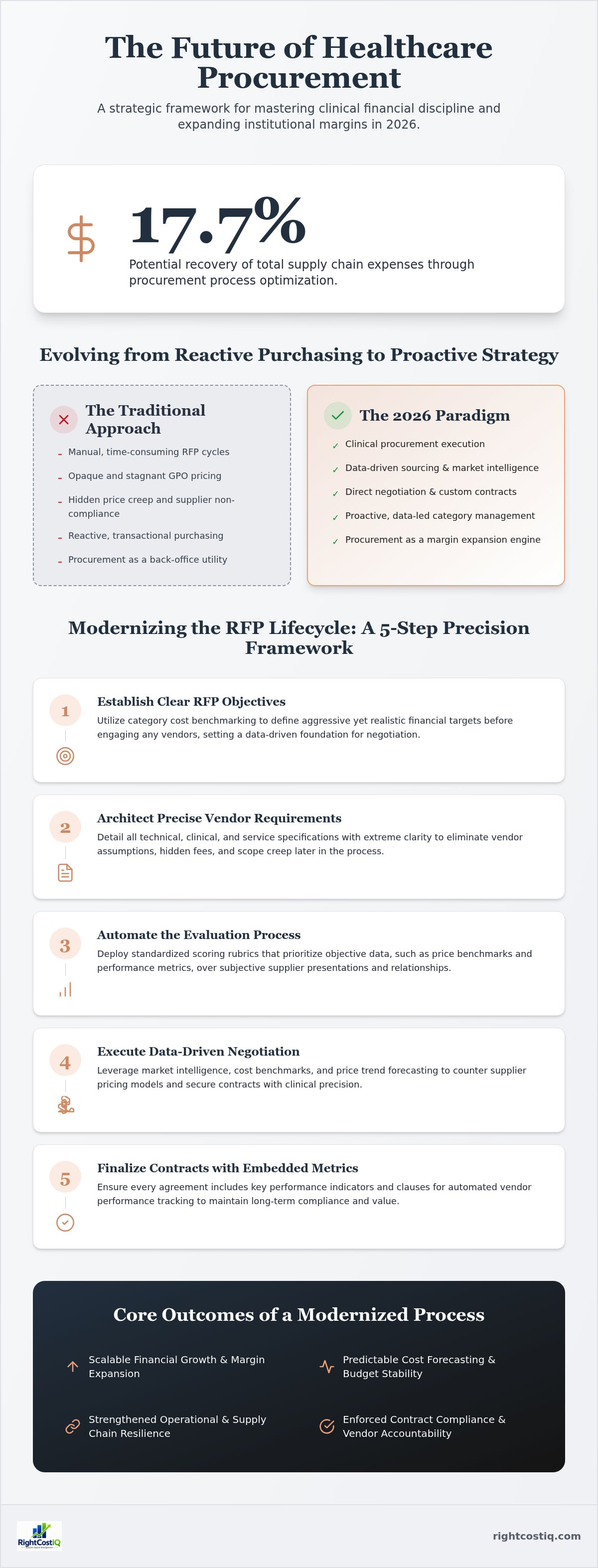
Optimizing procurement processes in healthcare has the potential to recover up to 17.7% of total supply chain expenses. Most health systems remain tethered to manual RFP cycles and opaque pricing structures that consistently erode institutional margins. You likely recognize that supplier non-compliance and hidden price creep are not just administrative hurdles; they're direct threats to your financial stability. Achieving true procurement process optimization requires moving beyond transactional purchasing toward a clinical financial discipline that prioritizes data-driven sourcing and market intelligence.
You understand that the current convergence of rising patient volumes and supply shortages demands a more resilient, automated architecture. This article provides a strategic framework for 2026 to master the clinical execution of healthcare procurement through rigorous RFP management and negotiation assistance. We'll examine proprietary cost benchmarking, price risk management, and automated vendor performance tracking. You'll learn how to leverage market intelligence to ensure predictable cost forecasting and secure clinical precision in every contract negotiation to expand your institutional margins effectively.
Key Takeaways
- Transition from passive supply chain visibility to clinical procurement execution to secure institutional margins against rising inflationary pressures in 2026.
- Adopt a modernized RFP framework that utilizes category cost benchmarking to architect precise vendor requirements and eliminate hidden price creep.
- Leverage market price trending and forecasting services to establish data-driven pricing targets and mitigate the impact of global supply chain volatility.
- Implement automated vendor performance tracking architectures to enforce contract compliance and strengthen operational resilience across all specialized medical categories.
- Prioritize procurement process optimization and professional negotiation assistance as the primary engines for scalable financial growth and sustainable margin expansion.
Evolving from Supply Chain Visibility to Clinical Procurement Execution
Clinical procurement execution represents the terminal stage of supply chain maturity. It integrates high-fidelity data-driven strategy with surgical operational precision. While many organizations settle for simple visibility, true competitive advantage in 2026 stems from the ability to act on intelligence in real time. This evolution transforms the procurement process from a back-office utility into a clinical financial discipline. Relying solely on Group Purchasing Organizations (GPOs) often results in stagnant pricing and missed opportunities for custom contract optimization. High-performing health systems now prioritize direct negotiation and category cost benchmarking to capture lost margins. Margin capture is mandatory. Procurement analytics serve as the primary engine for this transition, bridging the gap between traditional purchasing and modern financial management.
The Regulatory and Financial Stakes of 2026
The healthcare landscape faces unprecedented volatility this year. The global medical devices market is projected to reach USD 797.19 billion in 2026, yet institutional budgets remain under severe pressure. New regulatory mandates, including the mandatory FDA Quality Management System Regulation (QMSR) effective February 2, 2026, increase compliance costs and supply chain complexity. Price transparency laws have stripped away the veil of opaque pricing, making inefficient sourcing a visible financial liability. Organizations that fail to adapt risk insolvency as price creep outpaces reimbursement rates.
Shifting the Procurement Paradigm
Modern healthcare financial management requires redefining procurement as a primary engine for margin expansion. This shift necessitates a transition from reactive, transactional purchasing to proactive, data-led category management. By aligning procurement goals with C-suite financial objectives, departments can demonstrate clear ROI through procurement process optimization. Strategic architects within the supply chain use category cost benchmarking to establish realistic targets before entering negotiations. This proactive stance ensures every dollar spent is optimized for both clinical outcomes and institutional financial health.
Achieving this level of precision requires a scalable infrastructure. Professional RFP management and negotiation assistance provide the tools necessary to capture margin that's typically lost to supplier non-compliance. When procurement functions as a sophisticated financial tool, it provides the C-suite with the predictability needed for long-term capital planning. Transforming the procurement process optimization framework ensures that cost control and supply chain resilience are perfectly aligned for the fiscal challenges ahead.
Modernizing the RFP Lifecycle: A 5-Step Precision Framework
Effective procurement process optimization requires a departure from legacy bidding. High-stakes healthcare sourcing demands a structured, five-step precision framework to ensure financial growth and clinical alignment. This architecture transforms the Request for Proposal from a simple inquiry into a rigorous financial instrument. By following a methodical progression, health systems can eliminate the ambiguities that typically lead to price creep and supplier non-compliance.
- Establish clear RFP objectives: Use category cost benchmarking to define aggressive yet realistic financial targets before engaging the market.
- Architect precise vendor requirements: Detail technical and clinical specifications to remove vendor assumptions and hidden service fees.
- Automate the evaluation process: Deploy scoring rubrics that prioritize objective data over subjective supplier presentations.
- Execute data-driven negotiation: Utilize market intelligence to counter supplier pricing models with clinical precision.
- Finalize contracts with embedded metrics: Ensure every agreement includes automated vendor performance tracking to maintain long-term compliance.
Drafting High-Performance RFP Documents
Precision starts with the document architecture. Utilizing professional RFP management services allows organizations to standardize sourcing across complex medical categories. You must include data points such as total cost of ownership, regulatory compliance timelines, and specific logistics requirements. This approach aligns with a strategic framework for procurement that prioritizes institutional resilience over transactional speed. Avoid the pitfall of generic templates. Standardized healthcare sourcing requests must account for the 2026 FDA Quality Management System Regulation (QMSR) to prevent future supply chain disruptions. Detailed documentation prevents vendors from burying margin in vague service level agreements.
The Role of Negotiation Coaching
Negotiation is a clinical discipline, not a soft skill. Leveraging negotiation coach tools provides your team with the leverage points necessary to challenge entrenched supplier pricing. By identifying supplier vulnerabilities through market price trending, you can capture value that exists far beyond the initial price quote. This process involves analyzing vendor margins and historical price volatility to secure favorable terms. Capturing lost margin requires an assertive stance backed by real-time analytics. Successful procurement process optimization hinges on your ability to maintain this pressure throughout the contract lifecycle. It's about securing the bottom line through relentless data application.
You can begin refining your sourcing strategy today by exploring how advanced procurement analytics can transform your next RFP cycle into a driver of institutional growth.
Cost Benchmarking vs. Market Volatility: Data-Driven Pricing Strategies
Market volatility remains the primary disruptor of healthcare financial stability in 2026. With the global medical devices market projected to reach USD 797.19 billion this year, institutional leaders can't afford to rely on historical spend data alone. True procurement process optimization demands a shift toward predictive pricing models that account for external market shifts and inflationary pressures. This approach moves beyond simple spend visibility to active price risk management, ensuring that every contract is anchored in current market realities rather than outdated supplier models.
Predictive procurement models integrate internal spend analytics with external market intelligence. This intersection allows health systems to forecast future supply chain costs with surgical precision. By identifying the early warning signs of price creep, procurement teams can proactively adjust sourcing strategies before margins are compromised. This proactive stance is essential for maintaining operational resilience in a post-inflationary market where supplier pricing often lacks transparency.
Executing Precise Cost Benchmarking
Effective benchmarking requires more than just comparing invoices. It involves identifying should-cost models for high-value categories like surgical instruments, which saw a 92.62% year-over-year buyer growth on global platforms recently. Using should-cost analytics allows your team to challenge supplier quotes with objective data. You must benchmark against regional and national market averages to ensure your facility isn't overpaying for standardized medical commodities. This data-led approach provides the leverage needed to secure aggressive pricing targets during the RFP cycle.
Managing Price Risk and Market Trends
Strategic forecasting serves as a critical lever in long-term contract negotiations. Developing a dedicated price risk management tracking service enables you to monitor market price trending in real-time. This intelligence allows you to lock in favorable rates before projected market spikes occur. Identifying early warning signs of supply chain price creep, such as raw material shortages or regulatory shifts, provides the lead time necessary to diversify your supplier base. Procurement process optimization isn't a one-time event; it's a continuous cycle of monitoring and adjustment that protects your bottom line from unforeseen market shocks.
Vendor Performance Tracking: Ensuring Compliance and Operational Resilience
Vendor compliance represents the final, critical hurdle in procurement process optimization. Strategic pricing and data-driven RFP architectures are ineffective if the supply chain fails during execution. Manual oversight is no longer a viable strategy for 2026 health systems. Automated vendor performance tracking architectures ensure contract terms are met in real time, reducing supply chain risk and protecting clinical operations from unpredicted shortages. High-level decision-makers must treat vendor performance as a financial metric that directly impacts institutional liquidity.
Vendor non-performance carries a heavy economic burden. Clinical delays caused by low fill rates or extended lead times necessitate emergency spot-buying at premium market rates. This reactive purchasing erodes the margins secured during the initial negotiation phase. By integrating performance data back into the RFP management cycle, organizations create a closed-loop system. This feedback loop allows for the continuous refinement of supplier selection based on actual reliability rather than theoretical promises.
Architecting a Performance Tracking System
A robust tracking system relies on clearly defined Key Performance Indicators (KPIs). You must prioritize metrics such as fill rates, lead time consistency, and invoice price accuracy. Price accuracy is particularly vital; "price creep" often occurs at the point of invoicing despite negotiated contract rates. Utilizing automated vendor performance tracking services provides the real-time visibility needed to identify these discrepancies immediately. Linking this data to contract renewal strategies ensures that only high-performing partners remain in your institutional network, strengthening long-term operational resilience.
Addressing the Tail Spend Challenge
Managing the unmanaged is a core component of modern margin expansion. Tail spend optimization strategies target the fragmented, low-value procurement categories that typically escape rigorous oversight. These categories often account for a disproportionate number of vendors, creating administrative bloat and hidden costs. Reducing vendor fragmentation in these areas simplifies compliance tracking and consolidates purchasing power. For a deeper analysis of structured sourcing, review our framework on Category Management in Procurement: A Clinical Framework for Margin Expansion (2026). This strategic consolidation is a primary driver of efficiency in complex healthcare environments.
You can identify hidden inefficiencies in your current vendor network by conducting a comprehensive procurement diagnostic to baseline your performance metrics today.
Integrating Advanced Procurement Analytics for Margin Expansion
The final phase of procurement process optimization centers on the integration of advanced analytics into the institutional financial reporting structure. Data collection alone doesn't drive growth; strategic execution based on that data does. Enterprise health systems must build a scalable procurement infrastructure that translates raw sourcing metrics into tangible margin expansion. By moving beyond transactional tracking, organizations use procurement as a primary lever for financial stability in 2026. This transition requires a shift from viewing procurement as a cost center to recognizing it as a sophisticated engine for capital preservation.
Professional RFP management and negotiation assistance deliver a high ROI by capturing margins typically lost to supplier-led pricing models. While competitors often measure success by time saved, the clinical procurement framework prioritizes financial risk mitigation and margin capture. The future of healthcare sourcing lies in AI-led optimization. Predictive algorithms now identify pricing anomalies and negotiation leverage points before the RFP cycle even begins. This technological integration bridges the gap between high-level financial strategy and granular technical execution.
Quantifying the Impact of Strategic Procurement
Institutional leaders must measure "spend under management" as a primary financial metric. This KPI tracks the percentage of total expenditure subjected to rigorous, data-driven sourcing protocols. Reporting these procurement-led savings to the C-suite requires precision and objective data. Clear, analytical reporting demonstrates how procurement process optimization directly contributes to the bottom line. For deep technical analysis of these frameworks, read our guide on RFP Management: Strategic Frameworks for AI-Led Procurement Optimization. Precision in reporting builds the trust necessary for continued investment in supply chain technology.
Next Steps for Procurement Transformation
Executing a transformation requires immediate action on three fronts. First, conduct a comprehensive procurement category cost analysis to baseline your current spend against 2026 market benchmarks. Second, engage professional RFP management services to secure immediate ROI on upcoming high-value contracts. Finally, request a Free Procurement Diagnostic to identify specific areas where your current architecture is leaking margin. These steps ensure your organization is prepared for the regulatory and financial pressures of the coming fiscal years. Transitioning to a proactive, data-led model isn't just an operational upgrade; it's a financial necessity.
Securing Institutional Margins Through Strategic Procurement Architecture
The transition toward clinical procurement execution is no longer optional for health systems facing the fiscal complexities of 2026. Successful procurement process optimization requires an integrated architecture that combines rigorous RFP management with automated vendor performance tracking. By anchoring your sourcing strategy in proprietary cost benchmarking and market intelligence, you move beyond reactive purchasing to proactive margin expansion. This framework ensures that every contract aligns with clinical requirements while protecting the institutional bottom line from hidden price creep and supplier non-compliance. Data-driven precision is the only viable path to operational resilience in a volatile market.
RightCostIQ provides the specialized healthcare procurement analytics and expert negotiation assistance necessary to secure high-value contracts across global enterprise health systems. It's time to bridge the gap between high-level financial strategy and technical execution. You can begin identifying lost margin and streamlining your RFP cycles immediately to capture immediate ROI. Optimize your healthcare procurement outcomes with a Free Diagnostic. Precision in execution remains your most powerful tool for sustainable financial growth and institutional stability.
Frequently Asked Questions
What are the primary challenges in healthcare procurement for 2026?
Primary challenges include workforce constraints, patient volume surges, and mandatory compliance with the FDA Quality Management System Regulation (QMSR) effective February 2, 2026. New international classification systems, such as Circular 57 in Vietnam and Thailand's labeling regulations, add layers of global complexity. These pressures necessitate a move away from manual, fragmented systems toward integrated, automated solutions that maintain supply chain resilience amidst tightening regulatory scrutiny and significant market growth.
How does RFP management improve healthcare supply chain efficiency?
RFP management standardizes the sourcing process by architecting precise vendor requirements that eliminate technical ambiguities. This precision reduces time spent on clarification cycles and ensures that bids are evaluated against objective clinical and financial criteria. By automating the evaluation phase, health systems can accelerate decision-making and ensure that contract awards are based on data-driven performance metrics. This systematic approach directly supports procurement process optimization by removing manual bottlenecks in the selection cycle.
What is the difference between cost benchmarking and spend analysis?
Spend analysis focuses on internal historical data to identify where capital was allocated across specific categories. Cost benchmarking, conversely, incorporates external market intelligence to determine what those categories should cost based on regional and national averages. While spend analysis provides visibility into past patterns, cost benchmarking establishes the aggressive financial targets required for future negotiations. Integrating both allows for a comprehensive strategy that identifies internal inefficiencies while leveraging external market realities to capture lost margin.
How can healthcare organizations mitigate price risk in volatile markets?
Organizations mitigate price risk by deploying market price trending and forecasting services that provide real-time visibility into raw material shifts and inflationary trends. This predictive modeling allows procurement teams to lock in favorable rates before projected market spikes occur. By identifying early warning signs of supply chain price creep, health systems can diversify their supplier base or adjust inventory levels. This proactive strategy transforms procurement into a primary driver of financial stability during periods of global economic volatility.
Why is vendor performance tracking critical for regulatory compliance?
Vendor performance tracking ensures that suppliers adhere to the strict regulatory standards mandated by the FDA and other international bodies. By automating compliance monitoring, health systems can verify that vendors maintain the necessary certifications and quality management systems in real time. This continuous oversight reduces the risk of institutional liability and ensures that clinical operations aren't compromised by non-compliant components. It acts as a fail-safe mechanism that links operational execution directly to regulatory requirements.
How does tail spend management impact the total cost of procurement?
Tail spend management targets the fragmented, low-value expenditure that typically involves a high volume of unmanaged vendors. Optimizing these categories reduces administrative bloat and vendor fragmentation, which account for significant hidden operational costs. Consolidating this spend into structured contracts allows for better pricing leverage and simplified compliance tracking. Addressing these neglected categories isn't just an administrative task; it's a critical component of procurement process optimization that captures the cumulative margin lost through decentralized purchasing.
What role does technology play in modernizing healthcare sourcing?
Technology unifies sourcing, contracting, and supplier risk management onto a single data model, replacing fragmented legacy systems. Digital platforms enable the automation of repetitive tasks like vendor performance tracking and RFP evaluation, allowing procurement teams to focus on strategic financial execution. Advanced analytics and forecasting provide the market intelligence necessary to challenge entrenched supplier pricing models. This digital infrastructure serves as the foundation for a scalable procurement department capable of supporting complex, enterprise-level health systems in 2026.
How can negotiation coaching capture additional value in medical contracts?
Negotiation coaching provides procurement teams with the technical upskilling and market intelligence needed to identify supplier leverage points. By analyzing vendor margins and historical price volatility, coaches help teams move beyond initial quotes to secure more favorable terms. This process doesn't just focus on price; it captures value through improved service level agreements and better payment terms. It transforms a standard purchasing interaction into a sophisticated financial transaction that maximizes institutional margin and ensures long-term contract compliance.


