
Information asymmetry is the silent architect of margin erosion in modern supply chains. While the procurement analytics market is projected to reach between $6.75 billion and $8.15 billion by 2026, many organizations remain trapped in inefficient RFP cycles that rely on historical data rather than real-time intelligence. You likely recognize that manual price tracking and fragmented vendor data create significant vulnerabilities during high-stakes negotiations.
This guide provides a strategic framework to master the integration of ai in procurement to reclaim your competitive advantage. By shifting from reactive sourcing to a clinical, data-driven model, you'll secure the leverage necessary for sustained margin expansion. We'll explore the transition to agentic AI systems that facilitate automated cost benchmarking, predictive price risk management, and precision vendor performance tracking. This is the roadmap for evolving procurement from a back-office cost center into a primary driver of institutional financial growth.
Key Takeaways
- Transition from basic automation to agentic AI workflows to capture maximum value across the entire sourcing lifecycle.
- Leverage 'Should-Cost' modeling to eliminate information asymmetry and secure clinical negotiation leverage before an RFP is even issued.
- Replace static price lists with dynamic, AI-powered cost benchmarking to identify and capture category-specific margin expansion opportunities.
- Deploy real-time market price trending and predictive analytics to proactively manage price risk and vendor performance.
- Establish a centralized data architecture to ensure the successful integration of ai in procurement and drive long-term operational efficiency.
Defining AI in Procurement: Beyond the Hype of Basic Automation
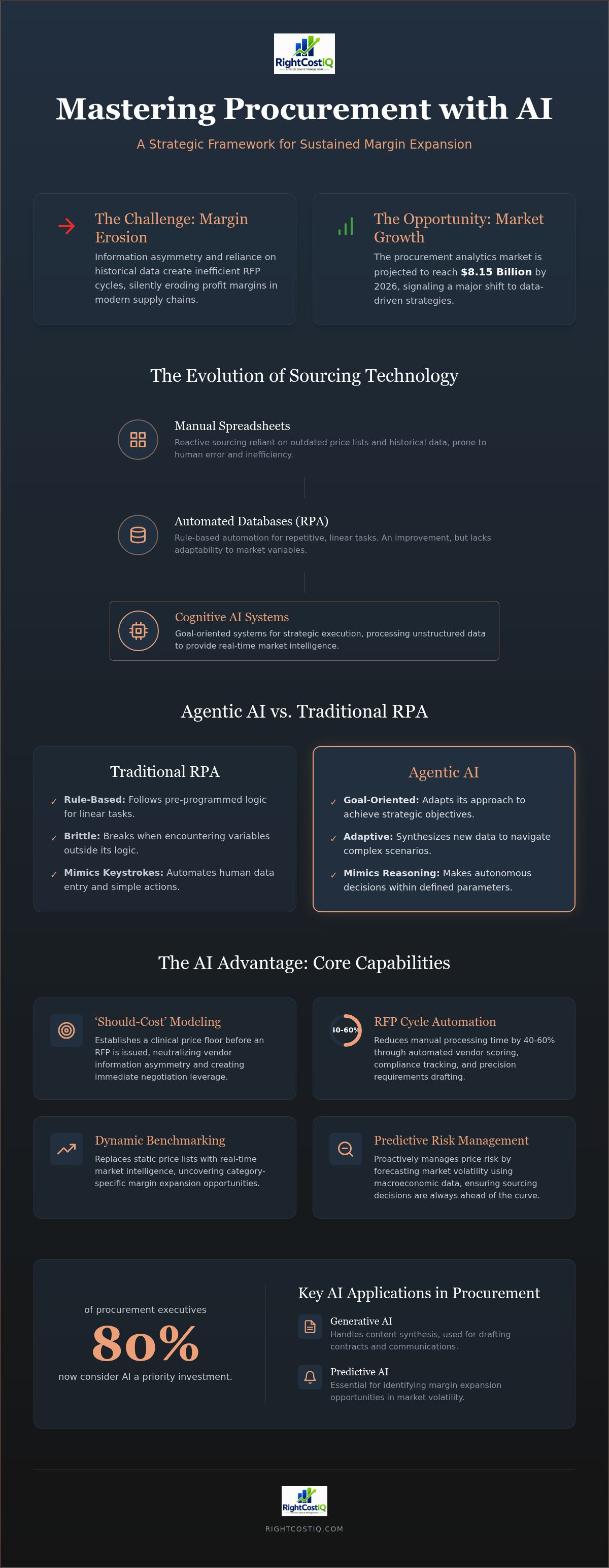
AI in procurement represents a fundamental shift from human-led data entry to machine-led strategic execution. It integrates machine learning and agentic workflows to optimize every phase of the sourcing lifecycle. With 80% of procurement executives now considering AI a priority investment, decision-makers must distinguish between Generative AI, used for drafting contracts, and Predictive AI, which is essential for market price trending. While Generative AI handles content synthesis, Predictive AI identifies the margin expansion opportunities hidden within market volatility.
The strategic urgency of 2026 demands a transition to "Agentic Procurement." This model moves beyond simple process automation toward systems that execute tactical tasks based on high-level financial goals. However, the efficacy of these tools depends entirely on the clinical precision of the underlying data. Without rigorous data hygiene, ai in procurement cannot generate the clinical negotiation leverage required to outperform competitors. Precision is the non-negotiable prerequisite for financial optimization.
The Evolution of Sourcing Technology
The trajectory of sourcing technology has moved from manual spreadsheets to automated databases, and finally to cognitive systems. Modern architectures now utilize AI to process unstructured vendor data, such as legacy contracts and fragmented email threads, which often obscure the true state of the procurement process. By converting this unstructured noise into structured intelligence, AI enables real-time cost benchmarking. This allows procurement teams to move from historical reporting to active market intelligence, ensuring that every sourcing event is informed by current category-specific data rather than outdated price lists.
Agentic AI vs. Traditional Robotic Process Automation (RPA)
Understanding the distinction between RPA and Agentic AI is critical for infrastructure planning. RPA is rule-based; it excels at repetitive, linear tasks but breaks when encountering variables outside its programmed logic. Agentic AI is goal-oriented and adaptive. It's particularly effective for complex negotiation assistance because it can synthesize multiple data points to recommend the best path forward. While RPA mimics human keystrokes, Agentic AI mimics human reasoning within defined strategic parameters. Agentic AI is a system capable of autonomous decision-making within procurement guardrails. This autonomy allows procurement leaders to focus on high-level strategy while the AI manages the granular execution of cost-reduction initiatives.
AI-Enhanced RFP Management: Precision in Sourcing Cycles
The 2026 standard for RFP management demands a departure from reactive vendor selection. In this era, ai in procurement acts as a strategic gatekeeper that validates market conditions before a single bid is invited. Central to this framework is the predictive identification of a 'Should-Cost' model. By synthesizing historical spend, real-time commodity indices, and macroeconomic labor data, AI establishes a clinical price floor. This upfront intelligence ensures that the procurement team enters the market with a definitive benchmark, effectively neutralizing the information asymmetry that vendors typically exploit during the discovery phase.
Automated vendor scoring and compliance tracking now operate with surgical accuracy. Modern systems evaluate responses against pre-defined technical rubrics in milliseconds, eliminating the subjective bias inherent in human review. Early adopters of these AI architectures report a 40-60% reduction in manual processing time. This efficiency doesn't just save time; it accelerates the realization of captured savings, allowing strategic leads to focus on final-stage tactical leverage rather than administrative data entry.
Automating the RFP Lifecycle for Enterprise Efficiency
Effective RFP Management Services now utilize AI to draft technical requirements with such precision that scope creep is virtually eliminated. The system analyzes past project failures and change-order patterns to suggest airtight specifications. During the bidding phase, AI manages real-time clarification requests, ensuring every vendor receives identical, synchronized updates. This level of coordination maintains a high-intensity competitive environment, forcing vendors to submit their most aggressive pricing from the outset. Organizations seeking to optimize their sourcing infrastructure can integrate these analytics into their existing workflows at RightCostIQ.
Vendor Performance Tracking through AI Architectures
The sourcing cycle doesn't end at contract execution. AI architectures now provide continuous monitoring of post-contract compliance and KPI achievement. By linking real-time performance data back to the original RFP commitments, organizations build a repository of objective vendor truth. This data becomes critical leverage for future sourcing events; it ensures that underperformers are identified and high-performers are rewarded with strategic volume. For a deeper analysis of these methodologies, consult our resource on RFP Management: Strategic Frameworks for AI-Led Procurement Optimization. Continuous performance tracking creates a feedback loop that refines future 'Should-Cost' models, ensuring your procurement strategy remains resilient against market fluctuations.
Benchmarking and Market Price Trending: The Analytics Advantage
Static price lists are a strategic liability in volatile markets. The 2026 procurement standard has shifted toward dynamic, AI-powered cost benchmarking that updates in real-time. By utilizing ai in procurement, organizations can move beyond historical spend analysis to capture category-specific savings through high-velocity data-driven sourcing. This methodology analyzes millions of external market signals to identify the "bottom of the market," allowing procurement leads to time contract renewals and spot purchases with clinical precision. Benchmarking is no longer a periodic exercise; it's the primary driver for financial growth metrics, ensuring that every dollar of spend is optimized against the most current global indices.
Predictive Price Risk Management
Predictive price risk management functions as a financial hedge against supply chain volatility. By integrating Should-Cost Analytics, teams gain total transparency into the raw material, labor, and logistics components that dictate vendor pricing. AI models process global economic indicators, from currency fluctuations to geopolitical shifts, to forecast potential disruptions before they impact the bottom line. This foresight allows for the proactive restructuring of agreements, mitigating risk and protecting margins during periods of high inflation or resource scarcity.
AI-Driven vs. Manual Benchmarking Comparison
Manual benchmarking is obsolete in a high-inflation environment where price data decays within weeks. The following table illustrates the performance gap between traditional methods and AI-integrated architectures:
| Metric | Manual Benchmarking | AI-Driven Analytics |
|---|---|---|
| Data Frequency | Quarterly or Annual | Real-time / Continuous |
| Accuracy | Subjective and Sample-based | Objective and Comprehensive |
| Category Depth | High-spend categories only | Granular across all spend tiers |
| Strategic Impact | Reactive cost-cutting | Proactive margin expansion |
Manual processes lack the scalability to monitor thousands of SKUs, leading to significant "leakage" in tail-spend categories. Automated spend analytics deliver a demonstrable ROI by capturing these missed savings and reallocating them to strategic initiatives. Organizations that deploy these systems transition from defensive cost-avoidance to offensive financial optimization, securing a dominant position in their respective markets.
Strategic Negotiation in the Age of AI: Data as Leverage
Negotiation has transitioned from an interpersonal art form to a technical discipline rooted in algorithmic insights. The primary objective is the total elimination of vendor information asymmetry. By utilizing ai in procurement, sourcing teams enter discussions equipped with a clinical understanding of market realities. This isn't about soft skills or personal rapport. It's about the assertive application of 'Should-Cost' data to dismantle vendor pricing justifications. When procurement leads possess a machine-verified price floor, the power dynamic shifts permanently in favor of the buyer.
Algorithmic insights provide a level of transparency that was previously impossible. During high-value contract renewals, AI identifies specific points of margin erosion and provides the exact data points needed to reclaim them. This technical approach ensures that negotiations are driven by objective market price trending rather than vendor-supplied narratives. The result is a clinical execution of sourcing strategy that prioritizes financial growth metrics above all else.
The Negotiation Coach: AI-Powered Tactical Support
Accessing specialized Negotiation Assistance allows enterprises to simulate high-stakes interactions before they occur. These systems function as a strategic architect, analyzing years of historical vendor behavior to predict likely counter-arguments. This preparation ensures that sourcing teams aren't caught off guard by sudden price escalations or service tier adjustments. Additionally, advanced sentiment analysis in vendor communications identifies subtle shifts in tone that indicate underlying risk or flexibility. These insights transform every email and meeting into a data point for strategic leverage, ensuring your team remains the dominant party in every exchange.
Mitigating Volatility in Contract Negotiations
Volatile markets require index-based pricing models that adjust automatically based on AI-verified trends. Rather than locking into fixed rates that favor the vendor during market downturns, procurement teams now negotiate formulas that protect the organization's bottom line. AI also identifies hidden margin expansion opportunities within tail spend, where fragmented purchasing often conceals significant waste. By aggregating these low-visibility categories, AI creates the volume necessary for meaningful negotiation leverage. For a more detailed breakdown of this approach, refer to our framework on Category Management.
The result is a clinical negotiation process where outcomes are determined by data rather than conjecture. To evaluate how your current negotiation strategy compares to 2026 industry standards, access our free diagnostic to identify immediate leverage opportunities in your vendor portfolio.
Implementing AI Infrastructure for Sustainable Margin Expansion
Successful integration of ai in procurement requires a departure from siloed data practices. The roadmap begins with rigorous data hygiene, ensuring that internal spend records are cleaned, categorized, and centralized. Without this foundation, even the most advanced predictive models will produce flawed outputs. As the procurement analytics market scales toward an estimated $8.15 billion in 2026, the priority shifts from experimental pilots to enterprise-wide clinical execution. This transition involves embedding AI directly into existing ERP and S2P infrastructure to ensure seamless data flow and real-time decision support. RightCostIQ acts as the strategic architect in this process, aligning technical capabilities with specific financial growth targets.
The move from pilot programs to full-scale implementation is the primary differentiator for high-growth firms. While over 60% of organizations have initiated AI pilots as of 2026, many struggle to bridge the gap between testing and operational reality. Scaling requires a disciplined approach to change management and a commitment to data-driven sourcing. By centralizing analytics, procurement leaders gain a holistic view of the global supply chain, allowing for the proactive mitigation of price risks and the clinical tracking of vendor performance across the entire enterprise.
Addressing Tail Spend through AI Automation
AI is uniquely suited for Tail Spend Management because it can process the high-volume, low-value transactions that human teams typically ignore. This "hidden 20%" of spend often contains significant margin erosion due to unmanaged vendor pricing and a lack of competitive bidding. Automated systems can analyze these fragmented categories, identify consolidation opportunities, and execute micro-RFPs without human intervention. Capturing these savings doesn't just improve the bottom line; it reallocates human capital toward high-stakes strategic initiatives that require complex reasoning and high-level negotiation leverage.
The Future of the Procurement Professional
The role of the procurement professional is evolving from tactical buying to strategic management. AI doesn't replace the strategist; it provides the clinical data necessary to lead with authority. Professionals must now focus on high-level data interpretation, market analytics, and the management of agentic AI workflows. Upskilling in these areas is essential for anyone seeking to maintain a competitive edge in a market where the compound annual growth rate for procurement analytics exceeds 22%. To begin this transition and secure your position as a strategic driver of growth, conduct a Procurement Optimization Assessment to identify immediate infrastructure gaps and high-ROI automation opportunities.
Securing Competitive Dominance through Algorithmic Sourcing
The transition to agentic workflows represents a permanent shift in how enterprises manage their supply chain capital. Mastering the integration of ai in procurement is the only path to eliminating the information asymmetry that historically favors vendors. By deploying clinical cost benchmarking and predictive price risk management, your organization can move from reactive cost-cutting to proactive margin expansion. This data-driven approach ensures that every RFP cycle and contract renewal is executed with surgical precision, maximizing financial growth metrics across all spend categories.
RightCostIQ acts as your strategic partner in this technological evolution. We provide the specialized analytics and expert negotiation coach services necessary to convert raw market intelligence into tangible bottom-line results. Our framework prioritizes operational efficiency and deep industry expertise, ensuring your procurement infrastructure is resilient against market volatility. The opportunity to redefine your department as a primary driver of corporate value is here. Optimize your sourcing outcomes with RightCostIQ’s clinical RFP management and negotiation assistance. We look forward to architecting your procurement transformation.
Frequently Asked Questions
How exactly does AI improve RFP management?
AI optimizes RFP management by automating technical requirement drafting and objective vendor scoring. It utilizes historical performance data and market benchmarks to identify scope creep risks before bid issuance. By processing unstructured vendor responses in milliseconds, it reduces manual review time by 40% to 60%. This acceleration allows procurement teams to focus on final stage tactical leverage rather than administrative data entry, ensuring a more competitive and synchronized bidding environment.
Is AI in procurement only for large enterprises?
AI in procurement is accessible to organizations of all sizes due to the proliferation of scalable SaaS platforms. While enterprise suites often require significant license fees, mid-market platforms are available for budgets ranging from $7,000 to $60,000 annually. These tools allow smaller teams to capture margin expansion opportunities previously reserved for large corporations. Smaller entities specifically benefit from automated tail spend management, which captures fragmented spend without increasing headcount.
What is the difference between spend analysis and AI-driven spend analytics?
Traditional spend analysis is a reactive, historical review of static data often plagued by categorization errors. AI-driven spend analytics utilizes machine learning to provide real-time, predictive insights across millions of data points. This clinical approach identifies granular savings opportunities by linking internal spend to global market indices. It transforms procurement from a reporting function into a strategic driver of financial growth through continuous, automated cost benchmarking and spend categorization.
Can AI help with vendor risk and compliance tracking?
AI enhances vendor risk management by providing continuous monitoring of post-contract compliance and KPI achievement. It utilizes sentiment analysis and global market signals to detect early indicators of vendor instability or service degradation. By linking real-time performance data to original RFP commitments, AI builds an objective repository of vendor truth. This clinical tracking allows procurement leaders to proactively restructure agreements or switch vendors before disruptions impact the organizational bottom line.
What is a 'Should-Cost' model in AI procurement?
A 'Should-Cost' model is a predictive price floor generated by synthesizing raw material costs, labor data, and logistics indices. In an ai in procurement framework, this model eliminates information asymmetry by establishing a clinical benchmark before negotiations begin. It allows procurement teams to dismantle vendor pricing justifications with objective data. By understanding the underlying cost drivers of a product or service, organizations secure the leverage necessary to drive sustained margin expansion.
How does AI provide leverage in vendor negotiations?
AI provides negotiation leverage by simulating vendor counter-arguments and providing real-time tactical assistance. It utilizes market price trending to identify the exact bottom of the market for contract timing. This technical approach ensures that discussions are driven by algorithmic insights rather than interpersonal rapport. Procurement teams equipped with AI-verified price data can assertively challenge vendor narratives, shifting the power dynamic permanently in favor of the buyer during high-stakes renewals.
What are the first steps for a CPO to implement AI in 2026?
The primary step is establishing rigorous data hygiene and a centralized analytics architecture. CPOs must first audit existing procurement infrastructure to ensure data is cleaned and categorized for machine consumption. Following this, the transition moves from targeted pilot programs to enterprise-wide clinical execution. Upskilling the workforce in data-driven negotiation and market analytics is also essential to ensure that human strategists can effectively manage and interpret agentic AI workflows for maximum ROI.
How does AI-driven market price trending mitigate financial risk?
AI-driven market price trending mitigates financial risk by forecasting supply chain disruptions and price volatility through global economic indicators. These models process real-time data from currency fluctuations and geopolitical shifts to predict cost escalations before they occur. This foresight allows for the proactive implementation of index-based pricing models that protect margins. By identifying optimal contract timing, organizations can hedge against inflation and ensure their sourcing strategy remains resilient in high-volatility environments.


