

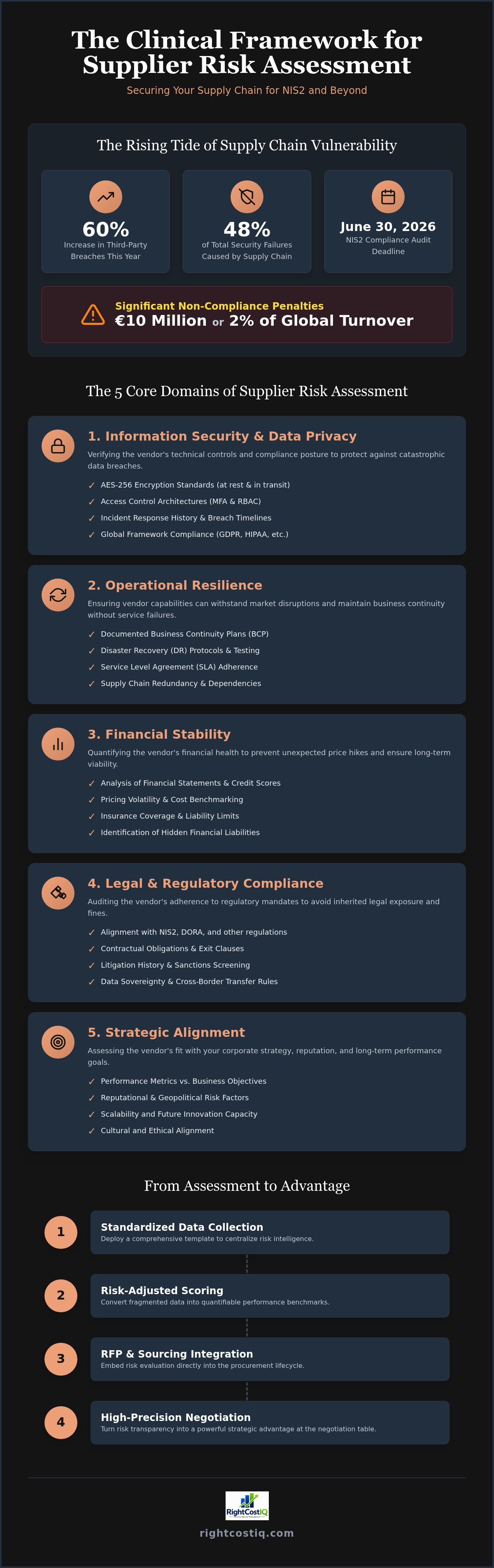
Third-party breaches increased by 60% this year, accounting for 48% of total security failures. This surge in supply chain vulnerability coincides with the June 30, 2026, NIS2 compliance audit deadline, where essential entities face fines of at least €10 million or 2% of global annual turnover. For procurement leaders, a standardized supplier risk assessment template is no longer optional; it's a critical tool for mitigating fragmented risk data and unexpected price hikes that threaten margin stability.
You recognize that a reactive approach to vendor management creates regulatory exposure and weakens your negotiation position. This article provides a clinical framework designed to execute high-precision evaluations that protect financial growth. By centralizing risk intelligence, you'll ensure supply chain compliance while gaining the transparency needed for aggressive cost benchmarking. We'll preview a repeatable system that aligns procurement with compliance to turn risk mitigation into a strategic advantage.
Key Takeaways
- Transition from superficial security audits to a clinical due diligence framework that secures the entire procurement lifecycle against regulatory penalties.
- Deploy a comprehensive supplier risk assessment template to standardize data collection across five critical domains, ensuring operational continuity and compliance.
- Utilize advanced cost benchmarking to detect hidden financial risks and pricing volatility before they impact your corporate margins.
- Embed risk-adjusted scoring into your RFP process to convert fragmented vendor data into high-precision negotiation leverage.
- Scale procurement efficiency by integrating vendor performance tracking with expert-led negotiation assistance for sustained financial optimization.
Defining the Strategic Scope of Vendor Risk Assessment
Vendor risk assessment is a methodical due diligence process designed to evaluate the operational and financial viability of third-party entities. In high-stakes corporate environments, this assessment functions as a clinical diagnostic tool rather than an administrative formality. While many organizations treat these evaluations as isolated security audits, true procurement resilience requires a holistic approach. A robust supplier risk assessment template must integrate financial health, regulatory compliance, and performance metrics to provide a 360-degree view of the vendor ecosystem.
This strategic shift from narrow technical audits to a comprehensive Vendor Risk Management Overview ensures that every partnership aligns with enterprise-wide resilience standards. When risk transparency is embedded directly into the sourcing and procurement lifecycle, it transforms raw data into a powerful negotiation lever. Procurement teams can then identify hidden liabilities before they impact margins or trigger non-compliance penalties. It's about moving beyond reactive fire-fighting and toward a model of strategic architectural control.
The Objective of Clinical Risk Execution
Precision in risk execution serves three primary functions that directly impact financial stability. First, it enables proactive vulnerability identification, detecting operational weaknesses before they manifest as service failures or supply chain disruptions. Second, it allows for economic impact quantification, where you calculate the potential financial loss associated with a third-party failure to protect the bottom line. Finally, it ensures resilience alignment, confirming that vendor capabilities and disaster recovery protocols match your organization's specific risk tolerance levels. By treating risk as a measurable variable, decision-makers can optimize their vendor portfolio based on data-driven performance benchmarks rather than subjective trust.
Why Traditional Checklists Fail in 2026
Static, once-a-year security questionnaires are fundamentally obsolete. In a market defined by rapid regulatory shifts like NIS2 and DORA, a compliance-only mindset creates a dangerous false sense of security. Traditional methods fail because they rely on fragmented data points that don't communicate across departments. When procurement teams use a disconnected supplier risk assessment template, they often miss strategic blind spots such as vendor price hikes or geopolitical instability. Modern procurement requires dynamic, real-time intelligence that integrates risk data into the daily flow of financial decision-making. Relying on outdated data isn't just inefficient; it's a direct threat to corporate margin integrity and operational continuity.
The Multi-Dimensional Checklist: Core Risk Categories
A clinical supplier risk assessment template functions as a multi-dimensional diagnostic tool, categorizing risk into five distinct domains: Information Security, Operational Resilience, Financial Stability, Legal Compliance, and Strategic Alignment. This structured approach prevents the fragmented data silos that typically lead to supply chain service failures. Unlike generic checklists that prioritize conversational warmth over hard data, this framework demands verifiable evidence of a vendor's internal controls. By treating each domain as a critical performance metric, procurement leaders can build a resilient architecture that withstands both market volatility and regulatory scrutiny.
Information Security and Data Privacy
Data privacy and cybersecurity constitute the non-negotiable foundation of any modern procurement evaluation. You must verify encryption standards for data at rest and in transit, specifically looking for AES-256 or equivalent protocols. Evaluation of access control architectures, including Multi-Factor Authentication (MFA) and Role-Based Access Control (RBAC), is essential for mitigating unauthorized entry. Beyond technical specs, you should audit the vendor's incident response history and breach notification timelines to ensure alignment with CISA Supply Chain Risk Management standards. Compliance with global frameworks such as GDPR or HIPAA isn't just a legal checkbox; it's a primary indicator of a vendor's operational maturity. Failure to validate these baselines exposes your organization to catastrophic financial and reputational damage.
Operational and Legal Resilience
Operational resilience ensures business continuity during vendor transitions or sudden market disruptions. A sophisticated assessment interrogates the vendor's Disaster Recovery (DR) and Business Continuity (BC) plans through documented stress tests and recovery time objectives. You must also account for fourth-party risk, which involves analyzing the stability of the vendor’s own critical suppliers to prevent cascading failures within your supply chain. Legal resilience requires a rigorous review of contractual SLA history and service reliability metrics to identify recurring performance gaps. This level of scrutiny mitigates litigation exposure and protects your organization from unexpected service outages or regulatory fines. Evaluating these metrics through a supplier risk assessment template and a comprehensive diagnostic analysis allows procurement teams to quantify risk-adjusted value before finalizing any contract. This methodical interrogation transforms the assessment phase from a compliance hurdle into a strategic advantage that secures long-term margin stability.
Quantifying Financial and Market Risk: The Procurement Lens
While cybersecurity audits dominate modern risk conversations, financial instability remains a primary driver of supply chain collapse. A clinical supplier risk assessment template must expand its scope to include market-driven economic variables. Financial viability isn't a binary state; it's a dynamic condition influenced by inflationary pressures and competitive positioning. Integrating Mitigating Supply Chain Financial Risks strategies into your procurement framework ensures that you aren't just selecting a secure vendor, but a financially sustainable one. This approach establishes the clinical necessity of risk data in high-stakes corporate environments, where margin protection is the ultimate metric of success.
Cost Benchmarking and Price Risk
Procurement teams often suffer margin erosion due to vendor price hikes that outpace market averages. To counter this, a supplier risk assessment template must incorporate advanced cost benchmarking analytics. This process involves analyzing should-cost data to identify pricing anomalies that signal either predatory margins or unsustainable business models. By utilizing market price trending and forecasting, you can anticipate future cost volatility and lock in favorable terms before market shifts occur. Identifying these risks early transforms the assessment phase into a strategic diagnostic that protects the bottom line from unexpected expense surges. It's about utilizing market intelligence to identify vendors with unsustainable pricing models before they become a liability.
Supplier Viability and Economic Impact
Assessing supplier viability requires a rigorous review of audited financial statements, debt-to-equity ratios, and credit ratings. A strategic architect looks deeper, evaluating the vendor's competitive resilience and market position relative to its peers. You must calculate the Cost of Failure for every critical partner, quantifying the exact economic impact of a service failure on your operations. This data-driven approach allows for risk-adjusted scoring that directly informs the negotiation-coach phase of procurement. When you possess transparency into a vendor's financial health and market risk, you gain significant leverage to demand better terms and more robust performance guarantees. This methodical interrogation ensures that high-level strategy and technical execution are perfectly aligned for maximum financial growth.
Methodical Integration: Embedding Risk into the RFP Lifecycle
Integrating risk intelligence into the RFP cycle transforms procurement from a transactional function into a strategic defense mechanism. A clinical supplier risk assessment template serves as the primary diagnostic tool during this transition. You must move away from raw data collection and toward risk-adjusted scoring models that quantify a vendor's total impact on enterprise resilience. This methodical integration ensures that only high-viability partners reach the final negotiation stages, protecting your margins from the start. It's about building a procurement architecture where risk data informs every financial decision.
Phase 1: Pre-Qualification and Intake
Pre-qualification acts as the first clinical filter in the sourcing process. By setting baseline risk requirements for all RFP participants, you eliminate high-risk entities before they consume valuable evaluation resources. Standardization is essential for efficiency. You should tier vendors based on the criticality of the service provided, applying more rigorous scrutiny to partners with access to sensitive data or critical infrastructure. This early elimination phase prevents the sunk cost fallacy where procurement teams feel compelled to move forward with a risky vendor simply because the evaluation process is nearly complete. Establishing these non-negotiable baselines ensures that your supplier risk assessment template filters out instability at the point of entry.
Phase 2: Evaluation and Negotiation
During the evaluation phase, risk scores must be weighted alongside technical capabilities and cost. A vendor with a low price point but a high risk profile often represents a higher total cost of ownership when potential failure costs are factored in. Use identified vulnerabilities as aggressive leverage during contract negotiations. If your assessment reveals gaps in a vendor's disaster recovery or cybersecurity posture, you can demand lower pricing or include specific remediation requirements as binding contractual obligations. This approach ensures that risk mitigation is built into the financial structure of the deal, aligning vendor performance with your enterprise standards from day one.
Long-term resilience requires moving beyond the initial contract signature. Automated performance tracking allows for continuous monitoring of vendor health, ensuring that the risk profile established during the RFP remains stable throughout the partnership. By maintaining this level of architectural control, you ensure that supply chain compliance is a persistent state rather than a one-time event. To begin optimizing your vendor evaluation process and identifying hidden vulnerabilities, you can access a comprehensive diagnostic analysis to evaluate your current procurement framework.
Scaling Efficiency with RightCostIQ Performance Architectures
RightCostIQ serves as the strategic architect for organizations seeking to convert risk management from a cost center into a driver of financial growth. While a supplier risk assessment template provides the necessary framework for due diligence, scaling that efficiency requires the integration of advanced analytics and expert-led intervention. Our performance architectures bridge the gap between traditional sourcing and modern, data-driven procurement, ensuring that high-level strategy and technical execution are perfectly aligned. This holistic approach prioritizes results and efficiency, positioning your firm as a sophisticated partner in a volatile market.
Precision RFP Management
We streamline complex sourcing cycles by embedding clinical precision into every phase of the vendor selection process. By integrating proprietary cost benchmarking and analytics, we ensure your RFP isn't just a request for quotes but a high-precision diagnostic of market viability. This level of rigor eliminates operational friction and guarantees that only the most resilient vendors enter your ecosystem. Our specialization in healthcare financial analytics provides a specialized lens that identifies hidden liabilities often missed by generic consulting firms. Rigorous vendor performance tracking then maintains this standard, ensuring that compliance remains a persistent state rather than a one-time event.
The Clinical Edge in Negotiation
True negotiation leverage stems from risk transparency and market intelligence. We utilize market price trending and forecasting to mitigate financial volatility, allowing you to lock in pricing based on objective data rather than vendor-driven narratives. This process transforms raw risk data into strategic assets that procurement teams use to secure superior terms. Our negotiation assistance provides the technical upskilling needed to navigate high-stakes corporate discussions with confidence. Through expert-led negotiation coaching, we optimize procurement outcomes by aligning high-level financial goals with granular execution tactics. This ensures your supplier risk assessment template isn't just a compliance document, but a powerful tool for margin protection.
Don't allow fragmented data or service failures to erode your corporate margins. It's time for a clinical review of your existing procurement risk frameworks to identify hidden vulnerabilities. By partnering with a strategic architect, you ensure your supply chain is not just compliant, but optimized for sustained economic performance. Move quickly from broad strategic promises to granular service details by initiating a professional assessment of your current vendor risk posture today.
Architecting a Resilient Procurement Ecosystem
Implementing a clinical supplier risk assessment template is the first step toward transforming procurement into a high-performance financial engine. You've seen how integrating multi-dimensional risk categories and advanced cost benchmarking protects your margins from unexpected volatility. By embedding these diagnostics directly into the RFP lifecycle, you convert raw data into strategic negotiation leverage that ensures long-term compliance and operational continuity.
This transition requires more than a checklist; it demands a sophisticated partner with global procurement risk expertise. Our strategic RFP management architectures provide the clinical precision in cost benchmarking necessary to identify hidden liabilities before they impact your bottom line. It's time to move beyond fragmented data and toward a model of unwavering operational efficiency. Optimize your procurement risk framework with RightCostIQ to secure your competitive advantage. Your organization's resilience depends on the precision of your current vendor evaluations.
Frequently Asked Questions
What is the most critical element of a vendor risk assessment checklist?
The most critical element is the integration of verifiable data across multiple clinical domains. A checklist must move beyond subjective questionnaires and require evidence of encryption standards, financial solvency, and business continuity stress tests. Without documented proof, an assessment is merely a collection of vendor promises. High-precision evaluations prioritize objective metrics that quantify the potential economic impact of a third-party failure to ensure enterprise-wide resilience.
How often should vendor risk assessments be updated in 2026?
In 2026, static annual reviews are insufficient for maintaining supply chain compliance. You should implement a continuous monitoring architecture that triggers a full reassessment during significant market shifts or vendor transitions. Essential entities under the NIS2 Directive must adhere to strict reporting timelines, making real-time data updates a legal necessity. Quarterly technical audits combined with automated performance tracking ensure your risk profile remains current and protects you from severe non-compliance penalties.
Can a vendor risk assessment help lower procurement costs?
A clinical evaluation directly facilitates cost reduction by identifying hidden liabilities and pricing anomalies. Using a supplier risk assessment template allows procurement teams to uncover unsustainable vendor margins or high-risk operational gaps. This transparency serves as aggressive leverage during contract negotiations, enabling you to demand lower pricing or remediation credits. Quantifying the cost of failure ensures you don't overpay for services with high latent risks that threaten your bottom line.
What is the difference between an IT security audit and a vendor risk assessment?
An IT security audit focuses exclusively on technical controls like firewall configurations and penetration test results. In contrast, a vendor risk assessment is a holistic due diligence process that includes financial stability, legal compliance, and operational resilience. While security is a non-negotiable baseline, the broader assessment evaluates the vendor’s long-term viability as a strategic partner. It bridges the gap between technical defense and corporate financial strategy for high-level decision-makers.
How do you handle a vendor that fails certain risk criteria?
Vendors that fail specific criteria require immediate clinical intervention through a structured remediation plan. You should draft binding contractual obligations that mandate specific improvements within a defined timeline, such as upgrading encryption or diversifying their own supply chain. If the risk remains above your organization's tolerance threshold, you must initiate a transition to a high-viability alternative. Maintaining margin stability requires the courage to terminate relationships that threaten enterprise resilience and financial growth.
What role does cost benchmarking play in risk management?
Cost benchmarking identifies financial risk by flagging pricing models that deviate significantly from market averages. Predatory pricing may indicate a vendor's desperate attempt to secure cash flow, signaling potential insolvency. Conversely, overpricing suggests a lack of market transparency that erodes your margins. Integrating benchmarking into your supplier risk assessment template ensures that your financial risk data is grounded in real-world market intelligence and forecasting, allowing for high-precision price risk management.
Should small vendors be subject to the same risk checklist as large enterprises?
Risk scrutiny should be determined by the criticality of the service rather than the size of the vendor. A small software provider with access to sensitive data represents a higher risk than a large facility management firm. You should utilize a tiered assessment framework where high-impact partners undergo rigorous clinical evaluation regardless of their headcount. This ensures that resource allocation is optimized while maintaining strict compliance across all essential supply chain nodes.
How does RFP management software improve risk visibility?
RFP management software centralizes fragmented risk data into a single source of truth for decision-makers. It automates the transition from raw data collection to risk-adjusted scoring, allowing for objective comparisons between participants. This architectural control prevents strategic blind spots during the evaluation phase and ensures that risk findings are integrated into the final negotiation strategy. Professional software solutions also provide the performance tracking needed to maintain compliance throughout the entire contract lifecycle.


