
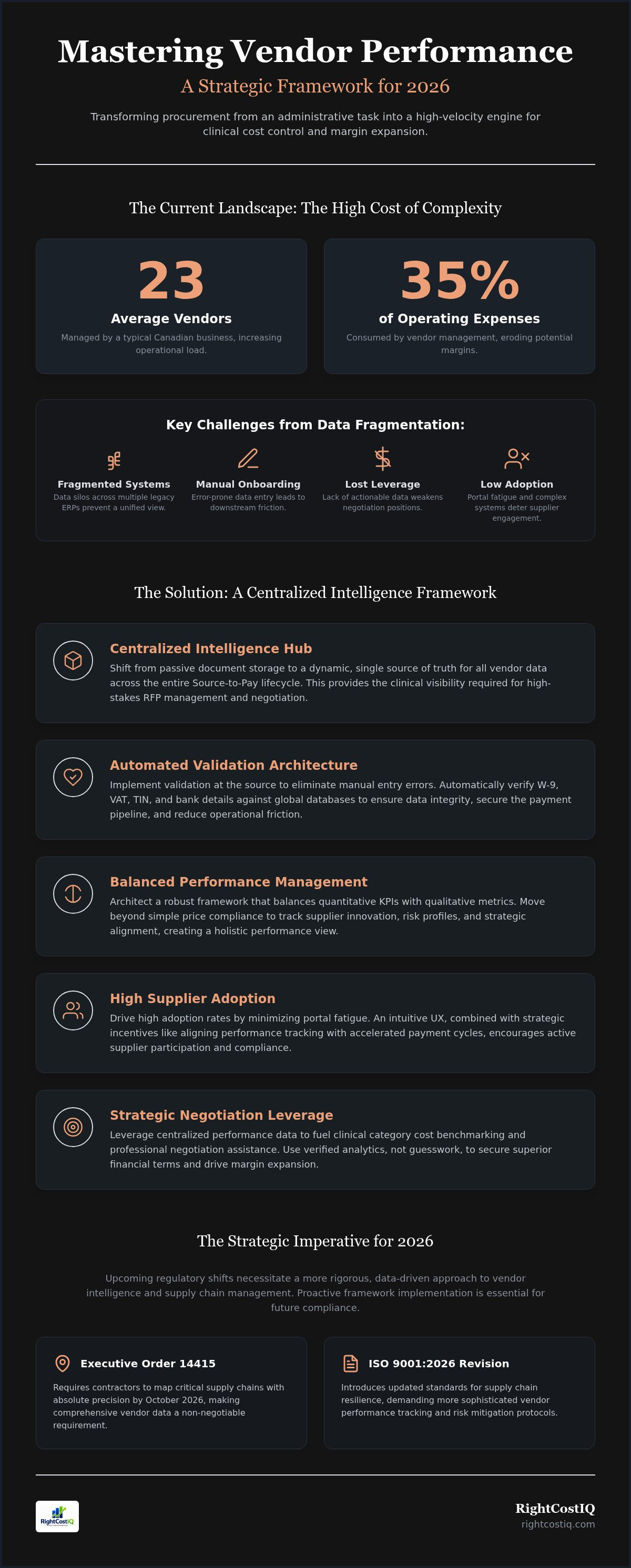
Canadian businesses now manage an average of 23 vendors, a volume that consumes nearly 35% of total operating expenses according to Venn research from January 2026. Most procurement leaders agree that managing this complexity through fragmented ERP systems and manual onboarding results in data silos that directly erode negotiation leverage. You're likely struggling with low supplier adoption rates and a lack of actionable metrics that prevent true margin expansion. Margins are won or lost in the data. Implementing a sophisticated vendor performance management framework is no longer an administrative convenience; it's a strategic necessity for maintaining clinical cost control.
This article provides the clinical frameworks required to transform your operational oversight into a high-velocity engine for procurement optimization and margin expansion. We'll architect a centralized single source of truth for vendor data, automate compliant onboarding processes, and deploy advanced performance analytics to secure superior financial outcomes. By mastering these strategic intelligence protocols, you'll move beyond simple administrative oversight. You'll gain the leverage required for professional RFP management and negotiation assistance. We'll also examine how upcoming 2026 regulatory shifts, including new supply chain mapping mandates, necessitate a more rigorous approach to vendor intelligence.
Key Takeaways
- Shift from passive document storage to a centralized intelligence hub that drives strategic data acquisition across the entire Source-to-Pay lifecycle.
- Implement automated validation architectures for tax and regulatory credentials to eliminate manual entry errors and reduce downstream operational friction.
- Architect a robust vendor performance management framework that balances quantitative KPIs like contract price compliance with qualitative metrics like supplier innovation.
- Drive high supplier adoption rates by minimizing portal fatigue through intuitive UX and aligning performance tracking with accelerated payment cycles.
- Leverage centralized performance data to fuel clinical category cost benchmarking and professional negotiation assistance during critical sourcing cycles.
Beyond Administrative Efficiency: The Strategic Role of Vendor Performance Management in 2026
A modern vendor performance management framework operates as a centralized intelligence hub for the entire Source-to-Pay lifecycle. In 2026, shifting focus from manual task reduction to strategic data acquisition is the primary driver for procurement optimization. Administrative efficiency is merely a byproduct of a well-architected system. Fragmented supplier data across multiple legacy ERP systems creates significant financial blind spots that erode enterprise resilience. When data is siloed, procurement teams lack the clinical visibility required for high-stakes RFP Management and complex negotiation cycles.
The economic impact of data fragmentation is quantifiable. Venn research from January 2026 highlights that Canadian businesses manage an average of 23 vendors, which accounts for nearly 35% of total operating expenses. Without a clinical framework architecture, this spend remains unoptimized and vulnerable to market volatility. Strategic architects use these intelligence engines to bridge the gap between traditional sourcing and digital innovation. This ensures every vendor interaction feeds into a larger intelligence model specifically designed for margin expansion and cost reduction.
The Evolution of Supplier Information Management (SIM)
Supplier information management has transitioned from static directories to dynamic, performance-driven hubs. Static repositories don't account for global supply chain volatility or the complexities of modern compliance. Recent mandates, such as Executive Order 14415 signed in July 2026, require contractors to map critical supply chains with absolute precision by October 2026. One-size-fits-all frameworks fail because they don't address these specific regulatory pressures or the technical requirements of the ISO 9001:2026 revision. Sophisticated partners require an architecture that evolves alongside real-time market intelligence.
Frameworks as the Foundation for Procurement Analytics
A robust vendor performance management framework provides the data integrity necessary for accurate procurement category cost benchmarking. High-level decision-makers utilize this centralized data to integrate framework outputs with market price trending and forecasting models. This integration allows for the identification of hidden category savings that are often missed in manual audits. Data integrity is the primary link to successful negotiation outcomes. Procurement leaders aren't guessing; they're using verified performance analytics to secure superior financial terms. This creates a relentless focus on the bottom line, where technical execution and high-level financial strategy are perfectly aligned.
Data Integrity Best Practices: Automated Validation Architectures
Data integrity is the non-negotiable foundation of a high-velocity vendor performance management framework. Manual data entry is a strategic liability. It introduces persistent errors that compromise financial reporting and operational compliance. Organizations must implement validation at the source. This ensures that vendor information is verified against global databases before it ever touches the ERP system. Automated validation for W-9, VAT, and TIN credentials eliminates the friction of manual cross-referencing. It also secures the payment pipeline by verifying bank details in real-time, preventing fraudulent diversions and ensuring payment accuracy.
A clinical hierarchy for data ownership is essential for maintaining a single source of truth. Vendors should manage their own demographic and financial data via secure portals, while procurement maintains control over performance ratings and risk assessments. Enforcing 100% mandatory field completion is the only way to prevent incomplete profiles. If a profile is missing critical data, the onboarding process must stall automatically. This prevents the "cleanup later" mentality that costs procurement teams hundreds of hours annually. Establishing these protocols ensures that your sourcing pipeline remains clean and audit-ready. For teams looking to optimize their initial supplier engagement, a clinical RFP management strategy provides the necessary data structure from day one.
Tiered Risk-Based Onboarding Workflows
Enterprise-grade frameworks segment vendors by spend, criticality, and geographic risk profiles. A high-spend critical component supplier requires deep-dive financial audits and SOC 2 compliance verification. A low-spend office supply vendor does not. Dynamic workflows adjust documentation requirements based on these specific tiers. Risk-based onboarding is the strategic alignment of compliance rigor with vendor importance. This approach ensures that resources are focused where the financial and operational stakes are highest, particularly as the ISO 9001:2026 revision places increased emphasis on digital risk management.
Continuous Data Maintenance and Re-Certification
Stale data is a hidden cost center that erodes enterprise efficiency. ERP systems often contain expired Certificate of Insurance (COI) documents and outdated diversity certifications. Automated triggers should initiate re-certification requests based on contract lifecycle milestones or expiration dates. This proactive maintenance ensures operational compliance without manual intervention. Reducing the hidden cost of stale data requires a system that treats vendor intelligence as a living asset rather than a static record. By automating these renewals, procurement leaders can focus on high-level strategy rather than administrative chasing.
Clinical Vendor Performance Tracking and Risk Mitigation
Effective 2026 performance tracking requires a blend of quantitative precision and qualitative insight. Quantitative KPIs provide the objective baseline: On-time delivery (OTD), quality rates, and contract price compliance. These metrics are non-negotiable for enterprise financial health. However, a modern vendor performance management framework must also integrate qualitative metrics to capture the full value of a partnership. This includes assessing supplier responsiveness, innovation contribution, and adherence to Corporate Social Responsibility (CSR) standards. Without this dual-layered approach, procurement leaders risk optimizing for cost at the expense of long-term operational resilience.
Real-time dashboards serve as the primary tool for identifying performance drift before it impacts the bottom line. When a vendor's quality rate dips below a clinical threshold, the system triggers an immediate alert. This proactive posture allows for corrective action before minor deviations become systemic failures. During annual reviews, procurement architects leverage this historical data via Vendor Performance Tracking Services to secure superior terms. Data-backed reviews transform subjective discussions into objective negotiation cycles where performance is the primary currency for margin expansion.
Automating Supplier Compliance and Audit Trails
Compliance is no longer a periodic check; it's a continuous operational requirement. A sophisticated framework creates a clinical, immutable log of all supplier interactions. This ensures that every communication, document submission, and performance alert is recorded for regulatory compliance. Centralized document management standardizes audit responses, reducing the time required to demonstrate adherence to ISO 9001:2026 or federal supply chain mapping mandates. Automated monitoring of debarment and sanction lists further reduces financial risk by identifying prohibited entities in real-time, preventing costly legal entanglements.
Predictive Risk Modeling via Performance Data
Predictive modeling identifies early warning signals of supplier financial distress long before bankruptcy filings occur. By analyzing patterns in payment terms, delivery delays, and responsiveness, procurement teams forecast future supply chain disruptions with high accuracy. This intelligence allows for the strategic reallocation of spend to more stable partners before a crisis hits. Rigorous performance tracking acts as a clinical hedge against price risk by ensuring that contract compliance is maintained even during periods of extreme market volatility.
Adoption Frameworks: Driving Supplier Engagement and Compliance
Low supplier adoption rates directly compromise the integrity of any vendor performance management framework. To secure compliance, procurement must shift the value proposition from administrative burden to financial benefit. Vendors prioritize cash flow. By explicitly linking portal usage to accelerated payment cycles, organizations transform a compliance requirement into a competitive advantage for the supplier. Minimizing portal fatigue is equally critical. Implementing intuitive UX and single-sign-on (SSO) capabilities ensures that the technical barrier to entry remains low. When a system's difficult to navigate, data accuracy drops and operational friction increases.
Clinical enforcement is necessary for 100% adoption. Procurement architects should mandate usage through specific contract clauses and "No Portal, No Pay" policies. This eliminates ambiguity and establishes the framework as the exclusive channel for business interaction. Tiered support structures, including self-service knowledge bases and AI-driven chatbots, provide the necessary infrastructure for vendor success without increasing internal headcount. High-level decision-makers must view adoption not as a suggestion but as a core operational requirement. For teams struggling with low engagement, a clinical diagnostic of your current procurement architecture can identify specific friction points.
Supplier Self-Service as a Productivity Multiplier
Supplier self-service acts as a productivity multiplier for both parties. Enabling vendors to track invoice status and payment dates independently reduces the volume of repetitive inquiries to Accounts Payable. Vendors also manage their own profile updates, which significantly lowers the administrative load on procurement teams. This creates a collaborative environment essential for RFP Management, where real-time data exchange is the primary driver of sourcing efficiency. By shifting the data entry burden to the vendor, procurement maintains a clinical focus on strategic analysis rather than data entry.
Communication and Change Management Strategies
Effective change management requires a phased rollout strategy to maintain system stability and support capacity. Incentivized onboarding programs for high-criticality suppliers accelerate the transition for the most impactful partners. Success is measured through specific engagement metrics like login frequency and task completion time. These data points allow procurement leaders to identify lagging segments and deploy targeted interventions. Strategic architects don't hope for adoption; they engineer it through technical precision and clinical enforcement. This methodical approach ensures that the framework remains a reliable source of intelligence for future negotiation cycles.
Strategic Integration: Leveraging Framework Data for Negotiation and Cost Benchmarking
A sophisticated vendor performance management framework is not merely an audit tool; it's the primary feeder system for enterprise financial growth. By centralizing performance metrics, procurement architects transform raw data into actionable intelligence for Negotiation Assistance. This objective evidence eliminates the subjective friction often found in annual reviews. It replaces anecdotes with clinical data. High-level decision-makers also utilize this comprehensive spend data to conduct Category Cost Benchmarking. This process identifies hidden savings by comparing internal contract rates against real-time market indices with absolute precision.
Optimization opportunities extend beyond high-value contracts. Granular item-level visibility allows teams to identify Tail Spend inefficiencies that often escape traditional oversight. When you aggregate these smaller, fragmented purchases, the potential for margin expansion is significant. This level of detail also supports advanced price risk management. It enables precise market price trending and forecasting, allowing organizations to hedge against global volatility before it impacts the P&L. The framework acts as the infrastructure that feeds these strategic services, ensuring that every sourcing decision is backed by verified intelligence.
From Data Points to Negotiation Levers
Performance data provides the leverage required to eliminate price variance across global locations. If one facility pays a premium for the same service level provided elsewhere, the system flags the discrepancy immediately. This clinical precision ensures that contract re-negotiations are grounded in objective performance history rather than market averages. It moves the conversation from speculative savings to data-proven outcomes. Strategic architects use these insights to apply market price trending and forecasting models, securing long-term price stability in volatile categories.
The ROI of an Integrated Procurement Infrastructure
The financial impact of an integrated procurement infrastructure is measured through reduced sourcing cycle times and improved supplier compliance. These efficiencies directly impact enterprise financial resilience and support sustainable margin expansion. Quantifying this impact requires a system where high-level strategy and technical execution are perfectly aligned. Organizations that fail to integrate their vendor performance management framework into their broader financial strategy leave significant capital on the table. Ready to optimize your procurement outcomes? Get your Free Diagnostic from RightCostIQ.
Securing Enterprise Resilience through Clinical Framework Integration
Transitioning your procurement operations from a passive document repository to a high-velocity intelligence engine requires a methodical approach. By architecting a robust vendor performance management framework, you establish the clinical data foundation necessary for total cost control. We've examined how automated validation and tiered onboarding protocols eliminate operational friction while ensuring absolute compliance with 2026 regulatory shifts. Leveraging this centralized intelligence allows for objective negotiation cycles and precise category cost benchmarking that directly fuels margin expansion. High-level decision-makers don't rely on intuition; they use verified performance metrics to secure superior financial outcomes. Global expertise in RFP management and risk mitigation ensures your supply chain remains resilient against global market volatility. It's time to transform your supplier data into a strategic asset that drives relentless efficiency across the entire Source-to-Pay lifecycle. Optimize Your Procurement Outcomes with RightCostIQ and secure your competitive advantage today. Your path to procurement optimization starts with data integrity.
Frequently Asked Questions
What is the difference between a supplier network and a vendor portal?
A supplier network is a multi-tenant ecosystem where multiple buyers and sellers interact, whereas a vendor portal is a private, enterprise-specific interface. Networks are primarily for discovery and broad collaboration across industries. Portals focus on the execution of specific contracts and the management of granular performance metrics within a single organization's supply chain. This distinction is critical for maintaining data privacy and ensuring focused operational oversight.
How do vendor performance management frameworks improve procurement compliance?
A vendor performance management framework improves compliance by enforcing mandatory data validation and automating the tracking of regulatory credentials. It creates a clinical audit trail that demonstrates adherence to standards such as the ISO 9001:2026 revision. By centralizing certifications and insurance documents, the framework ensures that non-compliant vendors are flagged before they can impact production. This proactive monitoring reduces the risk of legal penalties and operational downtime.
Can a vendor performance framework integrate with existing ERP systems like SAP?
Modern frameworks are specifically architected to integrate with enterprise ERP systems through robust API connections. This integration allows for the real-time synchronization of vendor data, purchase orders, and payment statuses between the portal and systems like SAP or Oracle. By automating this data flow, organizations eliminate manual entry errors and ensure that procurement teams are working from a single source of truth for all financial reporting and performance analysis.
What are the most common reasons for vendor portal implementation failure?
Implementation failures usually stem from low supplier adoption rates and overly complex user experiences. If a portal introduces significant administrative friction without offering a clear value proposition to the vendor, participation will stall. Other common factors include fragmented data across legacy systems and a lack of executive support for enforcing specific portal policies. Success requires a strategic focus on intuitive UX and clear communication regarding the benefits of participation.
How does a vendor framework assist in RFP management and sourcing cycles?
The framework serves as the primary data foundation for professional RFP management and strategic sourcing cycles. It provides historical performance metrics that allow procurement teams to evaluate potential suppliers based on objective data rather than speculative claims. By integrating these insights into the sourcing process, organizations ensure that only vendors with proven track records for quality and reliability are invited to bid on critical contracts, significantly reducing selection risk.
What security standards should a modern vendor portal meet in 2026?
In 2026, a modern vendor portal must meet rigorous security standards, including SOC 2 Type II compliance and ISO 27001 certification. These benchmarks ensure that sensitive financial and personal data is protected through end-to-end encryption and multi-factor authentication (MFA). Given the increased emphasis on cybersecurity in global supply chains, maintaining these standards is essential for mitigating the risk of data breaches and ensuring long-term operational continuity.
How can a performance framework help in identifying category cost savings?
A vendor performance management framework identifies category cost savings by providing granular visibility into spend patterns and price variances. By aggregating item-level data across different locations and business units, procurement architects can identify opportunities for consolidation and volume discounts. This clinical analysis enables accurate cost benchmarking against market indices, allowing teams to negotiate from a position of data-driven authority and achieve significant margin expansion in volatile categories.
How do you incentivize suppliers to adopt a new performance management system?
Effective incentives focus on reducing administrative friction and improving cash flow for the supplier. You should explicitly link portal adoption to accelerated payment cycles and real-time visibility into invoice processing status. Providing vendors with self-service tools for profile updates and performance tracking also serves as a productivity multiplier. When suppliers see that the system simplifies their internal processes and ensures faster payments, they're far more likely to comply with the new framework.


