
The conventional wisdom of delegating procurement to a global Business Process Outsourcing (BPO) provider often results in a strategic paradox: you gain operational bandwidth but lose the granular control necessary for elite margin expansion. While managed services provide a baseline of stability, they frequently rely on opaque pricing models that mask the true erosion of your internal category expertise. You've likely experienced the difficulty of trying to benchmark category costs against real-time market shifts when your data is siloed within a third-party's proprietary system.
This comparison of WNS procurement outsourcing vs RightCostIQ examines whether a broad-scale managed service or a surgical, data-driven negotiation framework better serves your high-stakes financial goals. You'll discover how to reclaim control over vendor negotiations and implement predictable price risk management without sacrificing operational efficiency. We'll evaluate how precision analytics and RFP management assistance provide the strategic leverage required to outperform traditional BPO models while keeping your procurement intelligence in-house.
Key Takeaways
- Contrast the traditional Business Process Outsourcing model with precision procurement frameworks to align your sourcing strategy with specific financial growth metrics.
- Analyze the operational trade-offs of WNS procurement outsourcing vs RightCostIQ to determine if your organization requires administrative relief or surgical negotiation assistance.
- Learn how proprietary category cost benchmarking and market price forecasting enable internal teams to execute high-performance sourcing with clinical precision.
- Evaluate the effectiveness of end-to-end supply chain management against modular vendor performance tracking for superior risk mitigation and price volatility control.
- Apply a strategic decision framework to choose between large-scale operational outsourcing and a data-driven architecture that preserves internal procurement expertise.
The Evolution of Procurement: Managed Services vs. Precision Optimization
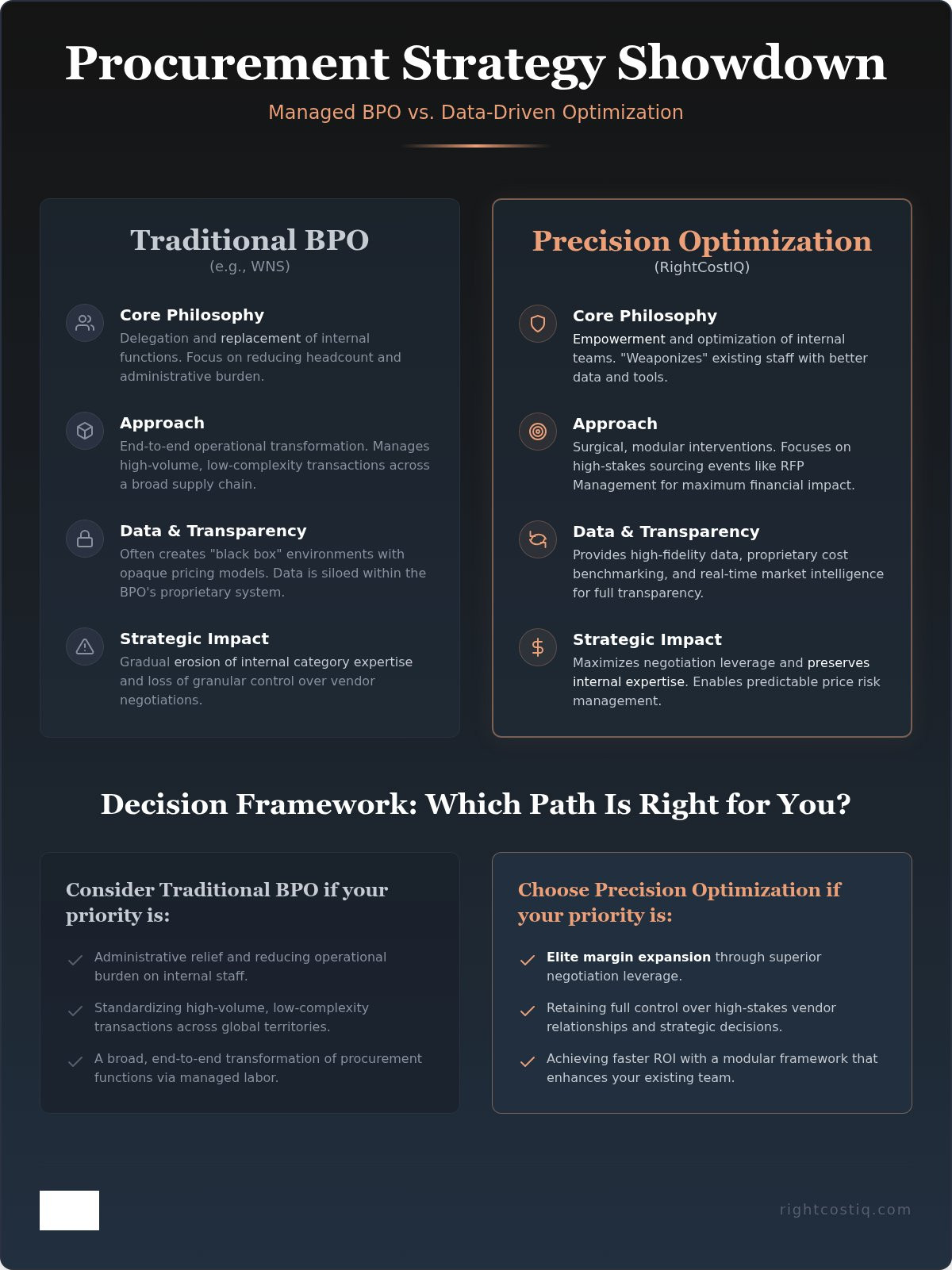
Procurement departments are no longer viewed as mere administrative cost centers. They've transitioned into primary drivers of enterprise value and margin expansion. This shift forces a critical decision between two diverging paths: the total delegation of functions to a global Business Process Outsourcing (BPO) firm or the adoption of a precision-led optimization framework. The debate between WNS procurement outsourcing vs RightCostIQ centers on whether your organization prioritizes the reduction of headcount or the maximization of negotiation leverage through data.
Large-scale BPO models focus on end-to-end transformation, aiming for operational cost reduction by standardizing processes across a massive supply chain ecosystem. In contrast, the precision procurement model focuses on surgical interventions. It utilizes high-fidelity data to drive superior outcomes during critical sourcing events. While a BPO might manage the volume, precision frameworks ensure that every dollar committed is backed by real-time market intelligence and rigorous cost benchmarking.
What is Procurement Outsourcing?
Procurement outsourcing involves the strategic transfer of specific procurement activities to a third-party provider. Organizations often select the WNS Procure-to-Pay (P2P) route when they need to stabilize high-volume, low-complexity transactions across global territories. This model effectively reduces the administrative burden on internal staff. However, large-scale BPO contracts can create "black box" environments. In these scenarios, transparency in pricing and vendor performance often diminishes, leading to the gradual erosion of internal category expertise. You're left with a managed service that functions efficiently but lacks the strategic agility to respond to rapid market volatility.
The RightCostIQ Approach: Optimization Over Replacement
RightCostIQ operates on the principle that internal teams shouldn't be replaced; they should be weaponized with better data. By focusing on Request For Proposal (RFP) Management as a strategic lever, this approach allows companies to maintain full control over high-stakes vendor relationships. It's about clinical execution. Instead of outsourcing the entire function, you use a modular framework to track vendor performance and manage price risk with precision. This strategy ensures that sourcing and procurement decisions are driven by objective analytics rather than outsourced convenience. It's a fundamental move from simply managing spend to actively optimizing margins through every negotiation cycle. This framework provides the predictability and transparency that traditional BPO models often fail to deliver.
Comparing Operational Models: End-to-End BPO vs. Targeted RFP Management
The choice between WNS procurement outsourcing vs RightCostIQ represents a fundamental decision in corporate resource allocation. WNS offers a comprehensive, end-to-end management model that replaces internal functions with external managed labor. This represents a horizontal expansion of capacity. RightCostIQ, conversely, provides a vertical deepening of capability through a modular framework designed for high-stakes negotiation. You aren't just adding headcount; you're upgrading the data architecture of your existing team to drive superior financial outcomes.
Integration depth varies significantly between these two operational paths. WNS requires a deep, often multi-year commitment to transform your corporate infrastructure to align with their proprietary ecosystems. RightCostIQ integrates as a specialized toolset, fitting into your current workflow to provide immediate negotiation leverage. The resource allocation also differs fundamentally. WNS provides managed labor to execute the process, while RightCostIQ provides the professional analytics and tracking services to ensure the process is more profitable. For leaders focused on immediate margin expansion, the modular nature of surgical RFP assistance often yields a faster return on investment.
Managed Services: The WNS Value Proposition
WNS positions itself as a global orchestrator of the supply chain ecosystem. Its value proposition rests on a massive global footprint and the ability to manage diverse supplier networks across multiple continents simultaneously. For organizations with thousands of vendors and a need for total digital procurement transformation, this model offers significant scalability. It utilizes a blend of artificial intelligence and human intelligence to streamline the Procure-to-Pay cycle. This ensures that high-volume transactions are processed with operational consistency, though this often occurs at the expense of granular cost transparency and internal skill retention.
Surgical RFP Assistance: The RightCostIQ Advantage
RightCostIQ prioritizes strategic precision over general management. By executing Category Management in Procurement with clinical accuracy, the platform empowers internal teams to win their own negotiations. This model targets high-value contracts where a 1% shift in price significantly impacts the bottom line. Professional negotiation assistance and real-time cost benchmarking eliminate the 'outsourcing tax' inherent in large BPO contracts. You maintain strategic control while leveraging analytics that most BPOs keep behind a restricted interface. This approach ensures that your internal expertise isn't eroded but rather enhanced by world-class market intelligence. To evaluate how your current category costs align with market benchmarks, you can utilize a strategic procurement assessment to identify hidden margin opportunities.
Ultimately, the divergence between WNS procurement outsourcing vs RightCostIQ is a choice between outsourcing the process or optimizing the result. One provides a managed service to handle the burden, while the other provides a data-driven framework to capture the margin.
Data Architectures: Global Analytics vs. Category Cost Benchmarking
The efficacy of any procurement strategy is dictated by its underlying data architecture. In the comparison of WNS procurement outsourcing vs RightCostIQ, the primary distinction lies in the granularity and utility of the intelligence provided to decision-makers. WNS utilizes broad-spectrum global analytics to monitor commodity trends and supplier risk across massive, diverse ecosystems. This approach is valuable for high-level supply chain visibility and general risk mitigation, yet it often lacks the clinical specificity required to challenge a vendor's pricing structure during a high-stakes RFP. It provides the "what" of market movement without the "why" of specific cost drivers.
RightCostIQ replaces these broad observations with Procurement Category Cost Benchmarking. This transition from general market data to negotiation-ready cost models allows procurement leaders to dissect price components with surgical precision. While a BPO might report that general market prices are rising, RightCostIQ identifies exactly which cost drivers are shifting and by how much. This level of transparency acts as a primary catalyst for margin expansion. It transforms procurement from a reactive function into a proactive financial architect, ensuring every negotiation is backed by unassailable data.
Benchmarking for Real-World Savings
Generic price lists and historical spend reports are insufficient for modern sourcing requirements. Achieving real-world savings requires moving toward clinical cost analytics that expose the "should-cost" of a specific category. By utilizing advanced procurement analytics, internal teams can uncover hidden margins that remain obscured in traditional BPO reporting cycles. These cost models provide the factual foundation necessary to drive harder, more successful negotiations. You don't just ask for a discount; you demonstrate exactly where the vendor's quote exceeds market-justified levels based on real-time data inputs.
Market Price Trending and Forecasting
Financial volatility is a constant threat to procurement budgets and corporate margin targets. RightCostIQ addresses this through a specialized approach to price risk management and predictive market trending. Instead of reacting to price spikes after they've already impacted the balance sheet, procurement leaders use forecasting as a strategic lever. This predictive capability is essential during multi-year vendor contract negotiations. When evaluating WNS procurement outsourcing vs RightCostIQ for risk mitigation, the ability to lock in favorable rates or build index-based pricing models becomes a defining advantage. It allows your team to protect the bottom line from future market fluctuations while maintaining long-term vendor compliance.
Strategic Risk: Managing Price Volatility and Vendor Performance
Risk mitigation in the comparison of WNS procurement outsourcing vs RightCostIQ hinges on the depth of visibility into vendor behavior. WNS provides a macro-level monitoring system designed to flag major supplier disruptions across a global footprint. This global monitoring is effective for broad supply chain continuity but often overlooks the micro-fluctuations in vendor performance that erode margins over time. RightCostIQ shifts the focus to a specialized Vendor Performance Tracking Service, providing the granular data necessary to enforce strict supply chain compliance. This transition from broad monitoring to specific performance metrics ensures that vendor risks are managed with clinical precision rather than general oversight.
Vendor Compliance and Performance
Ensuring operational efficiency requires more than just a signed contract; it demands a rigorous, automated architecture for monitoring vendor compliance. RightCostIQ’s tracking service functions as a compliance engine, capturing real-time performance metrics that inform the next RFP cycle. Instead of relying on anecdotal evidence or self-reported vendor data, procurement leaders use objective performance tracking to justify renewals or terminations. This data-driven approach ensures that vendor performance directly aligns with corporate margin targets and operational standards. By maintaining this level of transparency, organizations avoid the hidden costs associated with non-compliant suppliers that often go unnoticed in larger BPO models.
Mitigating Volatility in High-Stakes Categories
The financial danger of "set and forget" contracts is particularly acute in volatile markets where price variances can quickly outpace budget projections. While a BPO might manage the administrative lifecycle of a contract, they rarely offer the real-time price risk management required for financial resilience in 2026. RightCostIQ provides the Price Risk Management and Tracking Service to protect against these fluctuations. Price risk management is the strategic forecasting of cost fluctuations to protect margins. This capability allows your team to move away from reactive budget adjustments and toward proactive financial architecture.
When evaluating WNS procurement outsourcing vs RightCostIQ for financial stability, the choice rests on whether you prioritize broad monitoring or clinical performance tracking. Using RightCostIQ to track and manage price risk in real-time allows procurement teams to negotiate index-based pricing or early-buy opportunities that lock in value. This proactive stance is a critical asset for maintaining a competitive advantage in a fluctuating economy. To begin identifying these risks in your own supply chain, you can access a specialized procurement risk assessment to benchmark your current vendor performance and identify potential margin leaks.
Decision Framework: When to Outsource vs. When to Optimize
Determining the optimal path between WNS procurement outsourcing vs RightCostIQ requires a clinical assessment of your financial objectives. Organizations seeking to offload the entire Procure-to-Pay burden to reduce internal labor costs find value in the WNS model. This approach prioritizes administrative relief over tactical precision. Conversely, RightCostIQ serves leaders who view procurement as a primary lever for margin expansion. It ensures you maintain strategic vendor relationships while utilizing deep-dive analytics to win every negotiation. The choice between WNS procurement outsourcing vs RightCostIQ ultimately defines whether you are buying a process or investing in a result.
Assess your current operational state across three primary vectors: headcount flexibility, category complexity, and margin urgency. If your internal team is overextended with low-value administrative tasks, the broad-scale BPO model offers immediate relief. However, if your focus is on extracting maximum value from high-stakes negotiations, the precision framework is the necessary tool. This distinction is critical for high-level decision-makers who cannot afford to erode internal expertise for the sake of outsourced convenience.
A hybrid approach is also gaining traction among sophisticated enterprises. Many use RightCostIQ’s analytics to audit and optimize their existing BPO arrangements. This prevents the "black box" effect where a managed service provider might prioritize process speed over cost-saving precision. It creates a layer of accountability that traditional managed services lack. It ensures that even if you outsource the labor, you never outsource the intelligence or the final financial outcome. Evaluating your current RFP success rate and negotiation effectiveness is the first step in deciding which model aligns with your growth targets.
Empowering the Internal Team
Maintaining institutional knowledge is a critical defensive strategy against supply chain disruption. The Negotiation Coach framework upskills internal talent by providing the specific data points needed to challenge vendor pricing. Unlike fixed outsourcing fees that represent a permanent operational expense, professional negotiation assistance delivers a high ROI by capturing immediate savings on a per-contract basis. It weaponizes your existing team with world-class market intelligence. This ensures expertise stays within your organization rather than being leased from an external provider. You don't just complete the RFP; you dominate the negotiation cycle.
Final Recommendation: Precision Over Volume
Precision always outperforms volume in high-value procurement categories. While a BPO might manage the bulk of your transactions, RightCostIQ provides the clinical framework required to optimize tail spend and high-stakes contracts without abdicating authority. You retain the power to make data-led decisions while benefiting from advanced price forecasting and cost benchmarking. This model ensures that your procurement strategy is an active driver of corporate profitability rather than a passive managed service. Optimize your next RFP with RightCostIQ’s precision framework.
Strategic Alignment for Maximum Margin Expansion
Selecting the optimal procurement model requires a clinical evaluation of your long-term financial architecture. The debate between WNS procurement outsourcing vs RightCostIQ isn't just about resource allocation; it's about who controls the data that drives your bottom line. While broad-scale BPO models offer operational relief, they often sacrifice the granular transparency needed for elite negotiation outcomes. Transitioning to a precision-led framework ensures that your internal team retains strategic authority while leveraging world-class intelligence to capture hidden margins.
Success in 2026 demands the integration of Specialized RFP Management Frameworks and Advanced Category Cost Benchmarking into your core sourcing workflow. By utilizing Global Price Risk Management Services, you move from a reactive posture to a proactive strategy that protects margins against market volatility. Reclaiming control over high-stakes negotiations is the most direct path to sustainable profitability and competitive advantage. Don't let your category expertise erode through unnecessary delegation.
Secure your procurement margins with RightCostIQ’s Negotiation Coach. You're now equipped to transform your procurement department into a high-performance financial engine.
Frequently Asked Questions
What is the main difference between WNS and RightCostIQ?
The primary distinction in the WNS procurement outsourcing vs RightCostIQ comparison lies in the operational objective. WNS functions as a comprehensive Business Process Outsourcing (BPO) entity focused on headcount reduction and administrative delegation through a managed services model. RightCostIQ operates as a strategic precision partner, providing the data frameworks and negotiation assistance required for internal teams to drive maximum margin expansion.
Can RightCostIQ integrate with my existing ERP system?
RightCostIQ is engineered for high-fidelity data integration with standard corporate ERP architectures. This allows for the seamless ingestion of historical spend data to generate actionable cost models and benchmarking reports. The platform functions as a strategic intelligence layer that enhances your existing infrastructure without requiring a total system replacement or disruptive digital transformation.
Is RightCostIQ considered a procurement outsourcing firm?
RightCostIQ is not a traditional outsourcing firm but a specialized procurement analytics and negotiation assistance provider. It empowers internal procurement departments with clinical market data and forecasting tools. This model preserves institutional knowledge and category expertise while leveraging the same level of intelligence typically siloed within large global consultancies.
How does RightCostIQ’s negotiation assistance work?
The negotiation assistance service utilizes proprietary category cost benchmarking to identify specific price variances within vendor quotes. Internal teams receive a surgical "should-cost" framework that provides objective data points to challenge vendor pricing during the RFP process. This transforms the negotiation from a subjective discussion into a data-driven financial exercise with predictable outcomes.
What are the typical savings associated with category cost benchmarking?
Savings outcomes depend on category volatility and previous sourcing rigor. By identifying hidden margins through real-time market price trending, organizations capture financial value that remains invisible in standard BPO reporting. This benchmarking ensures that every contract reflects current market realities rather than historical vendor pricing or generic industry averages.
Does WNS offer specialized price risk management like RightCostIQ?
WNS provides broad global risk monitoring focused on supply chain continuity and supplier stability across its managed network. RightCostIQ offers a specialized Price Risk Management and Tracking Service that specifically forecasts cost fluctuations to protect corporate margins. This predictive capability is essential for managing financial resilience in volatile commodity and service markets.
Which solution is better for managing tail spend?
The choice depends on your preference for automation versus optimization. WNS manages tail spend through high-volume automated processes to reduce administrative overhead for large fleets. RightCostIQ applies a surgical optimization framework to tail spend, identifying margin expansion opportunities that automated systems frequently overlook due to their broad-spectrum focus.
How do I determine if my firm is ready for precision procurement analytics?
Your organization is ready if you possess internal procurement talent but lack the real-time benchmarking data necessary to execute high-performance sourcing events. If your current RFP success rate is stagnating or vendor negotiations lack clinical data support, precision analytics will provide the strategic leverage required for immediate margin expansion. It's the logical step for firms that want to win their own negotiations.


