
Relying on supplier-provided data for high-stakes RFPs is a strategic failure that guarantees margin erosion. You've likely experienced the frustration of opaque pricing structures where "fair" profit margins remain a moving target. Without a data-driven baseline, your negotiations rely on intuition rather than clinical precision. Mastering advanced procurement cost modeling techniques is the only way to eliminate this informational asymmetry. By deconstructing the value chain into granular components, you transform from a reactive buyer into a strategic architect of enterprise value.
This guide provides the analytical methodologies required to secure maximum leverage and identify hidden savings within complex category spend. We'll explore how to integrate market price trending and predictive modeling to mitigate volatility. You'll learn to move beyond static estimates toward a framework that delivers the 10% to 15% savings typical of best-in-class category management. We'll also examine how the latest AI-driven analytics are refining should-cost tools to meet the rigorous demands of the 2026 procurement environment, ensuring your financial strategy remains both predictive and profitable.
Key Takeaways
- Transition from reactive price-based sourcing to strategic cost-based architecting to eliminate informational asymmetry in supplier negotiations.
- Deploy advanced procurement cost modeling techniques, including Should-Cost and TCO analysis, to deconstruct supplier margins with clinical precision.
- Evaluate the strategic application of parametric statistical modeling versus granular bottom-up analysis based on category complexity and data availability.
- Integrate real-time market intelligence and price trending data to transform static cost models into dynamic, predictive negotiation tools.
- Align rigorous RFP management with category-specific cost benchmarking to secure maximum leverage and mitigate long-term price risk.
The Strategic Imperative of Precision Cost Modeling in 2026
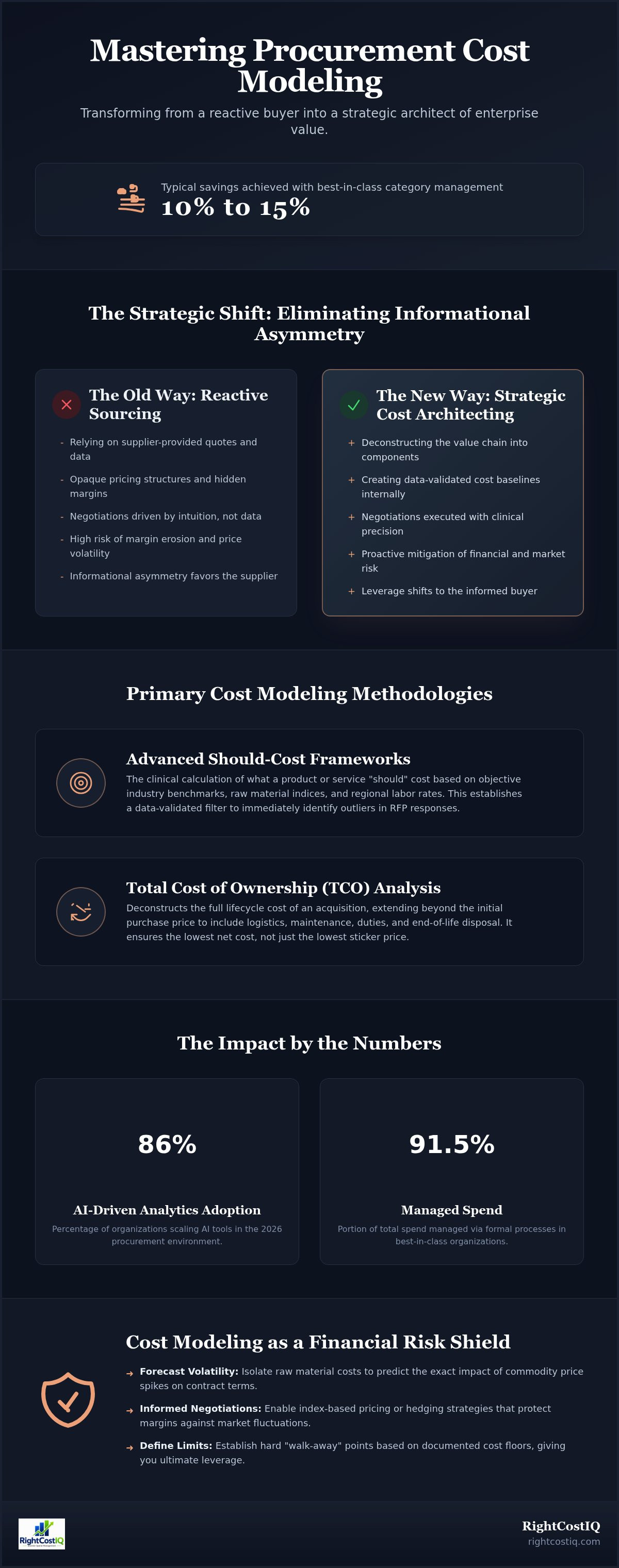
Procurement cost modeling is the systematic deconstruction of supplier price points into their constituent elements. It represents a fundamental shift from reactive price-based sourcing toward cost-based strategic architecting. In the 2026 procurement environment, where 86% of organizations are scaling AI-driven analytics, relying on a supplier’s quoted price without internal validation is an unacceptable financial risk. Advanced procurement cost modeling techniques allow decision-makers to strip away the "black box" of vendor pricing, identifying the exact impact of raw materials, labor, overhead, and profit margins. This analytical rigor transforms procurement from a back-office function into a primary driver of enterprise growth.
Neutralizing supplier informational advantages requires a clinical understanding of the value chain. By utilizing sophisticated Cost Estimation Techniques, teams can pinpoint exactly where a supplier’s inefficiency or excessive margin is inflating the bottom line. Best-in-class organizations now manage 91.5% of their total spend through these formal processes, moving beyond simple bid comparisons to a deep-tissue analysis of supplier operations. This methodology ensures that every dollar spent is mapped to a tangible cost driver, eliminating the guesswork that traditionally plagues enterprise sourcing.
Eliminating Informational Asymmetry in RFPs
Organizations deploying should-cost modeling establish a clinical baseline for evaluating RFP responses before the first bid arrives. This baseline serves as a data-validated filter, immediately identifying outliers and unrealistic proposals. Transparency in the cost structure doesn't just lower prices; it improves long-term supplier performance tracking by aligning both parties on efficiency targets. We're moving past the era of "Darwinian Rivalry," where the goal was to squeeze the supplier until they broke. Instead, data-validated collaboration focuses on stripping out waste while protecting the supplier’s ability to deliver quality and innovation.
Cost Modeling as a Financial Risk Mitigation Tool
Precision modeling acts as a shield against market price volatility. By isolating raw material costs within a model, procurement leaders can forecast exactly how a 5% spike in commodity prices will impact contract terms. This foresight is critical for price risk management, allowing teams to negotiate index-based pricing or hedging strategies that protect margins. It also establishes hard "walk-away" points based on documented cost floors. When you know the minimum viable cost to produce a unit, you gain the ultimate leverage. You aren't just negotiating for a lower price; you're defending the financial integrity of your organization through predictive analytics.
Primary Cost Modeling Methodologies: Deconstructing Supplier Margins
Strategic sourcing requires a clinical departure from surface-level price comparisons. Professional procurement teams utilize specific procurement cost modeling techniques to isolate supplier inefficiencies and validate margin fairness. These methodologies provide the analytical leverage needed to challenge quotes that deviate from verified market realities. Without these frameworks, negotiations remain subjective and vulnerable to supplier informational advantages.
Total Cost of Ownership (TCO) Analysis
TCO deconstructs the full lifecycle cost of an acquisition, extending far beyond the initial purchase price. It incorporates logistics, maintenance, insurance, and end-of-life disposal costs into a single financial model. In global supply chains, hidden costs like customs duties, safety stock requirements, and quality non-conformance frequently erode expected savings. Integrating these variables into your RFP Management: Strategic Frameworks for AI-Led Procurement Optimization ensures that the selected vendor provides the lowest net cost over the contract's duration, rather than just the lowest sticker price.
Advanced Should-Cost Frameworks
Should-cost modeling is the clinical calculation of what a product or service "should" cost based on objective industry benchmarks. The mathematical formula involves aggregating raw material indices, regional labor rates, and specific energy consumption data. Unlike basic competitor quotes, this framework accounts for geographic variances. For instance, labor rates in Southeast Asia versus Eastern Europe require distinct modeling parameters to remain accurate in the 2026 market. Utilizing RightCostIQ Should-Cost tools enables procurement professionals to generate these benchmarks rapidly, providing immediate leverage during high-stakes supplier negotiations.
Target costing reverses the traditional pricing model by starting with the desired market price. It subtracts the required profit margin to determine the allowable procurement cost. This technique is essential for high-stakes product development cycles where traditional cost-plus pricing would render the final product uncompetitive in a volatile market. Activity-Based Costing (ABC) adds a final layer of precision by assigning overhead costs to specific procurement activities rather than using broad percentage allocations. By mapping specific labor hours and facility usage to individual SKUs, procurement architects eliminate the "overhead padding" that suppliers often use to hide excess profit.
Establishing these baselines is the first step toward clinical negotiation. Teams that integrate these procurement cost modeling techniques into their standard operating procedures consistently achieve superior financial outcomes. For a deeper look at your current spend efficiency, you can explore our procurement analytics platform to identify immediate saving opportunities and mitigate price risk.
Advanced Quantitative Techniques: Parametric vs. Bottom-Up Analysis
High-level decision-makers require more than just basic formulas. They need advanced procurement cost modeling techniques that differentiate between statistical prediction and engineering-based deconstruction. Parametric modeling leverages historical data to forecast costs for standardized categories. Conversely, bottom-up analysis builds an estimate from the ground up. In 2026, the most effective strategy is hybrid modeling. This approach fuses historical trends with real-time market price trending to ensure accuracy in volatile environments. It eliminates the guesswork that often leads to budget overruns.
Sensitivity analysis is the final component of a resilient model. It tests how changes in specific variables, like a 10% increase in energy costs or a logistics delay, impact the total price. This stress-testing ensures your model remains resilient against market shocks. It provides a range of potential outcomes rather than a single static number. By identifying which variables have the most significant impact on the bottom line, you can focus your risk mitigation efforts where they matter most. This analytical rigor transforms procurement from a guessing game into a precise financial science.
When to Deploy Parametric Estimating
Parametric estimating is the optimal choice for high-volume, standardized category spend. It utilizes statistical relationships between historical data and specific variables, such as weight, volume, or processing speed, to predict future costs. This method requires high-quality data sets to maintain statistical validity. If your data is fragmented, the model fails. It's less effective for highly specialized or novel sourcing where historical benchmarks don't exist. In these cases, the lack of data points makes statistical prediction unreliable and potentially misleading.
The Rigor of Bottom-Up Cost Engineering
Bottom-up cost engineering provides the highest level of clinical precision. It involves a step-by-step deconstruction of manufacturing processes, calculating specific costs for every component, labor hour, and utility requirement. This granular visibility allows you to validate supplier overhead claims against industry-standard benchmarks. You aren't just guessing; you're proving what the cost should be. This level of detail makes bottom-up models the primary lever in complex contract negotiations. When you present a supplier with an engineered cost breakdown, their ability to defend "hidden" margins evaporates.
Implementation Framework: Integrating Market Intelligence into Cost Models
Execution of advanced procurement cost modeling techniques requires a structured integration of internal data and external market intelligence. A static model is a liability in a volatile market. To achieve clinical precision, procurement architects must follow a rigorous five-step implementation framework that ensures every negotiation is backed by verified financial data. This methodology transforms raw spend data into a strategic asset that protects enterprise margins.
The process begins with defining the scope and granularity required for the specific category. High-complexity sourcing events require a bottom-up deconstruction, while standardized spend may only need parametric analysis. Once the scope is set, teams gather primary data from internal spend analysis and secondary data from global market benchmarks. Integrating real-time market price trending ensures the model remains dynamic, reflecting current commodity shifts and labor rate changes. Before deployment, a cross-functional review involving Finance, Operations, and Sourcing validates the model's accuracy. Finally, the model output is applied directly to RFP evaluations and negotiation scripts to secure maximum leverage.
Sourcing High-Fidelity Data for 2026 Models
Data integrity is the primary driver of model reliability. In 2026, where AI readiness in procurement is still maturing, manually sourced data often contains errors that undermine negotiation leverage. Utilizing Procurement Category Cost Benchmarking allows teams to fill critical data gaps with verified industry standards. Market price trending acts as a dynamic variable, adjusting static should-cost figures to reflect real-time volatility. This ensures that your financial baselines remain accurate even as global supply chains shift. Automated platforms must maintain strict data governance to prevent "garbage in, garbage out" scenarios that lead to faulty sourcing decisions.
Translating Model Outputs into Negotiation Strategy
A cost model is only as effective as the negotiation strategy it informs. Procurement leaders must translate technical findings into fact-based negotiation scripts. These scripts allow sourcing teams to address supplier objections regarding overhead and margin requirements with clinical objectivity. When a supplier claims an "unavoidable" price hike, your model provides the evidence to challenge that assertion. Establishing clear KPIs for vendor performance tracking post-negotiation ensures that the savings identified during the modeling phase actually materialize in the bottom line. This closed-loop process secures long-term value and mitigates future price risk.
Achieving this level of precision requires the right analytical infrastructure. To evaluate your current framework and identify hidden savings, you can access our procurement cost diagnostic tool to benchmark your category spend against 2026 market standards.
RightCostIQ: Optimizing Procurement Outcomes through Analytical Rigor
RightCostIQ functions as the strategic architect for enterprise procurement optimization. We bridge the gap between theoretical procurement cost modeling techniques and tangible financial results. Our framework integrates category-specific cost benchmarking directly into the RFP process. This ensures every vendor selection is backed by engineered data rather than subjective quotes. This synergy allows high-level decision-makers to capture the "hidden 20%" of savings often lost in unmanaged tail spend. Architectural rigor is required to dismantle opaque pricing. Our platform provides the infrastructure needed to execute the parametric and bottom-up analyses explored earlier. We don't just provide data; we provide the strategic roadmap to use that data for operational efficiency.
Clinical RFP Management and Execution
The transition from cost modeling to vendor selection must be seamless to prevent margin leakage. RightCostIQ streamlines this process by embedding should-cost benchmarks into our RFP management services. Initial bids are evaluated against a clinical cost floor from the outset. RightCostIQ's negotiation assistance utilizes these precision models to drive margin expansion during final contract discussions. By deploying a Category Management in Procurement: A Clinical Framework for Margin Expansion (2026), organizations move beyond simple purchasing toward strategic value creation. This approach eliminates the informational asymmetry that suppliers rely on to protect their own margins. It turns the procurement department into a profit center by identifying and capturing value that competitors overlook.
Maximizing ROI through Continuous Performance Tracking
Negotiated savings only translate to the bottom line if they're strictly enforced post-contract. RightCostIQ ensures realized value through automated vendor performance tracking and price risk management. Our RightCostIQ analytics platform monitors market price trending and forecasts future shifts. This allows you to proactively manage volatility before it impacts your budget. Continuous oversight prevents the "savings erosion" that typically occurs in long-term enterprise agreements. It's not enough to win the negotiation; you must maintain the advantage throughout the entire supplier lifecycle.
- Automated benchmarking against 2026 market price data.
- Real-time tracking of supplier compliance with negotiated cost structures.
- Predictive forecasting to mitigate raw material price shocks.
- Clinical deconstruction of tail spend to capture fragmented savings.
The ROI of cost modeling is the delta between the market-offered price and the clinical cost floor established through rigorous analysis. By maintaining this focus on hard data and analytical precision, RightCostIQ helps enterprise leaders secure maximum leverage and long-term financial stability.
Securing Competitive Advantage through Clinical Sourcing Architecture
Precision sourcing is the primary driver of enterprise margin defense in a volatile global market. The transition from reactive price-based comparisons to cost-based architecting is a non-negotiable prerequisite for financial growth. By deploying advanced procurement cost modeling techniques, your organization eliminates the informational asymmetry that suppliers traditionally exploit. You've learned that integrating real-time market price trending and forecasting into your frameworks transforms procurement into a clinical instrument for value creation. This analytical rigor ensures that every contract is anchored in engineered reality rather than supplier-dictated quotes.
RightCostIQ provides the specialized price risk management services and data-driven procurement category benchmarking required to execute these strategies at scale. Our focus on global market price forecasting allows you to anticipate shifts and protect your bottom line from unforeseen volatility. Success in 2026 demands a rigorous, model-first approach to every sourcing event. It's time to move beyond intuition and secure the leverage your organization deserves through superior analytical precision.
Optimize your next RFP with RightCostIQ’s clinical negotiation and modeling frameworks.
Frequently Asked Questions
What is the difference between a should-cost model and a total cost of ownership model?
Should-cost modeling deconstructs the specific manufacturing and overhead elements to determine a clinical price floor. Total Cost of Ownership (TCO) extends this analysis to include lifecycle variables such as logistics, maintenance, and disposal costs. While should-cost focuses on the purchase event, TCO captures the long-term financial impact of the acquisition. Both procurement cost modeling techniques are necessary to ensure short-term savings don't lead to long-term operational deficits.
How can cost modeling techniques improve RFP outcomes in 2026?
Cost modeling improves RFP outcomes by establishing a data-validated baseline before supplier bids arrive. This clinical filter allows sourcing teams to identify unrealistic proposals and outliers immediately. Best-in-class organizations use these models to manage 91.5% of their total spend through formal processes. In the 2026 procurement market, these models provide the predictive analytics needed to set firm walk-away points and challenge opaque pricing structures during negotiations.
Is should-cost modeling effective for service-based procurement categories?
Should-cost modeling is highly effective for service-based categories when focused on labor deconstruction and overhead allocation. You must analyze specific billable hours, regional labor rates, and administrative multipliers to build an accurate estimate. This granular visibility prevents suppliers from padding service quotes with excessive margins or vague management fees. Applying these analytical methodologies ensures that professional services are priced according to actual operational effort rather than arbitrary market perception.
How often should procurement cost models be updated to reflect market trends?
Models should be updated quarterly for stable categories and in real-time for commodities subject to high price volatility. Static models become liabilities within months in the current economic environment. Integrating live market price trending data ensures your cost baselines reflect contemporary realities during negotiations. Frequent validation against secondary data sources is required to maintain the clinical precision necessary for high-stakes enterprise sourcing and effective price risk mitigation.
What data sources are most reliable for building a parametric cost model?
Reliable parametric models require high-fidelity internal spend history and verified external category benchmarks. You should also integrate secondary data from government labor statistics and global commodity indices to maintain statistical validity. These sources provide the historical variables needed to establish the mathematical relationships that drive predictive cost estimates. Ensuring data integrity across these inputs is the primary prerequisite for building a resilient and accurate sourcing framework.
Can automated software replace the need for manual cost engineering in procurement?
Automated software augments the speed of data processing but cannot replace the strategic oversight of professional cost engineering. With AI readiness in procurement currently rated at 2.1 out of 5, human architects are still required to interpret regional complexities and supplier objections. The most effective 2026 strategy utilizes automation for baseline generation while retaining expert-led analysis for final negotiation strategy. This hybrid approach ensures both operational efficiency and clinical accuracy.
How do I address a supplier who refuses to share their cost breakdown?
Address supplier opacity by presenting your independently engineered should-cost model as the clinical baseline for discussion. You don't need their internal data if your model is built on verified market benchmarks and regional labor rates. Shift the burden of proof to the supplier by asking them to justify the delta between your engineered cost floor and their quoted price. This tactic forces transparency without requiring the supplier to reveal proprietary secrets.
What are the most common mistakes when implementing cost modeling techniques?
The most common mistake when implementing advanced procurement cost modeling techniques is treating the model as a static, one-time estimate. Models fail when they aren't updated against market volatility or when they rely on fragmented, low-fidelity data. Organizations also struggle with a lack of cross-functional buy-in, which leads to models that stakeholders don't trust. Continuous refinement and integration with market intelligence are required to achieve maximum financial leverage and realized savings.


