
The traditional procurement model that prioritizes volume over value is officially obsolete. Effective procurement cost analysis is not a back-office accounting exercise; it's the clinical decomposition of value that transforms sourcing from a cost center into a strategic growth driver. Most organizations continue to struggle with fragmented data and supplier price opacity, leaving significant capital on the table. By implementing advanced procurement spend analysis techniques, decision-makers can pierce through supplier margins and align internal spend with 2026 market benchmarks.
You likely recognize that relying on historical pricing or surface-level quotes is a liability in an era of updated federal thresholds and complex global regulations. This article provides the strategic framework necessary to master the analytical methodologies required to identify hidden margins and drive superior negotiation outcomes. We'll examine how to quantify Total Cost of Ownership (TCO), standardize category-specific frameworks, and leverage market intelligence to achieve a consistent 10-15% annual cost reduction. From fact-based negotiation leverage to standardized analytical logic, this guide prepares your team for high-stakes execution.
Key Takeaways
- Redefine cost analysis from a tactical administrative task into a strategic engine for clinical execution and operational efficiency.
- Implement advanced procurement spend analysis techniques to decompose supplier pricing, identifying hidden margins through Should-Cost and TCO modeling.
- Align sourcing strategies by distinguishing between high-level price benchmarking and granular cost decomposition for complex, non-competitive categories.
- Standardize analytical frameworks across RFP cycles to gain fact-based negotiation leverage and achieve consistent annual cost reductions.
- Bridge the gap between raw spend data and superior ROI by utilizing professional negotiation assistance and market-aligned benchmarks.
The Strategic Imperative of Procurement Cost Analysis
Procurement cost analysis has evolved from a back-office accounting function into a high-stakes strategic imperative. In the volatile markets of 2026, organizations can't afford the luxury of tactical price monitoring. Modern supply chain leaders must transition to a model of strategic value architecture. A comprehensive spend analysis serves as the primary data layer for this transition; it's the clinical decomposition of expenditure that allows a firm to move from reactive purchasing to proactive financial engineering. Data is leverage. Without it, your team is guessing during high-stakes negotiations.
The opportunity cost of analytical gaps is staggering. When procurement teams operate without granular visibility, they fail to identify the hidden margins that suppliers bake into complex quotes. By institutionalizing advanced procurement spend analysis techniques, leaders can insulate their organizations against the market price volatility that has become a permanent fixture of global trade. This isn't about finding the lowest price; it's about building a defense mechanism that ensures every dollar spent contributes directly to enterprise-wide margin expansion.
Beyond Sticker Price: The Anatomy of Value
The purchase price is often a deceptive metric. To achieve clinical execution, procurement must distinguish between the nominal price and the actual cost of acquisition. A price-only focus ignores the logistical, quality, and compliance variables that comprise the Total Cost of Ownership. This narrow view creates supply chain fragility. When a low-price supplier fails to meet 2026 regulatory standards, the resulting disruption costs far exceed any initial savings. Value orchestration requires total data transparency. It demands a framework where every component of a supplier's quote is scrutinized for alignment with market-aligned benchmarks. This transparency is the only path to identifying where a supplier's operational inefficiency is being passed on to your bottom line.
The Economic Impact of Analytical Precision
Precision in cost analysis correlates directly to financial growth. Organizations that treat "spend under management" as a primary C-suite KPI consistently outperform their peers in operational efficiency. Precision allows for proactive price risk management, enabling teams to forecast trends rather than merely reacting to them. This is particularly critical when managing professional RFP management cycles. Without a data-driven baseline, an RFP is just a request for a quote. With granular analysis, it becomes a surgical tool for value extraction. Key benefits of this analytical precision include:
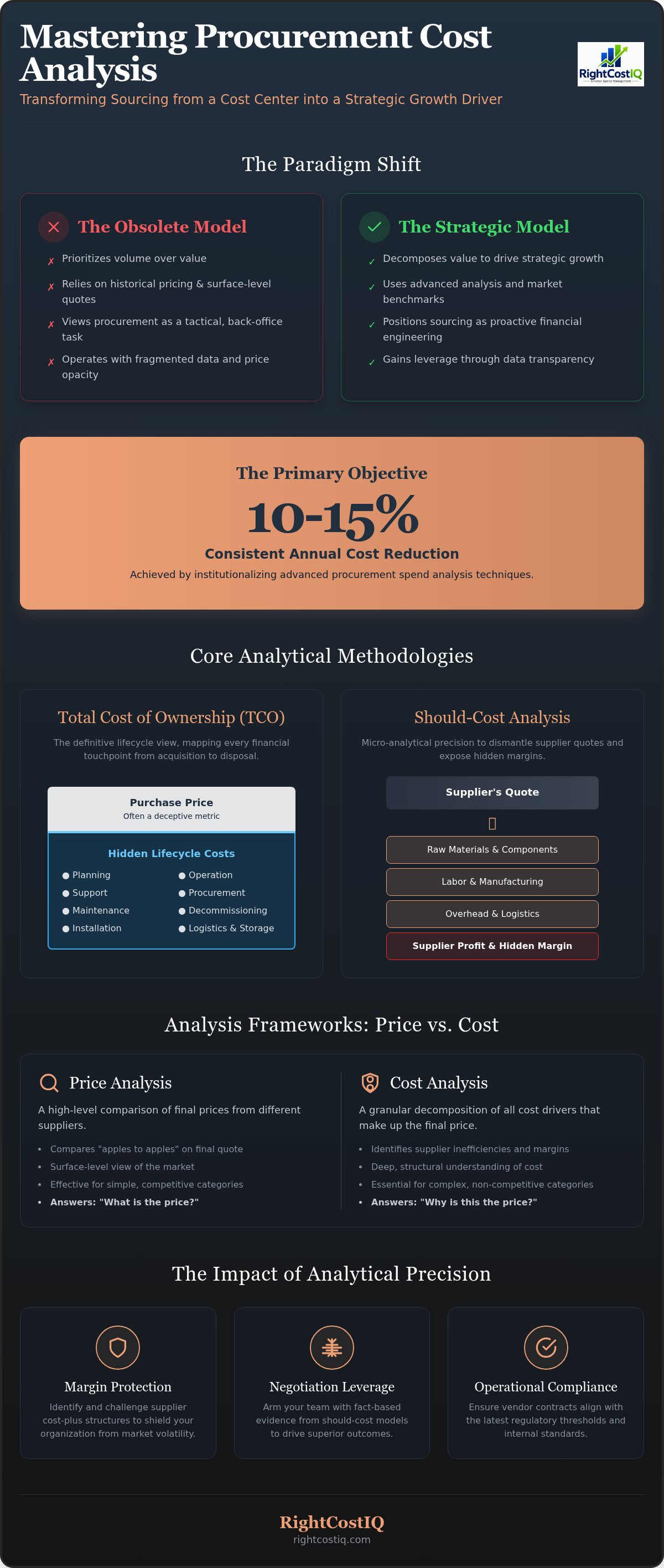
- Margin Protection: Identifying cost-plus structures that allow for automatic price adjustments during commodity fluctuations.
- Negotiation Leverage: Using should-cost modeling to challenge supplier assumptions with fact-based evidence.
- Operational Compliance: Ensuring all vendor contracts align with the latest 2026 procurement thresholds, such as the UK’s £135,018 central government supplies limit.
Standardizing these procurement spend analysis techniques across all categories ensures that your sourcing strategy remains resilient, regardless of macroeconomic shifts or geopolitical instability.
Core Methodologies: TCO and Should-Cost Architectures
Advanced procurement spend analysis techniques demand a departure from simplistic price comparisons toward structural cost modeling. Total Cost of Ownership (TCO) and Should-Cost Architectures represent the two primary analytical frameworks for clinical execution. TCO provides the macro-economic view of an asset's lifecycle, while Should-Cost analysis delivers the micro-analytical precision required to dismantle supplier quotes and expose hidden margins. Integrating these methodologies ensures that procurement decisions align with long-term financial growth rather than short-term budget cycles.
Total Cost of Ownership (TCO) Modeling
TCO is the definitive lifecycle modeling approach, mapping every financial touchpoint from acquisition to disposal. This framework typically encompasses seven critical stages: planning, procurement, installation, operation, maintenance, support, and decommissioning. Logistics, storage, and maintenance frequently eclipse the initial purchase price. Regulatory compliance costs, including the mandatory VAT-inclusive estimations now required by the UK’s Procurement Act 2023, must be integrated into the model to avoid unforeseen financial exposure. Total Cost of Ownership serves as a comprehensive financial metric that accounts for all direct and indirect expenses throughout an asset's lifecycle, providing a data-driven baseline for long-term vendor performance tracking.
Executing a Precision Should-Cost Analysis
Should-Cost analysis builds the baseline for fact-based negotiations by surgically decomposing supplier pricing into four primary components: material, labor, overhead, and profit. This level of strategic cost management in procurement is the only effective defense against margin padding in complex RFPs. For service-oriented categories where physical materials are absent, Activity-Based Costing (ABC) becomes the dominant tool, linking specific service activities to their underlying cost drivers. Using market benchmarks to validate fair pricing allows procurement teams to identify where a supplier's internal inefficiencies are being passed on to the buyer. By utilizing sophisticated should-cost models, sourcing leads can enter negotiations with a clinical understanding of the vendor’s true cost structure. This data serves as the primary engine for the negotiation coach, shifting the conversation from price concessions to structural alignment. To see how these benchmarks apply to your specific categories, you can explore our procurement benchmarking and analytics tools.
Comparative Frameworks: Cost vs. Price Analysis
Distinguishing between price and cost analysis is a fundamental requirement for clinical procurement execution. While both are essential procurement spend analysis techniques, they serve distinct strategic functions based on market dynamics and contract complexity. Price analysis focuses on the final quote in relation to the market, whereas cost analysis scrutinizes the underlying economics of the supplier’s operations. Organizations must align their choice of methodology with the federal proposal analysis techniques that define modern sourcing standards to ensure regulatory compliance and maximum value extraction.
The selection process is governed by the risk and spend profile of the category. Relying on a single analytical lens creates blind spots that suppliers can exploit through margin padding or inefficient overhead allocations. By integrating both frameworks, procurement leaders transition from passive price-taking to active value orchestration, ensuring that every contract is anchored in fact-based logic rather than surface-level comparisons.
Price Analysis: The Benchmark Strategy
Price analysis remains the primary benchmark strategy for competitive market environments where multiple vendors offer standardized goods or services. This tactical approach involves comparing current quotes against historical data and established market indices, such as the Consumer Price Index (CPI-U) used for 2026 bidding threshold adjustments. It's particularly effective for identifying price variance across global supply chain nodes, allowing procurement leads to capitalize on regional market shifts and arbitrage opportunities. For low-complexity tail spend or contracts falling below the US federal simplified acquisition threshold of $350,000, price analysis often provides sufficient data to validate market alignment without the administrative burden of a full cost decomposition.
Cost Analysis: The Strategic Decomposition
Cost analysis is the strategic decomposition required for high-value, complex, or non-competitive sourcing scenarios. This method involves a deep dive into the supplier's internal cost structure, validating labor rates, overhead allocations, and material indices against industry standards. It's the only way to ensure cost realism in contracts where market competition is limited. Beyond high-value agreements, applying cost analysis to tail spend management is a proven method for capturing the hidden 20 percent of savings often lost in unmanaged expenditure. By dismantling the "black box" of supplier pricing, procurement teams move from passive acceptance to active financial engineering. This level of scrutiny ensures that labor and material costs remain aligned with the 2026 benchmarks established for enterprise-level sourcing.
Integrating these methodologies into a holistic procurement analytics strategy allows organizations to maintain agility without sacrificing financial oversight. This dual-track approach ensures that every sourcing event is supported by the specific data required to drive superior negotiation outcomes and sustained margin expansion.
Executing Methodical Cost Analysis in RFP Cycles
The transition from data collection to negotiation leverage occurs during the Request for Proposal (RFP) cycle. Many procurement teams treat cost analysis as a post-hoc reporting function, but clinical execution requires it to be the foundational layer of the sourcing process. By institutionalizing a five-step methodical framework, organizations transform procurement spend analysis techniques into a potent negotiation weapon. This process ensures that every vendor interaction is governed by empirical evidence rather than supplier-led narratives.
The framework begins with rigorous data consolidation and spend classification. Fragmented data across disparate ERP systems creates a visibility gap that suppliers often exploit. Once data is cleaned, procurement leads must move through category benchmarking, scenario-based what-if analysis, and the formal integration of these insights into RFP management workflows. The cycle concludes with post-award performance tracking to ensure that the negotiated savings actually materialize as bottom-line growth. Without this structured approach, the analytical effort remains a theoretical exercise rather than a driver of financial growth.
Data Consolidation and Clinical Benchmarking
Clean data is the prerequisite for any sophisticated sourcing strategy. Fragmented spend records must be scrubbed and categorized to allow for accurate category analysis. Standardizing benchmarks across the organization ensures apples-to-apples supplier comparisons, removing the "noise" of regional variations or inconsistent SKU descriptions. Benchmarking identifies immediate category savings by exposing the variance between current contract rates and real-world market averages. This clinical approach allows procurement teams to set aggressive but achievable targets before the first RFP is even issued.
Market Price Trending and Risk Forecasting
In the volatile economic climate of 2026, static pricing models are a liability. Procurement leaders must utilize market price trending to forecast future cost fluctuations and build enterprise resilience. Integrating predictive analytics into the sourcing strategy allows for the mitigation of price risk during multi-year contract negotiations. For instance, accounting for the 3.0% Consumer Price Index (CPI-U) increase observed in late 2025 ensures that contracts remain market-aligned throughout their duration. Scenario-based what-if analysis further strengthens this position by modeling the impact of potential tariff shifts or logistics disruptions. This forward-looking stance shifts procurement from a reactive function to a strategic architect of financial stability. To begin identifying these opportunities within your own spend data, you can access a clinical spend diagnostic here.
Systematizing these procurement spend analysis techniques ensures that your team maintains a fact-based advantage. When analysis is embedded directly into the RFP workflow, it dictates the terms of the engagement, forcing suppliers to justify their pricing against objective market intelligence.
Optimizing Outcomes with RightCostIQ’s Analytical Ecosystem
Raw data is a liability without a framework for clinical execution. While the preceding sections established the theoretical necessity of TCO and should-cost modeling, the true value lies in the transition from insight to action. RightCostIQ bridges the gap between fragmented spend records and superior ROI by integrating advanced procurement spend analysis techniques directly into the sourcing lifecycle. This ecosystem doesn't just identify potential savings; it provides the structural architecture required to capture and sustain them across complex categories.
Professional RFP management serves as the primary vehicle for realizing identified cost reductions. When negotiation assistance is applied to a clinical cost decomposition, the dynamic shifts from a request for savings to a demand for structural alignment. This methodology ensures that every contract is anchored in fact-based logic, effectively neutralizing supplier margin padding. Establishing a continuous improvement loop through rigorous vendor performance tracking further solidifies these gains, preventing the "savings leakage" that often occurs in unmanaged or poorly monitored categories.
Clinical RFP Management and Negotiation Integration
Transforming cost analysis insights into actionable negotiation levers is the hallmark of a high-maturity procurement function. RightCostIQ’s platform ensures operational efficiency by automating performance tracking and variance analysis. This automation allows decision-makers to focus on strategic value architecture rather than manual data entry. By aligning your sourcing events with proprietary market intelligence, you can explore our RFP management solutions to drive consistent annual cost reductions. Negotiation assistance transforms a should-cost model from a static report into a dynamic tactical advantage during high-stakes vendor sessions.
Scalable Benchmarking for Enterprise Excellence
Accessing proprietary category cost benchmarking and analytics is the only way to maintain a competitive edge in the volatile market of 2026. Precision price risk management, supported by a dedicated market price trending and forecasting service, allows organizations to anticipate fluctuations and lock in favorable terms before market shifts occur. This proactive stance is essential for protecting margins and ensuring long-term supply chain resilience. Utilizing these procurement spend analysis techniques within a unified ecosystem transforms procurement from a cost center into a strategic driver of financial growth. To begin your transition to a data-driven sourcing model, optimize your procurement outcomes with a free diagnostic today.
Mastering the Architecture of Clinical Value
Strategic sourcing in 2026 demands more than surface-level price comparisons; it requires a clinical decomposition of the supplier's internal cost structure. You've seen how dismantling margins through Should-Cost modeling and TCO architectures transforms procurement into a primary driver of financial growth. By aligning your category strategies with objective, market-based benchmarks, you eliminate the visibility gaps that lead to supply chain fragility and margin erosion. This approach ensures that every contract is anchored in empirical evidence rather than supplier-led narratives.
Implementing these advanced procurement spend analysis techniques is the only way to secure fact-based negotiation leverage in a volatile economy. RightCostIQ provides the sophisticated tools required for this transition, including Professional RFP Management and Proprietary Cost Benchmarking. Our Advanced Negotiation Assistance ensures that identified cost-reduction opportunities are actually realized at the bottom line rather than remaining theoretical projections. It's time to move beyond tactical price monitoring toward a model of proactive value orchestration that protects your enterprise margins. Success in modern procurement is built on clinical data, and your organization is positioned to lead this strategic shift.
Secure a free procurement diagnostic to identify hidden savings and begin your journey toward operational excellence today. Your path to superior ROI starts with analytical precision.
Frequently Asked Questions
What is the primary difference between cost analysis and price analysis in procurement?
Price analysis evaluates a supplier's total quote against external market benchmarks and historical data to ensure competitive alignment. In contrast, cost analysis involves a deep-dive decomposition of the supplier's internal cost drivers, such as labor rates, material indices, and overhead allocations. This distinction is critical for selecting the appropriate procurement spend analysis techniques based on category complexity and risk profile.
How do you calculate the Total Cost of Ownership (TCO) for a complex service?
Calculating TCO for services requires mapping every financial touchpoint from initial onboarding through contract decommissioning. Organizations must quantify indirect costs such as regulatory compliance, internal management hours, and service-level credits. Utilizing Activity-Based Costing (ABC) allows procurement teams to link specific service activities to their underlying cost drivers, ensuring a comprehensive lifecycle valuation rather than a surface-level price comparison.
When is a Should-Cost analysis most effective during the RFP process?
Should-Cost analysis is most effective during the RFP evaluation phase to establish an empirical baseline for negotiations. By dismantling supplier quotes into material, labor, and profit components, procurement leads can identify margin padding before final contract awarding. This methodology provides the clinical evidence required to challenge supplier assumptions and drive superior financial outcomes during high-stakes vendor sessions.
Can procurement cost analysis be automated with modern software tools?
Modern software platforms effectively automate the cleansing, classification, and benchmarking of fragmented spend data across disparate ERP systems. This automation eliminates manual data entry errors and accelerates the identification of cost-saving opportunities. By integrating these procurement spend analysis techniques into a digital ecosystem, procurement teams shift their focus from administrative reporting to clinical negotiation execution.
How does market price trending impact long-term contract negotiations?
Market price trending provides the predictive intelligence required to forecast cost fluctuations and mitigate price risk. During multi-year contract negotiations, this data ensures that price adjustment clauses remain aligned with real-world economic shifts. This proactive stance protects enterprise margins against volatility, such as the 3.0% CPI-U increase observed in late 2025, ensuring contracts stay market-aligned.
What are the most common challenges when performing a spend analysis?
The most prevalent challenges include fragmented spend data across multiple systems and a lack of standardized category classification. These analytical gaps create visibility barriers that hinder accurate benchmarking and apples-to-apples supplier comparisons. Overcoming these hurdles requires a structured approach to data consolidation and the institutionalization of clinical analytical frameworks to ensure data integrity.
How does cost analysis help in managing tail spend?
Cost analysis captures the hidden savings in tail spend by identifying price variance in unmanaged, low-value categories. While individual transactions may be small, the aggregate volume often represents significant capital leakage. Applying methodical decomposition to these categories ensures that even non-strategic spend remains aligned with market benchmarks and organizational efficiency goals.
Why is vendor performance tracking considered a part of cost analysis?
Vendor performance tracking is integral to cost analysis because it prevents savings leakage throughout the contract lifecycle. It ensures that the negotiated value and service levels are consistently delivered as promised. Continuous monitoring of vendor KPIs allows procurement teams to perform variance analysis and maintain the financial integrity of the initial sourcing outcome.


