
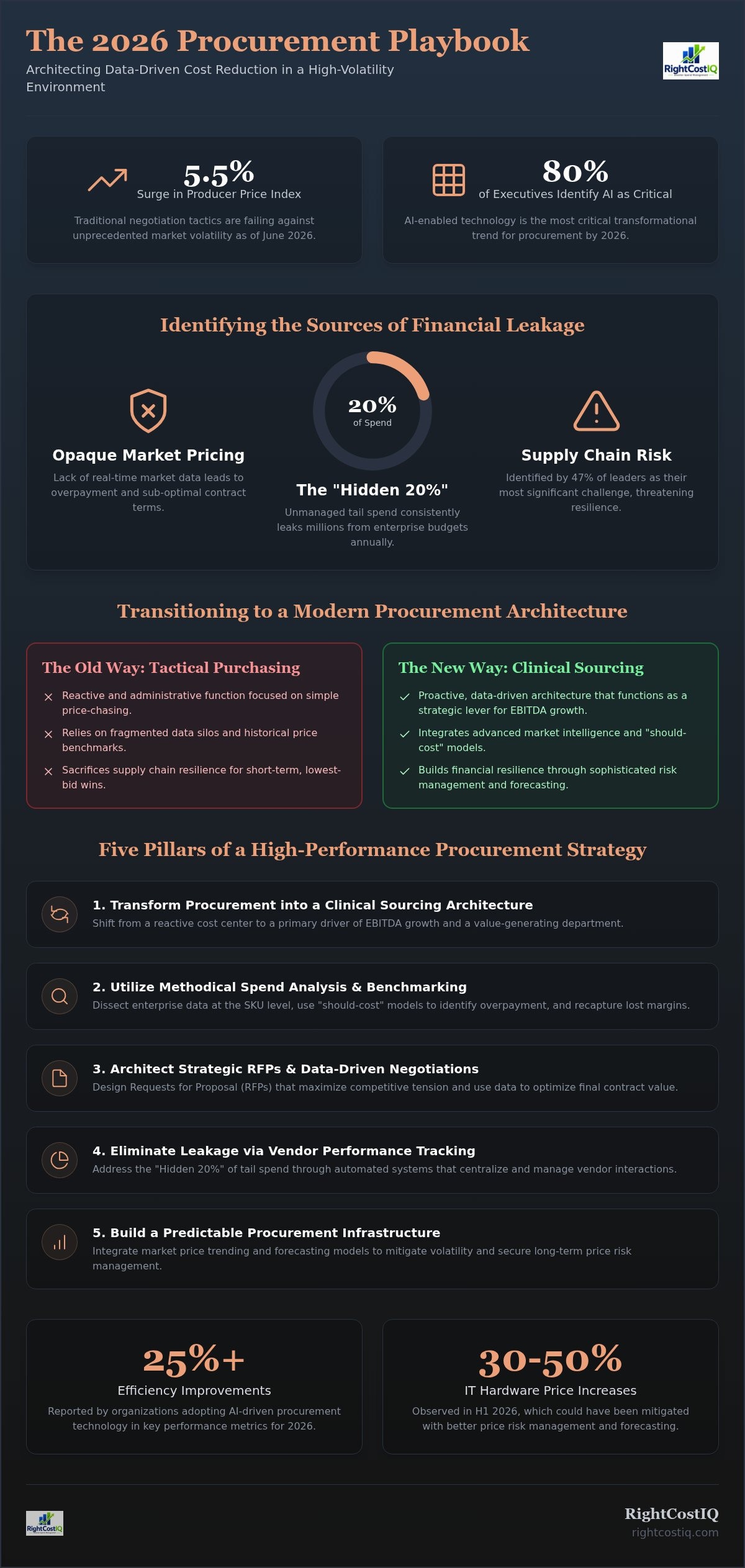
Eighty percent of procurement executives identify AI-enabled technology as the most critical transformational trend for 2026, yet most enterprises continue to lose millions to unmanaged tail spend and opaque market pricing. You recognize that traditional negotiation tactics are failing against a Producer Price Index that surged 5.5% as of June 2026. Effective procurement cost reduction strategies now require more than aggressive discounting; they demand a clinical, data-driven architecture that shifts financial risk and secures supply chain resilience.
This framework provides the professional negotiation methodologies and strategic sourcing models required to optimize enterprise spend and mitigate extreme market volatility. You'll master how to transition from reactive purchasing to a technology-led model that ensures predictable cost forecasting and automated vendor performance tracking. We'll analyze the shift toward fixed-price contract defaults and the specific RFP management techniques that drive quantifiable margin expansion in a high-inflation environment.
Key Takeaways
- Transition from tactical purchasing to a clinical sourcing architecture to transform procurement into a primary driver of EBITDA growth.
- Utilize methodical category cost benchmarking and spend analysis to identify overpayment and recapture lost margins across the enterprise.
- Implement professional procurement cost reduction strategies by architecting RFPs that maximize competitive tension and optimize contract value through data-driven negotiation frameworks.
- Eliminate financial leakage by addressing the "Hidden 20%" of unmanaged tail spend through automated vendor performance tracking systems.
- Build a predictable procurement infrastructure by integrating market price trending and forecasting to mitigate volatility and secure long-term price risk management.
Modernizing Procurement Cost Reduction Strategies for 2026
Procurement is no longer a back-office administrative function; it's a high-precision strategic lever for EBITDA growth. In the volatile economic climate of 2026, where the Producer Price Index saw a 5.5% year-over-year increase by June, traditional cost-cutting measures are insufficient. Modern procurement cost reduction strategies require a shift from tactical purchasing to clinical sourcing architectures. This approach integrates Cost Reduction Principles with advanced market intelligence to secure long-term margin expansion.
The primary drivers of procurement inefficiency in enterprise environments often stem from fragmented data silos and opaque market pricing. Without a centralized framework, unmanaged tail spend leaks millions, while inefficient RFP processes result in sub-optimal contracts. Strategic architects now prioritize data-driven decision-making to navigate 2026 market price trend projections and mitigate the 30-50% price increases observed in IT hardware sectors. Moving toward a clinical model allows firms to forecast costs with surgical precision rather than reacting to market shocks.
Transcending Transactional Purchasing
Simple price-chasing fails because it ignores the underlying mechanics of market volatility. When procurement teams focus solely on the lowest bid, they often sacrifice supply chain resilience and invite hidden risks. Strategic sourcing addresses this by building financial resilience through sophisticated negotiation and risk management. This transition from a reactive cost center to a value-generating department is essential as 47% of procurement leaders identify supply chain disruption as their most significant challenge this year. Professional sourcing frameworks allow you to capture value that transactional buying misses.
The Economic Impact of Spend Under Management
Spend Under Management (SUM) serves as a critical metric for C-suite reporting, representing the percentage of total enterprise spend that is actively managed through professional procurement channels. Centralized procurement frameworks reduce administrative leakage by standardizing vendor interactions and price risk management. By implementing these rigorous controls, organizations can bridge the gap between an 8% increase in projected workloads and declining operating budgets. Organizations adopting AI-driven procurement technology report efficiency improvements of 25% or more in key performance metrics for 2026.
Clinical Spend Analysis: Benchmarking for Margin Expansion
Clinical spend analysis identifies overpayment by dissecting enterprise data at the SKU level. It's the foundation of effective procurement cost reduction strategies. You can't optimize what you haven't categorized. The 5.5% PPI increase in mid-2026 makes visibility non-negotiable. Organizations that fail to implement methodical analysis often suffer from unmanaged tail spend that leaks millions annually. By categorizing spend into high-impact clusters, you identify exactly where market price trending deviates from your actual contract rates. This visibility is the first step toward reclaiming lost margins and ensuring every dollar is accounted for.
Advanced Benchmarking Standards
Compare internal costs against objective market data to expose sub-optimal pricing. Many firms rely on historical price benchmarks, but those figures are irrelevant in 2026's volatile market. You need "should-cost" models to determine what a product or service should cost based on raw material inputs, labor, and overhead. Utilize advanced should-cost models to regain leverage during renewals. This data-driven approach removes the guesswork from negotiations and forces vendors to justify their margins against verified market intelligence. By applying these standards, you transform procurement from a reactive support function into a proactive driver of financial health. Perform a benchmarking audit to see how your current rates stack up against the 2026 index.
Market Price Trending and Risk Management
Timing is everything. Use forecasting models to secure advantageous contract terms before market shifts occur. For instance, the 30-50% price increases observed in IT hardware during the first half of 2026 could have been mitigated with better price risk management. Securing these terms is a pillar of modern procurement cost reduction strategies. Mitigating price volatility requires strategic index-linking in your contracts. This ensures your costs move with the market rather than being locked into high, fixed rates during a downturn. Predictable cost forecasting allows for the creation of multi-year roadmaps that align with enterprise growth targets. For a deeper dive into organizing these clusters, see our guide on Category Management in Procurement: A Clinical Framework (2026).
Strategic RFP Management and Negotiation Frameworks
Architecting the RFP lifecycle creates the competitive tension required to drive contract value. In a market where 47% of procurement leaders are struggling with supply chain disruption, a passive bidding process is a liability. You must move beyond simple quote collection to a clinical framework that forces vendors to compete on total value. This structured approach is a cornerstone of advanced procurement cost reduction strategies. By standardizing the evaluation process, you eliminate subjective bias and ensure vendor selection is driven by objective financial metrics and performance data.
The 2026 federal shift toward fixed-price contracts as a default has set a new standard for private sector procurement. Agencies and enterprises alike now prioritize price certainty to shift financial risk away from the buyer. To achieve this, your RFP must be a precision instrument. It should define exact technical requirements while leveraging market intelligence to set realistic cost ceilings. This level of rigor prevents the mid-contract price creep that often erodes expected savings.
Optimizing the RFP Lifecycle
Successful RFP execution begins with clinical requirement specification. You must define the scope with enough granularity to prevent "estimation padding" from vendors. Scope creep is a primary driver of cost overruns; clear specifications eliminate this risk at the source. Once requirements are set, leveraging automated platforms for bid solicitation allows you to manage a broader vendor pool without increasing administrative overhead. This is vital as procurement workloads are projected to increase by 8% this year despite declining headcount. Implementing Precision RFP Management Frameworks ensures your team can handle increased complexity while maintaining surgical focus on margin expansion.
The Negotiation Coach: Leveraging Market Intelligence
Data-backed negotiation reduces vendor pushback by replacing intuition with verified market facts. When you enter a discussion armed with category cost benchmarking, the conversation shifts from "what can you do?" to "why is this price higher than the market index?" This objective leverage is essential for optimizing the total cost of ownership (TCO) rather than just the initial purchase price. Professional negotiation assistance acts as a force multiplier for your internal team. It allows you to navigate complex contract structures and secure favorable terms that account for 2026's 5.5% inflation rate. By focusing on TCO, you capture long-term value through improved service levels, reduced maintenance costs, and better risk mitigation clauses.
Eliminating Leakage: Tail Spend and Vendor Performance
Financial leakage occurs when procurement departments lack granular visibility into low-value transactions. This "Hidden 20%" of spend often accounts for 80% of supplier volume, yet remains unmanaged in most enterprise environments. Effective procurement cost reduction strategies must address this tail spend to prevent systemic margin erosion. Maverick spend, characterized by purchases made outside of negotiated contracts, actively undermines the clinical sourcing architectures established in strategic RFP phases. By centralizing procurement infrastructure, enterprises recapture lost value and ensure every transaction aligns with pre-defined strategic financial goals.
The 2026 procurement landscape demands a shift from passive oversight to active compliance monitoring. With 65% of organizations reporting supply chain shortages in the past 12 months, the cost of vendor failure has never been higher. Identifying leakage requires more than just looking at invoices; it requires a systematic analysis of how well vendors are meeting their contractual obligations. Centralized monitoring prevents the mid-contract price creep that often follows 2026's 5.5% Producer Price Index surge.
Tail Spend Optimization
High-volume, low-value transactions are the primary source of administrative leakage. Categorizing these transactions allows for the identification of redundant suppliers and fragmented purchasing patterns that drive up the total cost of ownership. Consolidating these vendors into a streamlined roster enables volume-based discounts that are otherwise inaccessible. Mastering Tail Spend Management requires moving away from manual oversight toward automated categorization. This shift is critical as procurement workloads are projected to increase by 8% in 2026, making manual tail spend management physically impossible for shrinking procurement headcounts.
Automated Vendor Performance Tracking
Establishing KPIs for vendor efficiency is no longer optional for firms seeking quantifiable margin expansion. Automated vendor performance tracking is the continuous, algorithmic monitoring of supplier delivery metrics and compliance parameters against contractual benchmarks to mitigate operational risk. These systems utilize real-time analytics to identify underperforming suppliers before their failures impact the bottom line. Clinical monitoring provides the objective evidence needed to renegotiate or terminate sub-optimal contracts with precision. Secure your supply chain integrity by performing a vendor performance diagnostic to identify high-risk leakage points in your current supplier roster.
Centralization provides the audit trail necessary for C-suite reporting, proving that procurement cost reduction strategies are being enforced across all departments. This methodical oversight transforms vendor relationships from passive agreements into high-performance partnerships that drive EBITDA growth. When performance tracking is automated, procurement teams can focus on strategic architecting rather than manual data entry.
The Strategic Architect: Implementing a Procurement Infrastructure
The transition from manual purchasing to a clinical sourcing architecture requires more than just policy changes; it demands a robust procurement infrastructure. Modern procurement cost reduction strategies reach their full potential only when supported by a technology-led sourcing platform that integrates high-fidelity data into every decision. This infrastructure acts as the central nervous system of your operation. It bridges the gap between high-level financial objectives and granular technical execution. Without this foundation, the benchmarking and analysis frameworks discussed previously remain static reports rather than active drivers of EBITDA growth.
Professional RFP management and negotiation services provide a significant return on investment by securing contract terms that internal teams often overlook. In 2026, the complexity of global supply chains and the 5.5% surge in the Producer Price Index make expert-led intervention a necessity. Strategic architects utilize these services to shift financial risk and ensure price certainty. By deploying professional negotiation assistance, enterprises move beyond simple price-chasing to secure long-term value through optimized total cost of ownership and superior service level agreements.
Digital Transformation in Sourcing
Execution is everything. Replacing manual, spreadsheet-based processes with automated sourcing architectures eliminates human error and accelerates the procurement lifecycle. Eighty percent of procurement executives identify AI-enabled technology as the primary transformational trend for 2026. These tools aren't just for automation; they provide the predictive power required for accurate market price trending and forecasting. Organizations that successfully implement these platforms report efficiency improvements of 25% or more across key performance metrics. For a detailed roadmap on integrating these tools, see our guide on RFP Management: Strategic Frameworks for AI-Led Procurement.
RightCostIQ: Clinical Precision in Procurement
RightCostIQ serves as your strategic partner in procurement optimization. We deliver quantifiable cost reduction by combining proprietary benchmarking analytics with specialized price risk management. Our platform transforms your procurement department into a value-generating entity through surgical visibility into enterprise spend and vendor performance. Don't let market volatility erode your margins. Secure your financial future by requesting a clinical procurement category cost benchmarking audit today. Optimize Your Procurement Outcome with RightCostIQ and gain the competitive advantage your enterprise requires in 2026's volatile economy.
Architecting Your Sourcing Future
Securing enterprise profitability in 2026 requires a definitive departure from traditional purchasing toward a clinical sourcing architecture. By implementing data-driven procurement cost reduction strategies, you transform procurement into a primary driver of EBITDA growth rather than a reactive cost center. This framework ensures that clinical spend analysis and strategic RFP management become the standard for every category, effectively eliminating the financial leakage associated with unmanaged tail spend and sub-optimal vendor performance tracking.
RightCostIQ provides the specialized infrastructure required to navigate this transition with precision. Our platform integrates global procurement category benchmarking with a proprietary price risk management service to insulate your margins from market volatility. Through our professional negotiation coach architecture, your team gains the objective market intelligence needed to secure superior contract value in a high-inflation environment. It's time to replace manual processes with an automated, technology-led system that delivers predictable financial results.
Take the first step toward clinical spend visibility and sustainable margin expansion today. Execute Your Procurement Strategy with RightCostIQ and lead your organization toward a more resilient financial future.
Frequently Asked Questions
What are the most effective procurement cost reduction strategies for 2026?
The most effective procurement cost reduction strategies for 2026 prioritize clinical spend visibility and the transition to fixed-price contract architectures. Enterprises must leverage AI-enabled technology to counteract the 5.5% Producer Price Index increase recorded in mid-2026. By automating vendor performance tracking and integrating market intelligence into every RFP, organizations shift financial risk back to suppliers while securing predictable cost forecasting. This clinical approach replaces reactive purchasing with strategic, data-driven margin expansion.
How does spend analysis differ from simple expense management?
Spend analysis differs from expense management by providing a granular, SKU-level dissection of enterprise data rather than simple transaction tracking. While expense management focuses on budgetary compliance, clinical spend analysis utilizes category cost benchmarking to identify overpayment and redundant suppliers. This methodical approach allows strategic architects to categorize the "Hidden 20%" of tail spend. It transforms raw financial data into actionable market intelligence for long-term margin expansion.
Can professional RFP management services reduce procurement cycle times?
Professional RFP management services significantly reduce cycle times by replacing manual solicitation with automated sourcing architectures. These frameworks eliminate administrative leakage and prevent scope creep through clinical requirement specification. By standardizing the evaluation process, enterprises manage a broader vendor pool without increasing headcount. This efficiency is critical in 2026 as procurement workloads are projected to increase by 8% despite declining operating budgets and talent shortages.
Is tail spend management worth the investment for large enterprises?
Tail spend management is a high-ROI investment for large enterprises because it addresses the unmanaged leakage that often accounts for 80% of supplier volume. Without a centralized infrastructure, maverick spend erodes the savings secured during strategic sourcing phases. Consolidating low-value, high-volume transactions into streamlined rosters enables volume-based discounts. Organizations that implement automated procurement cost reduction strategies for tail spend recapture millions in lost value while improving overall supply chain compliance.
How do market price trending and forecasting impact negotiation outcomes?
Market price trending and forecasting provide the objective leverage required to reduce vendor pushback during high-stakes discussions. By utilizing forecasting models, procurement teams can time their sourcing cycles to avoid peak volatility, such as the 30-50% price increases observed in 2026 IT hardware markets. This data-driven approach replaces intuition with verified market facts. It allows for strategic index-linking in contracts, ensuring costs move with the market rather than remaining fixed at sub-optimal rates.
What is the difference between purchasing and strategic procurement?
Purchasing is a transactional, cost-center function focused on fulfilling immediate needs; strategic procurement is a clinical sourcing architecture designed for EBITDA growth. Strategic procurement integrates advanced analytics, price risk management, and long-term vendor performance tracking into the sourcing lifecycle. While purchasing reacts to market shocks, strategic procurement utilizes market intelligence to build financial resilience. This shift positions the department as a strategic partner focused on quantifiable margin expansion and total cost of ownership.
How can vendor performance tracking improve supply chain resilience?
Vendor performance tracking improves supply chain resilience by establishing algorithmic monitoring of delivery metrics and compliance parameters. With 65% of organizations reporting supply chain shortages in the past 12 months, identifying underperforming suppliers early is critical for risk mitigation. Automated tracking systems provide the objective evidence needed to renegotiate sub-optimal contracts or transition to more reliable partners. This clinical monitoring ensures that supply chain integrity is maintained despite ongoing geopolitical and economic volatility.
What is a should-cost model in procurement analytics?
A should-cost model is an analytical framework that determines what a product or service should cost based on raw material inputs, labor, and overhead. In procurement analytics, this model exposes vendor overpayment by comparing actual contract rates against objective market data. Strategic architects use these models to regain leverage during renewals and RFP evaluations. It removes the guesswork from negotiations, forcing suppliers to justify their margins against verified industry cost structures.


