
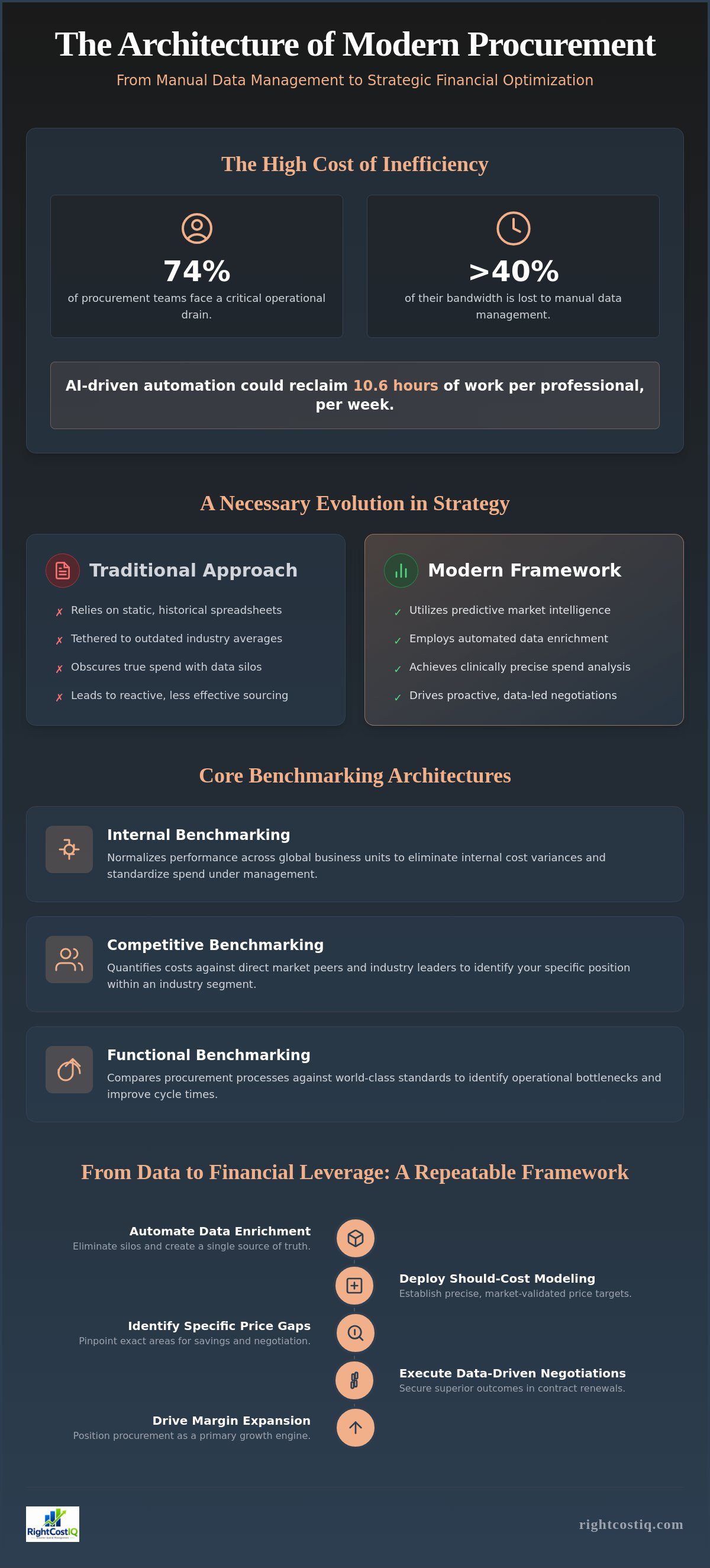
Current industry data indicates that 74% of procurement teams sacrifice over 40% of their operational bandwidth to manual data management. Despite the rapid evolution of market intelligence, most organizations remain tethered to static industry averages that ignore specific regional and category-level fluctuations. Leveraging professional procurement benchmarking services is now a critical prerequisite for maintaining competitive margins. You understand the frustration of fragmented data silos that obscure true spend visibility and undermine your credibility during high-stakes vendor reviews.
You need a transition from reactive sourcing to a technology-led financial optimization strategy. This guide delivers the strategic architecture required to master procurement benchmarking tools for identifying hidden savings and executing data-driven negotiations with clinical precision. We provide a comprehensive preview of a repeatable, automated framework designed to ensure cost transparency. You'll learn how to translate complex benchmark data into actionable leverage, securing superior outcomes in contract renewals and meeting the stringent compliance demands of the 2026 regulatory environment. This approach moves beyond simple cost-cutting, positioning procurement as the primary driver for enterprise-wide financial growth.
Key Takeaways
- Transition from retrospective reporting to predictive market intelligence to align procurement with high-level financial strategy.
- Utilize automated data scrubbing and enrichment to eliminate silos and achieve clinically precise spend analysis across all categories.
- Implement specialized procurement benchmarking services to identify specific price gaps and deploy should-cost modeling for superior negotiation leverage.
- Integrate market price forecasting into the sourcing cycle to optimize negotiation timelines and mitigate financial risk.
- Apply advanced technology frameworks to traditional business functions to drive margin expansion and repeatable cost optimization.
Beyond Static Reports: The Evolution of Procurement Benchmarking Services
Traditional procurement models often treat spend data as a historical artifact. In 2026, sophisticated Cost benchmarking has evolved into a clinical execution of financial strategy rather than a simple administrative audit. Static spreadsheets fail to capture modern market volatility; they don't reflect real-time price fluctuations or fragmented supply chain shifts. Modern procurement benchmarking services now prioritize predictive market intelligence over retrospective reporting. This transition ensures enterprise resilience by identifying margin expansion opportunities before market shifts erode profitability. Organizations relying on manual data work risk falling behind. Procurement professionals estimate AI could automate 10.6 hours of their work per week according to Suplari research. Benchmarking is the critical mechanism that converts raw market data into high-stakes financial leverage.
The Strategic Architect Perspective on Benchmarking
Advanced procurement leaders operate as strategic architects. They move beyond administrative tasks to become high-level financial growth drivers. Aligning benchmarking objectives with C-suite reporting requirements is essential for modern corporate accountability. It's no longer enough to report savings; you must demonstrate how these savings impact the bottom line. C-level executives demand data-driven sourcing insights that link procurement performance directly to EBITDA and operational efficiency. When you utilize procurement benchmarking services, you provide the clinical precision required for sophisticated corporate presentations. This strategic alignment ensures every sourcing decision supports the broader enterprise mission of maximizing shareholder value.
Types of Benchmarking Architectures
A comprehensive optimization strategy requires a multi-layered approach to data analysis. Implementing these specific architectures allows for a holistic view of organizational performance:
- Internal Benchmarking: This process normalizes performance across global business units to eliminate internal cost variances and standardize spend under management.
- Competitive Benchmarking: This identifies your specific position within an industry segment by quantifying costs against direct market peers and industry leaders.
- Functional Benchmarking: This compares procurement processes against world-class standards to identify operational bottlenecks and improve cycle times.
Integrating these frameworks provides the cost transparency needed to identify hidden savings. It moves the organization away from fragmented data silos and toward a unified, automated benchmarking framework. This structured approach is the foundation for executing data-driven negotiations with clinical precision. By 2026, the ability to benchmark at the category level is what separates resilient enterprises from those vulnerable to market volatility.
Core Architectures of Enterprise-Grade Benchmarking Platforms
Clinical cost optimization requires a foundation of absolute data integrity. High-performance procurement benchmarking services utilize advanced data scrubbing and enrichment protocols to convert fragmented data silos into actionable intelligence. Without this normalization, benchmarking remains a theoretical exercise. Organizations must move beyond the current industry reality where 74% of procurement teams spend 40% or more of their time on manual data work. High-grade platforms automate this process; they allow for real-time market price trending and forecasting modules that inform strategic decision-making with mathematical certainty. Research from The Hackett Group's procurement benchmarking services indicates that world-class procurement performance is driven by structural factors and ROI-focused data architectures. These systems integrate directly with RFP management cycles to ensure that benchmarking insights are immediately applied to live sourcing events.
Technical Descriptors of High-Performance Tools
Effective benchmarking tools utilize multi-dimensional data aggregation to normalize performance across global sourcing regions. API-led integration with existing ERP systems ensures that spend analysis isn't a disconnected event but a continuous feed of operational reality. This connectivity enables automated vendor performance tracking. It's vital for maintaining compliance and monitoring service level agreements in real time. Sophisticated platforms also incorporate price risk management models, which allow procurement leaders to anticipate market volatility. By 2026, the standard for excellence is an AI-native system that reduces cycle times while increasing spend under management through automated categorization.
Tail Spend Optimization Frameworks
Strategic architects recognize that the hidden 20% of indirect spend often contains the most significant margin expansion opportunities. You can optimize your tail spend management by applying automated benchmarking to these low-value, high-volume transactions. Clinical precision in this area prevents "leakage" where unmanaged suppliers erode the savings achieved in high-stakes category negotiations. Automated categorization ensures that even the smallest purchase is measured against world-class standards. This structured approach transforms tail spend from an administrative burden into a source of tangible financial growth. You can request a strategic technical walkthrough to see how these automated modules align with your specific financial growth metrics.
Clinical Comparison: Internal KPIs vs. External Category Benchmarking
Measuring performance solely through internal Key Performance Indicators (KPIs) often creates a false sense of operational security. While metrics like spend under management provide a baseline for internal governance, they fail to account for industry-specific cost transparency standards. Sophisticated procurement benchmarking services bridge this gap by aligning internal spend data with external market realities. Relying on static internal averages is a strategic risk in 2026. You must quantify the variance between market price trending and your actual contract pricing to identify performance deficits. This clinical comparison ensures that your procurement strategy isn't just consistent with past performance but competitive against current market leaders. It transforms procurement from a back-office function into a high-level financial growth driver.
Should-Cost Analysis: Precision Beyond Averages
Basic benchmarking often relies on broad industry statistics that don't reflect the granular cost drivers of specific categories. You can explore clinical should-cost modeling to move beyond these surface-level averages. This methodology breaks down category costs into raw material, labor, and overhead components. By reconstructing the supplier's cost structure, you gain the market intelligence needed to challenge aggressive margin assumptions. It's a fundamental shift from price-taking to price-making. Strategic architects use these models to establish a "ground truth" for negotiations, ensuring that every dollar spent is justified by underlying economic data rather than supplier-dictated price lists. This level of technical upskilling is what distinguishes world-class procurement teams in the current economic landscape.
Normalization Protocols for Data Integrity
Raw external data is rarely directly comparable to your specific operational environment without rigorous normalization. High-performance benchmarking requires adjusting for geographic price risk management and logistics volatility. You must also account for volume-based pricing tiers to ensure your benchmarks reflect your actual purchasing power. Effective data normalization in 2026 requires the integration of real-time inflation adjustment factors to maintain the integrity of multi-year cost comparisons. These protocols ensure that benchmarking reports are not just accurate but actionable. Without clinical normalization, procurement teams risk making high-stakes decisions based on skewed data. Precision in data processing is the only way to achieve repeatable margin expansion in a volatile global economy. It's the difference between a generic report and a surgical financial tool.
Strategic Execution: Turning Benchmarks into Negotiation Levers
Data without execution is a stranded asset. Clinical cost optimization requires a methodical transition from passive analysis to aggressive market engagement. High-performance procurement benchmarking services function as the primary catalyst for this transformation. By following a structured five-step execution cycle, strategic architects convert category intelligence into tangible financial growth. This process ensures that negotiation outcomes are dictated by mathematical certainty rather than supplier-led narratives.
- Step 1: Identify the Price Gap. Utilize specialized category cost benchmarking to quantify the delta between current contract rates and world-class market standards.
- Step 2: Deploy Market Price Forecasting. Establish optimal negotiation windows by analyzing market price trending data to anticipate favorable shifts in raw material or service costs.
- Step 3: Deploy Negotiation Coach Frameworks. Prepare for high-stakes vendor reviews by utilizing data-backed scripts that surgically address common supplier objections regarding inflation or labor costs.
- Step 4: Execute RFP Management. Launch competitive sourcing events with clinical target pricing derived from normalized benchmark data to ensure immediate margin expansion.
- Step 5: Track Vendor Performance. Monitor post-contract compliance to prevent "savings leakage" and ensure that negotiated rates are consistently applied throughout the contract lifecycle.
The Negotiation Coach: Clinical Strategy at the Table
Benchmarks provide the evidence, but the negotiation coach provides the delivery mechanism. You can access professional negotiation coaching to transform raw data into action-oriented scripts. This approach leverages price risk management data to mitigate financial volatility during live discussions. It's about maintaining a serious, data-driven demeanor that signals deep industry expertise to your vendors. By using proprietary frameworks, procurement leaders can neutralize supplier margin assumptions with clinical precision. This technical upskilling is essential for maintaining a competitive advantage in high-stakes corporate management.
RFP Lifecycle Optimization
Integrating benchmarking into the sourcing cycle ensures that every Request for Proposal is grounded in market reality. You should review RFP Management: Strategic Frameworks for AI-Led Procurement Optimization to understand how advanced technology streamlines vendor selection. Structured RFP management eliminates the manual data work that currently plagues 74% of procurement teams according to Suplari research. It ensures operational efficiency by automating the comparison of complex bid responses against established category benchmarks. This alignment between high-level strategy and technical execution is what drives sustainable margin expansion. To evaluate your current negotiation readiness, you can request a clinical cost optimization diagnostic today.
Optimizing Financial Outcomes with RightCostIQ Analytics
RightCostIQ functions as the strategic architect for organizations seeking clinical enterprise optimization. We specialize in deploying advanced technology into traditional business functions to drive immediate margin expansion. By integrating procurement benchmarking services with real-time market price trending, we provide high-level decision-makers with the transparency required to protect profitability. Our models move beyond retrospective data. We prioritize predictive market intelligence to ensure your sourcing infrastructure remains resilient against global volatility. This approach transforms procurement from a back-office function into a primary driver for EBITDA growth. It ensures that every sourcing decision supports the broader enterprise mission of maximizing shareholder value through data-backed certainty.
Clinical precision in price risk management is no longer optional. RightCostIQ’s analytics framework bridges the gap between raw data and successful negotiation outcomes. Our platform offers seamless integration of RFP management and negotiation assistance; this allows your team to execute sourcing events with mathematical certainty. This holistic approach ensures that high-level strategy and technical execution are perfectly aligned. We eliminate the inefficiencies of manual data work, which currently consumes 40% or more of procurement bandwidth in 74% of organizations according to Suplari research. By automating spend analysis and categorization, we empower your team to focus on high-value strategic initiatives that impact the bottom line.
The RightCostIQ Advantage: Precision Frameworks
RightCostIQ provides proprietary cost benchmarking and analytics tailored for high-stakes decision-makers. Our systems focus on mitigating financial volatility through rigorous market intelligence and forecasting models. This allows you to identify hidden savings and secure superior leverage during vendor reviews. We don't offer generic support; we provide the surgical financial tools required to challenge supplier margin assumptions. Our frameworks are designed to deliver repeatable results in high-pressure corporate environments. Optimize your procurement outcomes with RightCostIQ’s clinical benchmarking tools to start transforming your cost structure today.
Future-Proofing Sourcing Infrastructure
Scaling procurement analytics is vital to meet 2026 global supply chain challenges. You must adopt a clinical framework for margin expansion to maintain a competitive advantage. This requires a shift from traditional sourcing to a technology-led financial optimization model. For a deeper analysis of these strategies, review our guide on Category Management in Procurement: A Clinical Framework for Margin Expansion (2026). RightCostIQ remains committed to technical upskilling and financial optimization. We ensure your department is positioned as a sophisticated partner for the C-suite, delivering the data-driven sourcing insights required for modern accountability. View RightCostIQ Pricing and Solutions to align your department with world-class financial standards.
Architecting a Resilient Procurement Engine for 2026
Success in the modern sourcing landscape requires a departure from retrospective analysis toward a predictive, technology-led financial strategy. Adopting sophisticated procurement benchmarking services ensures your organization maintains a clinical edge in an increasingly volatile market. By replacing static industry averages with granular should-cost modeling and automated data normalization, you transform raw spend data into a powerful instrument for repeatable margin expansion. This strategic shift moves procurement from an administrative function to a primary driver of enterprise-wide financial growth.
RightCostIQ delivers the specialized infrastructure required for high-stakes corporate management. Our platform facilitates the clinical execution of RFP cycles while deploying data-driven negotiation coach frameworks to secure superior vendor terms. With comprehensive price risk management integrated into every sourcing event, you're equipped to navigate global supply chain complexities with mathematical certainty. Access your free procurement diagnostic and benchmarking assessment to begin your transition toward data-driven financial optimization. Your path to absolute cost transparency and strategic leverage starts today.
Frequently Asked Questions
What are procurement benchmarking services?
Procurement benchmarking services are specialized strategic frameworks that compare an organization's internal procurement costs, processes, and KPIs against validated industry standards. These services provide the clinical cost transparency required to identify specific performance gaps. By utilizing multi-dimensional data sets, they allow high-level decision-makers to move beyond internal historical data and align with world-class market realities.
How do benchmarking tools identify cost savings?
Benchmarking tools identify cost savings by quantifying the "Price Gap" between existing contract rates and normalized market standards. They utilize should-cost modeling to break down category expenses into raw materials, labor, and overhead components. This clinical granularity reveals where supplier margins are disproportionately high, allowing procurement teams to target specific categories for immediate margin expansion and financial growth.
Can procurement benchmarking assist in negotiation?
Yes, procurement benchmarking services provide the clinical evidence required for data-driven negotiation coach frameworks. By establishing a mathematical "ground truth" for pricing, procurement leaders can neutralize supplier objections regarding inflation or market volatility. This strategic leverage ensures negotiation outcomes are dictated by objective market intelligence rather than supplier-led narratives, securing superior contract terms and protecting margins.
What is the difference between spend analysis and benchmarking?
Spend analysis is a retrospective internal audit focusing on where and how an organization allocates its capital. In contrast, benchmarking is an external comparative exercise that measures those internal findings against market peers and world-class standards. While spend analysis identifies what you've spent, benchmarking reveals what you should be spending based on clinical market intelligence and category-specific cost drivers.
How often should procurement benchmarking be performed?
Procurement benchmarking should be performed continuously through automated modules or at a minimum on a quarterly basis. Given the rapid market price trending shifts in 2026, annual reviews are no longer sufficient to maintain a competitive advantage. Regular execution ensures your cost structures remain aligned with current market realities, allowing for proactive price risk management and timely contract renegotiations.
What data sources do procurement benchmarking tools use?
High-performance procurement benchmarking services aggregate data from proprietary databases, global market indexes, and anonymized peer-to-peer transaction records. They also integrate real-time commodity pricing and labor market statistics to ensure clinical precision. This multi-dimensional data aggregation allows for the normalization of costs across different geographic regions and volume-based pricing tiers, ensuring the reporting maintains absolute integrity.
What happens if our internal data is messy or incomplete?
Messy or incomplete internal data is addressed through automated data scrubbing and enrichment protocols. Sophisticated platforms utilize AI-native categorization to normalize fragmented data silos and eliminate manual entry errors. This process ensures that even imperfect datasets are converted into high-fidelity intelligence, providing a reliable foundation for clinical cost optimization and strategic decision-making without requiring extensive manual cleanup.
Is benchmarking effective for tail spend management?
Benchmarking is highly effective for tail spend management as it identifies "leakage" in low-value, high-volume sourcing categories. By applying automated benchmarking to the hidden 20% of indirect spend, organizations can normalize pricing across thousands of small transactions. This clinical precision ensures that tail spend is no longer an unmanaged administrative burden but a source of tangible financial growth and margin expansion.


